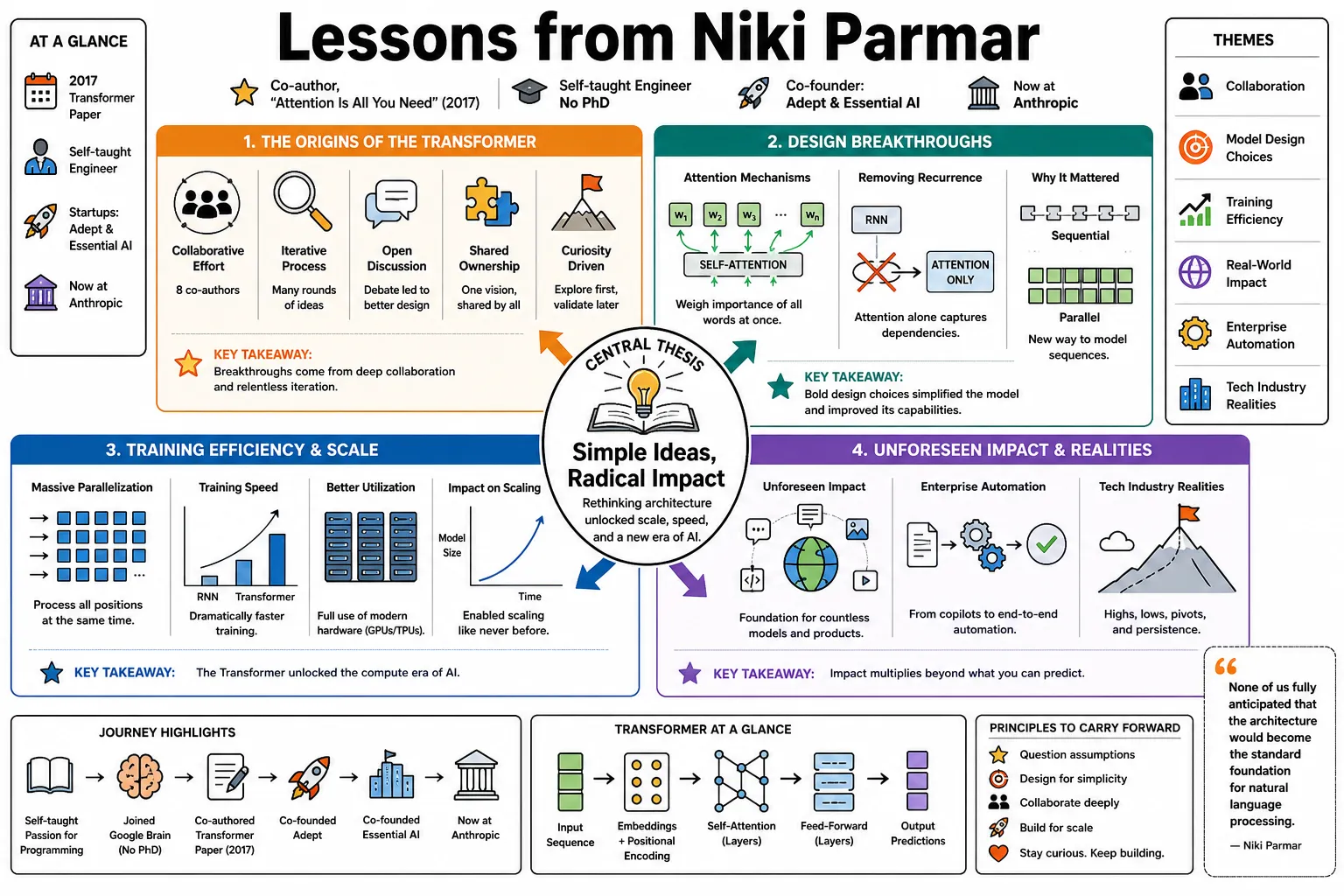
Niki Parmar co-authored the 2017 "Attention Is All You Need" paper that introduced the Transformer architecture. A self-taught engineer who joined Google Brain without a PhD, she later co-founded the startups Adept and Essential AI before moving to Anthropic. This profile gathers her views on model design, enterprise automation, and the realities of the tech industry.
Part 1: The Origins of the Transformer
- On Collaboration: "The development of the Transformer model was a highly iterative and deeply collaborative process among the eight co-authors." — Source: [Forbes India]
- On Attention Mechanisms: "Self-attention allowed the model to weigh the importance of different words in a sequence simultaneously rather than sequentially." — Source: [Attention Is All You Need Paper]
- On Removing Recurrence: "By discarding recurrent layers entirely, we discovered that attention mechanisms alone were sufficient for capturing dependencies." — Source: [Attention Is All You Need Paper]
- On Training Efficiency: "The Transformer architecture changed how models are trained, making massive parallelization possible for the first time." — Source: [Medium Interview with Sayak Paul]
- On Unforeseen Impact: "None of us fully anticipated that the architecture would become the standard foundation for natural language processing and computer vision." — Source: [NDTV]
- On Solving Translation: "Initially, our primary focus was beating the state-of-the-art benchmarks in machine translation, not necessarily building a general-purpose world model." — Source: [Attention Is All You Need Paper]
- On Simplification: "Sometimes breakthroughs come from stripping away complex, legacy architectures and asking what the simplest effective mechanism is." — Source: [Forbes India]
- On the Paper's Drafting: "The paper itself was a living document, constantly refined as experiments finished and our understanding of the architecture grew." — Source: [Niki Parmar at the IIT Bay Area Leadership Conference 2023]
- On the Name: "The title 'Attention Is All You Need' was meant to be a direct, provocative statement about the power of the attention mechanism." — Source: [Medium Interview with Sayak Paul]
- On Iterative Research: "Research requires a willingness to fail fast and discard ideas that do not scale efficiently across large datasets." — Source: [Forbes India]
Part 2: Navigating Google Brain and Big Tech
- On Intimidation: "Joining Google Brain as a 24-year-old without a PhD was an intimidating experience, surrounded by veterans of the field." — Source: [NDTV]
- On Credentialism: "You do not necessarily need a PhD to make fundamental contributions to artificial intelligence if you have the drive to learn and experiment." — Source: [Forbes India]
- On Learning Curves: "The environment at Google Brain was less about what you already knew and more about how quickly you could adapt to new paradigms." — Source: [NDTV]
- On Mentorship: "Working alongside seasoned researchers accelerates your growth in ways that formal academic programs often cannot match." — Source: [Medium Interview with Sayak Paul]
- On Engineering vs. Science: "The line between software engineering and research science blurs when you are building systems that have never existed before." — Source: [Forbes India]
- On Compute Access: "Being inside a massive tech organization provides the indispensable compute resources required to test ambitious models." — Source: [Economic Times]
- On Team Dynamics: "The best research teams operate without strict hierarchies, allowing the best ideas to win regardless of who proposes them." — Source: [NDTV]
- On Open Publication: "Publishing our findings openly was essential for pushing the entire field forward and stress-testing our assumptions." — Source: [Medium Interview with Sayak Paul]
- On Taking Risks: "When you are the youngest person in the room, you sometimes have the advantage of not knowing what is supposedly impossible." — Source: [Analytics India Magazine]
- On Institutional Knowledge: "You learn as much from the failed experiments running in the background as you do from the publicized successes." — Source: [Niki Parmar at the IIT Bay Area Leadership Conference 2023]
Part 3: The Power of Self-Taught Persistence
- On Academic Setbacks: "Missing admission to the Indian Institute of Technology was a major early setback, but it forced me to find alternative paths to knowledge." — Source: [NDTV]
- On Online Education: "Taking online courses from pioneers like Andrew Ng proved that world-class education is accessible to anyone with an internet connection." — Source: [Analytics India Magazine]
- On Independent Study: "Self-teaching requires a level of discipline and curiosity that formal education rarely demands." — Source: [Forbes India]
- On Building Intuition: "You build intuition for neural networks not just by reading papers, but by constantly writing code and watching how models fail." — Source: [Medium Interview with Sayak Paul]
- On Overcoming Doubt: "The tech industry can feel exclusionary, but raw competence and persistent curiosity will eventually break through those barriers." — Source: [NDTV]
- On Non-Traditional Backgrounds: "Having a non-traditional background means you often approach established problems from an angle that others overlook." — Source: [Analytics India Magazine]
- On Foundational Math: "You cannot skip the underlying mathematics; self-taught does not mean skimming over difficult linear algebra and calculus." — Source: [Medium Interview with Sayak Paul]
- On Curiosity-Driven Research: "Letting your genuine curiosity guide your reading list is often more productive than following a rigid curriculum." — Source: [NDTV]
- On Proving Yourself: "When you lack formal credentials, your code, your experiments, and your results become your only resume." — Source: [Forbes India]
- On Lifelong Learning: "The field of AI moves so fast that everyone, regardless of their degrees, essentially becomes self-taught within a few years." — Source: [Analytics India Magazine]
Part 4: Architecting Adept AI and Human-Computer Interaction
- On Action-Driven AI: "At Adept, the vision was to move beyond models that just generate text, creating models that can take direct actions on a computer." — Source: [Grokipedia]
- On Browser Interfaces: "The most universal API we have is the graphical user interface; an AI should be able to navigate a browser just like a human." — Source: [Niki Parmar at the IIT Bay Area Leadership Conference 2023]
- On Tool Use: "Teaching a model to use software tools is fundamentally different from teaching it to predict the next word in a sentence." — Source: [Grokipedia]
- On Human Collaboration: "AI should be viewed as an interactive partner that works alongside you, executing workflows across multiple applications." — Source: [Essential AI Announcement]
- On Multi-Modal Reasoning: "To interact with software, an AI must understand visual layouts, text, and the underlying logic of the application simultaneously." — Source: [Niki Parmar at the IIT Bay Area Leadership Conference 2023]
- On Software Workflows: "Much of modern knowledge work is repetitive software manipulation; automating this frees humans for higher-level tasks." — Source: [Grokipedia]
- On the CTO Role: "Transitioning from a researcher to a Chief Technology Officer requires shifting focus from pure model architecture to product viability and engineering execution." — Source: [Analytics India Magazine]
- On Startup Speed: "In a startup, you do not have the luxury of endless compute; you have to be highly efficient in how you train and deploy models." — Source: [Niki Parmar at the IIT Bay Area Leadership Conference 2023]
- On Defining New Categories: "Building action-oriented AI meant we were defining a new category of technology rather than optimizing an existing one." — Source: [Grokipedia]
Part 5: Essential AI and the Enterprise Brain
- On Enterprise Automation: "Essential AI focuses on solving the specific, highly complex workflows that bog down large corporations." — Source: [Essential AI Announcement]
- On the Enterprise Brain: "We envision an 'Enterprise Brain' that understands the specific data, history, and operational logic of a business." — Source: [Grokipedia]
- On Full-Stack Solutions: "To truly serve the enterprise, you cannot just offer an API; you have to build full-stack applications that integrate deeply with their systems." — Source: [Essential AI Announcement]
- On Data Privacy: "Corporate customers require assurance that their proprietary data is secure and will not leak into public foundational models." — Source: [Grokipedia]
- On Productivity Bottlenecks: "The greatest productivity bottlenecks in business are not a lack of ideas, but the friction of executing those ideas across disconnected software." — Source: [Essential AI Announcement]
- On Co-Founding Again: "Starting a second company with Ashish Vaswani allowed us to apply the lessons learned from our previous ventures with greater precision." — Source: [Analytics India Magazine]
- On Custom LLMs: "Off-the-shelf models often fail in enterprise settings because they lack context; custom-tailored LLMs bridge that gap." — Source: [Grokipedia]
- On Scaling Startups: "Raising venture capital is not the finish line; it is the starting gun for the immense engineering challenges ahead." — Source: [Essential AI Announcement]
- On Measurable Impact: "In the enterprise space, AI is judged entirely on measurable return on investment and its ability to reduce operational drag." — Source: [Grokipedia]
Part 6: Data, Compute, and Scaling Constraints
- On Data Scarcity: "Finding high-quality, specialized data for complex reasoning tasks is becoming one of the primary bottlenecks in AI development." — Source: [Economic Times]
- On Synthetic Data: "As we exhaust the easily available text on the internet, we must rely more heavily on sophisticated synthetic data generation." — Source: [Economic Times]
- On Compute Costs: "The financial and energetic cost of training frontier models is astronomical, requiring constant innovation in algorithmic efficiency." — Source: [Analytics India Magazine]
- On Scaling Laws: "While scaling laws hold true, we cannot rely solely on making models bigger; we have to make them smarter and more efficient." — Source: [Medium Interview with Sayak Paul]
- On Hardware Dependencies: "The evolution of AI architectures is deeply intertwined with the evolution of the silicon that runs them." — Source: [Niki Parmar at the IIT Bay Area Leadership Conference 2023]
- On Open vs. Closed Models: "There is a continuous tension between open-source research and the immense capital required to train state-of-the-art closed models." — Source: [Economic Times]
- On Model Evaluation: "Our benchmarks are failing to keep pace with model capabilities; we need better ways to evaluate true reasoning rather than memorization." — Source: [Analytics India Magazine]
- On Infrastructure Limits: "Access to high-performance computing clusters is effectively the new barrier to entry in frontier AI research." — Source: [Economic Times]
- On Algorithmic Breakthroughs: "The next leap forward will likely come from a fundamental architectural shift, not just throwing more compute at the Transformer." — Source: [Medium Interview with Sayak Paul]
Part 7: Reinforcement Learning and Frontier Capabilities
- On Test-Time Scaling: "Improving a model's ability to 'think' during inference, or test-time scaling, is critical for complex problem-solving." — Source: [Grokipedia]
- On RLHF Limitations: "Reinforcement Learning from Human Feedback is powerful, but human preferences are noisy and difficult to scale perfectly." — Source: [Analytics India Magazine]
- On Joining Anthropic: "Moving to Anthropic represents a focus on pushing the absolute boundaries of frontier capabilities and safety simultaneously." — Source: [Grokipedia]
- On Deep Reasoning: "We are shifting from models that simply retrieve information to models capable of sustained, multi-step logical reasoning." — Source: [Economic Times]
- On Reward Models: "Designing robust reward models is arguably harder than training the base policy model, as it dictates the system's ultimate behavior." — Source: [Analytics India Magazine]
- On AI Safety: "Frontier capabilities cannot be decoupled from rigorous safety research; they must advance in tandem." — Source: [Grokipedia]
- On Autonomous Agents: "True autonomy requires a model to evaluate its own mistakes and correct its course without human intervention." — Source: [Niki Parmar at the IIT Bay Area Leadership Conference 2023]
- On Generalization: "The goal of reinforcement learning is a model that generalizes perfectly to environments it has never encountered during training." — Source: [Economic Times]
- On the Early Stages: "Despite the rapid progress, we are still fundamentally in the early stages of understanding what these architectures can achieve." — Source: [NDTV]
Part 8: Building a Career in Artificial Intelligence
- On Being the Only Woman: "Being the only woman in the room at tech companies is a reality you learn to navigate by letting your technical work speak for itself." — Source: [Forbes India]
- On Confidence: "When you lack a traditional academic background, your confidence must come entirely from the verifiable results of your experiments." — Source: [NDTV]
- On Taking Initiative: "Do not wait for someone to give you permission to work on an ambitious idea; start building the prototype." — Source: [Niki Parmar at the IIT Bay Area Leadership Conference 2023]
- On Choosing Projects: "Work on problems that fundamentally interest you, rather than chasing whatever sub-field is currently generating the most hype." — Source: [Medium Interview with Sayak Paul]
- On Founder Mentalities: "Being a founder means you must be willing to transition from writing elegant code to managing investor expectations and hiring." — Source: [Analytics India Magazine]
- On Resilience: "The path to a breakthrough is paved with months of silent failures and broken code." — Source: [Forbes India]
- On Community Support: "Finding a small, trusted group of peers to review your ideas is more valuable than widespread public recognition." — Source: [Medium Interview with Sayak Paul]
- On Redefining Success: "Success is not just about the papers you publish; it is about the products you build and the people whose careers you help elevate." — Source: [Analytics India Magazine]
- On the Future: "The next generation of AI researchers will come from entirely non-traditional backgrounds, and that diversity of thought is exactly what the field needs." — Source: [NDTV]