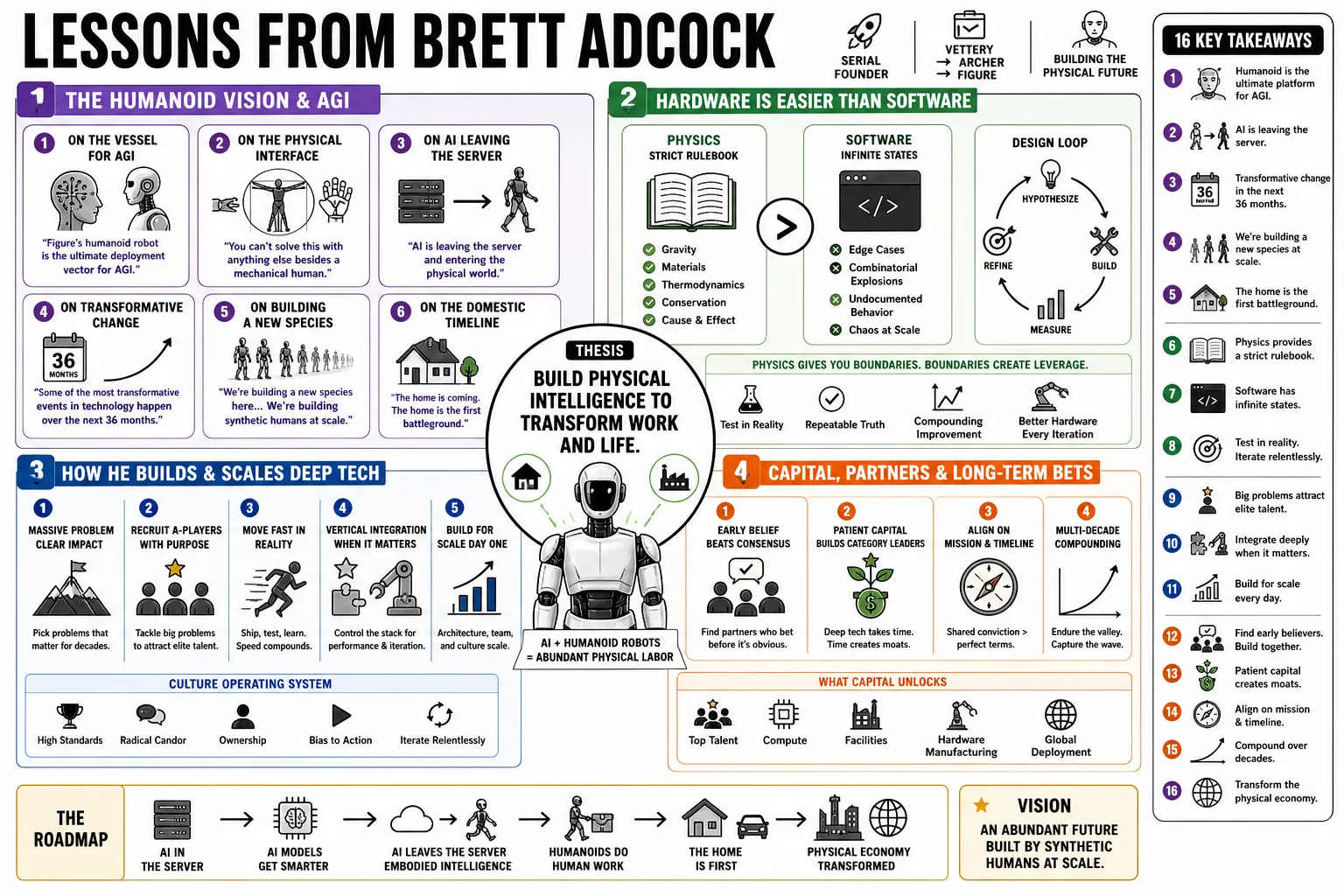
Lessons from Brett Adcock
Brett Adcock is a serial founder whose companies include the hiring platform Vettery, the electric aviation startup Archer, and the humanoid robotics firm Figure. He argues that hardware is actually easier than software because physics provides a strict rulebook, and that tackling massive problems is the easiest way to recruit elite talent. These notes detail his approach to scaling deep tech, raising capital, and preparing for an automated physical economy.
Part 1: The Humanoid Vision and AGI
- On the vessel for AGI: "Figure's humanoid robot is the ultimate deployment vector for AGI." — Global Player: Technology & Business Podcasts]
- On the physical interface: "You can’t solve this with anything else besides a mechanical human—a single platform that, with no hardware changes, can do everything a human can." — The Logan Bartlett Show on Podscripts: Transcripts & Interviews]
- On AI leaving the server: "I think you’ll see some of the most transformative events in technology happen over the next 36 months that we’ve ever seen... I’m watching AI in a human body do human work." — Shawn Ryan Show: Brett Adcock on Figure AI & Humanoid Robotics]
- On building a new species: "We’re building a new species here... We're building synthetic humans at scale." — Singju Post: About & Speeches Archive]
- On the domestic timeline: "The home is coming. The home is like single-digit years away from being a place where humanoid robots can do useful work." — Singju Post: About & Speeches Archive]
- On inevitable sci-fi: "It’s literally going to feel like a sci-fi movie." — Business Insider: Tech]
- On continuous progress: "This is not like something we can turn off. You turn off the internet, you’re going to stop people from trying to build systems that make us more productive." — Shawn Ryan Show: Brett Adcock on Figure AI & Humanoid Robotics]
- On real-world data: "Once one robot masters a task, the updated model is pushed across the fleet, creating a moat of data that hardware-only companies cannot match." — Fortune India: Technology & Enterprise]
- On the true metric of success: "The winner is... who can hit 100,000, who can hit a million units in the market as fast as possible." — Humanoids Daily: About & Robotics Coverage]
- On replacing hand-coded logic: "The era of hand-coded robotics is officially over, marking the shift from writing C++ to relying entirely on neural weights for pixels-to-torque control." — Cyber News Centre: About]
Part 2: Hard Tech and Physical AI
- On atoms over bits: "I always envied things that you can go touch and build... basically like Adams over bits." — Figure AI: Autonomous Humanoid Robotics]
- On the hardware rulebook: "Building hardware... has been like the least stressful years of my career... because we have a rulebook with physics that we can basically aimatically attribute back to." — Shawn Ryan Show: Brett Adcock on Figure AI & Humanoid Robotics]
- On the hardware gauntlet: "Hardware is just like tough to get out the door... it's like a death gauntlet for software entrepreneurs. It's like software entrepreneurship on steroids." — Shawn Ryan Show: Brett Adcock on Figure AI & Humanoid Robotics]
- On software's lack of stakes: "Software is easy in a sense like... it’s just code, right? No one’s gonna die if you screw it up." — Shawn Ryan Show: Brett Adcock on Figure AI & Humanoid Robotics]
- On the built environment: "The physical world will last several hundred years; we built it to interact with the human body... Everything around us was built for a human interface." — Brett Adcock Feature Interview on Robotics & Scaling Figure]
- On poor components: "AI is not going to run well on shitty hardware... you can't get this done on mediocre hardware." — Humanoids Daily: About & Robotics Coverage]
- On vertical integration: "The future only becomes possible when the entire stack is built together... foundation models, software systems, native hardware, and new interfaces." — Gizmodo: Tech & Robotics]
- On separating from software partners: "The Figure team's internal robotics researchers began outperforming OpenAI in testing and deployment on robots, leading us to pursue our own approach and maintain control over progress and IP." — Global Player: Technology & Business Podcasts]
- On physical constraints: "Hardware is no longer the constraint. The brain will require significantly more data... but the physical platform capable of that dexterity will be ready by end of 2026." — Cyber News Centre: About]
- On extreme practicality: "With extreme practicality, I make crazy ideas real." — Archer Aviation: Electric Vertical Takeoff & Landing]
Part 3: The Future of Labor and Economics
- On eating labor: "While software ate the world in the previous decade, AI will now eat software and physical labor, leading to a collapse in the cost of goods and services." — Fortune India: Technology & Enterprise]
- On a new economic metric: "The primary economic metric will shift from GDP per capita to GDP per humanoid as robots begin to drive the majority of productivity." — Fortune India: Technology & Enterprise]
- On market sizing: "There's $30–40 trillion of wages paid every year... we'll build tens of trillions of revenue. This is gonna be a huge business." — Singju Post: About & Speeches Archive]
- On software-like economics: "Once hardware is solved, the economics of robotics will stop resembling manufacturing and start resembling software because capabilities can be updated across a global fleet instantly." — Cyber News Centre: About]
- On filling labor gaps: "About 50% of global GDP is human labor. We're building general-purpose humanoid robots to fill labor shortages and work alongside humans." — Global Player: Technology & Business Podcasts]
- On selling labor, not robots: "We're here to sell humanlike work. Figure's goal isn't just cool demos, but reliable, autonomous work that meets customer performance targets." — Fortune India: Technology & Enterprise]
- On building for everyone: "We're building the AI that everyone deserves, but no one has built yet—one that actually knows you, speaks your language, is highly personalized, and lives on hardware made for you." — Singju Post: About & Speeches Archive]
- On demographic shifts: "As longevity improves for humans, the severity of having an accident and dying is going to be higher and higher... we’re not going to want to do riskier things as we can live longer." — Shawn Ryan Show: Brett Adcock on Figure AI & Humanoid Robotics]
- On corporate adoption: "It's pretty clear that we're being pulled past this event horizon and into the singularity... this is the decade where you're gonna start seeing them in corporate roles." — Singju Post: About & Speeches Archive]
Part 4: Aviation and 3D Mobility
- On solving traffic: "I felt very clearly that the way to help solve transport was to move into 3D airspace. Nobody's worked on reducing traffic in 100 years." — New Atlas: Robotics & Technology]
- On the urban micro-explorer: "We want to create urban micro-explorers, operating a customer-focused electric airline that targets routes between 20 to 60 miles." — Figure AI: About & Company Mission]
- On mechanical simplicity: "These aircraft use 70 to 80% less parts than helicopters... and they have zero critical parts, which means zero single points of failure." — Shawn Ryan Show: Brett Adcock on Figure AI & Humanoid Robotics]
- On commuting timelines: "Instead of being stuck in hours of traffic, LA residents can travel from Malibu to downtown LA in under 15 minutes." — Figure AI: About & Company Mission]
- On market transitions: "We view this as a multi-trillion dollar market over the next 20 years. It is a market that will exist in every major city around the world." — Shawn Ryan Show: Brett Adcock on Figure AI & Humanoid Robotics]
- On learning a new industry: "What the hell did I know about building a fucking airplane? I knew nothing, I was just like, I really wanted to do it." — Brett Adcock Feature Interview on Robotics & Scaling Figure]
- On regulatory timelines: "The certification of world-changing technology requires a substantial amount of capital and time to ensure that we bring electric aviation to the market safely." — Figure AI: About & Company Mission]
- On competition: "I believe the space is big enough for multiple businesses to be successful and we have a great vehicle design and team to lead the market here." — Figure AI: About & Company Mission]
- On choosing hard problems: "I basically spent a lot of time trying to figure out if I was either going to work on school shootings... or robotics and aviation. I ended up going all-in on Archer." — Shawn Ryan Show: Brett Adcock on Figure AI & Humanoid Robotics]
Part 5: Starting Up and Grinding
- On fixing broken systems: "I started Vettery at age 26 because the post-college job search process was broken. I hated applying for jobs and never hearing back." — Singju Post: About & Speeches Archive]
- On the dead broke years: "I was dead broke for the first three years of Vettery. I took no salary for nearly four years, lived on credit card debt, and was at one point $100,000 in the red." — Shawn Ryan Show: Brett Adcock on Figure AI & Humanoid Robotics]
- On quiet building: "It took two years of quietly building before the company hockey-sticked in growth." — Singju Post: About & Speeches Archive]
- On industry incumbents: "The same groups that were trying to take out our business were the ones who eventually said, 'We want to acquire the company.'" — Singju Post: About & Speeches Archive]
- On focusing on solutions: "I don't dwell or fixate on any particular problems—instead, I just treat each problem as something else to figure out and solve." — Figure AI: Autonomous Humanoid Robotics]
- On personal risk: "I went all-in. After the Vettery exit, I put almost all my money into Archer, and later did the same for Figure." — Figure AI: Autonomous Humanoid Robotics]
- On avoiding the worst-case scenario: "I think it’s just devastating to spend like 20-30 years working on something that doesn’t work. That’s the worst-case scenario for an entrepreneur." — Shawn Ryan Show: Brett Adcock on Figure AI & Humanoid Robotics]
- On riding tidal waves: "Look for one chart businesses: where you see some crazy chart and you’re like 'Oh well, there’s an opportunity.' There’s a tidal wave, and if you just sort of catch that wave, the market is pulling it out of you." — Shawn Ryan Show: Brett Adcock on Figure AI & Humanoid Robotics]
- On motivation: "If I wanted to make a lot of money, I’m probably in the wrong field." — Shawn Ryan Show: Brett Adcock on Figure AI & Humanoid Robotics]
Part 6: Thinking Big and Ambition
- On the counter-intuitive nature of scale: "Thinking big is easier than thinking small. When you work on a problem that is massive and important, it’s easier to recruit the best people and raise the necessary capital." — Global Player: Technology & Business Podcasts]
- On talent attraction: "You can hire better people because they’re more ambitious and they’re interested in working on harder things." — Shawn Ryan Show: Brett Adcock on Figure AI & Humanoid Robotics]
- On the risk-reward ratio: "Harder things are easier... big grand things offer that risk-reward opportunity for investors." — Shawn Ryan Show: Brett Adcock on Figure AI & Humanoid Robotics]
- On the desire to win: "I don’t really reflect like that too often. I just want to go build important things and win. That’s it." — Shawn Ryan Show: Brett Adcock on Figure AI & Humanoid Robotics]
- On commercial viability: "I don’t want to do something exciting in a lab that doesn’t have the ability to have commercial applications... I’m not a research scientist." — Shawn Ryan Show: Brett Adcock on Figure AI & Humanoid Robotics]
- On building the impossible: "I LIKE TO BUILD IMPOSSIBLE THINGS." — Archer Aviation: Electric Vertical Takeoff & Landing]
- On deep tech as the new frontier: "In the last seven years, the climate towards deep tech has really flipped. People realize now that probably some of these deep tech companies might be the biggest businesses in the world." — Figure AI: Master Plan & Milestones]
- On choosing your life's work: "Choose wisely what you work on... and then try to be as ambitious as possible. There’s capital for that and there’s humans for that that want to work at really crazy projects." — Shawn Ryan Show: Brett Adcock on Figure AI & Humanoid Robotics]
- On personal intelligence systems: "We are entering an AI founder mode. We need to move beyond traditional software like advanced Google search engines to systems that proactively offload your mental workload." — Gizmodo: Tech & Robotics]
Part 7: Building Teams and Speed
- On organizational velocity: "The whole company was built just to move fast. Design the whole world from the ground up to do this." — Shawn Ryan Show: Brett Adcock on Figure AI & Humanoid Robotics]
- On flat hierarchies: "We don't have a hierarchy where people are managing other people... the entire organization was structured to ship product and ship product fast." — Shawn Ryan Show: Brett Adcock on Figure AI & Humanoid Robotics]
- On the necessity of speed: "Speed matters immensely. The team that solves general-purpose humanoids first will define the category for decades." — Archer Aviation: Electric Vertical Takeoff & Landing]
- On extreme selectivity: "Just checked, 176,000 job applications at Figure the last 3 years... We've hired roughly 425 people." — Business Insider: Tech]
- On filtering noise: "We go through these resumes one by one like a monkey—it's incredibly time-consuming... most of them were slop." — Business Insider: Tech]
- On the danger of big-company hires: "Hiring senior executives from large, established companies rarely leads to positive outcomes... the transition for senior professionals from big firms into new environments often proves difficult." — Traders Union: Market Insights & Executive Profiles]
- On hiring for character: "One of my favorite quotes around talent is: we recruit for talent with character." — Archer Aviation: Electric Vertical Takeoff & Landing]
- On open-source vision: "I think people should know the long-term vision of the company... it should be open source for everyone to see." — Shawn Ryan Show: Brett Adcock on Figure AI & Humanoid Robotics]
- On relentless execution: "The only way out is through. We have just got to show the world this works." — Shawn Ryan Show: Brett Adcock on Figure AI & Humanoid Robotics]
Part 8: Fundraising and Capital
- On the lifeblood of startups: "Capital is the lifeblood of any high-growth company. It has to be treated as a key priority. It can never be outsourced or downgraded." — Figure AI: Master Plan & Milestones]
- On the grind of pitching: "Fundraising is about talking to 200 investors and finding the 1 person who will take a bet on you. I've always experienced really low conversion rates... it's never been easy for me." — Figure AI: Master Plan & Milestones]
- On pipeline ratios: "Aim for 80% of investor pitches to come from outbound processes, like cold calls or emails, and 20% from inbound processes, like referrals." — Figure AI: Master Plan & Milestones]
- On spotting momentum: "Recognize that interested investors move quickly. If they're not hurrying, it's likely a sign you don't have a deal." — Figure AI: Master Plan & Milestones]
- On the playbook: "Raise a lot of capital, do great engineering work, bring in the right partners, build a great team, move extremely fast." — New Atlas: Robotics & Technology]
- On funding hard tech: "I don't feel like we're in a bubble here; I feel like we're just scratching the surface. I'm watching AI in a human body do human work." — Singju Post: About & Speeches Archive]
- On learning rapidly to attract capital: "I have to first build this trunk of first-order understanding about the topic before I can ever comprehend and remember the limbs and the leaves." — Shawn Ryan Show: Brett Adcock on Figure AI & Humanoid Robotics]
- On leveraging experts: "I would call people who know what they’re talking about and ask them, 'What books do you read?' and then I would go and read the books and take lessons." — Shawn Ryan Show: Brett Adcock on Figure AI & Humanoid Robotics]
- On valuations and multiples: "What do tech companies trade at? 10 or 20x revenue. If we capture the $30-40 trillion wage market, this is gonna be a huge business." — Singju Post: About & Speeches Archive]
- On skin in the game: "Founders must put their own skin in the game. I seeded Hark with $100 million of my own capital." — Figure AI: About & Company Mission]