Bryan Cantrill is a systems software engineer who co-created DTrace and later co-founded Oxide Computer Company. He writes and speaks about the values embedded in software, tooling, systems ethics and hardware/software co-design. — Platform as a Reflection of Values (2017 talk, video transcript).
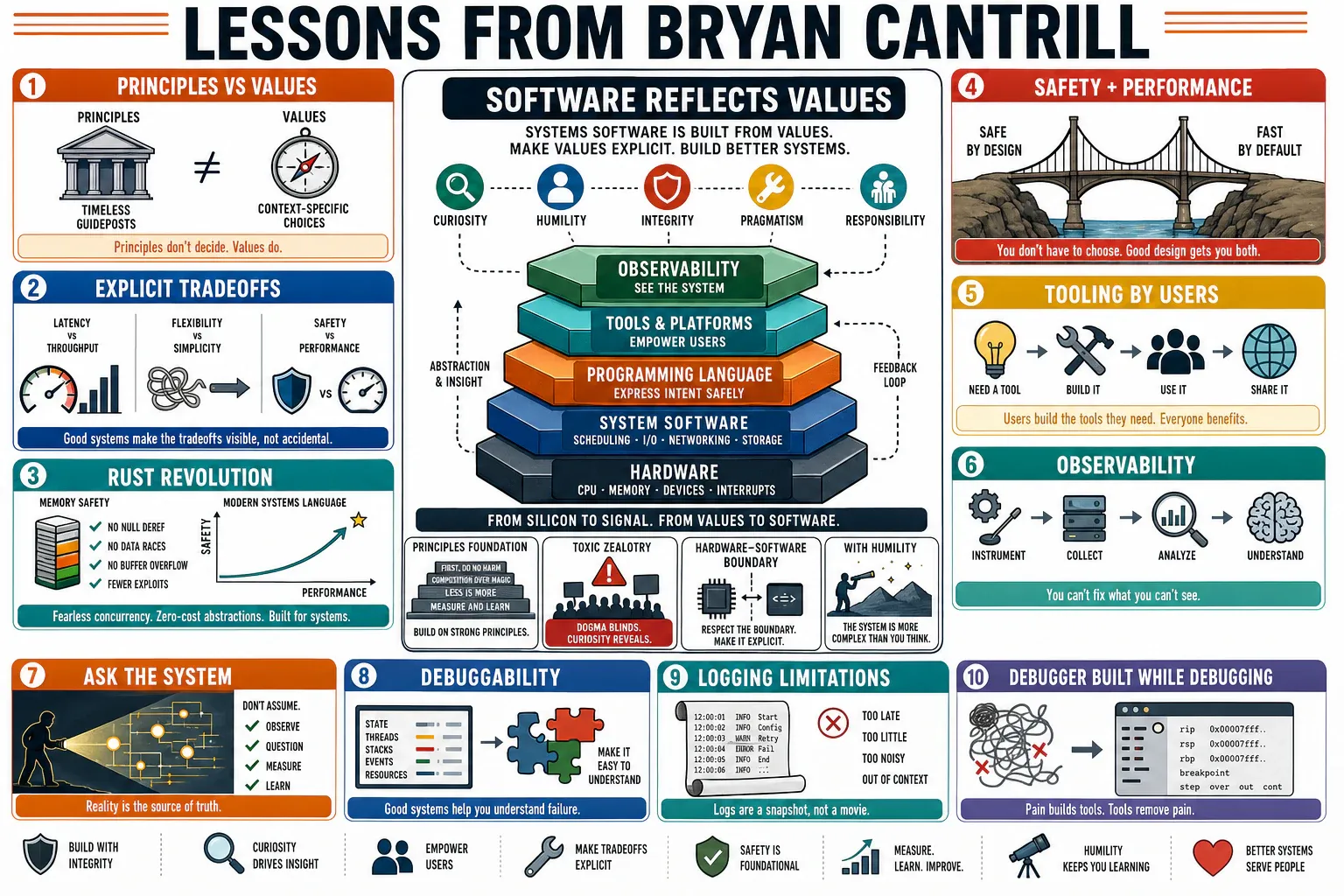
Part 1: On Software as a Reflection of Values
- On Everything Having Values: Cantrill: "I think everything has values, right? I think that we don't really talk about it because sometimes it's so implicit, but we do the things that we do because of what we think is important." — Software as a Reflection of Values (podcast interview transcript).
- On Values, Not Tools: Cantrill: "it's not the right tool for the job it's the right values for the job". — Platform as a Reflection of Values (2017 talk, video transcript).
- On Core Values: Cantrill: "there are core values in a platform these values are all equal but some are more equal than others". — Platform as a Reflection of Values (2017 talk, video transcript).
- On Unarticulated Values: Cantrill: "those core values are often not articulated you've got to figure it out a bit after the fact". — Platform as a Reflection of Values (2017 talk, video transcript).
- On Self-Reinforcing Communities: Cantrill: "the values themselves then attract a like-minded community they become self-reinforcing". — Platform as a Reflection of Values (2017 talk, video transcript).
- On the Opening Paragraph: Cantrill: "if you want to understand a platform's values go to the opening paragraph of the book written by the authors of the language that opening paragraph will tell you what their core values are". — Platform as a Reflection of Values (2017 talk, video transcript).
- On JavaScript's Values: Cantrill: "JavaScript's values are allowing really every person on the planet to write software." — Software as a Reflection of Values (podcast interview transcript).
- On Choosing Robustness: On Joyent's values, Cantrill says: "we have to pick between performance and robustness we pick robustness". — Platform as a Reflection of Values (2017 talk, video transcript).
- On Being Shown an Exploit: Cantrill: "there is nothing more clarifying than having someone present you with an exploit in your own software". — Platform as a Reflection of Values (2017 talk, video transcript).
- On Trade-Offs: Cantrill: "Languages, operating systems, and communities have to make trade-offs and they do that based on their values." — Software as a Reflection of Values (podcast interview transcript).
Part 2: On Systems Programming and Rust
- On Approachability and Rigor: On Rust, Cantrill says: "we're not going to pick approachability over robustness. We're not going to pick approachability over rigor." — Software as a Reflection of Values (podcast interview transcript).
- On Rust's Compelling Values: Cantrill: "Rust is highly performing. It's memory safe, which is really interesting." — Software as a Reflection of Values (podcast interview transcript).
- On Performance in Rust: Cantrill: "it is easier to deliver very high performing software in Rust than it is in C". — Software as a Reflection of Values (podcast interview transcript).
- On Ownership and Data Structures: Cantrill: "the strength of the ownership model allows Rust to be truly composable so you can use much more powerful data structures." — Software as a Reflection of Values (podcast interview transcript).
- On Memory Disambiguation: Cantrill: "Rust is able to actually do true memory disambiguation." — Software as a Reflection of Values (podcast interview transcript).
- On Explicit Mutability: Cantrill: "I love all the explicitness around mutability". — Software as a Reflection of Values (podcast interview transcript).
- On Casting Away Const: Cantrill: "if it's not mutable, you can't mutate it, you can't just magically make it mutable." — Software as a Reflection of Values (podcast interview transcript).
- On Helpful Compiler Errors: Cantrill: "you'll get these incredibly verbose, helpful error messages out of the compiler." — Software as a Reflection of Values (podcast interview transcript).
- On Abstractions Near the Machine: Cantrill: "for those abstractions that are going to be closest to the machine, they have to yield the maximum performance of the machine." — Software as a Reflection of Values (podcast interview transcript).
- On a Place for C: Cantrill: "there's still going to be a place for C in the universe." — Software as a Reflection of Values (podcast interview transcript).
Part 3: On Tooling, Debugging, and Observability
- On Developing Debuggers: Cantrill: "The best time to develop a debugger is when debugging!" — Sharpening the Axe: The Primacy of Toolmaking (2022 talk, video transcript).
- On Better Tools: Cantrill: "we know that better tools yield better artifacts". — Sharpening the Axe: The Primacy of Toolmaking (2022 talk, video transcript).
- On Invisible Tools: Cantrill: "the tools themselves are entirely invisible to the end user of the product". — Sharpening the Axe: The Primacy of Toolmaking (2022 talk, video transcript).
- On Toolmakers Building What They Need: Cantrill: "these were tool makers building the things that they themselves needed". — Sharpening the Axe: The Primacy of Toolmaking (2022 talk, video transcript).
- On Building What You Need: Cantrill: "when you're building a tool that you yourself need, you are tautologically building something that someone wants". — Sharpening the Axe: The Primacy of Toolmaking (2022 talk, video transcript).
- On Errant Lines of Code: Cantrill: "less errant lines of code can do more unintended work". — Sharpening the Axe: The Primacy of Toolmaking (2022 talk, video transcript).
- On Safety: Cantrill on DTrace: "a value for drace above all else was safety". — DTrace at 21: Reflections on Fully-grown Software (2024 talk, video transcript).
- On Systems Reflecting Values: Cantrill: "systems reflect their values". — DTrace at 21: Reflections on Fully-grown Software (2024 talk, video transcript).
- On Not Relying on a Compiler: On DTrace's availability, Cantrill says: "we didn't want to rely on recompiling things we didn't want to rely on the presence of a compiler". — DTrace at 21: Reflections on Fully-grown Software (2024 talk, video transcript).
- On Not Encouraging Toolmaking: Cantrill: "we don't explicitly encourage it it can feel like a distraction". — Sharpening the Axe: The Primacy of Toolmaking (2022 talk, video transcript).
Part 4: On Leadership Without Management
- On Trust: Cantrill: "trust is how we build organizations". — Sharpening the Axe: The Primacy of Toolmaking (2022 talk, video transcript).
- On Trusting One Another: Cantrill: "we have to trust one another we have to trust ourselves the people we work with". — Sharpening the Axe: The Primacy of Toolmaking (2022 talk, video transcript).
- On Binding a Team With Trust: Cantrill reads from Tracy Kidder: "he would bind his team with mutual trust he decided when a person signed up to do a job for him he would in turn trust that person to accomplish it". — Things I Learned the Hard Way (2023 talk, video transcript).
- On Not Breaking Work Into Dull Pieces: From the same passage: "he wouldn't break it down into little pieces and make the task small easy and dull". — Things I Learned the Hard Way (2023 talk, video transcript).
- On Trust as Risk: From the same passage: "trust is risk and risk avoidance is the name of the game in business". — Things I Learned the Hard Way (2023 talk, video transcript).
- On Not Unseeing Problems: Cantrill: "you can't unsee problems right". — Things I Learned the Hard Way (2023 talk, video transcript).
- On Passing Down Wisdom: Cantrill: "I think we as a discipline need to do a lot more of this so we can make sure that the people come up that come up behind you can learn more things". — Things I Learned the Hard Way (2023 talk, video transcript).
- On Heterogeneity: Cantrill: "big believer in heterogeneity of systems and of thought". — Software as a Reflection of Values (podcast interview transcript).
- On Idiosyncratic Choices: Cantrill: "when you make one of those idiosyncratic decisions, you are almost certainly making it for more deeply held reasons than someone who is making a safer decision." — Software as a Reflection of Values (podcast interview transcript).
- On the Currency of Creative Work: Cantrill: "we need that most fundamental currency of the realm for Creative Endeavor and that is trust". — Sharpening the Axe: The Primacy of Toolmaking (2022 talk, video transcript).
Part 5: On the Ethics and Impact of Software
- On Novel Ethical Dilemmas: Cantrill: "software's contact with our broader world is bringing with it novel ethical dilemmas for those who endeavor to build it." — Andreessen's Corollary: Ethical Dilemmas in Software Engineering (2019 talk, video transcript).
- On Software Growing Up: Cantrill: "software has grown a lot since 1997 and we've come into contact with a lot of ethical dilemmas honestly". — Andreessen's Corollary: Ethical Dilemmas in Software Engineering (2019 talk, video transcript).
- On the 1997 Code: Cantrill on the 1997 code of ethics: "I don't think any software engineer survives this first principle intact." — Andreessen's Corollary: Ethical Dilemmas in Software Engineering (2019 talk, video transcript).
- On Social Networking: Cantrill: "Social networking was born crooked." — Andreessen's Corollary: Ethical Dilemmas in Software Engineering (2019 talk, video transcript).
- On a Tsunami: Cantrill: "a tsunami of social interaction coming, societal interaction coming that we were illprepared for". — Andreessen's Corollary: Ethical Dilemmas in Software Engineering (2019 talk, video transcript).
- On Growing Up: Cantrill on Andreessen's essay: "it should have been a warning that Silicon Valley needed to grow up, that tech companies needed to grow up". — Andreessen's Corollary: Ethical Dilemmas in Software Engineering (2019 talk, video transcript).
- On the 2018 Code: Cantrill on the newer code: "we're going to focus on contributing to society and human well-being, avoiding harm. Be honest and trustworthy." — Andreessen's Corollary: Ethical Dilemmas in Software Engineering (2019 talk, video transcript).
- On Judgment: Cantrill on the code's call for judgment: "to act in a manner that is most consistent with the spirit of the code". — Andreessen's Corollary: Ethical Dilemmas in Software Engineering (2019 talk, video transcript).
Part 6: On Building Hardware and Oxide
- On Software-Centric Thinking: Cantrill: "we take this software-centric thinking too far that we begin to think that only software matters that the hardware vessel that we're actually operating on is irrelevant". — Hardware/Software Co-design: The Coming Golden Age (2021 keynote, video transcript).
- On Not Dismissing Hardware: Cantrill: "you cannot dismiss hardware you cannot dismiss software from hardware entirely". — Hardware/Software Co-design: The Coming Golden Age (2021 keynote, video transcript).
- On Andreessen's Blind Spot: Cantrill on Andreessen's essay: "the big problem with andreessen's software is eating the world peace it misses hardware entirely". — Hardware/Software Co-design: The Coming Golden Age (2021 keynote, video transcript).
- On Not Purely Software Companies: Cantrill: "both of those companies have very significant hardware components hardware components that you cannot take away and still have the same company". — Hardware/Software Co-design: The Coming Golden Age (2021 keynote, video transcript).
- On a URL in the BIOS: Cantrill: "what is a URL doing in my bias this is the brainstem of my data center". — The Soul of a New Machine: Rethinking the Computer (2020 seminar, video transcript).
- On a Hardware Root of Trust: Cantrill: "we need an actual proper hardware root of trust that can actually attest firmware". — The Soul of a New Machine: Rethinking the Computer (2020 seminar, video transcript).
- On a Minimal Service Processor: Cantrill: "what this thing needs to do is it needs to be able to bounce the box it needs to be able to give you a serial line and that's about it". — The Soul of a New Machine: Rethinking the Computer (2020 seminar, video transcript).
- On Firmware From the DOS Era: Cantrill: "The irony is that we still run firmware, that dates from that DOS era." — Software as a Reflection of Values (podcast interview transcript).
- On Being Close to the Machine: Cantrill: "I like being that layer that's close to the machine". — Software as a Reflection of Values (podcast interview transcript).
Part 7: On Language Trade-offs (C, C++, Go, Node.js)
- On Being a C Programmer: Cantrill: "I'm really a C programmer at the end of the day or have been historically. I'm a systems programmer." — Software as a Reflection of Values (podcast interview transcript).
- On the Operating System as Runtime: Cantrill: "the operating system itself is that runtime that you can't see when you're writing your program". — Software as a Reflection of Values (podcast interview transcript).
- On Go's Decisions: Cantrill: "GO then makes a bunch of decisions for you that do feel like it's kind of infringing your own way of expressing yourself". — Software as a Reflection of Values (podcast interview transcript).
- On Mandating a Style: Cantrill: "mandating a consistent style, it's too much, or mandating one style is to me too much". — Software as a Reflection of Values (podcast interview transcript).
- On Rigor as a First Principle: Cantrill on JavaScript: "it's not designed around rigor as a first principle." — Software as a Reflection of Values (podcast interview transcript).
- On Node's Values: Cantrill on Node: "it was about Simplicity and performance it was about here you can write a highly performing async program in a very small number of lines of code". — Platform as a Reflection of Values (2017 talk, video transcript).
- On Sentinel Values: Cantrill: "for new languages, we need to be done with sentinel values." — Software as a Reflection of Values (podcast interview transcript).
- On C as a Default: Cantrill: "C is my default." — Software as a Reflection of Values (podcast interview transcript).
Part 8: On the Craft and Culture of Engineering
- On the Virtue of Laziness: Cantrill: "Laziness drives us to make the system as simple as possible (but no simpler!) — to develop the powerful abstractions that then allow us to do much more, much more easily." — The peril of laziness lost (2026 blog post).
- On the Work of Being Lazy: Cantrill: "it takes a lot of work to be lazy". — The peril of laziness lost (2026 blog post).
- On LLMs and Laziness: Cantrill: "The problem is that LLMs inherently lack the virtue of laziness. Work costs nothing to an LLM." — The peril of laziness lost (2026 blog post).
- On Systems Growing Larger: Cantrill: "Left unchecked, LLMs will make systems larger, not better". — The peril of laziness lost (2026 blog post).
- On Crisp Abstractions: Cantrill: "our finite time forces us to develop crisp abstractions in part because we don't want to waste our (human!) time on the consequences of clunky ones." — The peril of laziness lost (2026 blog post).
- On Constraints: Cantrill: "The best engineering is always borne of constraints". — The peril of laziness lost (2026 blog post).
- On Swapping War Stories: Cantrill on learning from senior technologists: "you're just kind of listening to people Swap War Stories and you're accumulating that wisdom". — Things I Learned the Hard Way (2023 talk, video transcript).
- On Lines of Code: Cantrill: "all of DTrace is — depending on how you count it — on the order of sixty thousand lines of code". — The peril of laziness lost (2026 blog post).