Bryce Roberts co-founded the seed fund OATV (O'Reilly AlphaTech Ventures) in 2005 and later started Indie.vc, which invests in startups that already have revenue and aims to help them reach profitability rather than a next funding round. — Startups for the Rest of Us, Episode 310: Indie.vc and a More Realistic Approach to Funding (transcript).
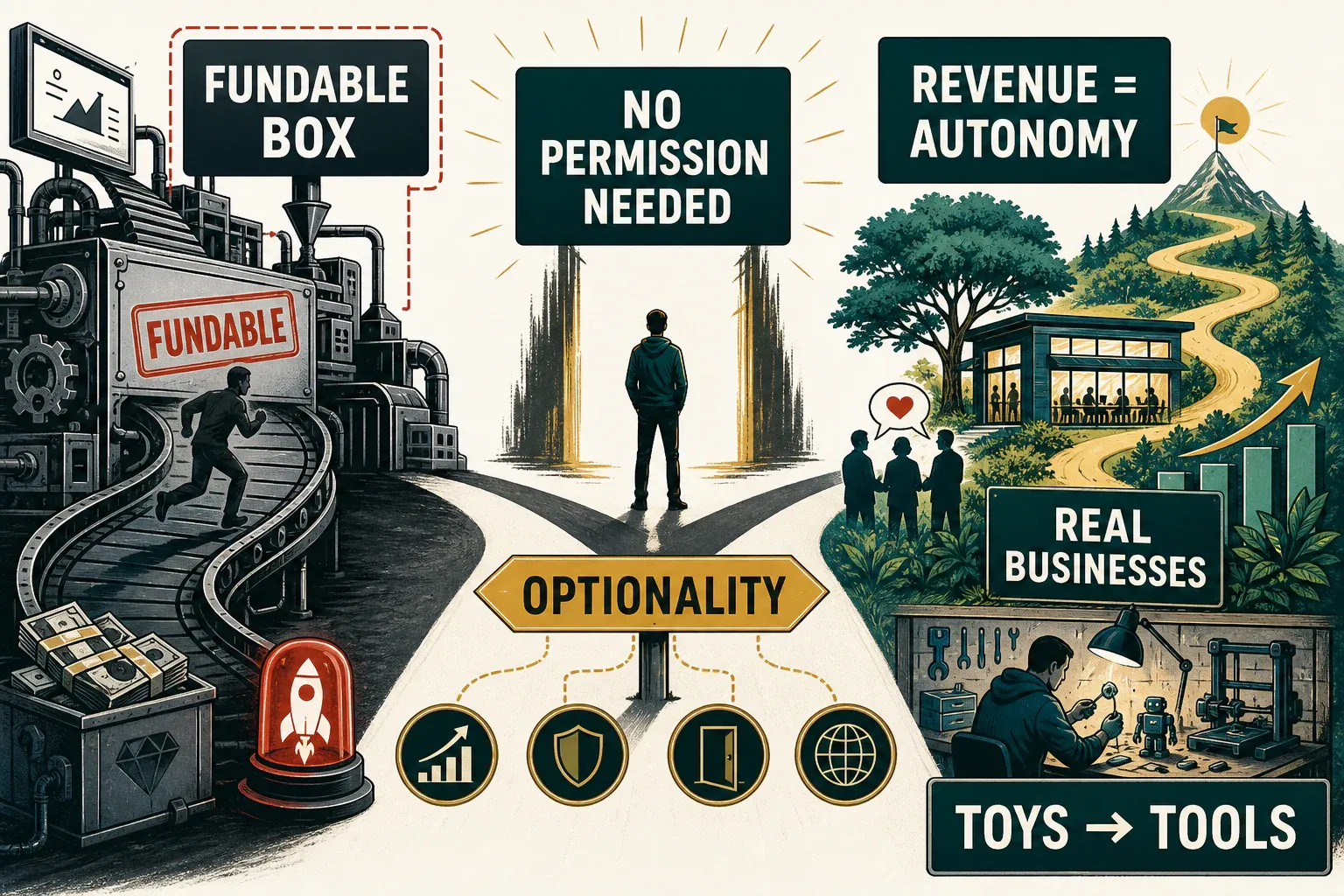
Part 1: The Entrepreneurial Industrial Complex
- On Daddy Issues: Roberts joked in a talk: "I occasionally joke that like VC is daddy issues with a business model." — The Indie Era of Startups, Main Street Summit talk (transcript).
- On Fundraising as the Business Model: Roberts: "fundraising is the business model of this new, unicorn-obsessed, startup cohort." — Startups for the Rest of Us, Episode 310: Indie.vc and a More Realistic Approach to Funding (transcript).
- On the Language of Entrepreneurship: Roberts: "In the same regards that VCs want to fund billion-dollar, monopoly-style businesses, they have themselves a monopoly on the language we use about entrepreneurship". — Recode Media interview with Bryce Roberts (Vox, lightly edited transcript).
- On Funding the Same Things: Roberts: "VCs aren't in the business necessarily of funding new things. They're in the business of funding the same things with more money." — The Indie Era of Startups, Main Street Summit talk (transcript).
- On the Wrong Product: Roberts: "Venture capital is the wrong product for most companies. Less than 1 percent of all companies that get started raise venture capital." — Recode Media interview with Bryce Roberts (Vox, lightly edited transcript).
- On One Product to Sell: Roberts: "If you don't fit that, even within the venture-funded startup tech landscape, we still only have one product to sell you." — Recode Media interview with Bryce Roberts (Vox, lightly edited transcript).
- On Seed Becoming Traditional: Roberts said seed investing "has essentially co-opted the traditional venture business model". — Recode Media interview with Bryce Roberts (Vox, lightly edited transcript).
- On 1,000X Returns: Roberts: "I think people have this idea that the venture model is built on the back of 10X returns, but it's not. It's actually built on the back of 1,000X returns." — Recode Media interview with Bryce Roberts (Vox, lightly edited transcript).
- On Unsustainable Valuations: Roberts: "we've been funding these companies at unsustainable valuations, at an unsustainable velocity". — The Indie Era of Startups, Main Street Summit talk (transcript).
- On Capital Without New Companies: Roberts: "seven times the amount of capital available, we didn't even double the number of companies that were getting started in that time". — The Indie Era of Startups, Main Street Summit talk (transcript).
Part 2: Indie.vc & The Permissionless Path
- On Building Without Permission: Roberts: "I think there’s a group of people who really want to have an impact, who want to build something that doesn’t necessarily rely on getting permission from an investor to be able to have it exist". — Startups for the Rest of Us, Episode 310: Indie.vc and a More Realistic Approach to Funding (transcript).
- On a Loan With No Maturity Date: Roberts on Indie.vc's terms: "it’s structured essentially as a loan with no maturity date, so there isn’t an interest accruing". — Startups for the Rest of Us, Episode 310: Indie.vc and a More Realistic Approach to Funding (transcript).
- On Sharing in Founder Cash: Roberts: "If the founder wants to start taking a significant amount of cash out of the business, we share in that." — Startups for the Rest of Us, Episode 310: Indie.vc and a More Realistic Approach to Funding (transcript).
- On Post-Revenue Checks: Roberts: "we write checks between a hundred thousand and a million dollars, into startups that are post-revenue." — Recode Media interview with Bryce Roberts (Vox, lightly edited transcript).
- On Setting Up the Next Round: Roberts: "Oftentimes, especially in the early stages, the goal of a round of funding is to set yourself up to be in a position to raise that next round." — Recode Media interview with Bryce Roberts (Vox, lightly edited transcript).
- On Portfolio Growth: Roberts: "our Indie.vc companies on average are growing 100 percent in the first year and 300 percent after the second year of working with us." — Recode Media interview with Bryce Roberts (Vox, lightly edited transcript).
- On Restaurant Investors: Roberts on how the idea began: "Why couldn’t we be trying this with tech businesses?" — Startups for the Rest of Us, Episode 310: Indie.vc and a More Realistic Approach to Funding (transcript).
- On Thin Margins: Roberts: "The margins in a restaurant business are just so paper-thin, in general." — Startups for the Rest of Us, Episode 310: Indie.vc and a More Realistic Approach to Funding (transcript).
- On the Implicit A: Roberts: "there’s an implicit A as soon as you take that seed round these days." — Startups for the Rest of Us, Episode 310: Indie.vc and a More Realistic Approach to Funding (transcript).
- On Pressure Toward Another Round: Roberts: "Most of the advice and most of the effort and most of the incentives around that seed round of funding end up pushing you towards another round of funding and another round of funding." — Startups for the Rest of Us, Episode 310: Indie.vc and a More Realistic Approach to Funding (transcript).
Part 3: Real Businesses vs. Startup Myths
- On a $5 Million-a-Month Business: Roberts voicing how most people would react to a founder running a $5 million-a-month business: "If I had the opportunity to run a $5 million-a-month software business? Sign me up for that!" — Startups for the Rest of Us, Episode 310: Indie.vc and a More Realistic Approach to Funding (transcript).
- On Cash Cows: Roberts: "cash cows are the new unicorns." — The Indie Era of Startups, Main Street Summit talk (transcript).
- On Asking Permission to Exist: Roberts on a durable business: "One that isn't having to ask permission to exist every nine months to a year." — The Indie Era of Startups, Main Street Summit talk (transcript).
- On Main Street and Silicon Valley: Roberts: "I think there is this moment where the Main Street mindset and the Silicon Valley ambition are colliding increasingly." — The Indie Era of Startups, Main Street Summit talk (transcript).
- On Building the Thing in You: Roberts: "Build the thing that's in you. Build the thing that you care deeply about." — The Indie Era of Startups, Main Street Summit talk (transcript).
- On Removing the Filter: Roberts: "you can now remove that as your primary filter or even the top five filters of what it is you want to go build and just freaking go build it." — The Indie Era of Startups, Main Street Summit talk (transcript).
- On Ignoring Investors: Roberts: "Don't worry about what these investors want." — The Indie Era of Startups, Main Street Summit talk (transcript).
- On Blooming Where Planted: Roberts on a line from the original Indie.vc letter: "Bloom where you’re planted." — Startups for the Rest of Us, Episode 310: Indie.vc and a More Realistic Approach to Funding (transcript).
- On Easy Money: Roberts: "when the money’s easy, it’s easy to sprint." — Recode Media interview with Bryce Roberts (Vox, lightly edited transcript).
Part 4: The Alpha Geek Thesis & Early OATV
- On Optionality Since 2005: Roberts: "we set up a seed fund to introduce a new kind of optionality for entrepreneurs". — Startups for the Rest of Us, Episode 310: Indie.vc and a More Realistic Approach to Funding (transcript).
- On Falling Costs: Roberts: "the cost for getting these businesses online, up and going was dropping significantly." — Startups for the Rest of Us, Episode 310: Indie.vc and a More Realistic Approach to Funding (transcript).
- On Open Source Costs: Roberts on the 2005-2010 seed boom: "you took millions and millions of dollars of infrastructure cost and shrunk it to effectively zero." — Get The Leverage: The VC Who Disrupted His Own Career (interview excerpts).
- On a Different Experience: Roberts on the early Indie community: "People wanted a different experience". — Get The Leverage: The VC Who Disrupted His Own Career (interview excerpts).
- On Plodding Companies: Roberts: "Indie has never, EVER, been about building a portfolio of plodding companies lead by unambitious or unfundable entrepreneurs." — What Ended Indie (Bryce Roberts, Medium).
- On the Next Twelve: Roberts: "how can we unlock the next 12–15 of those value-driving companies?" — What Ended Indie (Bryce Roberts, Medium).
- On Zapiers: Roberts: "There are thousands more “Zapiers” out there dying of starvation OR suffering from the indigestion of overfunding who could benefit from the Indie path and founder community." — What Ended Indie (Bryce Roberts, Medium).
- On a Value Hand: Roberts: "you’re playing a value hand in a growth game" — What Ended Indie (Bryce Roberts, Medium).
- On Fundamentals in a Growth Game: Roberts: "The way the startup game is played, even compelling fundamentals take a distant back seat to how much money companies are raising, at what valuation they are raising it, and which top-tier firm is leading the raise." — What Ended Indie (Bryce Roberts, Medium).
Part 5: Growth, Scale, & The Treadmill
- On the Vanished Series A: Roberts: "The idea that you're going to raise your seed round and then nine months to 12 months later, you're going to turn around and raise your A round is, that world doesn't exist." — The Indie Era of Startups, Main Street Summit talk (transcript).
- On Investor Incentives: Roberts on early-stage VCs: "the incentives for them are actually to make sure you get more funding". — Recode Media interview with Bryce Roberts (Vox, lightly edited transcript).
- On the Industry Not Returning: Roberts: "The venture industry is not going to come back the way it was over the last 10 years." — The Indie Era of Startups, Main Street Summit talk (transcript).
- On the Indie Era: Roberts: "Whether by default, disposition, or desperation, the Indy era of startups is here." — The Indie Era of Startups, Main Street Summit talk (transcript).
- On Different Rules: Roberts: "I tried to play by a different set of rules and got burned." — What Ended Indie (Bryce Roberts, Medium).
- On Features and Bugs: Roberts: "What we believed was a feature, was largely perceived as a bug." — What Ended Indie (Bryce Roberts, Medium).
- On Compounding Ownership: Roberts: "The value of our, and the founder’s, ownership is compounding instead of diluting." — What Ended Indie (Bryce Roberts, Medium).
- On Permission to Exist: Roberts: "Real Businesses create their own source of funding and don’t have to ask anyone for permission to exist." — Permissionless Entrepreneurship (Bryce Roberts, Strong Words).
Part 6: Ego, Ethos, & Leadership
- On Ego Over Ethos: Roberts on the first Indie: "I would actually say it’s like ego over ethos is how I chose to do the first one." — Get The Leverage: The VC Who Disrupted His Own Career (interview excerpts).
- On Being Right: Roberts: "I wanted to be right. I was more interested in being right than being good". — Get The Leverage: The VC Who Disrupted His Own Career (interview excerpts).
- On Nothing to Prove: Roberts: "I’ve got nothing to prove." — Get The Leverage: The VC Who Disrupted His Own Career (interview excerpts).
- On Selling Products: Roberts: "Real businesses make products and sell them for a profit." — Real Businesses (Bryce Roberts, Strong Words).
- On Business Models: Roberts: "They have a functioning business model, not a believable financial model." — Real Businesses (Bryce Roberts, Strong Words).
- On Exit Slides: Roberts: "if your pitch deck has an “exit strategy” slide you are pitching a lifestyle business." — Real Businesses (Bryce Roberts, Strong Words).
- On Customer Needs: Roberts: "Real businesses prioritize their customer’s needs over their customer’s eyeballs." — Real Businesses (Bryce Roberts, Strong Words).
- On the Space in Between: Roberts: "If you are somewhere between a lifestyle business and a VC funded monopoly, you should reconsider your funding strategy and try building a real business instead." — Real Businesses (Bryce Roberts, Strong Words).
- On Spending Other People's Money: Roberts: "Scaling a business through happy customers and revenue is no harder than breaking the addiction of spending other people’s money." — Real Businesses (Bryce Roberts, Strong Words).
- On the Last Round: Roberts: "Our hope is to play a small role in ushering in the age of Permissionless Entrepreneurship by offering the last (only?) round of funding founders NEED to take." — Permissionless Entrepreneurship (Bryce Roberts, Strong Words).
Part 7: Founder Autonomy & Optionality
- On Alternatives to a Venture Future: Roberts: "One way to avoid this venture-backed future is to create alternatives to it". — Get The Leverage: The VC Who Disrupted His Own Career (interview excerpts).
- On Shots on Goal: Roberts: "I want as many shots on goal for possible futures as possible." — Get The Leverage: The VC Who Disrupted His Own Career (interview excerpts).
- On a Honeypot: Roberts: "It was always a strategy, investment structure and marketing message designed as a honeypot to attract a certain kind of entrepreneur." — The Inevitabilities of Indie (Bryce Roberts, Medium).
- On Ephemeral Structures: Roberts: "In the inevitable future, ephemerally adapting to opportunity will eat legacy’s lunch." — The Inevitabilities of Indie (Bryce Roberts, Medium).
- On Optimizing Ownership: Roberts: "As growth capital commodifies, firms that can help founders optimize ownership and optionality beyond offering increasingly higher valuations will be advantaged." — The Inevitabilities of Indie (Bryce Roberts, Medium).
- On Equity Upside: Roberts: "Our attempt at Indie was to marry the potential upside of equity with the reality that most venture funded companies don’t achieve venture scale returns." — The Inevitabilities of Indie (Bryce Roberts, Medium).
- On Mortality: Roberts: "our Indie companies had a far lower mortality rate (roughly 12% of Indie funded companies have gone out of business entirely) vs. their classically venture funded peers." — The Inevitabilities of Indie (Bryce Roberts, Medium).
- On Communities and Economies: Roberts: "I believe the next ten years will be defined by communities evolving into economies." — The Inevitabilities of Indie (Bryce Roberts, Medium).
- On the Scout Program: Roberts: "Our Scout program completely rewired my brain around how to activate and incentivize a community." — The Inevitabilities of Indie (Bryce Roberts, Medium).
Part 8: Market Realities & Board Dynamics
- On the Coming Explosion: Roberts: "we're about to see the largest explosion of entrepreneurship and startup activity I've ever seen in my career". — The Indie Era of Startups, Main Street Summit talk (transcript).
- On Hard-Coding Values: Roberts: "We couldn’t just talk about rethinking founders and investors toxic relationship to funding, we had to hard code our values of optionality and incentivize an early revenue/profit mindset that the status quo actively seeks to have them avoid." — V3 Terms (Bryce Roberts, Strong Words).
- On Revenue Over Rounds: Roberts: "we’ve also taken great care to cultivate a community of founders who have a laser focus on raising their revenue and profits, not their next round of funding." — V3 Terms (Bryce Roberts, Strong Words).
- On a Fixed Percentage: Roberts: "We use a simple fixed % to express this ownership as it avoids much of the confusion and signaling associated with valuations or valuation caps." — V3 Terms (Bryce Roberts, Strong Words).
- On the Fund and the Strategy: Roberts: "When it comes to OATV and Indie.vc they are the same thing. OATV is the Fund, Indie.vc is the strategy." — OATV and Indie.vc (Bryce Roberts, Medium).
- On Betting the Firm: Roberts: "We firmly believe ambitious founders deserve an alternative. So we bet our firm on it." — OATV and Indie.vc (Bryce Roberts, Medium).
- On Being Misunderstood: Roberts: "We were misunderstood by those same constituents then and we are comfortable being misunderstood by them now." — OATV and Indie.vc (Bryce Roberts, Medium).
- On the Blitzscale Model: Roberts: "One that stood in stark contrast to the growth at all costs blitzscale based model which had become the dominant path for startup founders to follow." — Indie.vc 2020 (Bryce Roberts, Strong Words).
- On Weeks Not Months: Roberts: "Taking our learnings from previous years we’ve designed a human-centered investment process that moves founders from application to funded in weeks, not months (or years)." — Indie.vc 2020 (Bryce Roberts, Strong Words).