Victor Niederhoffer is a legendary hedge fund manager, former world-class squash champion, and pioneer of statistical arbitrage who approaches the financial markets as a grand, interconnected ecosystem. Drawing inspiration from fields as diverse as classical music, board games, and biological empiricism, his philosophies fiercely challenge conventional wisdom. The following insights capture his relentless pursuit of truth through data, his deep respect for the hazards of speculation, and his lifelong quest to master the art of counting.
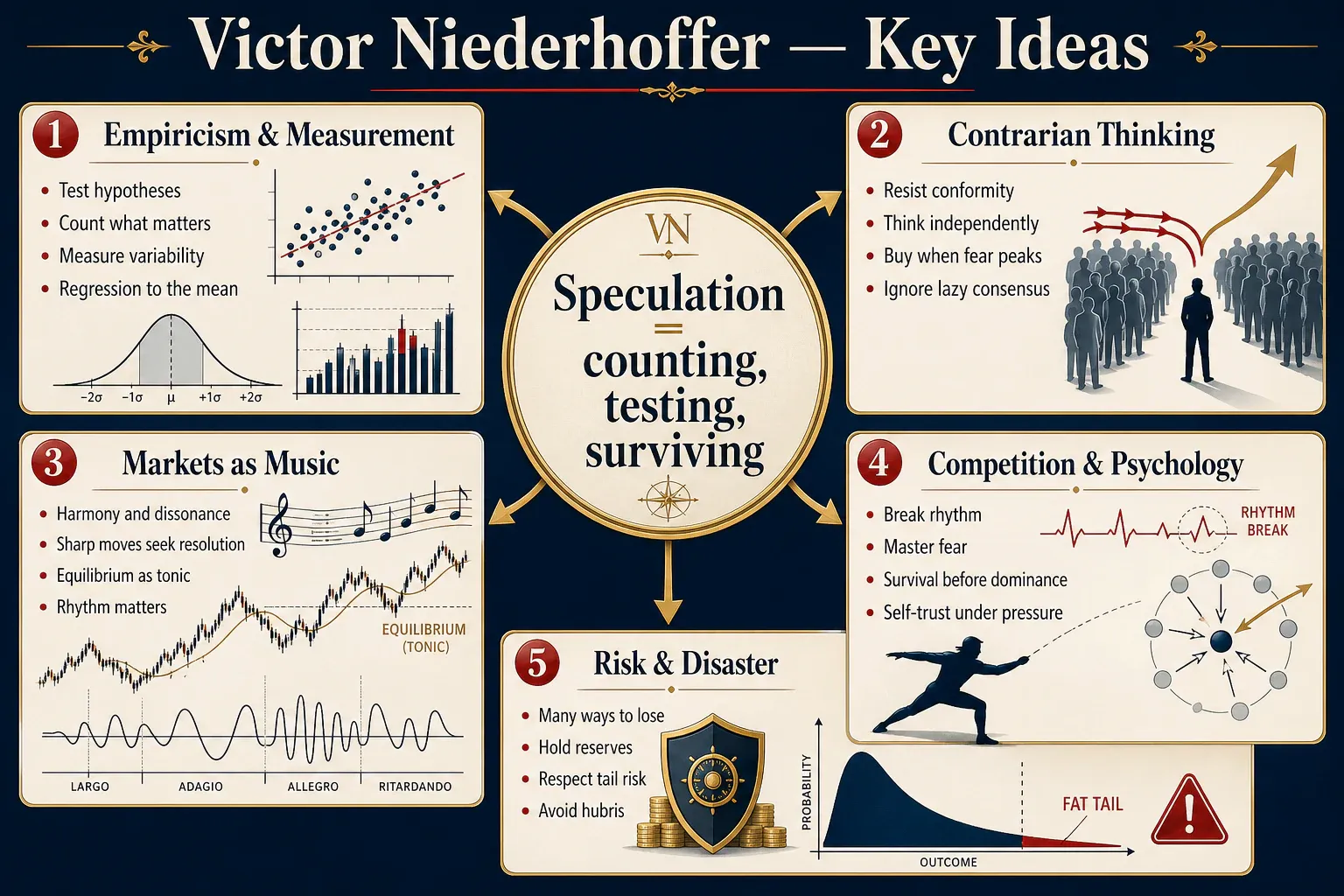
Part 1: The Education of a Speculator (Life & Markets)
- On Speculation as Life: "In the world according to Victor Niederhoffer, life is speculation and we are all speculators, except when we lose—then we are gamblers." — Source: [The Education of a Speculator]
- On Market Personification: "Imagine the mind of Mr. Market as he disguises and conceals himself, intimidates and plays dead. Market life is hazardous." — Source: [The Education of a Speculator]
- On the Path to Mastery: "Success does not come all at once; even for masters it comes in stages, separated by years." — Source: [Practical Speculation]
- On the Requirement of Passion: "Only those with passion can become masters." — Source: [The Education of a Speculator]
- On Market Panics: "Selling out when the fear is greatest is the worst time to sell." — Source: [The Education of a Speculator]
- On the Speculator's Role: "I am proud that my humble attempts to predict Tuesday's prices on Monday are an indispensable component of our society." — Source: [Daily Speculations]
- On Creating Harmony: "By buying low and selling high, I create harmony and freedom." — Source: [Daily Speculations]
- On Self-Trust: "A speculator must think for himself, must follow his own connections, self-trust is the foundation of successful effort." — Source: [The Education of a Speculator]
- On the Limits of Knowledge: "It isn't only what you know that counts, it's also what you don't know; and don't know that you don't know." — Source: [The Education of a Speculator]
- On Information Diets: "I don't own a television, don't follow the news, don't talk to anyone during the trading day, and don't like to read books less than 100 years old." — Source: [The Education of a Speculator]
Part 2: The Scientific Method & Empiricism
- On Measurement: "If you can't measure it, you probably can't manage it… Things you measure tend to improve." — Source: [Practical Speculation]
- On Prediction and Understanding: "The integration I seek is that of prediction and understanding." — Source: [Practical Speculation]
- On High-Frequency Trading: "In general, higher-frequency trading succumbs to declining profit potential against non-declining transaction costs." — Source: [Practical Speculation]
- On Hypothesis Testing: "A good trader has to be a good scientist, a good creator of hypotheses, and a tester of them in his market performances." — Source: [The Education of a Speculator]
- On Empirical Independence: "My resistance to conformity has been the bedrock of my speculative persona." — Source: [The Education of a Speculator]
- On Scientific Principles: "Some of the features common to most scientific work are: classification, observation, questioning, testing, measuring, collecting information, experimenting, modeling, and revising theories." — Source: [Practical Speculation]
- On Regression to the Mean: "Like Galton's peas, extreme market movements eventually succumb to regression toward mediocrity." — Source: [The Education of a Speculator]
- On Counting as Discipline: "If a question is important, it deserves to be tested which involves counting, and taking account of variability and uncertainty." — Source: [Practical Speculation]
- On Defining Randomness: "Conventions for settling how much of a difference is enough to differentiate the result from randomness must be decided in advance." — Source: [Practical Speculation]
- On Real Value: "I can't show you how to make money by parroting systematic trades. But I can show you something more valuable: a way of thinking that will lead you to greater success." — Source: [Practical Speculation]
Part 3: Competition, Squash, & Board Games
- On Breaking the Opponent: "My goal on the squash court was always to break my opponent's rhythm through relentless pressure and a street-fighter mentality." — Source: [The Education of a Speculator]
- On Internal Monologue: "What should I do? (Asked aloud before unleashing a smashing serve to win a critical match point against Sam Howe)." — Source: [1966 U.S. Nationals]
- On the Brighton Beach Style: "I brought a one-wall handball mentality from Brooklyn to the elite world of squash to intimidate and outwork opponents." — Source: [The Education of a Speculator]
- On Winning vs. Being Right: "The winner of a match is not always determined by who is right… but in the end… who is left." — Source: [Daily Speculations]
- On Survival as Victory: "Survival is a form of winning until you can really win." — Source: [Daily Speculations]
- On Board Games and Markets: "The patterns of advantage and structural edge in checkers and chess map perfectly onto the ever-shifting topography of the financial markets." — Source: [The Education of a Speculator]
- On Competitive Attrition: "Only the strongest players can swim in the shark-infested waters of the Masters' Seas." — Source: [Daily Speculations]
- On the Psychology of the Match: "In both squash and trading, the game is often won by the player who can master their own fear while exploiting the fear of the opponent." — Source: [The Education of a Speculator]
- On Rapid Learning: "The greatest competitor is one who assimilates everything thrown at them and comes back for more." — Source: [Harvard Squash Years]
Part 4: George Soros & Market Mentors
- On Soros's Survival Instinct: "George Soros has a feeling of—I won't say he has an intuitive feel for the market, but he has a survival instinct that's very well developed." — Source: [The Alchemy of Finance]
- On Soros's Focus on Losses: "I never heard George Soros speak once about a winning trade. To hear him talk, you'd think he had nothing but losers." — Source: [1998 NHK Special]
- On the Trait of Losers: "Conversely, listening to the biggest losers, you'd think they had nothing but winners." — Source: [1998 NHK Special]
- On Knowing When to Step Aside: "Soros told me 'that's your big problem. You don't know when to stand away when the big waves are coming.' And he was right." — Source: [1998 NHK Special]
- On Francis Galton's Influence: "Francis Galton provided the scientific basis for the study of the individual and the mass, which is essential for any speculator." — Source: [The Education of a Speculator]
- On Rationality over Prayer: "Francis Galton did not pray. He thought of his shared heredity with all other creatures and this made him reverential. But the priests do not die older than others. All my praying will not make the dollar go down." — Source: [The Education of a Speculator]
- On Quitting While Ahead: "Niederhoffer was the only one of my managers who retired voluntarily from trading for me while still ahead." — Source: [George Soros, The Alchemy of Finance]
- On Enduring Mentorship: "A true mentor doesn't just teach you how to trade; they expose your psychological blind spots before the market exploits them." — Source: [Daily Speculations]
- On Institutional Pedigree vs. Grit: "While Ivy League pedigrees open doors, it is the grit of the street fighter that actually extracts alpha from the markets over the long term." — Source: [The Education of a Speculator]
Part 5: Dissonance, Harmony, & Music
- On the Market as Music: "The market plays music all the time. The problem is you never know how the music of the market is going to end." — Source: [Traders Magazine]
- On the Tonic: "A good framework is that the market, much like a classical composition, will always eventually end on the tonic, returning to equilibrium." — Source: [Traders Magazine]
- On Consonance and Dissonance: "It’s the language of emotions, it’s the language of consonance and dissonance, it’s the language of movement back to equilibrium." — Source: [Traders Magazine]
- On the Universal Language: "Music is a language of its own. It has infinite connections to the market." — Source: [Traders Magazine]
- On Musicians as Traders: "Musicians make excellent traders because they are trained in rigorous, mathematical precision and the exact art of counting." — Source: [The Education of a Speculator]
- On Strident Moves: "When a sharp, strident move occurs in one direction, it creates a dissonance that the market ecosystem will ultimately seek to resolve." — Source: [The Education of a Speculator]
- On Composing Hypotheses: "A good musician, a good composer of music, has to be a good scientist, a good creator of hypotheses, and a tester of them in his musical performances." — Source: [Traders Magazine]
- On Natural Rhythms: "Market movements are not purely random; they follow the natural rhythms and cycles found in biology and classical symphonies." — Source: [The Education of a Speculator]
- On Hearing the Crowd: "You must tune your ear to hear the subtle shifts in the crowd's emotional pitch, recognizing panic as a distinct, actionable frequency." — Source: [The Education of a Speculator]
Part 6: Market Myths & Contrarianism
- On Charlatans: "In no field are there more cranks and charlatans than in the market." — Source: [Practical Speculation]
- On Get-Rich Schemes: "It is inconceivable that anyone will divulge a truly effective get-rich scheme for the price of a book." — Source: [Practical Speculation]
- On Sharing Secrets: "Neither I nor my friends are interested in putting themselves at a disadvantage by sharing their true proprietary trading secrets." — Source: [Practical Speculation]
- On the Media: "Don't follow the mentally lazy habit of allowing a newspaper or broker or a wise friend to do our security market thinking." — Source: [Practical Speculation]
- On Technical Analysis: "Most popular technical indicators, like head-and-shoulders patterns, fail miserably when subjected to rigorous statistical backtesting." — Source: [Practical Speculation]
- On Contrarian Action: "To me, the worse things seem, the better they are. I buy when blood is in the streets." — Source: [The Education of a Speculator]
- On Emotional Drivers: "Emotions, not logic, move the world." — Source: [Daily Speculations]
- On the Evolving Ecosystem: "The market is an ever-changing ecosystem; a pattern that worked yesterday may not work today because other participants have identified and exploited it." — Source: [Practical Speculation]
- On Long-Term Optimism: "Despite short-term volatility, the long-term trajectory of the U.S. market is upward, making optimism a statistically sound baseline." — Source: [Practical Speculation]
- On Crowded Trades: "Just when you've found the perfect stream, the fish will stop biting, the weather will change, and other fishermen will appear, reducing the catch." — Source: [Practical Speculation]
Part 7: Hubris, Disaster, & Risk Management
- On the Rules of Disaster: "There are so many ways to lose, but so few ways to win. Perhaps the best way to achieve victory is to master all the rules for disaster, and then concentrate on avoiding them." — Source: [Practical Speculation]
- On Fear as Alpha: "If you are not scared, you are not taking enough risk, thus you're not going to make money. You need fear when you come up with an idea. Fear is where alpha comes from." — Source: [Daily Speculations]
- On Being Humbled: "The market is always creative in finding a way to make investors eat crow—raw, squawking and fully feathered." — Source: [Practical Speculation]
- On Reserves: "Always have enough in reserve to meet any conceivable market eventuality." — Source: [Practical Speculation]
- On the Urge to Get Even: "The urge to get even is one of the most costly and self-destructive habits a speculator can harbor." — Source: [The Education of a Speculator]
- On Specialization Constraints: "Knowledge changes too fast and the level of specialization is too high for any individual to coast without paying close attention." — Source: [Practical Speculation]
- On Leverage: "Leverage is the silent killer; it amplifies both your genius and your hubris until one inevitably breaks you." — Source: [The Education of a Speculator]
- On Emphasizing Losses: "I tend to emphasize my losses... it keeps me humble, an essential for success in a field where one false move can lead to irreversible disaster." — Source: [The Education of a Speculator]
- On Adapting to the Unthinkable: "A speculator must always account for the tail risk—the five-sigma event that traditional models dismiss as impossible." — Source: [Daily Speculations]
Part 8: Philosophy, Independence, & Objectivism
- On Assuming Risk: "Life, like the markets, offers the greatest rewards to those willing to assume risk. Assuming risk brings uncertainty, anxiety, and occasional loss, but it also brings out the best in us." — Source: [Practical Speculation]
- On the Heroic Quest: "In becoming a speculator in life, each person embarks on a heroic quest, becoming more than he or she already is." — Source: [Practical Speculation]
- On the Uncompromising Creator: "A speculator must embody the uncompromising creator, serving as a productive force who provides liquidity and price discovery." — Source: [NYC Junto]
- On Intellectual Independence: "The most important thing in life is to be able to think for yourself and not be swayed by the crowd." — Source: [The Education of a Speculator]
- On Free Exchange: "I founded the NYC Junto to create a community of rational individuals dedicated to the open exchange of ideas on libertarianism and markets." — Source: [NYC Junto]
- On the Morality of Speculation: "Speculators are not parasites; they are the rational actors who enforce the law of objective reality upon an irrational herd." — Source: [Daily Speculations]
- On Testing Premises: "In the market, the Objectivist mandate to 'check your premises' is enforced daily, often brutally, through the profit and loss ledger." — Source: [Daily Speculations]
- On Objective Reality (A is A): "The tape does not lie. Price is price, and refusing to accept the objective reality of the market is the fastest route to ruin." — Source: [The Education of a Speculator]
- On the Ultimate Test: "Ultimately, trading is the ultimate philosophical proving ground. It tests not just your models, but the very integrity of your character." — Source: [The Education of a Speculator]