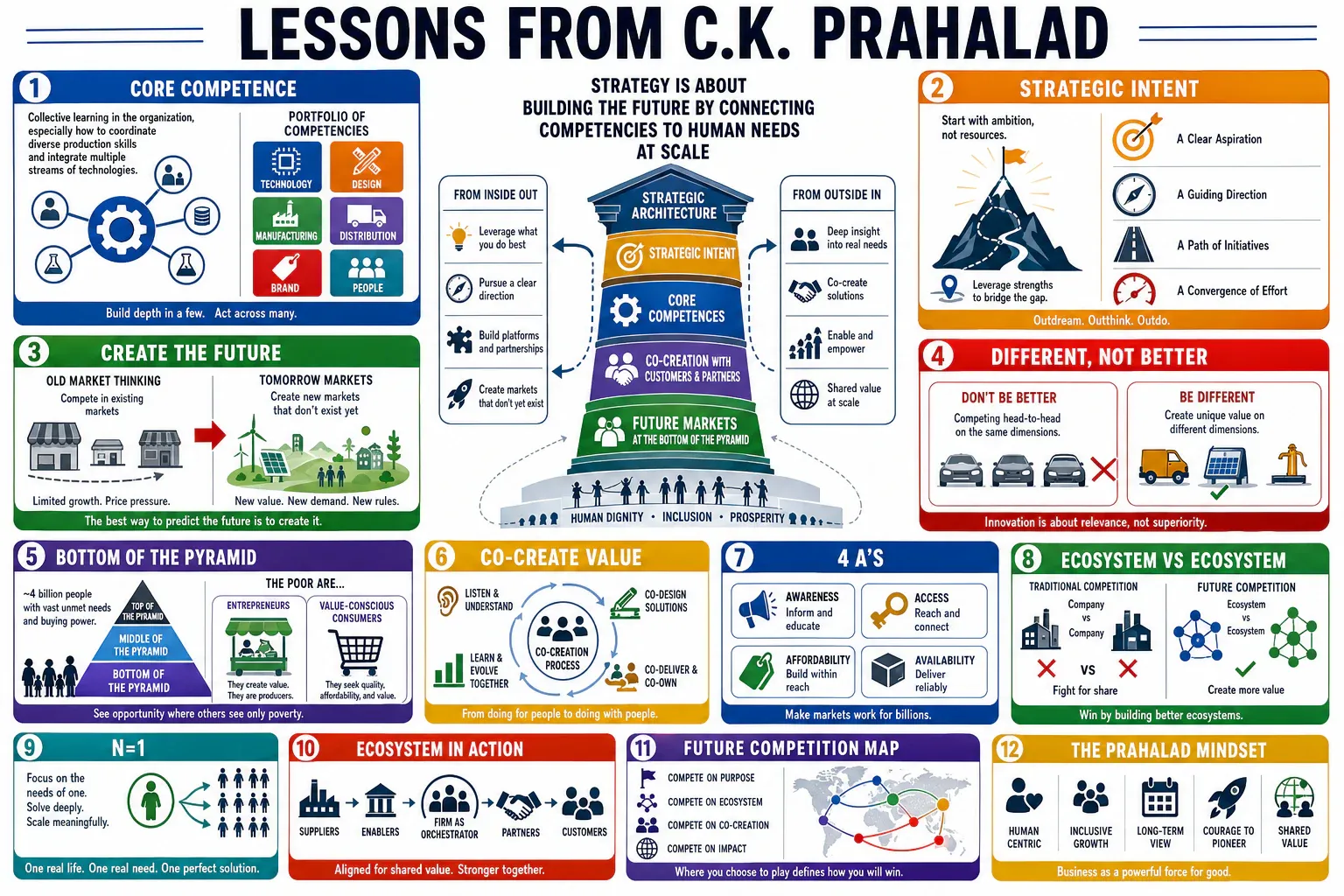
C.K. Prahalad (1941–2010) was a management thinker at the University of Michigan’s Ross School of Business. With Gary Hamel he introduced the term core competencies; his later work developed co-creation and the idea of the bottom of the pyramid. This collection gathers his own words from interviews and one co-authored article. — C.K. Prahalad: Top And Bottom Of The Pyramid (Thinkers50).
On Core Competence and Corporate Strategy
- On Looking at Six Billion People as Your Market: C.K. Prahalad: "If you look at the opportunity for companies, I’m making three simple points in all three books. One: look at six billion people as your market, not just the billion at the top of the pyramid. Look at six billion people as potentially micro producers, micro innovators and micro consumers." — C.K. Prahalad: Top And Bottom Of The Pyramid (Thinkers50; quoted remarks).
- On Understanding Each Customer: C.K. Prahalad: "The second thing I’m saying is if you want a very good way of serving the consumers and, therefore, retaining consumers, then you have to understand the uniqueness of each one and create a unique personalized experience." — C.K. Prahalad: Top And Bottom Of The Pyramid (Thinkers50; quoted remarks).
- On the Glue of Architecture: C.K. Prahalad: "And third, in The New Age of Innovation, I’m taking these two ideas and then saying, how do you do it operationally? What is the glue? The glue is information architecture, or IT architecture, and the social values that you create are the social architecture, in terms of skills, training, approach to talent and so on." — C.K. Prahalad: Top And Bottom Of The Pyramid (Thinkers50; quoted remarks).
- On Bite-Sized Concepts: C.K. Prahalad: "I had to separate them into bite-sized concepts, so the message didn’t get confused." — C.K. Prahalad: Top And Bottom Of The Pyramid (Thinkers50; quoted remarks).
- On Transitions Made in Small Steps: C.K. Prahalad: "These are not difficult transitions, but they are hard to do in one leap." — C.K. Prahalad: Top And Bottom Of The Pyramid (Thinkers50; quoted remarks).
- On Two Joint Problem Solvers: C.K. Prahalad: "What it says is that we need two joint problem solvers, not one. In the traditional industrial system, the firm was the centre of the universe, but when you move to the new information age, consumers have the opportunity to engage in a dialogue and be active and, therefore, they can shape their own personal experiences." — C.K. Prahalad: Top And Bottom Of The Pyramid (Thinkers50; quoted remarks).
- On Straddling the Pyramid: C.K. Prahalad: "I also recognize a significant portion of these populations will remain in the BOP realm and, therefore, I need to straddle the pyramid." — New Approaches to New Markets: How C.K. Prahalad’s Bottom of the Pyramid Strategies Are Paying Off (Knowledge at Wharton interview).
- On the Democratization of Commerce: C.K. Prahalad: "The hidden thread that runs through my work is the idea of the democratization of commerce." — C.K. Prahalad: Top And Bottom Of The Pyramid (Thinkers50; quoted remarks).
- On the Four Areas of His Work: C.K. Prahalad: "If you look at my work, they are centered around four areas: globalization, role of connectivity, inclusive growth and sustainability." — Sustainability can lead to innovation: CK Prahalad (The Economic Times interview).
- On Linking the Four Areas: C.K. Prahalad: "Nobody has looked at all four of them and said what are the linkages." — Sustainability can lead to innovation: CK Prahalad (The Economic Times interview).
On Strategic Intent
- On Leadership and the Future: C.K. Prahalad: "First, leaders must lead. You cannot lead unless you’re future oriented. Leadership is about the future; leadership is about a point of view about that future; and leadership is about hope." — C.K. Prahalad: Top And Bottom Of The Pyramid (Thinkers50; quoted remarks).
- On Gandhi's Leadership: C.K. Prahalad: "But he made every Indian realize their own personal ability to contribute to that effort." — C.K. Prahalad: Top And Bottom Of The Pyramid (Thinkers50; quoted remarks).
- On Non-Negotiables: C.K. Prahalad: "Moral authority comes from having clear non-negotiables. And that takes courage." — C.K. Prahalad: Top And Bottom Of The Pyramid (Thinkers50; quoted remarks).
- On Leading Like a Sheep Dog: C.K. Prahalad: "The second point about leadership is that it’s not about the leader. The metaphor I like to use is that of a sheep dog — not the shepherd. A sheep dog has to respect some rules. Number one, you always lead from behind. Number two, you can bark a lot, but don’t bite. And number three: don’t lose any sheep." — C.K. Prahalad: Top And Bottom Of The Pyramid (Thinkers50; quoted remarks).
- On Making Sense to Others: C.K. Prahalad: "Did I make sense to you? Because if I didn’t then I’m not doing my job properly." — C.K. Prahalad: Top And Bottom Of The Pyramid (Thinkers50; quoted remarks).
On The Fortune at the Bottom of the Pyramid (BoP)
- On the Real Source of Market Promise: C.K. Prahalad: "The real source of market promise is not the wealthy few in the developing world, or even the emerging middle-income consumers: It is the billions of aspiring poor who are joining the market economy for the first time." — The Fortune at the Bottom of the Pyramid (strategy+business, C.K. Prahalad and Stuart L. Hart).
- On the Impact of the Idea: C.K. Prahalad: "The impact has been interesting and profound in many ways — much more than one could have expected." — New Approaches to New Markets: How C.K. Prahalad’s Bottom of the Pyramid Strategies Are Paying Off (Knowledge at Wharton interview).
- On Capacity to Consume: C.K. Prahalad: "It is not how much income people have — it is how to create a capacity for them to consume." — New Approaches to New Markets: How C.K. Prahalad’s Bottom of the Pyramid Strategies Are Paying Off (Knowledge at Wharton interview).
- On Price Minus Profit: C.K. Prahalad: "That means we have to change from a mentality of “my current costs plus profit equals the price” to a much more consumer driven “price minus profit must equal cost.” That means you start with affordability." — New Approaches to New Markets: How C.K. Prahalad’s Bottom of the Pyramid Strategies Are Paying Off (Knowledge at Wharton interview).
- On a Multitrillion-Dollar Market: C.K. Prahalad: "In fact, given its vast size, Tier 4 represents a multitrillion-dollar market." — The Fortune at the Bottom of the Pyramid (strategy+business, C.K. Prahalad and Stuart L. Hart).
- On Immersing in Consumer Experience: C.K. Prahalad: "The difficulties of approaching these markets are not intercultural, but the ability to identify and immerse in consumer experience in these markets." — New Approaches to New Markets: How C.K. Prahalad’s Bottom of the Pyramid Strategies Are Paying Off (Knowledge at Wharton interview).
- On Going It Alone: C.K. Prahalad: "It is clear today that no company — however big it is — can afford to go it alone for cost reasons but, much more importantly, for access reasons." — New Approaches to New Markets: How C.K. Prahalad’s Bottom of the Pyramid Strategies Are Paying Off (Knowledge at Wharton interview).
- On the Rewards of the Bottom of the Pyramid: C.K. Prahalad: "For companies with the resources and persistence to compete at the bottom of the world economic pyramid, the prospective rewards include growth, profits, and incalculable contributions to humankind." — The Fortune at the Bottom of the Pyramid (strategy+business, C.K. Prahalad and Stuart L. Hart).
- On the Sweet Spot in Business Models: C.K. Prahalad: "So the first lesson here is if you can find the right sweet spot in terms of business models, there is a really huge and very profitable opportunity." — New Approaches to New Markets: How C.K. Prahalad’s Bottom of the Pyramid Strategies Are Paying Off (Knowledge at Wharton interview).
- On the Four As: C.K. Prahalad: "The 4 As are awareness, access, affordability and availability." — New Approaches to New Markets: How C.K. Prahalad’s Bottom of the Pyramid Strategies Are Paying Off (Knowledge at Wharton interview).
On Innovation and Co-Creation
- On Radical Innovation for the Poor: C.K. Prahalad: "Doing business with the world’s 4 billion poorest people — two-thirds of the world’s population — will require radical innovations in technology and business models." — The Fortune at the Bottom of the Pyramid (strategy+business, C.K. Prahalad and Stuart L. Hart).
- On Redefining Scale: C.K. Prahalad: "Companies will be forced to transform their understanding of scale, from a “bigger is better” ideal to an ideal of highly distributed small-scale operations married to world-scale capabilities." — The Fortune at the Bottom of the Pyramid (strategy+business, C.K. Prahalad and Stuart L. Hart).
- On N=1: C.K. Prahalad: "Think of Google. Google does not tell me how to use the system; I can personalize my own page, I can create iGoogle. I decide what I want. Google understands that it can have a hundred million consumers, but each one can do what they want with its platform. That is an extreme case of personalized cocreated value. We call that N=1." — C.K. Prahalad: Top And Bottom Of The Pyramid (Thinkers50; quoted remarks).
- On R=G: C.K. Prahalad: "On the other hand, Google does not produce the content at all. The content comes from a large number of institutions and individuals around the world. Google aggregates it and makes it available to me. So resources are not contained within the firm, but accessed from a wide variety of institutions; therefore resources are global. Our shorthand for that is R=G." — C.K. Prahalad: Top And Bottom Of The Pyramid (Thinkers50; quoted remarks).
- On Not Importing Western Practices: C.K. Prahalad: "And, finally, don’t push business model management practices and, most importantly, products and services that you are used to and accustomed to in the West onto these markets." — New Approaches to New Markets: How C.K. Prahalad’s Bottom of the Pyramid Strategies Are Paying Off (Knowledge at Wharton interview).
- On Learning Before Scaling: C.K. Prahalad: "You first learn, then invest and scale — not just invest and hope to learn." — New Approaches to New Markets: How C.K. Prahalad’s Bottom of the Pyramid Strategies Are Paying Off (Knowledge at Wharton interview).
- On Experimenting at Low Cost: C.K. Prahalad: "So the cycle is experiment at low cost, learn fast and scale rapidly so that you don’t make investments hoping to learn." — New Approaches to New Markets: How C.K. Prahalad’s Bottom of the Pyramid Strategies Are Paying Off (Knowledge at Wharton interview).
- On Taking Innovations Back West: C.K. Prahalad: "The beauty of this is, if you innovate here, you can take those innovations back to the US." — Sustainability can lead to innovation: CK Prahalad (The Economic Times interview).
- On Sustainability as Innovation: C.K. Prahalad: "Don't look at sustainability as compliance and regulation, but as an opportunity for breakthrough innovation." — Sustainability can lead to innovation: CK Prahalad (The Economic Times interview).
- On Disrupting Your Dominant Logic: C.K. Prahalad: "So the whole idea of building from within, learning rapidly and [having a] willingness to disrupt your own dominant logic is fundamental to succeed here." — New Approaches to New Markets: How C.K. Prahalad’s Bottom of the Pyramid Strategies Are Paying Off (Knowledge at Wharton interview).
On Leadership and Management
- On Not Denying the Obvious: C.K. Prahalad: "So, my starting point is, don't deny the obvious, get on with it and innovate." — Sustainability can lead to innovation: CK Prahalad (The Economic Times interview).
- On the Next Quality Challenge: C.K. Prahalad: "I believe sustainability can be the next quality challenge." — Sustainability can lead to innovation: CK Prahalad (The Economic Times interview).
- On Cost and Consumer Acceptance: C.K. Prahalad: "It's going to drastically reduce costs and increase consumer acceptance." — Sustainability can lead to innovation: CK Prahalad (The Economic Times interview).
- On Doing More for More People With Less: C.K. Prahalad: "In fact, what inclusive growth and sustainability force us to do is to recognize how to do more for more people with less." — Sustainability can lead to innovation: CK Prahalad (The Economic Times interview).
- On What Grows When You Give It: C.K. Prahalad: "He told us very early in life, there is only one thing that when you give more, you have more – and that’s knowledge." — C.K. Prahalad: Top And Bottom Of The Pyramid (Thinkers50; quoted remarks).
- On Learning to Accommodate: C.K. Prahalad: "You grow up in large families so you always have to make compromises; you have to learn to accommodate." — C.K. Prahalad: Top And Bottom Of The Pyramid (Thinkers50; quoted remarks).
- On Seeing Adversaries as Collaborators: C.K. Prahalad: "They were very clever and I learned not to see them as adversaries but as collaborators." — C.K. Prahalad: Top And Bottom Of The Pyramid (Thinkers50; quoted remarks).
- On Seeing Infinite Possibilities: C.K. Prahalad: "I see infinite possibilities, and I believe a lot of these innovations are going to come from BOP markets because there is a necessity there." — New Approaches to New Markets: How C.K. Prahalad’s Bottom of the Pyramid Strategies Are Paying Off (Knowledge at Wharton interview).
- On the Mental Hurdle: C.K. Prahalad: "If you start by saying, “Poor people don’t have money; therefore, they cannot be our consumers,” you already have a big impediment." — New Approaches to New Markets: How C.K. Prahalad’s Bottom of the Pyramid Strategies Are Paying Off (Knowledge at Wharton interview).
On the Future
- On Inclusive Growth and Pressure on Sustainability: C.K. Prahalad: "As you start including additional 4 billion people into the process of globalisation, you are going to put a lot more pressure on sustainable growth." — Sustainability can lead to innovation: CK Prahalad (The Economic Times interview).
- On Joined at the Hips: C.K. Prahalad: "Therefore, inclusive growth and sustainability are joined at the hips." — Sustainability can lead to innovation: CK Prahalad (The Economic Times interview).
- On the Intersection of the Four: C.K. Prahalad: "So it's this intersection of the four that's going to create the next big opportunities for management, the next big opportunities for humanity in general." — Sustainability can lead to innovation: CK Prahalad (The Economic Times interview).
- On the Largest Growth Opportunity: C.K. Prahalad: "So they all come together and I believe that we are on the verge of the largest growth opportunity that any firm has ever seen." — C.K. Prahalad: Top And Bottom Of The Pyramid (Thinkers50; quoted remarks).
- On Innovation From the Bottom of the Pyramid: C.K. Prahalad: "So I find continuously that BOPs not only serve micro-consumers and markets — it creates micro-producers and, more importantly, it creates opportunities for innovation — whether it is Tata’s Nano or GE’s EKG machine or Netbooks." — New Approaches to New Markets: How C.K. Prahalad’s Bottom of the Pyramid Strategies Are Paying Off (Knowledge at Wharton interview).
For further exploration of C.K. Prahalad's work:
- Books: His seminal works like Competing for the Future, The Fortune at the Bottom of the Pyramid, and The Future of Competition are widely available from major booksellers.
- Interviews and Lectures: Many of his talks and interviews can be found on YouTube and other video platforms, providing a direct sense of his powerful communication style.