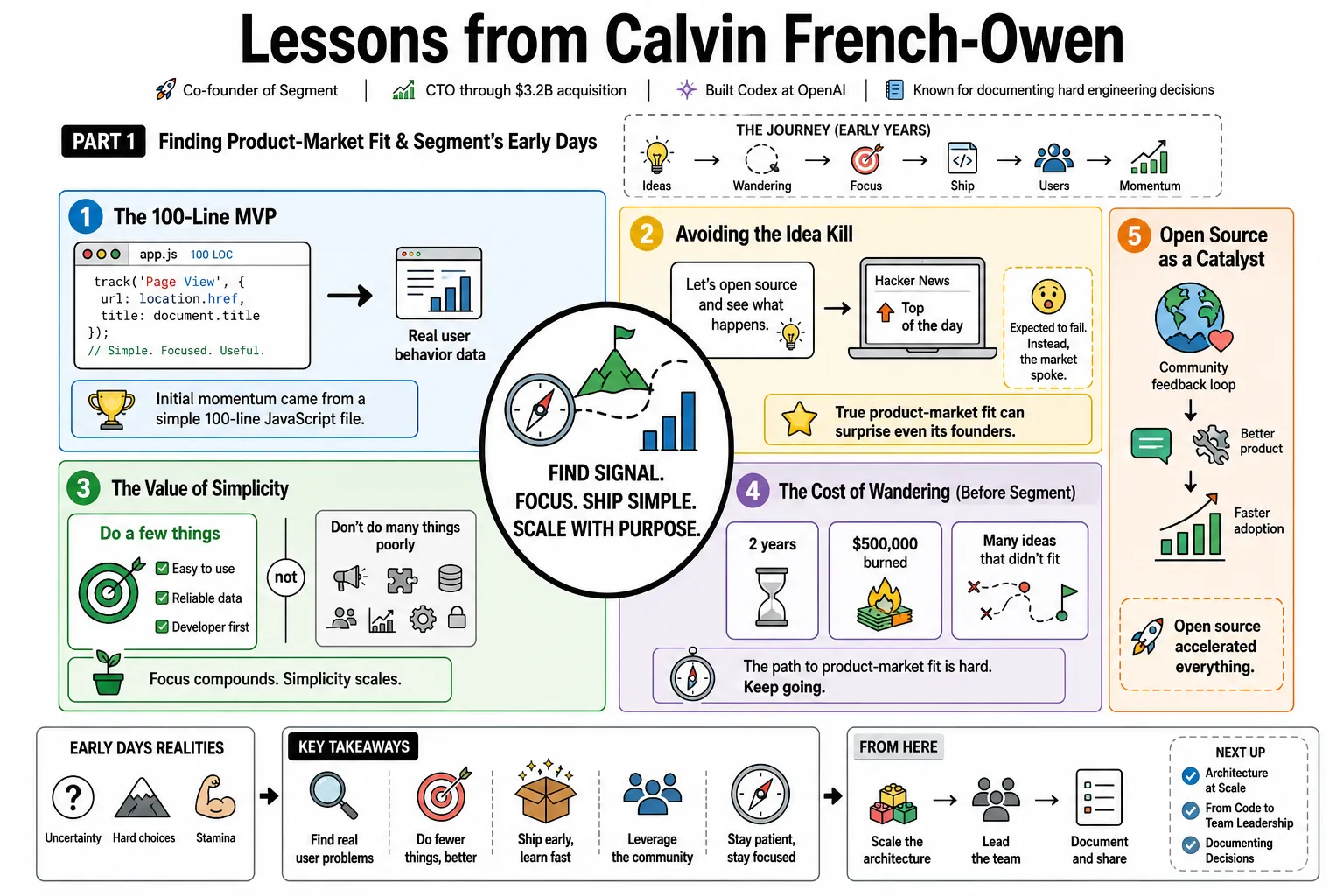
Lessons from Calvin French-Owen
Calvin French-Owen spent 2011 to 2020 growing Segment with his co-founders and worked at OpenAI from 2024 to 2025, helping to launch Codex. — About - Calvin French-Owen.
Part 1: Finding Product-Market Fit & Segment's Early Days
- On Moments With Teammates: Calvin French-Owen: "I've read about a concept in so many business books that it almost feels clichéd to say it, but the thing I'll remember most about Segment are the moments spent with all of my teammates." — A new adventure.
- On Not Needing a Fancy Algorithm: Calvin French-Owen: "More often than not, you don’t need a fancy new algorithm that runs in O(log n) time, a constant-sized data structure, or even a cutting-edge database." — Great products don’t require permission.
- On Moving Without Goals: Calvin French-Owen: "We moved ahead in various (often random) directions, and we would launch features consistently... but we never really set goals at all." — Lessons for early stage founders.
- On Highlighting Surprise: Calvin French-Owen: "The best pitches I hear explicitly focus on the unexpected." — High Bit-rate People.
- On Getting Developers Up and Running Quickly: Calvin French-Owen: "Whether it’s a building a prepackaged binary or writing high quality client libraries, doing a little extra work to get developers up and running quickly can make a huge difference in adoption." — What 10gen nailed with MongoDB.
- On One of the Best Moves: Calvin French-Owen: "In reflecting on the year, I think it was one of the best moves I've ever made." — Reflections on OpenAI.
- On Getting Your First Customers: Calvin French-Owen: "If you don't yet have product-market fit, your goal should probably be getting your first 3-5 customers using the product." — Lessons for early stage founders.
- On a Bias to Action: Calvin French-Owen: "There's a strong bias to action (you can just do things)." — Reflections on OpenAI.
Part 2: The "Layers of Insight" Framework
- On Listening and Showing You Listen: Calvin French-Owen: "Getting there requires two key skills: 1) actually listening to the business needs and 2) demonstrating that you’re listening." — How to sell a B2B product.
- On the ROI Story: Calvin French-Owen: "Saying “we have a better UI” doesn’t really paint the ROI story that you need." — How to sell a B2B product.
- On the Buyer Versus the User: Calvin French-Owen: "I think there’s a simpler, but easily forgotten explanation: a product’s UX will match the buyer, not necessarily the user." — UX doesn’t end with the user.
- On Lessons From 10gen: Calvin French-Owen: "If you’re looking for lessons in building a developer-focused product, you should look no further than 10gen’s decisions with MongoDB." — What 10gen nailed with MongoDB.
- On a Getting-Started Tutorial: Calvin French-Owen: "A prominently displayed and easy to follow “getting started” tutorial won’t annoy your veteran developers as much as it can help the newbies." — What 10gen nailed with MongoDB.
- On the People Who Work There: Calvin French-Owen: "If I believed it before, I believe it more strongly than ever now: the most important aspect of any company are the people who work there." — A new adventure.
- On Speed in College CS: Calvin French-Owen: "In my college CS classes, I always thought that speed was the most important part of software." — Great products don’t require permission.
- On Where Growth Came From: Calvin French-Owen: "Yet of all the things we’ve learned, the biggest lesson has come from how we’ve found our growth." — Great products don’t require permission.
- On Who Has the Biggest Problem: Calvin French-Owen: "Lesson learned: the people you happen to be talking to now are probably not the people who have the biggest problem in your space." — Lessons for early stage founders.
Part 3: Strong-Link vs. Weak-Link Problems
- On Strong-Link Problems: Calvin French-Owen: "I recently stumbled upon Adam Mastroanni's post on strong-link problems, and realized that it's the perfect framework for thinking about this shift." — Upsides and Downsides.
- On Variance and Outliers: Calvin French-Owen: "When you have a strong-link problem, you increase variance because you benefit from outliers." — Upsides and Downsides.
- On Weak-Link Problems: Calvin French-Owen: "Weak-link problems are solved by eliminating failure in all dimensions–it's why the FDA puts standards on the internal temperature of your meat or why you might study the p95 latency of an endpoint." — Upsides and Downsides.
- On Balancing Production Needs and Incubating Labs: Calvin French-Owen: "Founders need to simultaneously balance the 'production-grade' infrastructure needs of their existing customers while incubating the high-variance labs to launch the next big product." — Upsides and Downsides.
- On Late Adopters: Calvin French-Owen: "The early adopters who once valued variance are replaced by late adopters who care about minimizing risk." — Upsides and Downsides.
- On Decreasing Variance: Calvin French-Owen: "When you have a weak-link problem, you decrease variance because outliers will destroy you." — Upsides and Downsides.
- On Stalling at $5-10M: Calvin French-Owen: "Making this change can be really difficult–revenue stalls at 5-10m, product velocity falls off a cliff, churn is up." — Upsides and Downsides.
- On Products That Need No Permission: Calvin French-Owen: "For B2B companies, the most valuable products more or less offer a single value prop: you don’t need to ask permission to get your job done." — Great products don’t require permission.
Part 4: Monoliths vs. Microservices
Part 5: The CTO Transition & Scaling Teams
- On the Early Meaning of CTO: Calvin French-Owen: "In the early days, CTO is more or less equivalent to 'the most technical co-founder' (that's how we decided the title, anyway)." — From Founder to CTO.
- On Thinking About the CTO Role From First Principles: Calvin French-Owen: "Most of the founders I talk with fixate on the title of CTO, and don't think from first principles about why it should exist in the first place." — From Founder to CTO.
- On Running Toward the Fire: Calvin French-Owen: "I've seen a lot of founders who constantly embrace important (but perhaps unexciting) problems at the company and run towards the fire." — From Founder to CTO.
- On Synthesizing Feedback: Calvin French-Owen: "One of the most valuable things you can do in this role is synthesize it and make sure that feedback makes its way back to the product teams." — From Founder to CTO.
- On Embracing Mini-Games: Calvin French-Owen: "The best founders I know don't run away from this constant 'series of mini-games', they embrace it." — From Founder to CTO.
- On Writing Down How You Feel After an Exit: Calvin French-Owen: "My friend James (who sold his company in 2014) gave me a key piece of advice: take a moment to write down how you're feeling, because the next month will feel like a blur." — A new adventure.
- On Reproducible Systems: Calvin French-Owen: "In every part of the business, you want to create reproducible systems." — Write..
- On Not Hiring the People You Need: Calvin French-Owen: "If you have 24 months of runway, and a clear list of things you’d do if you had more copies of yourself: you probably aren't spending time to hire the people you need." — Lessons for early stage founders.
- On Hiring for Archetypes: Calvin French-Owen: "Remember, you can always hire someone to fill any one of these archetypes." — From Founder to CTO.
Part 6: Lessons from OpenAI & High-Intensity Execution
- On the Power of a Sidebar: Calvin French-Owen: "I've never seen a product get so much immediate uptick just from appearing in a left-hand sidebar, but that's the power of ChatGPT." — Reflections on OpenAI.
- On Frightening Ambition: Calvin French-Owen: "OpenAI is perhaps the most frighteningly ambitious org I've ever seen." — Reflections on OpenAI.
- On Direction Versus Coordination: Calvin French-Owen: "Nobody needed much direction, but we did need a decent amount of coordination." — Reflections on OpenAI.
- On Everything Running on Slack: Calvin French-Owen: "An unusual part of OpenAI is that everything, and I mean everything, runs on Slack." — Reflections on OpenAI.
- On Researchers as Mini-Executives: Calvin French-Owen: "Andrey (the Codex lead) used to tell me that you should think of researchers as their own 'mini-executive'." — Reflections on OpenAI.
- On Practical Versus Theoretical AI Risks at OpenAI: Calvin French-Owen: "Given the nature of OpenAI, I saw more focus on practical risks (hate speech, abuse, manipulating political biases, crafting bio-weapons, self-harm, prompt injection) than theoretical ones (intelligence explosion, power-seeking)." — Reflections on OpenAI.
- On Scaling a Codebase: Calvin French-Owen: "I learned a lot about how to scale a codebase based upon the number of developers contributing to it." — Reflections on OpenAI.
- On Walking the Walk: Calvin French-Owen: "The thing that I appreciate most is that the company is that it 'walks the walk' in terms of distributing the benefits of AI." — Reflections on OpenAI.
- On the Future of Programming: Calvin French-Owen: "Over the long arc of time, I do believe most programming will look more like Codex." — Reflections on OpenAI.
Part 7: AI-Native Development & Tools for Thought
- On Reaching for the Best Models: Calvin French-Owen: "When doing coding work, I almost always reach for the most expensive and capable models (Fable 5, 5.6 Sol)." — Small Models Have Arrived.
- On the Manager Role With LLMs: Calvin French-Owen: "The manager should be responsible for clearly describing the problem, setting the team goals, defining guardrails, and being specific about what 'good' looks like." — How much of a manager are you?.
- On the Thinking Budget: Calvin French-Owen: "If you accept this idea of a thinking budget, it's easy to understand why engineers might have very different experiences (positive and negative) using the different tools." — You Still Need to Think.
- On Where Humans Add Value: Calvin French-Owen: "Until we deploy tools for doing search across the organization, eliciting info from the user, and understanding the global context of an org–providing the right context still seems to be the area where humans can provide the most value." — You Still Need to Think.
- On Augmenting Yourself With LLMs: Calvin French-Owen: "Fundamentally, I think a lot of success or failure comes down to exactly how you as an engineer choose to augment yourself with LLMs." — How much of a manager are you?.
- On Not Reading Every Line of Every PR: Calvin French-Owen: "Cursor Bugbot and Codex Code Review -- I still spot-check the code, and make sure I understand it from an architecture level, but increasingly I am not reading every line of every PR." — Coding Agents in Feb 2026.
- On a Single Workflow: Calvin French-Owen: "I think it's unlikely that a 'single workflow' will satisfy all users." — You Still Need to Think.
- On Scaling Context Management: Calvin French-Owen: "To get models to solve harder and harder tasks that run for increasing amounts of time, you need to figure out how to scale that context management." — The Oracle and the Firm.
Part 8: Goal Setting, Focus, & Operations
- On the Number One Startup Mistake: Calvin French-Owen: "This sounds incredibly boring... but the #1 mistake I see startups making is that they don’t set goals." — Lessons for early stage founders.
- On Deadlines and Metrics: Calvin French-Owen: "Just set a deadline when you want to have something done and a metric you want to move or some other concrete result." — Lessons for early stage founders.
- On High Bit-Rate Communication: Calvin French-Owen: "As a founder, you want to strive for what I call 'high bit-rate' communication." — High Bit-rate People.
- On Updates That Take Too Long: Calvin French-Owen: "If it takes you more than 1-2h to put together an update on the most important things happening at the company, it's probably a sign that you should be doing more thinking about the big picture." — Lessons for early stage founders.
- On Tying Work Back to a Business Objective: Calvin French-Owen: "Tie back to a business objective: at the end of the day, businesses traditionally value just a handful of things: increased revenue, decreased cost, reduced risk, or time to outcome." — How to sell a B2B product.
- On Setting Goals for Where You Want to Be: Calvin French-Owen: "If you take one thing from this post, it's that you should set goals for where you want to be." — Lessons for early stage founders.
- On Writing Updates: Calvin French-Owen: "Simply writing the updates should clarify your own thinking tremendously." — Lessons for early stage founders.
- On What Matters in a Note System: Calvin French-Owen: "I've now come to believe that the only thing that matters is whether your system causes you to have better (and probably more) thoughts." — How I Use Obsidian.
- On a High-Level Synthesis: Calvin French-Owen: "My weekplan is never exhaustive to the point of sharing every little thing, but rather is a high-level synthesis of the areas I’m working on." — The Secret of the Weekplan.