Cameron McCord is the co-founder and CEO of Nominal and began his career as a submarine officer. — Crossing the Valley, Ep. 83: Nominal.
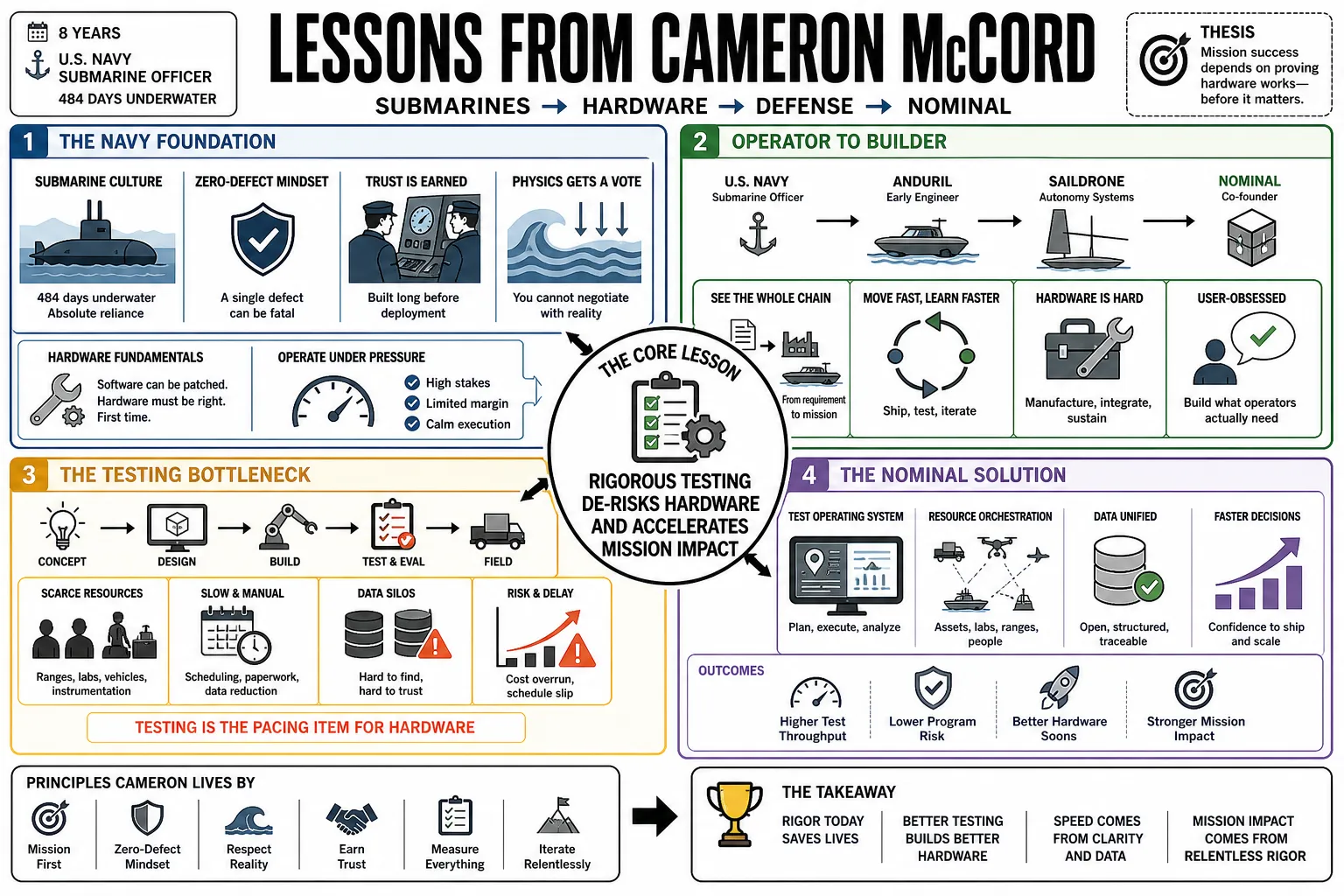
Part 1: The Navy Foundation
- On Doing Incredible Things With Limited Technology: Cameron McCord: "The first part of my career was spent as a submarine officer, being a true operator in the Navy, embracing the mentality of doing incredible things with limited and sometimes outdated technology." — Building the Base Episode 31: Biz Peabody, Chief of Staff at Shield AI, Cameron McCord, Co-Founder and CEO at Nominal, and Akhil Iyer, Vice President at Shield Capital | Business Executives for National Security.
- On Everything Having to Come Together: Cameron McCord: "Even if you’re the person that’s turning a wrench on a pump, if you don’t do your job, the team could be at risk because everything has to come together." — Startup lessons Silicon Valley won’t teach you | Cameron McCord (Co-founder of Nominal).
- On Being Direct in Conflict: Cameron McCord: "I think a second one that really comes to mind is being direct in conflict, direct in disagreement." — Startup lessons Silicon Valley won’t teach you | Cameron McCord (Co-founder of Nominal).
- On the Toughest Days: Cameron McCord: "I think the toughest days really were when I had to ask my team of sailors, to do frankly, the impossible with, limited time and resources." — Startup lessons Silicon Valley won’t teach you | Cameron McCord (Co-founder of Nominal).
- On Complex, Interconnected Systems: Cameron McCord: "I think it’s true that the International Space Station is number one, and then submarines are number two, in terms of some generic metric of like the most complex interconnected systems we’ve built, and things break all the time." — Startup lessons Silicon Valley won’t teach you | Cameron McCord (Co-founder of Nominal).
- On Legislation Not Being Zero-Sum: Cameron McCord: "I think to get any legislation done and people always think about one side of the aisle, Democrats, Republicans always arguing and always zero-sum, but it’s actually not." — Startup lessons Silicon Valley won’t teach you | Cameron McCord (Co-founder of Nominal).
- On Humans Being the Limiting Factor: Cameron McCord: "I’ve stayed up for I think over 30 hours a couple of times because humans are the limiting factor on a submarine." — Startup lessons Silicon Valley won’t teach you | Cameron McCord (Co-founder of Nominal).
Part 2: The Hardware Bottleneck
- On Purpose-Built Tools: Cameron McCord: "It’s a lot of non-purpose built software that’s been assembled together to sort of try to accomplish all these different functions that hardware engineers need to go through." — Startup lessons Silicon Valley won’t teach you | Cameron McCord (Co-founder of Nominal).
- On Testing Being Iterative: Cameron McCord: "I think the other answer, though, is just that testing is by definition iterative." — Physics Gets a Vote: Nominal Cofounders on Hardware Development in an AI World (Sequoia Capital podcast transcript).
- On the Status Quo in Test Data: Cameron McCord: "I think this sort of status quo in the industry for test data management is pretty shocking." — Physics Gets a Vote: Nominal Cofounders on Hardware Development in an AI World (Sequoia Capital podcast transcript).
- On the Know-How Gap: Cameron McCord: "I think though, the know-how, the education, the understanding of how to build some of these systems, that is the thing that we are really suffering from." — Startup lessons Silicon Valley won’t teach you | Cameron McCord (Co-founder of Nominal).
- On Building for the Test Engineer: Cameron McCord: "We've really built with that North Star of what is it that a test engineer or technician or systems engineer does on a daily basis, and how can we make that 10x or 100x better?" — From Submariner to CEO: Cameron McCord's Journey Building Nominal.
Part 3: Building "Software-Defined Hardware"
- On a Coming Period of Hardware Testing: Cameron McCord: "I have a thesis that actually I think that we’re entering a period where there is going to be much more—obviously I believe this from a business perspective, but much more hardware testing." — Physics Gets a Vote: Nominal Cofounders on Hardware Development in an AI World (Sequoia Capital podcast transcript).
- On GitHub as an Analogy: Cameron McCord: "I think if you look back at core software development and you think about what kind of happened over the past two decades, I think one really good way to think about it is actually talking about GitHub as an example." — Physics Gets a Vote: Nominal Cofounders on Hardware Development in an AI World (Sequoia Capital podcast transcript).
- On How Little We Know About Physical Systems: Cameron McCord: "I think we are coming to grasp with how little we actually understand about how physical systems operate in the world, and how lacking we are from a data perspective." — Physics Gets a Vote: Nominal Cofounders on Hardware Development in an AI World (Sequoia Capital podcast transcript).
- On the Infrastructure Layer: Cameron McCord: "I think so much of it is the infrastructure layer is still not fully there." — Startup lessons Silicon Valley won’t teach you | Cameron McCord (Co-founder of Nominal).
- On Leapfrogging Stages: Cameron McCord: "I think a lot of people are trying to see if they can leapfrog some of those stages, just build foundational models, build engineering and physics models of the world." — Startup lessons Silicon Valley won’t teach you | Cameron McCord (Co-founder of Nominal).
Part 4: The Defense Technology Gap
- On Who Holds the Dollars: Cameron McCord: "Someone has to have dollars for it and that person, they are never the end user and they’re often never even connected to the end user." — Startup lessons Silicon Valley won’t teach you | Cameron McCord (Co-founder of Nominal).
- On Supply Chains and Onshoring: Cameron McCord: "I think what that does is it is forcing lots of countries to think about their own supply chains and to onshore and prepare for their ability to scale production." — Startup lessons Silicon Valley won’t teach you | Cameron McCord (Co-founder of Nominal).
- On Dual-Use Businesses: Cameron McCord: "I think in most instances, building a dual-use business, both a joint commercial and federal business at the same time and in the early stages, is a bad idea." — Startup lessons Silicon Valley won’t teach you | Cameron McCord (Co-founder of Nominal).
- On Embracing Commercial Testing Technology: Cameron McCord: "I think there's a lot of really best in class commercial technology here around testing and T and E that I'd love to see just more widely embraced and adopted, all under the theme of, how do we not have testing be looked at as a bureaucratic piece of red tape that slows down getting capability to the warfighter." — From Submariner to CEO: Cameron McCord's Journey Building Nominal.
- On Reindustrialization: Cameron McCord: "I think reindustrialization more broadly, more money is going into building hardware products really rapidly, particularly in an area where we’re very prevalent in, which is in aerospace and defense." — Physics Gets a Vote: Nominal Cofounders on Hardware Development in an AI World (Sequoia Capital podcast transcript).
Part 5: Missionaries Over Mercenaries
- On People Who Are Three Layers Deep: Cameron McCord: "I have this framing I call like, we want people at Nominal that are three layers deep." — Startup lessons Silicon Valley won’t teach you | Cameron McCord (Co-founder of Nominal).
- On Loving the Work of Storytelling: Cameron McCord: "You have to have an exciting idea, something that's you're passionate about, like you really have to love, just like the nitty gritty process of, like, telling a story, trying to convince people to join your like crazy expedition, thriving in ambiguity." — From Submariner to CEO: Cameron McCord's Journey Building Nominal.
- On Building a Company as a Marathon: Cameron McCord: "I think there’s some learning in there as well, which is like building a company is a marathon." — Startup lessons Silicon Valley won’t teach you | Cameron McCord (Co-founder of Nominal).
- On Standing the Night Watch: Cameron McCord: "I call it a Nominal, sometimes safe hands, but the biggest gift and frankly a thing I think you look for in talent and recruiting is people that are fit to stand the night watch." — Startup lessons Silicon Valley won’t teach you | Cameron McCord (Co-founder of Nominal).
- On Feedback as a Gift: Cameron McCord: "I think feedback is a gift, and I think that directness is a gift, and the amazing people that want to do that and can receive it well will perform so much better." — Startup lessons Silicon Valley won’t teach you | Cameron McCord (Co-founder of Nominal).
- On Drawing the Thread to the Customer: Cameron McCord: "I think it is always worth going the extra mile to draw the thread between the impossible task you’re asking an engineer to do or someone on your team to do and the outcome for a customer." — Startup lessons Silicon Valley won’t teach you | Cameron McCord (Co-founder of Nominal).
- On the CEO Job Early On: Cameron McCord: "I always joke, in the earliest days, I think being the CEO is the least important job." — Startup lessons Silicon Valley won’t teach you | Cameron McCord (Co-founder of Nominal).
- On Earnestness in Leadership: Cameron McCord: "I think I often describe leadership, the earnestness piece to unpack it a little bit more is I think people that are joining an early-stage company as it’s growing, they’re betting on you as a group of founders, you as a CEO to figure it out." — Startup lessons Silicon Valley won’t teach you | Cameron McCord (Co-founder of Nominal).
- On the Inner Dialogue: Cameron McCord: "The moments where you’re lonely, or you’re sad, or you’re scared, or you just feel spent, actually have an inner dialogue with yourself, and I think that you build a muscle there." — Startup lessons Silicon Valley won’t teach you | Cameron McCord (Co-founder of Nominal).
- On Hiring Authentic People: Cameron McCord: "I know that they’re fit to be the Nominal bar, but the thing that I want and I think is so incredible when you assemble it is people that are really, really authentic and have a reason and are in touch with their own understanding of what motivates them." — Startup lessons Silicon Valley won’t teach you | Cameron McCord (Co-founder of Nominal).
Part 6: Lessons from the Vanguard
- On Execution and Clock Speed: Cameron McCord: "I think I saw incredible execution and clock speed and how powerful that can be and living it." — Startup lessons Silicon Valley won’t teach you | Cameron McCord (Co-founder of Nominal).
- On Simulation Versus Testing: Cameron McCord: "I saw the pendulum swing to let’s do everything in simulation, let’s get as early as we can in the design lifecycle." — Physics Gets a Vote: Nominal Cofounders on Hardware Development in an AI World (Sequoia Capital podcast transcript).
- On Capital Intensity: Cameron McCord: "I think it’s capital intensive, it’s difficult to bend metal and steel and electronics." — Physics Gets a Vote: Nominal Cofounders on Hardware Development in an AI World (Sequoia Capital podcast transcript).
- On Kill Criteria: Cameron McCord: "I think the best companies can say, “Six months, here’s some headcount, here’s a product lead, here’s an engineering lead, here’s a thesis, here’s some resourcing, here’s some success criteria.” We call it the double downs or the kill criteria for an effort, and Silicon Valley is made around doing that." — Startup lessons Silicon Valley won’t teach you | Cameron McCord (Co-founder of Nominal).
- On Moving Fast Where Stakes Are High: Cameron McCord: "I think you do have to find the right areas where you push back on the move fast and break things in a mentality of software speed because the stakes are so high." — Startup lessons Silicon Valley won’t teach you | Cameron McCord (Co-founder of Nominal).
Part 7: The Data Infrastructure Playbook
- On No-Code Access to Data: Cameron McCord: "You build no-code, low-code solutions, so you don’t have to be a PhD in avionics to access the data coming off of your system." — Startup lessons Silicon Valley won’t teach you | Cameron McCord (Co-founder of Nominal).
- On Standardizing Hardware: Cameron McCord: "We’ve been able to, I think, leverage the fact that the industrial and hardware sector is standardizing." — Startup lessons Silicon Valley won’t teach you | Cameron McCord (Co-founder of Nominal).
- On Slow Cloud Adoption: Cameron McCord: "Really, I think the industry was really slow to adapt to embracing the cloud and collaboration." — Startup lessons Silicon Valley won’t teach you | Cameron McCord (Co-founder of Nominal).
Part 8: Leadership and Execution
- On Saying No: Cameron McCord: "I think is a really, really like it's hard, it's hard, as an entrepreneur, to say no, but it's, it's massively clarifying for the team." — From Submariner to CEO: Cameron McCord's Journey Building Nominal.
- On Being Comfortable in Your Own Head: Cameron McCord: "Being comfortable in your own head I think is so powerful, and is the biggest gift I can give to Nominal, is knowing that I’m kind of comfortable in my own head." — Startup lessons Silicon Valley won’t teach you | Cameron McCord (Co-founder of Nominal).
- On Fielding Hardware Faster: Cameron McCord: "People are trying to build and field hardware products faster than they ever have before." — Physics Gets a Vote: Nominal Cofounders on Hardware Development in an AI World (Sequoia Capital podcast transcript).
- On Learning From Failure Data: Cameron McCord: "SpaceX did that to an extreme, where they're quite literally willing to blow up rockets on the launch pad, assuming that they get data from it." — From Submariner to CEO: Cameron McCord's Journey Building Nominal.
- On Sequencing Customers: Cameron McCord: "Once you have so many potential customers, I think there is an art to just sequencing and understanding the moment in time when customers are ready to receive your product or your services." — Startup lessons Silicon Valley won’t teach you | Cameron McCord (Co-founder of Nominal).
- On Falling in Love With the Process: Cameron McCord: "I think the simplest explanation I can give is, I think, as an entrepreneur and founder, you have to fall in love with the process, the technology and the idea that you have, like, it will change over time." — From Submariner to CEO: Cameron McCord's Journey Building Nominal.
- On Doing One Thing Ten Times Better: Cameron McCord: "I think sometimes people, they try and boil the ocean and that’s great for the early fundraising slides, but in practice, you need to do something 10 times better than the current way." — Startup lessons Silicon Valley won’t teach you | Cameron McCord (Co-founder of Nominal).
- On Executing on Multiple Bets: Cameron McCord: "I tell the company a lot that I think what makes a legendary or a generational company, and I think I learned and saw it Applied Intuition, is the best companies are always executing on multiple, I call them epochs, time horizons, eras." — Startup lessons Silicon Valley won’t teach you | Cameron McCord (Co-founder of Nominal).