Charlie Sutton is Atlassian’s chief design officer. His earlier design work spans Nokia, Apple, and Meta, including mobile and immersive interfaces; at Atlassian he now focuses on coherent experiences for people and AI agents. — Tech Talks Daily — Charlie Sutton Interview.
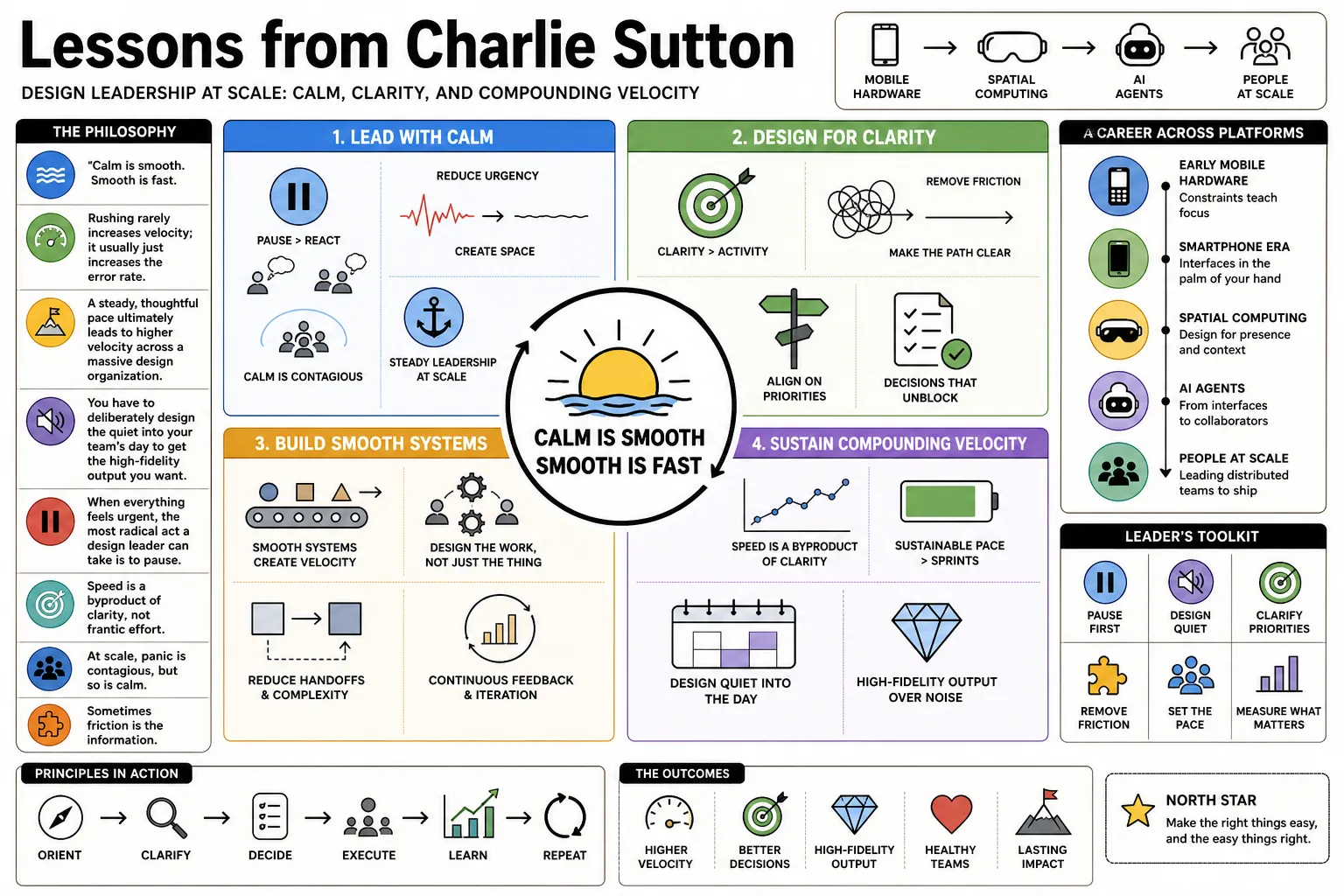
Part 1: The Philosophy of Calm and Speed
- Calm and Pace: Sutton uses “calm is smooth, smooth is fast” to describe a deliberate response to rapid AI change: think deeply and maintain an even keel while still moving quickly. — All Things Design — Charlie Sutton Interview.
- Avoid Reactive Work: In fast-changing design work, Sutton urges teams not to react to every new development in a panic; calm reflection can coexist with rapid experimentation. — All Things Design — Charlie Sutton Interview.
- Keep an Even Keel: Sutton warns that rapid changes can create a panicked team mindset and says designers should stay calm and think deeply. — All Things Design — Charlie Sutton Interview.
- Remove Unproductive Friction: Sutton and Crisan distinguish the productive mess of collaboration from busywork, duplication, and tool sprawl that design should reduce. — Atlassian — Designing for Modern Work.
- Plan Before Producing: Sutton argues for shared goals and more planning, strategy, and ideation before rapidly generating code or prototypes. — theCUBE — Charlie Sutton at Team ’26.
Part 2: Defining and Solving People Problems
- Frame People Problems: Sutton’s People Problems Framework is presented as a way to simplify product decisions and align the functions involved around the problem being solved. — RETHINK — The People Problems Framework.
- Observe Implicit Needs: Sutton says customers may not explicitly request what would help them; observing work habits and rituals can reveal useful product opportunities. — theCUBE — Charlie Sutton at Team ’26.
Part 3: Leading Distributed Design and Team Anywhere
- Design for Distributed Work: Atlassian’s Team Anywhere approach allows eligible employees to choose where they work and uses intentional gatherings alongside distributed collaboration. — Atlassian — Team Anywhere.
- Make Togetherness Deliberate: Sutton describes deliberate regional and product-team gatherings rather than assuming that simply bringing people into an office will build culture. — All Things Design — Charlie Sutton Interview.
- Build Culture When Together: Sutton says in-person meetings and offsites need an intentional culture-building program; attendance alone is not enough. — All Things Design — Charlie Sutton Interview.
- Develop Digital Presence: Sutton treats clear digital presence and asynchronous communication as skills for everyone, regardless of whether their company is formally remote-first. — All Things Design — Charlie Sutton Interview.
- Study Distributed Work: Atlassian’s Team Anywhere Lab studies how intentional in-person gatherings affect team connection and collaboration; this is a company program, not Sutton’s personal quotation. — Atlassian — Intentional Togetherness Research.
Part 4: Craft, Rituals, and Design Systems
- Make Rituals Meaningful: Sutton says rituals matter for teams of five, fifty, or five hundred; leaders should notice habitual interactions and make them intentional and meaningful. — All Things Design — Charlie Sutton Interview.
- Treat Design Systems as Shared Infrastructure: Sutton distinguishes a design system from a style guide and emphasizes scalable components, adoption, and designers contributing improvements back to the system. — All Things Design — Charlie Sutton Interview.
- Keep the System Adaptable: Sutton argues that a design system must allow contributions and useful variation rather than become so inflexible that teams avoid it. — All Things Design — Charlie Sutton Interview.
- Lead Through Cohesion: As Atlassian’s CDO, Sutton describes making many apps, interfaces, and documents feel like one coherent experience across a large team. — Tech Talks Daily — Charlie Sutton Interview.
- Prototype to Share Ideas: Sutton describes AI-enabled prototypes as a shared language that lets colleagues react to a concrete idea rather than wait for a specialist to visualize it. — Tech Talks Daily — Charlie Sutton Interview.
- Work Close to the Code: Sutton says designers should understand the material of their craft—today including code and agents—and can increasingly prototype or propose changes in code themselves. — theCUBE — Charlie Sutton at Team ’26.
Part 5: The Immersive Canvas and Spatial Design
- Design Beyond Rectangles: Sutton’s VR talk anticipates a larger, more immersive and distributed canvas beyond conventional screens, including interfaces that may act autonomously. — Mind the Product — Designing for Virtual Reality.
- Use Cinematic Craft: For immersive interfaces, Sutton’s talk identifies cinematic understanding of environment and mood as one of three useful design skills. — Mind the Product — Designing for Virtual Reality.
- Make Interactions Discoverable: Sutton’s talk calls for interaction or game mechanics that make virtual worlds learnable and discoverable. — Mind the Product — Designing for Virtual Reality.
- Connect VR to Mobility: Sutton’s talk says mobility can provide utility and feasibility to VR interfaces and help make them a more complete experience. — Mind the Product — Designing for Virtual Reality.
- Amplify Agency in VR: In the talk summary, Sutton frames the goal of a media-evoked reality as amplifying people’s sense of control and agency in immersive spaces. — Mind the Product — Designing for Virtual Reality.
- Explore Screen-Zero Interaction: Sutton’s VR talk explores a “screen zero” world in which interaction moves beyond constrained screens toward immersive, media-evoked experiences. — Mind the Product — Designing for Virtual Reality.
Part 6: Designing for the Age of Agents
- Give Humans and Agents Clear Goals: Sutton says human colleagues and AI agents both work better when they understand the goal and have the context to pursue it. — theCUBE — Charlie Sutton at Team ’26.
- Articulate Goals Explicitly: Sutton warns that leaders who communicate goals poorly disadvantage both their people and their agents. — theCUBE — Charlie Sutton at Team ’26.
- Share Organizational Context: Sutton argues that an open organization’s willingness to share context increases what agents can use to help teams. — theCUBE — Charlie Sutton at Team ’26.
- Connect Work through the Graph: Sutton describes Atlassian’s Teamwork Graph as connecting organizational context so designers and agents can work from shared goals, boundaries and knowledge. — Tech Talks Daily — Charlie Sutton Interview.
- Build Trust with Permissions: Sutton describes permissions in the Teamwork Graph as a technical foundation of trust: agents should not expose information a user cannot see or share. — theCUBE — Charlie Sutton at Team ’26.
- Show the Agent’s State: Sutton says showing reasoning and machine state helps users understand an agent’s operation and build trust, rather than receiving an unexplained result. — theCUBE — Charlie Sutton at Team ’26.
- Make Design Systems Agent-Usable: Sutton says Atlassian optimized its design system for agent consumption to reduce token costs and improve prototype efficiency. — theCUBE — Charlie Sutton at Team ’26.
- Observe Work Rituals: Sutton points to a morning brief as an example of designing for implicit human rhythms instead of treating workers as constant-notification machines. — theCUBE — Charlie Sutton at Team ’26.
- Balance Personalization and Cohesion: Sutton says AI design must reconcile personalized experiences with a consistent shared environment so colleagues can still work together. — Tech Talks Daily — Charlie Sutton Interview.
Part 7: The Human Tax and Multimodal Delegation
- Reduce Fractured Attention: Sutton identifies fractured attention and the work of translating between different ways of thinking as sources of cognitive load in modern teams. — theCUBE — Charlie Sutton at Team ’26.
- Free Specialists from Overhead: Sutton suggests agents can take on some knowledge-work overhead and let people focus more on their specialized craft. — theCUBE — Charlie Sutton at Team ’26.
- Support Multiple Modalities: Sutton says text-only prompting loses context for many people; audio, video, text, visual and direct manipulation can make AI interaction more natural. — theCUBE — Charlie Sutton at Team ’26.
- Design for Delegation: Sutton compares assigning work to agents with delegating to people: both need clear goals, success criteria and appropriately sized tasks. — Tech Talks Daily — Charlie Sutton Interview.
- Transform Content into Useful Forms: Sutton cites Confluence Remix as an example of turning a long written page into an infographic for people who understand information better visually. — theCUBE — Charlie Sutton at Team ’26.
- Treat Forty Percent as His Example: Sutton estimates that only about 40% of his own day is spent designing; he suggests agents could free more time for that specialist work. — theCUBE — Charlie Sutton at Team ’26.
- Recognize the Rising Floor: Sutton says generative tools raise the baseline: more people can now produce a reasonable first prototype. — theCUBE — Charlie Sutton at Team ’26.
- Design for the Higher Ceiling: Sutton says easier prototyping also raises expectations for excellent experiences, so designers should focus on the new ceiling rather than only the baseline. — theCUBE — Charlie Sutton at Team ’26.
Part 8: The Evolving Role of the Designer
- Keep User Agency Visible: Sutton names agency and control—including the ability to delete a memory—as essential trust principles when AI acts on someone’s behalf. — Tech Talks Daily — Charlie Sutton Interview.
- Make Systems Legible to Agents: Sutton describes adapting design-system information for agent consumption to make generated prototypes more efficient and consistent. — theCUBE — Charlie Sutton at Team ’26.
- Design for Control and Recoverability: Sutton says trustworthy AI interfaces should show their state, preserve user control, and avoid destructive actions without safeguards. — Tech Talks Daily — Charlie Sutton Interview.
- Unify a Complex Product Family: Sutton says Atlassian design should make shared interactions consistent across products while retaining differences required by each context. — Tech Talks Daily — Charlie Sutton Interview.
- Pause Amid Rapid Change: Sutton acknowledges rapid and conflicting views about design’s future and favors taking a breath to examine the changing craft rather than reacting to every claim. — Tech Talks Daily — Charlie Sutton Interview.