Cedric Chin writes Commoncog, a publication dedicated to the serious study of business, with the tagline "Ideas and cases to accelerate business expertise". — Optimise for Usefulness - Commoncog.
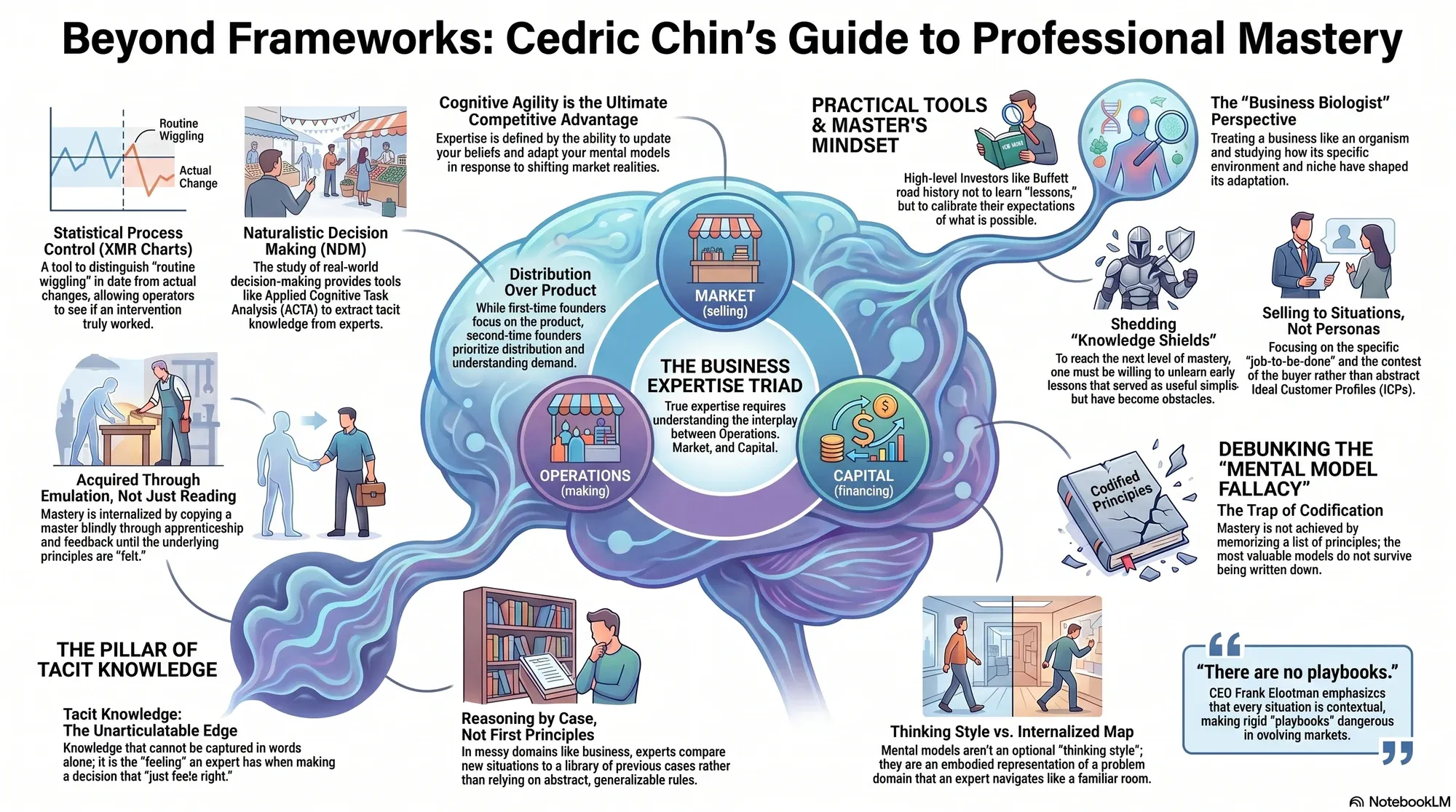
On Tacit Knowledge and the Limits of Frameworks
- On the nature of tacit knowledge: cedric-chin: "Tacit knowledge is knowledge that cannot be captured through words alone." — Why Tacit Knowledge is More Important Than Deliberate Practice.
- How tacit knowledge is acquired: cedric-chin: "Tacit knowledge instruction happens through things like imitation, emulation, and apprenticeship. You learn by copying what the master does, blindly, until you internalise the principles behind the actions." — Why Tacit Knowledge is More Important Than Deliberate Practice.
- The illusion of simple explanations: cedric-chin: "If you ever hear someone explaining things in terms of a long list of caveats, the odds are good that you're looking at tacit knowledge in action." — Why Tacit Knowledge is More Important Than Deliberate Practice.
- On Equal Confidence Without Expertise: cedric-chin: "The confidence produced by expert intuition will feel equally strong in cases where you have real expertise, and in cases where you do not." — Mental Models: Expert Decision Making - Commoncog.
- On Why Frameworks Compel Us: cedric-chin: "Frameworks are so compelling to the human mind because the mind is a sense-making tool, and sense-making tools abhor not making sense of information." — Reality Without Frameworks - Commoncog.
- On first principles in messy domains: cedric-chin: "Experts in ill-structured domains reason by comparison to previous cases, not by reference to first principles." — How Note Taking Can Help You Become an Expert.
- Context is king: cedric-chin: "You can't easily reduce cases in ill-structured domains into generalisable principles. You often have to treat the case as its whole thing." — How Note Taking Can Help You Become an Expert.
- On Advice That May Not Work for You: cedric-chin: "Understand that even if you take advice from a believable person, the technique that the person explains to you is not guaranteed to work for you." — A Small Update to Commonplace's Principles - Commoncog.
- The limits of deliberate practice: cedric-chin: "Deliberate practice can only exist in fields like music and math and chess." — Why Tacit Knowledge is More Important Than Deliberate Practice.
- The alternative to deliberate practice: cedric-chin: "The process of learning tacit knowledge looks something like the following: you find a master, you work under them for a few years, and you learn the ropes through emulation, feedback, and osmosis — not through deliberate practice." — Why Tacit Knowledge is More Important Than Deliberate Practice.
On Mental Models and True Expertise
- The Mental Model Fallacy: cedric-chin: "Successful, effective people make good decisions and achieve successful outcomes in life because they have better mental models. Therefore, the secret to achieving successful outcomes in business and in life is to distill their mental models into written principles, and then learn them." — The Mental Model Fallacy.
- The most valuable models are tacit: cedric-chin: "The most valuable mental models do not survive codification. They cannot be expressed through words alone." — The Mental Model Fallacy.
- Expertise is about building embodied models: cedric-chin: "an embodied model of a company, a place that he can navigate in his mind as surely as you or I might navigate a room." — The Mental Model Fallacy.
- Mental models are not optional: cedric-chin: "Mental models aren't something that we can choose to use. They're not a 'thinking style'. They are at the very heart of how we function as human beings." — Putting Mental Models to Practice Part 5: Skill Extraction.
- The purpose of a mental model: cedric-chin: "simplified representation of the most important parts of some problem domain that is good enough to enable problem solving." — The Mental Model FAQ.
- On Richer Frames: cedric-chin: "The better you are at frame construction, the richer your frames, the more capable you will become at dealing with situations you’ve never seen before." — Why Tactical Decision Games Work - Commoncog.
On Business Expertise and Decision-Making
- On Changes Across the Triad: cedric-chin: "As DiBello mentions, the key property of business expertise is in understanding how a change in one leg of the triad affects the other two legs, at least within the context of one’s specific industry." — A Tacit Mental Model of Business Expertise - Commoncog.
- It's about the interactions: cedric-chin: "The best businesspeople understand the interactions between all three legs of the triad for their specific industry." — Renaming the Business Expertise Triad.
- On Evolving Models in Messy Environments: cedric-chin: "Individuals with higher agility are able to evolve their mental models in messy, delayed-feedback-environments — and draw the right lessons from them." — Business Expertise: The Importance of Cognitive Agility - Commoncog.
- On Infinite Ways to Build a Business: cedric-chin: "The truth is that there are an infinite number of ways to build a profitable, rewarding business, and to adapt that business to your personal goals." — Don't Take Generic Business Advice From VCs - Commoncog.
- The reality of business: cedric-chin: "In business, it’s even more important to pay attention to cases (as instantiations of these concepts) over frameworks, because every situation you will encounter is going to be somewhat unique." — Cases from The Heart of Innovation.
- On Adapting a Process to Your Org: cedric-chin: "You’ll need to adapt it to fit your org, and such adaptation demands that you understand the original conditions the process was originally created for." — Book Summary: Working Backwards - Commoncog.
- The purpose of business: cedric-chin: "the purpose of a business is to create and keep a customer." — Speedrunning the Skill of Demand.
- First-time vs. second-time founders: cedric-chin: "First time founders talk about product, second time founders talk about distribution." — Speedrunning the Skill of Demand.
- On Who Is Believable: cedric-chin: "Believable people are people who have 1) a record of at least three relevant successes and have 2) great explanations of their approach when probed." — Robin Hanson on Ray Dalio - Commoncog.
- On Learners Who Cannot Articulate: cedric-chin: "Most learners were unable to articulate what they’ve learnt, and in many cases, did not actually ‘know’ that they had learnt something new." — Chicken Sexing and Perceptual Learning as a Path to Expertise - Commoncog.
- On Coherence and Lying to Yourself: cedric-chin: "Coherence is the output of good strategy, and it is difficult to lie to yourself if your business has no coherence." — Chaos and Coherence in Business - Commoncog.
- On the Limits of Startup Wisdom: cedric-chin: "Conventional startup wisdom has nothing to say about the SME loop, because growing a business to break out of the SME loop takes at least a decade of work." — Don't Take Generic Business Advice From VCs - Commoncog.
On Learning and Skill Acquisition
- On Assuming the Expert Is Right: cedric-chin: "If you’re a new student learning from a true expert, most of the time the most skilful way to resolve confusion is to assume the expert is right." — Tacit Expertise Extraction, Software Engineering Edition - Commoncog.
- Naturalistic Decision Making (NDM): cedric-chin: "RPD is one of the thinking models from the field of Naturalistic Decision Making (NDM), which is concerned with how practitioners actually make decisions on the job." — Mental Models: Expert Decision Making.
- Applied Cognitive Task Analysis (ACTA): cedric-chin: "Most of NDM’s methods for extracting tacit knowledge are quite involved; over the course of the Tacit Knowledge Series, we covered Applied Cognitive Task Analysis, which was designed to be used by domain practitioners (as opposed to trained expertise researchers)." — Tacit Expertise Extraction, Software Engineering Edition.
- Focus on cues and actions: cedric-chin: "focus primarily on the cues and the actionable strategies that the expert uses" — Putting Mental Models to Practice Part 5: Skill Extraction.
- The power of case studies: cedric-chin: "do a lot of their reasoning by combining fragments of prior cases they've seen." — How Reliance Won.
- On the Value of Reading History: cedric-chin: "The value you get from reading history is the value of calibration: you place events happening today in their proper, historical context." — Reading as the root of career planning - Commoncog.
- On the Strongest Result in a Messy Domain: cedric-chin: "A predictive model that works when tested against reality, by a person with skin in the game, over a multi-decade period, is pretty much the strongest result you can ask for in a messy domain like business." — A Tacit Mental Model of Business Expertise - Commoncog.
- On Non-Practitioner Blogs: cedric-chin: "Don’t read blogs written by non-practitioners, spouting insights that aren’t related to their field of practice." — The Mental Model Fallacy - Commoncog.
- On What Mentors Get Out of It: cedric-chin: "Mentors want to know that the advice they’re giving is actually helping you succeed, and they derive pleasure from your success since they’ve had a hand in it." — Be Good To Your Mentors - Commoncog.
- On Adaptive Expertise as the Highest Form: cedric-chin: "We have learnt the highest form of expertise is adaptive expertise." — Why Tactical Decision Games Work - Commoncog.
- On Never Knowing the Best Decision: cedric-chin: "You have to get used to the fact that you will never know if you are making the best decision, and take action with that sinking feeling in your gut." — This Is What Uncertainty Feels Like - Commoncog.
On Data and Operations
- On Quality as Variation: cedric-chin: "One way to think about this is to think of quality as a problem of variation: bad quality is the result of excessive variation during production." — Making Sense of Deming - Commoncog.
- On Routine Versus Exceptional Variation: cedric-chin: "The process behaviour chart is the easiest way to differentiate between routine and exceptional variation." — Process Behaviour Charts: More Than You Need To Know - Commoncog.
- On Metric Owners: cedric-chin: "Every metric has an owner, and every metrics owner is expected to understand what is normal variation and what is an anomaly." — Book Summary: Working Backwards - Commoncog.
- On Never Being Taught to Read Charts: cedric-chin: "You’ve never been taught to look at operational charts properly, and the bulk of data publications out there somehow skip over this simple challenge." — Becoming Data Driven, From First Principles - Commoncog.
- On Dropping Data as an Input: cedric-chin: "The eventual outcome of all three scenarios is identical: you stop using data as an input to drive decision making." — Becoming Data Driven, From First Principles - Commoncog.
On Mindset and Personal Growth
- On Curiosity in Disagreement: cedric-chin: "Open-minded people are curious when there's a disagreement, because they're aware of the possibility that they might be wrong." — On Lying To Yourself - Commoncog.
- On Received Wisdom Being Limited: cedric-chin: "Anyone who's had any experience running a conventional business would know that received SV wisdom is severely limited." — Don't Take Generic Business Advice From VCs - Commoncog.
- On Breaking Through Knowledge Shields: cedric-chin: "Knowledge shields tell us why learning seems discontinuous when you’re observing someone levelling up in the real world — people are often limited by how quickly they can break through knowledge shields, and leave their old mental models behind." — Business Expertise: The Importance of Cognitive Agility - Commoncog.
- On Replacing Flawed Mental Models: cedric-chin: "Cognitive Transformation Theory tells us that people learn when they replaced flawed mental models with better ones, as a result of trial and error cycles." — Business Expertise: The Importance of Cognitive Agility - Commoncog.
- On Naive Practice: cedric-chin: "Naive practice is the act of doing something repeatedly, with the belief that mere repetition would improve one’s performance." — Book Summary: Peak, the New Science of Expertise - Commoncog.
- On Where Demand Hides: cedric-chin: "If you’re creating a new product, one that has never been sold before, then the recommendation is slightly different: demand hides in the situation." — The Heart of Innovation: Why Most Startups Fail - Commoncog.
- On What Makes LLMs Powerful: cedric-chin: "As a technology, LLMs have certain properties that are very powerful, and are not commonly found in other forms of software." — A Vaccine for Anthropomorphism of AI - Commoncog.
- On Questions Outsiders Cannot See: cedric-chin: "The really interesting questions in a given subject area aren’t obvious to an outsider." — Lessons Learnt From Reading 51 Books in 2018 - Commoncog.
- On Calibrating Against the Past: cedric-chin: "The goal is to calibrate your expectations of how change has happened in the past, so you are not tricked by ungrounded speculation in the present." — How to Improve at Sensemaking AI? - Commoncog.
Learn more: