Chris Lattner created LLVM, led the development of Swift at Apple, and co-founded Modular. Across these projects, he has worked on compiler infrastructure, programming languages and the boundary between software and hardware. This collection examines those approaches rather than treating the existing lessons as evidence for themselves. — Chris Lattner’s Personal Site.
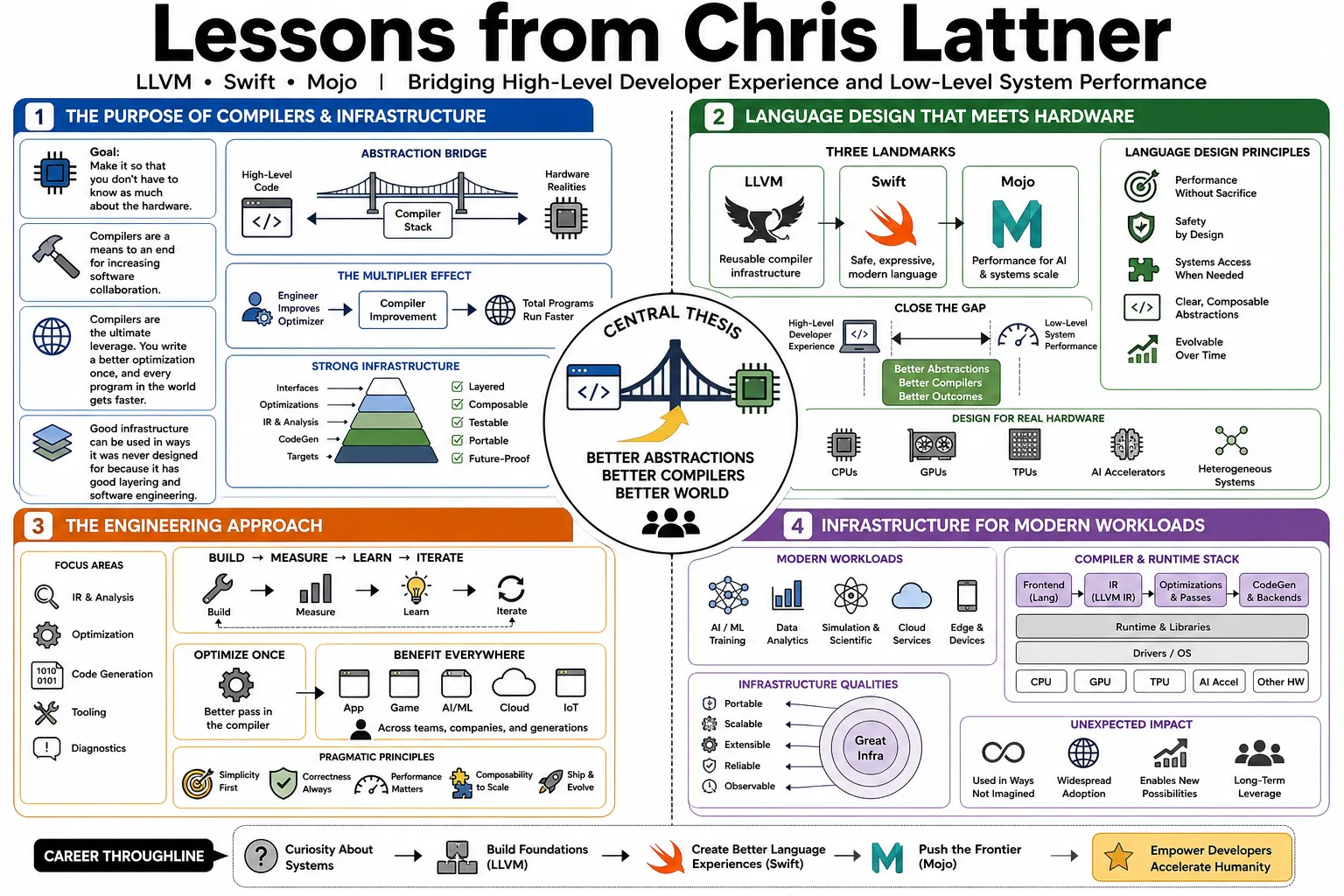
Part 1: The Purpose of Compilers & Infrastructure
- Why compilers matter: A compiler lets developers work at a higher level without having to know every detail of the underlying hardware. — Latent Space Interview.
- Work backward from the problem: Lattner describes starting with the problem and using compiler technology as a means to enable specialists to build together, rather than searching for problems to fit a compiler. — Latent Space Interview.
- Reusable optimization: LLVM and Bitcode can let a compiler improvement benefit existing application code without each developer rebuilding or re-uploading it; the reach depends on the platform and code using that infrastructure. — Accidental Tech Podcast #205.
- Design for unexpected uses: Lattner points to LLVM being used in a film/graphics pipeline he had not anticipated as evidence that layered, composable infrastructure can support unforeseen applications. — Lex Fridman Podcast #21.
- Compiler work is worth studying: Lattner argues that compilers are interesting, consequential engineering; understanding them helps developers see how code reaches hardware. — Pragmatic Engineer Interview.
- LLVM as reusable components: LLVM was built as a collection of libraries with defined interfaces, so language and tool builders can combine only the compiler components they need. — LLVM Architecture Chapter.
- Useful compiler diagnostics: A compiler should report invalid or doubtful code in ways that help a programmer understand and correct the problem, rather than leave them deciphering cryptic errors. — Clang Error Recovery.
- Catch memory errors early: Mojo’s ownership design aims to have type and lifetime checks catch certain memory mistakes before a program runs. — Mojo Ownership Deep Dive.
Part 2: Designing Swift and Mainstream Languages
- Swift built on LLVM: Lattner describes Swift as a high-level language whose compiler could use LLVM’s low-level primitives and optimization infrastructure. — PLDB Interview.
- Bring advanced ideas to everyday programming: Lattner says Swift brought ideas from academic language research, including concurrency, into a mainstream language. — Chris Lattner’s Personal Site.
- Let old and new code coexist: Swift’s interoperability with Objective-C allowed developers to adopt the new language while continuing to use existing Apple code and libraries. — Modular Developer Voices.
- Scale from small programs to systems work: Swift was intended to be approachable for a first program while retaining capabilities for large applications and systems-level work. — Accidental Tech Podcast #205.
- Progressive disclosure: Swift’s design lets newcomers start with simple code and encounter more advanced language capabilities as their needs grow. — Accidental Tech Podcast #205.
- Make language transitions participatory: A programming-language transition must account for developers’ investment and time constraints; Lattner argues that open development can give them agency in the change. — DFJ Growth Founder Q&A.
- Start fresh without severing compatibility: Lattner says Objective-C’s C pointer heritage constrained a clean redesign, so Swift began as a new language but was made to work with existing Apple code. — WWDC 2017 Swift Panel.
Part 3: Python, Mojo, and the Future of AI Programming
- Question the AI software stack: Lattner and his cofounder frame fragmented, costly AI tooling as a problem worth solving, asking why software lags the importance of AI itself. — Next-Generation AI Platform.
- A broader goal than faster Python: Modular set out to connect Python-friendly development with systems-level programming and access to heterogeneous AI hardware, rather than merely accelerating existing Python syntax. — Modular’s Unified AI Platform.
- Start from hardware limits: In describing Mojo, Lattner contrasts incrementally speeding up Python with starting from what modern hardware can do and designing a usable way to express that power. — Lex Fridman Podcast #381.
- Expose the systems work beneath high-level languages: Lattner notes that important libraries beneath Python and Objective-C have long depended on C or C++; Mojo aims to make lower-level capabilities more accessible to developers using familiar syntax. — Modular Developer Voices.
- Python-familiar syntax with systems control: Lattner uses the analogy of writing C- or Rust-like low-level code in Python-familiar syntax to explain Mojo’s design; it is an analogy, not language equivalence. — Modular Developer Voices.
- Python’s glue-layer cost: Lattner values Python as a glue language for AI, but points to the difficulty of connecting performance-critical C or C++ components to it. — Syntax Podcast #679.
- Put extensibility in libraries: Mojo’s design aims to let library and domain experts build specialized abstractions without requiring each new capability to be hard-coded into the compiler. — Modular Developer Voices.
- Fragmented AI tooling: Lattner and his cofounder describe AI development as split across research, production and hardware-specific stacks, creating repeated integration work. — Next-Generation AI Platform.
- Aim for a portable foundation: Lattner argues for shared AI infrastructure that developers and hardware makers can build on across vendor-specific stacks; he presents this as a goal, not a completed neutral platform. — Signals and Threads Interview.
- One model across high and low levels: The Mojo/MAX architecture aims to let developers move between high-level AI workflows and low-level systems or accelerator code within a common programming model. — MAX and Mojo.
Part 4: Managing Hardware Complexity
- Expose vector hardware when it matters: Modular’s Mojo design exposes SIMD and memory-layout controls to developers who need them, while aiming to keep higher-level code approachable. — Mojo vs. Rust Technical Comparison.
- Hardware keeps changing: Lattner argues that hardware constraints and specialization are not going away, so language and compiler tools must keep adapting to new machines. — Lex Fridman Podcast #381.
- Design for varied accelerators: AI accelerators differ across phones, data centers and specialized workloads; Lattner argues that software must account for this hardware diversity without hiding the performance-relevant details. — Lex Fridman Podcast #381.
- Delivered speed depends on the whole system: Lattner argues that an accelerator’s peak chip capability is not its delivered speed: the compiler, runtime and surrounding software have to be designed with the hardware. — EE Times Hardware Interview.
- Reuse an open processor toolchain: For accelerator control processors, Lattner says RISC-V offers an existing instruction-set and software-tool foundation, avoiding the burden of inventing a custom one. — EE Times Hardware Interview.
- Respect the memory hierarchy: Lattner warns that moving data between an accelerator and a host can erase nominal compute gains; good software and hardware design should keep work near the data when possible. — EE Times Hardware Interview.
- Start with physical limits: When evaluating Mojo and accelerator performance, Lattner asks what the hardware can actually do and identifies data movement—not just arithmetic speed—as a frequent constraint. — Lex Fridman Podcast #381.
- Hardware needs software from the start: Lattner argues that an AI accelerator is not a useful product merely because its gates are fast; compiler, runtime and application requirements must shape the chip design together. — EE Times Hardware Interview.
Part 5: Abstraction and Systems Design
- Share infrastructure without erasing domain differences: MLIR’s dialects let specialized domains retain their own operations while reusing common compiler infrastructure; Lattner presents this as a way to manage complexity without forcing one rigid representation. — Lattner’s MLIR Retrospective.
- Layer a language and an inference platform: Lattner describes Mojo as the inner programming-language layer and MAX as a wider inference framework, with each layer addressing a different developer need. — Latent Space: Shape of Compute.
- A language is a means to solve a problem: Lattner describes creating Mojo as a multi-year, pragmatic project aimed at closing the gap between AI research code and production systems, not as language-building for novelty’s sake. — Modular Developer Voices.
- Compiler quality must work at scale: Clang’s usefulness depended on fast compilation, useful diagnostics and the ability to handle very large real-world codebases—not merely an elegant compiler architecture. — FOSDEM 2011 Speaker Notes.
- Why MLIR began: Lattner says fragmented AI frameworks and changing hardware led teams to repeat compiler work; MLIR was created to let different domains share an extensible infrastructure. — Lattner’s MLIR Retrospective.
- Launch pressure creates technical debt: Lattner recounts that Swift’s rushed early launch left compiler shortcuts and later code breakage to repair; with Mojo, he preferred public iteration before promising production stability. — Lex Fridman Podcast #381.
- Evaluate features by the programmer model: Lattner argues that language features should be judged by the code and habits they encourage; advanced capabilities are worthwhile when they add expressiveness or performance without complicating the common path. — Lattner’s Swift Evolution Email.
- Balance evolution with source stability: Lattner explains that early Swift revisions sometimes broke developer code, and a growing ecosystem made source stability increasingly important even as the language continued to improve. — Accidental Tech Podcast #205.
Part 6: Open Source and Community Building
- Enable specialists to work together: Lattner asks how compiler and platform infrastructure can help people with different expertise collaborate on problems none could solve alone. — Latent Space Interview.
- Choose the right moment to open a project: Lattner says Swift shipped its initial version before every major piece was ready, but the team delayed open-sourcing until later so community obligations would not derail essential work. — Accidental Tech Podcast #205.
- Open the design, not just the code: Lattner distinguishes publishing source from inviting design participation; he says Swift sought the benefit of thoughtful contributors while acknowledging the cost of engaging a community. — Accidental Tech Podcast #205.
- Distribute ownership by expertise: Lattner describes LLVM as using code owners with responsibility for different areas, allowing expert review and distributed stewardship as the project grew. — Lex Fridman Podcast #21.
- Share compiler infrastructure across competitors: Lattner notes that different languages and even commercially competing companies reuse and contribute to LLVM’s common optimization and code-generation infrastructure. — Lex Fridman Podcast #21.
- Choose where community design is open: Lattner says Modular opened Mojo’s library, specification and documentation for broader participation while keeping the young core compiler more tightly directed. — DFJ Growth Founder Q&A.
- Build beyond the original author: Lattner reflects that LLVM grew far beyond his thesis because engineers at many institutions kept extending it; its endurance is a collective achievement, not proof of a universal “highest form of success.” — DFJ Growth Founder Q&A.
Part 7: Career, Learning, and Leadership
- Ask questions without pretending to know: Lattner says asking basic questions helped him learn quickly, especially when stepping into unfamiliar technical areas. — Lex Fridman Podcast #131.
- Learning a language changes perspective: Lattner says learning another programming language can put a developer back into learning mode and change how they see familiar programming problems. — Lex Fridman Podcast #131.
- Build tools that reach real products: Lattner valued that compiler and language work at Apple could ship in products used by millions of people, connecting hard engineering to visible user impact. — Accidental Tech Podcast #205.
- Leadership seeks the right answer: Lattner describes growing more comfortable not knowing everything; a leader’s job is to help a team arrive at the right answer, not always supply it personally. — Lex Fridman Podcast #131.
- Do not promise what a language project cannot deliver: Lattner warns that a new programming language is a multi-year undertaking and urges a practical scope the team can actually deliver. — Modular Developer Voices.
- Work at the hardware–software boundary: Lattner says much of his career has been at the boundary between hardware and software, using compilers and languages to make new kinds of machines usable by more developers. — Syntax Podcast #679.
- Grow leaders who can take responsibility: Lattner says building strong teams and leadership structures at Apple let colleagues take on responsibility and grow, freeing him to explore the next technical challenge. — Lex Fridman Podcast #21.
- Let incremental wins compound: Lattner recalls focusing on the next useful LLVM improvement during a long creative process; accumulated small gains expanded the project’s scope over time. — DFJ Growth Founder Q&A.
- Leave a project with a strong team behind: Lattner says stepping away as an active Swift committer was a hard decision, but he trusted the continuing team and remained involved in Swift’s direction. — WWDC 2017 Swift Panel.
Part 8: The Philosophy of Engineering and Innovation
- Lasting systems take years: Lattner says ambitious technical systems that are built to last require years of work and the right teams, culture and support—not a quick breakthrough alone. — DFJ Growth Founder Q&A.
- AI assistance still requires understanding: In a 2025 conversation with Jeremy Howard, Lattner cautions that AI-generated code can help with quick work, but durable systems require developers to understand and maintain what they build. — Build to Last Interview.
- Do not mask incompatible stacks with a thin layer: Lattner argues that a superficial interface over fragmented AI backends can leak complexity and fail to solve performance or manageability problems; the underlying infrastructure needs attention. — Signals and Threads Interview.
- Readability matters when code is maintained: In Lattner’s 2025 interview, language readability is treated as at least as important as ease of writing, especially when both people and AI tools produce code that others must understand. — Pragmatic Engineer Interview.
- Performance changes deployment economics: Lattner notes that, for server applications, execution speed and memory use affect the computing resources a service pays for; performance matters beyond a benchmark score. — WWDC 2017 Swift Panel.
- Give specialists an opt-in low-level path: Mojo aims to keep familiar higher-level syntax while letting specialists control memory and accelerator-oriented types when their task calls for it. — Modular Developer Voices.
- Interoperate instead of chasing purity: Lattner presents Mojo’s Python-familiar syntax and interoperability as pragmatic choices for existing AI code, rather than language novelty for its own sake. — Modular Developer Voices.
- AI code generation still needs a systems stack: Lattner argues that LLM coding tools may change developer productivity, but generated programs still depend on language, compiler and runtime infrastructure that can target real hardware. — Do LLMs Eliminate Programming Languages?.