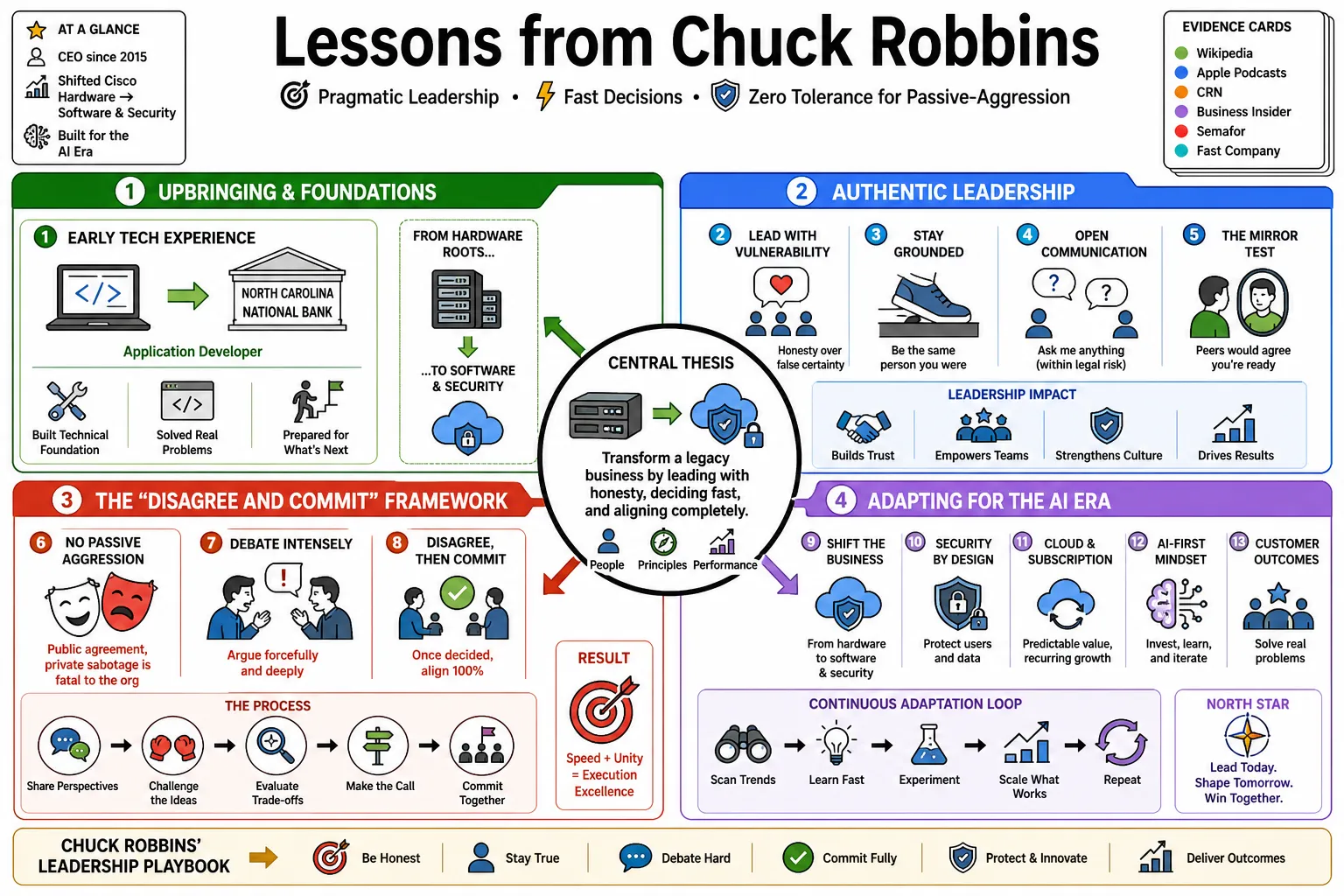
Since becoming CEO in 2015, Chuck Robbins has pushed Cisco away from its hardware roots and toward software and security. His management style is highly pragmatic, prioritizing fast decisions and zero tolerance for passive-aggressive executives. The lessons below cover his frameworks for evaluating talent, handling uncertainty, and adapting a legacy business for the AI era.
Part 1: Upbringing and Foundations
- On early tech experience: Before climbing the ranks to CEO, the foundation of his technical understanding was built working as an application developer for North Carolina National Bank. — Reference: Wikipedia
Part 2: Authentic Leadership
- On vulnerability: In times of crisis, it is better to lead with honesty and transparency than to manufacture a false sense of certainty. — Reference: Apple Podcasts
- On staying grounded: Executives should strive to remain the exact same person they were earlier in their careers to maintain trust with their teams. — Reference: CRN
- On open communication: Employees should feel empowered to ask the CEO any question, provided it does not put the company at legal risk. — Reference: CRN
- On the mirror test: If you cannot look in the mirror and honestly say your peers would agree you deserve a promotion, you are likely not ready for that next step. — Reference: Business Insider
Part 3: The "Disagree and Commit" Framework
- On passive aggression: When leaders publicly agree to a plan but privately undermine it, this passive-aggressive behavior is fatal to an organization. — Reference: Semafor
- On debating intensely: Teams should argue their differing perspectives as forcefully and deeply as possible before a final call is made. — Reference: Fast Company
- On post-decision alignment: Once a path is chosen, even the groups who strongly opposed the decision must fully commit to its success. — Reference: Semafor
- On stepping out of the room: A CEO's presence can distort how a team evaluates options, so knowing when to leave the room is essential for getting unvarnished debate. — Reference: Semafor
Part 4: Managing Speed and Decisions
- On the pace car concept: An organization will never move faster or communicate better than its leader; the CEO must set the tempo for responsiveness. — Reference: YouTube
- On reversing errors: Making a bad decision that you later reverse is almost always better than delaying a decision indefinitely. — Reference: Fast Company
- On executive choices: The problems that escalate to the CEO's desk are rarely simple; they usually involve choosing between two bad options. — Reference: YouTube
- On the danger of waiting: Waiting for perfect information in a rapidly changing industry is more damaging than moving forward with incomplete data. — Reference: Fast Company
Part 5: Rethinking Talent and Promotions
- On internal interviews: Formal interview processes for internal promotions are often ineffective because they fail to capture an employee's actual daily output. — Reference: Inc.
- On continuous evaluation: Every single day you spend working and interacting with your team serves as the real interview for your next job. — Reference: Business Chief
- On collaborative success: Individuals who focus exclusively on their own advancement tend to stall out; long-term success requires actively caring about the success of your peers. — Reference: Business Insider
- On the value of EQ: Technical expertise is necessary, but the most successful employees in the modern tech landscape pair that knowledge with a high emotional quotient. — Reference: Business Chief
Part 6: Navigating Uncertainty
- On useless worry: You should rigorously plan for scenarios outside of your control, but worrying about them is a waste of energy since it cannot change the outcome. — Reference: Fast Company
- On handling mistakes: When a company misses a major market shift, the first step to rebuilding trust is to stop pitching and start listening to customer complaints. — Reference: Semafor
- On avoiding the flat-footed trap: Learning from previous transitions, like the initial shift to the cloud, is critical to ensuring the company stays agile during the next massive wave. — Reference: Fast Company
Part 7: Strategy in the AI Era
- On the scale of change: The transition to artificial intelligence represents a technological shift that is fundamentally larger than the advent of the internet. — Reference: AI Magazine
- On providing the plumbing: Instead of competing in every software layer, a massive incumbent can thrive by supplying the essential connectivity, silicon, and infrastructure required to run large-scale AI. — Reference: Semafor
- On the trust deficit: The biggest barrier to widespread enterprise AI adoption is a lack of trust, making responsible frameworks for handling bias and hallucinations a business imperative. — Reference: Computer Weekly
- On enterprise readiness: AI cannot be treated merely as a side IT project; it must be integrated into the operational core to generate actual market value. — Reference: Cyber Magazine
Part 8: Customer Listening and Feedback
- On direct engagement: Staying connected to the most urgent customer pain points requires the CEO to personally review daily reports on critical accounts. — Reference: Cisco
- On closing the loop: Gathering feedback is useless unless there is a dedicated program to ensure every complaint has a clear, actionable path to resolution. — Reference: Cisco
- On market signals: Moving quickly on customer feedback is especially critical when navigating generational shifts in technology, as customer needs change faster than product cycles. — Reference: Inc.
- On the speed of defense: Because adversaries now use AI to attack at machine speed, traditional human-led responses to customer security incidents are no longer adequate. — Reference: Forbes
- On embedded security: Standalone security appliances are becoming obsolete; protection must be woven directly into the network fabric to properly secure AI workflows. — Reference: MarketBeat
The consistent thread is operating tempo. Robbins treats culture, talent, customer listening, and technology strategy as parts of the same execution system: debate openly, decide before perfect information arrives, commit after the decision, and keep feedback close enough to reverse course quickly. His approach is particularly relevant to established companies facing a platform shift, where delay can look prudent internally while becoming a serious competitive risk outside the organization.
That tempo depends on trust rather than command alone. Teams must be able to challenge a proposal without turning disagreement into sabotage, and leaders must admit uncertainty without surrendering responsibility. In this model, speed comes from clear behavioral rules and rapid learning, not from skipping debate or pretending that every early decision will prove correct.