Clay Bavor spent 18 years at Google, where he led products ranging from Workspace to Google Labs, before leaving to co-found the enterprise AI company Sierra. He focuses on taking frontier language models and applying them to messy, complex business processes to create reliable digital agents. This collection outlines his observations on how AI is altering software engineering, corporate hiring, and the core of customer experience.
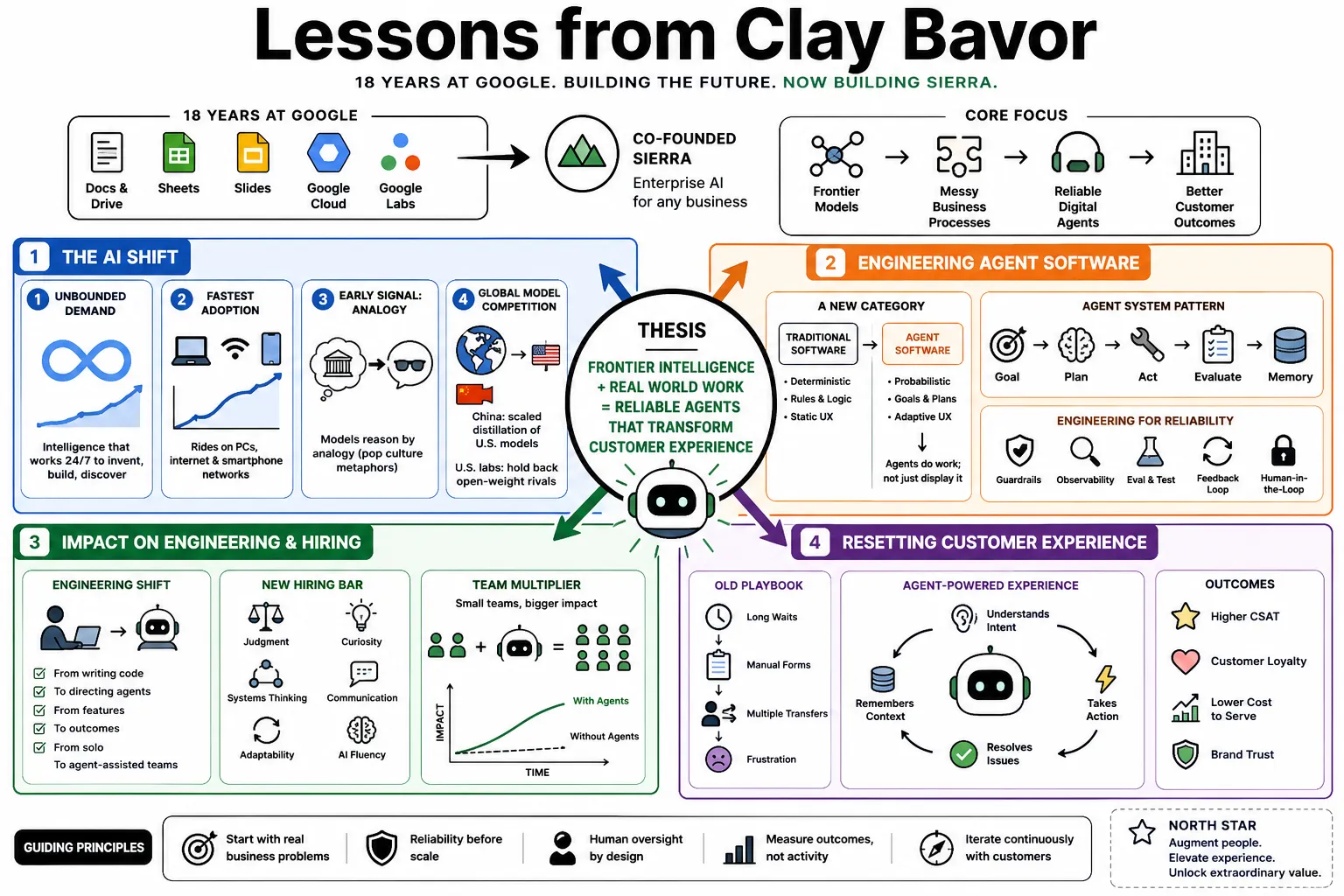
Part 1: The AI Shift
- On the demand for advanced AI: "We have not yet appreciated the unbounded demand for, call it frontier levels of intelligence... I think it's hard to get your mind around when you have intelligence that can work around the clock to invent, to build, to discover how you would use that and how much of it you could use." — Source: 20VC interview with Clay Bavor
- On rapid technology adoption: Generative AI is seeing faster adoption than any prior technology wave because it rides on the pre-built infrastructure of PCs, the internet, and smartphone networks. — Reference: Acquired conversation with Bret Taylor and Clay Bavor
- On recognizing early capabilities: An early indicator that language models were reaching new levels of intelligence was their ability to reason through analogy, such as summarizing complex historical events using pop culture metaphors. — Reference: Sequoia Training Data interview
- On global model competition: The perceived strength of Chinese open-weight models is likely due to the scaled distillation of U.S. frontier models, combined with the fact that U.S. labs intentionally avoid releasing powerful open-weight alternatives that would compete with their own paid APIs. — Reference: 20VC interview with Clay Bavor
Part 2: Engineering Agent Software
- On a new category of software: AI agents are a distinct new building block in software design that force developers to reconcile the probabilistic nature of language models with the strict rules of business logic. — Reference: Sequoia Training Data interview
- On fixing AI mistakes: Counterintuitively, the best way to solve errors generated by AI is often to apply more AI. Large language models are consistently better at identifying faults in their own outputs than they are at preventing them initially. — Reference: Sequoia Training Data interview
- On supervisor models: Setting up secondary agents to act as supervisors and review the work of primary agents is a practical method for maintaining output accuracy and safety. — Reference: Sequoia Training Data interview
- On the new development lifecycle: Because outputs are non-deterministic, organizations have to entirely rethink how they program, test, and deploy software. — Reference: Sequoia Training Data interview
- On strategic technical depth: Startups building AI applications should invest heavily in agent architectures and fine-tuned proprietary models, while avoiding the massive resource drain of pre-training general foundation models. — Reference: 20VC interview with Clay Bavor
- On internal infrastructure: Connecting all company knowledge—from internal messaging to operating reviews—into a single server protocol allows internal agents to access and interrogate the entirety of a business's operations. — Reference: 20VC interview with Clay Bavor
Part 3: Changing the Workforce
- On shifting engineering budgets: API tokens will soon become a fundamental corporate expense, treated with the same budgeting logic as traditional headcount. — Reference: 20VC interview with Clay Bavor
- On the rising cost of AI tools: "I have heard and I have observed that top engineers who are really leaning in to Claude Code, Codex, and so on, are spending more than $100,000 on a run rate basis on tokens per year... I would not bet on 3.8%. I would bet on much closer to 20%." — Source: 20VC interview with Clay Bavor
- On the value of young talent: "I can't remember a time when a young person with no work experience, but with the right mindset and experience using some of these tools, has ever been so valued" — Source: Business Insider interview on AI-savvy young talent
- On leveling the playing field: The natural comfort that recent graduates have developed with generative AI is closing the historical effectiveness gap between junior hires and veteran employees. — Reference: Business Insider interview on AI-savvy young talent
- On modernizing the technical interview: Instead of administering abstract coding tests, companies should give candidates a budget for API tokens and ask them to build a functional app using whichever AI coding tools they prefer. — Reference: Business Insider interview on AI-savvy young talent
Part 4: Redesigning Customer Interaction
- On the primary interface of the future: A company's AI agent will eventually supersede its traditional website and mobile applications as the dominant way customers interact with the brand. — Reference: Acquired conversation with Bret Taylor and Clay Bavor
- On humanizing automated support: It is possible to eliminate the hours consumers waste on hold and navigating phone trees without losing a conversational, empathetic tone. — Reference: The Heart of Healthcare interview with Clay Bavor
- On extending beyond deflection: Enterprise AI is moving away from just answering basic questions and is increasingly capable of handling revenue-generating tasks like inbound sales outreach and loan origination. — Reference: 20VC interview with Clay Bavor
- On capturing brand identity: Creating an effective AI agent requires as much focus on product design as it does on engineering, because the system must accurately mimic the company's established voice and operational logic. — Reference: Sequoia Training Data interview
- On moving beyond cost savings: When deployed correctly, AI agents do more than cut overhead; they function as strategic business tools that can elevate customer satisfaction metrics and open up new avenues for sales. — Reference: Sequoia Training Data interview
Part 5: Operating at Startup Speed
- On embedded customer deployment: Embedding your own engineers directly into a client's team from the start of a contract is the fastest way to get complex enterprise AI tools up and running. — Reference: 20VC interview with Clay Bavor
- On guiding the initial rollout: "What we generally find is in getting started, having Sierra and help from our teams kind of drive while our customer is in the passenger seat but navigating for the first version. It's what has enabled us to take companies like Next live in six weeks." — Source: 20VC interview with Clay Bavor
- On aligning governance with technology speed: Board structures and meeting cadences must be accelerated to match the rapid pace of AI model releases, relying on frequent touchpoints and written updates rather than slow, formal presentations. — Reference: 20VC interview with Clay Bavor
- On reacting to model upgrades: "We came back from winter break and suddenly coding agents were amazing. You had Claude 4.5, Codex 5.2. There is a fundamental step change in the capabilities of these models. It changed our approach to software development. It changed our approach to the core product. And so having a cadence where you can take in information even from the last six weeks, update your priors, and then change course, I think is quite important." — Source: 20VC interview with Clay Bavor
- On overcoming early jargon fatigue: Because the language surrounding new technology shifts constantly, it is more effective to use simple, descriptive terms with enterprise customers than to rely on the latest industry buzzwords. — Reference: Acquired conversation with Bret Taylor and Clay Bavor
- On early hardware foundations: The transition from flat screens to spatial computing required solving unglamorous infrastructural problems—like eliminating wasted resolution in 360-degree video projections—before the experiences felt natural. — Reference: Voices of VR interview with Clay Bavor
Part 6: Designing AI Around Outcomes
- On matching models to tasks: A resilient AI product should use a constellation of models, choosing frontier systems for complex reasoning and language while reserving smaller specialized models for narrow tasks. — Reference: The Tech Download
- On fine-tuning where nuance matters: Specialized models earn their place when a small perceptual distinction changes the whole experience, such as telling whether a caller is interrupting or merely coughing. — Reference: The Tech Download
- On building above the model layer: The durable product is a thick platform above foundation models, not a thin wrapper around one provider, because different parts of an agent demand different kinds of intelligence. — Reference: The Tech Download
- On pricing delivered value: AI agents make it possible to charge for completed business outcomes rather than seats or raw consumption, aligning the vendor's economics with the customer's results. — Reference: Outcome-based pricing for AI agents
- On defining success before deployment: Outcome-based contracts work only when the parties agree in advance on transparent criteria for what counts as a result, including how more complex resolutions and escalations are treated. — Reference: Outcome-based pricing for AI agents
- On choosing a pricing model by job: Not every interaction should be forced into outcome pricing; routing and greeting tasks may fit consumption pricing better, so commercial models should follow the work being performed. — Reference: Outcome-based pricing for AI agents
Part 7: Building Systems That Improve
- On giving agents proper scaffolding: Reliable agents need a strong harness around the model: tools, memory, a coherent action space, planning capability, and enough context to understand the job. — Reference: Agents as a Service
- On designing software for machine users: When agents become the operator, infrastructure should expose data and actions directly instead of forcing software to preserve menus, forms, and other interfaces designed for human clicking. — Reference: Agents as a Service
- On turning operating knowledge into behavior: Agent builders should be able to start from the artifacts a business already has—SOPs, support transcripts, whiteboard sketches, and expert interviews—and translate them into behaviors, integrations, guardrails, and edge cases. — Reference: Agents as a Service
- On closing the improvement loop: The real challenge begins after the first release, so the system should continuously analyze live interactions, identify weaknesses, test proposed changes safely, and prepare improvements for review. — Reference: Agents as a Service
- On pursuing goals across conversations: Complex outcomes require agents to preserve context and plan across many inbound and outbound interactions over days or weeks, rather than treating each conversation as an isolated session. — Reference: The next Horizon in agents
- On learning from every result: An agent should treat both successful outcomes and rejections as feedback, using the accumulated interaction history to improve future decisions and deepen the customer relationship. — Reference: The next Horizon in agents