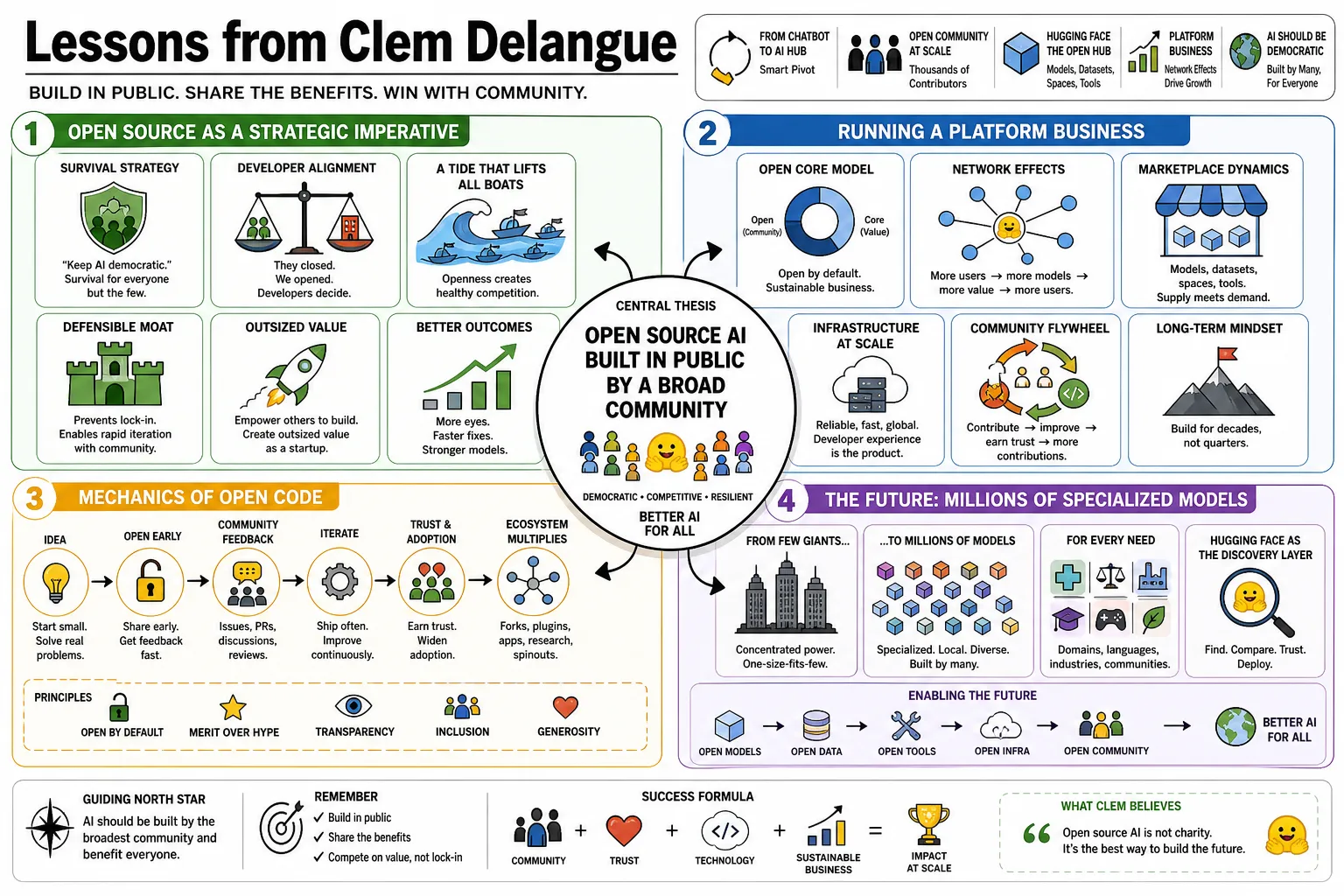
Lessons from Clem Delangue
Clem Delangue co-founded Hugging Face as a conversational-AI company, then followed developer demand for its open-source model tools into a collaborative AI platform. He advocates broad access to models and research while also supporting private use and safeguards. — ACQ2 Interview.
Part 1: Open Source as a Strategic Imperative
- Keep AI open to more builders: Delangue argues that access to open models and tools helps prevent AI capabilities from concentrating in only a few large companies. — Turing Post Interview.
- Open research lifts the field: Delangue says shared models, datasets and scientific work help more people build and understand AI, although not every project needs to be public. — ACQ2 Interview.
- Openness can reduce dependence: Open models give builders more control over adaptation and deployment instead of relying entirely on a vendor that can change an API or its terms. — Turing Post Interview.
- Empower a contributor community: Delangue argues that sharing foundational tools lets a startup benefit from and contribute to a much larger builder community. — Quartz Interview.
- Protect open-source leadership: Delangue warns that restrictions on open-source AI could weaken a country’s ability to compete and concentrate opportunity among a few firms. — Turing Post Interview.
- Make independent scrutiny possible: Delangue argues that accessible models and documentation let outside researchers examine risks that may be obscured in closed systems. — House AI Testimony.
- Support hardware choice: Hugging Face’s open-tooling approach includes optimizing models for different chips so builders have more hardware options and can seek better cost-performance. — Hugging Face–AMD Partnership.
- Build domestic open capacity: Delangue argues that countries should foster their own open-model builders rather than restrict access and leave AI capabilities concentrated elsewhere. — Turing Post Interview.
Part 2: The Future of Models and Ecosystems
- Many models, many use cases: Delangue expects a mix of large general-purpose models and smaller models tailored to particular domains, latency needs, hardware and costs. — ACQ2 Interview.
- More in-house adaptation: He expects many companies to train, fine-tune or optimize models for their own use cases rather than rely only on a few general-purpose APIs. — ACQ2 Interview.
- Models as numerous as repositories: Delangue imagines a world with nearly as many model repositories as code repositories because models will serve different technical and business contexts. — ACQ2 Interview.
- Build for the company’s job: Delangue expects companies that create AI value to adapt and build models themselves so the result fits their own use cases. — Unsupervised Learning Podcast.
- Choose the right-sized model: Large generalist models can serve broad questions, while narrower tasks may be handled faster and more cheaply by specialized models. — ACQ2 Interview.
- Distribute the power to build: Delangue argues that accessible models and tools can allow more organizations to contribute to AI rather than leave capability with a few high-resource institutions. — House AI Testimony.
- Avoid exclusive API dependence: He expects companies to gain more control and differentiation by learning to train and adapt open models instead of sending every workload to a closed API. — Turing Post Interview.
- Remember open science’s foundation: Delangue says even closed AI products build on open research and earlier shared models, and he wants more of that collaboration to continue. — ACQ2 Interview.
- Optimize for the actual task: He expects specialized models to be tuned for a particular domain, latency, hardware or cost constraint instead of competing only on broad benchmarks. — ACQ2 Interview.
- Share the building blocks: Public models and datasets can let researchers inspect, adapt and improve AI systems, while teams may keep sensitive artifacts private. — House AI Testimony.
Part 3: The Paradigm Shift to Software 2.0
- AI builders as software engineers: Delangue describes AI builders as the new software engineers: they combine models, datasets and applications to create technology. — ACQ2 Interview.
- AI as a building paradigm: Delangue views AI as a new way to build software and products, not as a humanlike being or a separate category of magic. — Sequoia Founder Interview.
- From hand-written rules to trained models: In his account, AI builders increasingly create capabilities by training models with datasets as well as writing conventional software code. — ACQ2 Interview.
- Include scientific depth: Delangue says an AI founding team benefits from scientific expertise alongside engineering and product skills. — ACQ2 Interview.
- Widen who can build: Delangue supports tools and training that let people from more disciplines use, evaluate and adapt AI systems. — House AI Testimony.
- Treat datasets as core infrastructure: Models are only part of the AI workflow; builders also need to curate, inspect and share datasets appropriate to the task. — ACQ2 Interview.
- Build AI-native products: Delangue expects strong AI companies to adapt models, data and product workflows together instead of limiting themselves to a thin interface over someone else’s API. — Unsupervised Learning Podcast.
- Add research to engineering: Delangue distinguishes AI development from ordinary software shipping because model training and optimization can require a longer experimental cycle. — ACQ2 Interview.
- Lower the barrier to training: Hugging Face builds tooling that helps people without deep ML infrastructure experience train, evaluate and deploy models. — House AI Testimony.
Part 4: Scaling Hugging Face and Community Building
- Follow the unexpected pull: Hugging Face began with a conversational app, but adoption of its open-source BERT/PyTorch work drew the founders toward a model-sharing platform. — ACQ2 Interview.
- Let an emoji carry the brand: Delangue has described the founders’ early joke about using an emoji, rather than a conventional three-letter ticker, if they ever went public. — Unsupervised Learning Podcast.
- Watch usage before revenue: Delangue says Hugging Face has focused heavily on adoption and community utility, expecting durable commercial opportunities to follow from serving builders well. — ACQ2 Interview.
- Celebrate builders together: Hugging Face’s developer event was framed as a celebration of open-source contributors, reinforcing the community around the tools. — Sequoia Founder Interview.
- Let users shape the platform: The transition from one open-source model port to a broader library, datasets and hosting followed requests from scientists and developers using the tools. — ACQ2 Interview.
- Use the platform’s economics: Rather than train every frontier model itself, Hugging Face builds tools around models, datasets and compute and seeks a sustainable business for its community. — ACQ2 Interview.
- Democratize good machine learning: Hugging Face states its mission as democratizing good machine learning through open tools and a collaborative platform. — House AI Testimony.
- Make collaboration easier: A shared hub for models, datasets and apps helps teams version assets, discuss them, report issues and build together. — ACQ2 Interview.
- Pair openness with private options: Hugging Face offers public sharing and private repositories so organizations can choose what to open while maintaining a broadly free community layer. — ACQ2 Interview.
Part 5: Navigating AI Safety and Ethics
- Make artifacts available for understanding: Delangue calls for more organizations to share models and datasets so people can examine and build AI themselves. — Quartz Interview.
- Enable external audits: Open access can help researchers discover and test limitations that are harder to inspect in inaccessible systems, but openness can also create misuse risks. — House AI Testimony.
- Watch restrictions that entrench incumbents: Delangue warns that lobbying to restrict open-source AI could make it harder for smaller builders to compete with the largest firms. — Turing Post Interview.
- Avoid anthropomorphizing chatbots: Delangue urges people to treat AI chatbots as technology rather than as humans, because humanlike framing can confuse public understanding. — Delangue on Chatbot Anthropomorphism.
- Evaluate with outside scrutiny: Delangue argues that accessible systems and shared evaluations let more researchers examine model behavior instead of relying only on vendors’ assurances. — House AI Testimony.
- Open access for public oversight: In testimony to the US House Science Committee, Delangue said access for researchers, auditors and public institutions can counter concentration of AI capability. — House AI Testimony.
- Document models and datasets: Delangue urges detailed model and dataset documentation so users and researchers can understand tradeoffs, limitations and risks. — House AI Testimony.
- Combine access with safeguards: Delangue advocates broad participation alongside documentation, evaluations, access controls and community moderation rather than treating a locked box or full release as automatically safe. — House AI Testimony.
Part 6: Founder Mechanics and Mindset
- Find satisfaction in the building: Using Camus’s Sisyphus as an analogy, Delangue says founders can find happiness in the daily work of building features and serving individual community members. — Sequoia Founder Interview.
- Build beyond Silicon Valley: Delangue argues AI founders need not relocate to Silicon Valley to build a significant company. — 20VC Interview.
- Protect focus between rounds: Delangue says he avoids routine conversations with outside investors between fundraising rounds so that building the company stays his focus. — 20VC Interview.
- Enjoy the work between milestones: Delangue says founders should find meaning in everyday building rather than waiting for a financing round or exit to make the work worthwhile. — Sequoia Founder Interview.
Part 7: Business Models in the AI Era
- Make the platform durable: Delangue says a community platform needs a sustainable business model so builders can rely on it for the long term, while much of it remains open and free. — ACQ2 Interview.
- Free use and paid services can coexist: Hugging Face uses a permissive free community layer and paid enterprise features, rather than treating openness and revenue as opposites. — ACQ2 Interview.
- Integrate compute with the workflow: Delangue says Hugging Face adds value by connecting deployment and compute services tightly to its model platform instead of competing only on raw compute price. — ACQ2 Interview.
- Charge for useful deployment: Managed inference and compute can be paid offerings when they make model deployment simpler for teams already using the hub. — ACQ2 Interview.
- Serve private enterprise work: Organizations can pay for private collaboration, security and governance features while using the same model-and-dataset hub. — ACQ2 Interview.
- Offer expert enterprise help: Hugging Face sells expert guidance and priority support to organizations that need help applying the platform to in-house AI work. — Hugging Face Enterprise Support.
- Build around shared models: A platform that hosts community-created models can focus capital on collaboration and tooling instead of funding every frontier-model training run itself. — ACQ2 Interview.
Part 8: Expanding Frontiers: Hardware and Robotics
- Extend openness to robotics: Delangue sees robotics as an extension of the open-model platform, combining shared models, datasets and accessible hardware. — Open-source AI Robotics.
- Use LeRobot as shared tooling: Hugging Face’s LeRobot project provides open software and datasets that let builders experiment with robot learning and deployment. — Hugging Face–Pollen Robotics.
- Support more than text models: Delangue expects AI development to span modalities and fields such as images, audio, video, biology and chemistry, not only text generation. — ACQ2 Interview.
- Make robot hardware approachable: Delangue includes 3D-printable or standard hardware in his definition of open robotics so more builders can obtain and modify physical platforms. — Open-source AI Robotics.
- Connect open robotics components: Open models, datasets and hardware give robotics developers parts they can inspect and adapt together rather than depend on an entirely closed stack. — Open-source AI Robotics.
- Link models to physical learning: Open robotics work joins model training with datasets collected from physical systems and hardware that people can modify. — Open-source AI Robotics.
- Preserve hardware choice: Hugging Face works with chip makers to help open models run on more CPUs and GPUs and give builders additional cost-performance options. — Hugging Face–AMD Partnership.
- Share robot-interaction datasets: Hugging Face’s LeRobot dataset format is designed to record, organize and stream multimodal interaction data from different robots for community experimentation. — LeRobot Dataset v3.