Daniel Gross co-founded Cue, which Apple acquired, and later worked on machine-learning projects at Apple before becoming a Y Combinator partner and founding Pioneer. He also coauthored Talent with Tyler Cowen. The lessons below focus on the views Gross expresses in direct interviews and his own writing, with coauthored ideas attributed as such. — Conversations with Tyler #150.
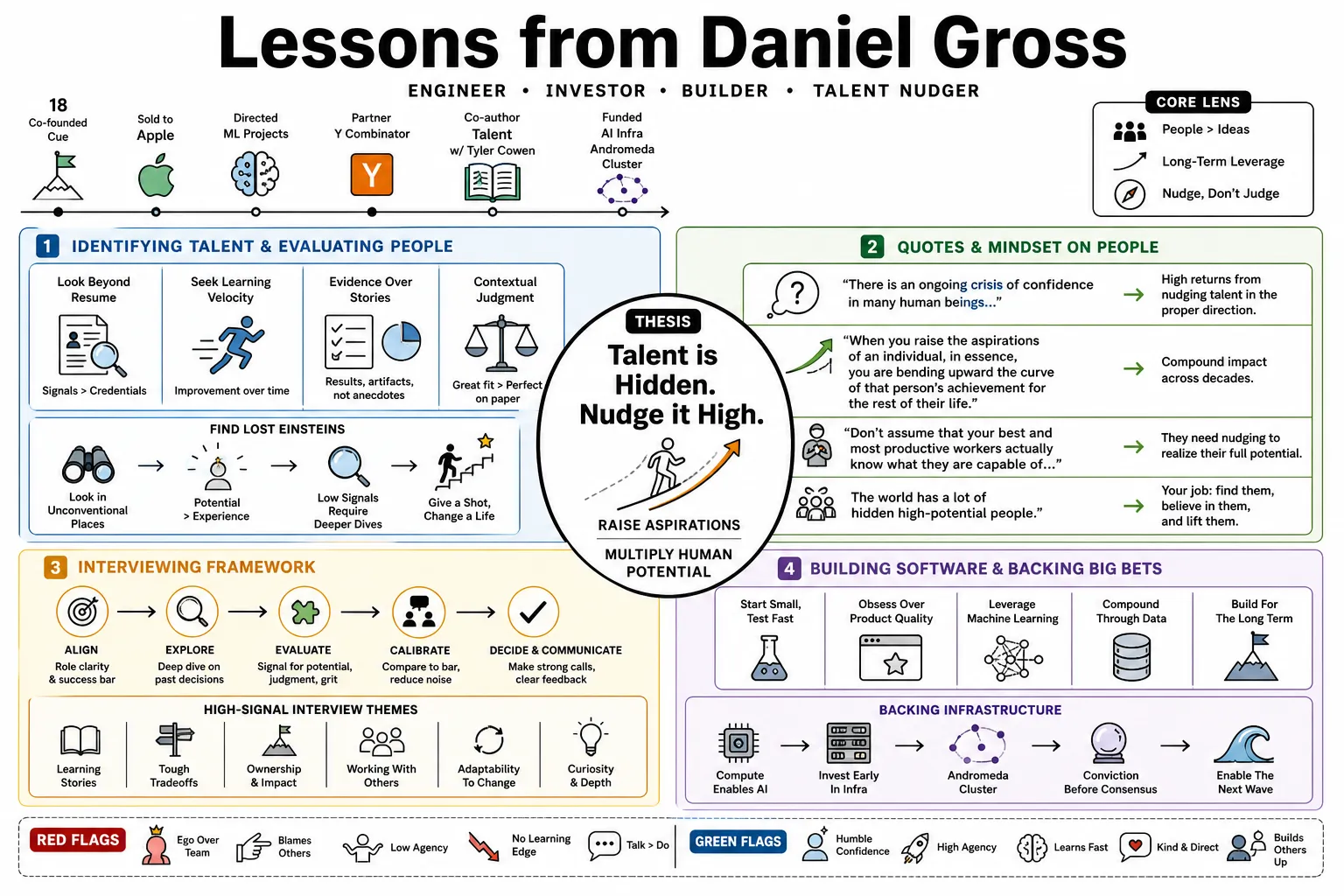
Part 1: Identifying Talent & Evaluating People
- Encouragement can change a trajectory: Gross argues that a small amount of credible encouragement can help someone pursue a path they had not considered possible. — Knowledge Project #56.
- Look for overlooked potential: Pioneer was designed to find ambitious people who lacked the chance encounters, peers and feedback that helped Gross himself. — Indie Hackers Podcast #080.
- Look beyond conventional fields: Gross points to game designers and gaming engineers as an overlooked source of creative technical talent. — Conversations with Tyler #150.
- Build a soft talent network: In their coauthored Talent framework, Cowen explains that a broad soft network helps capable people find an organization, rather than relying only on formal search. — EconTalk — Cowen on Talent.
- Value energy over a test score: Gross says psychometric approaches have limits in founder selection; he gives substantial weight to the energy an individual brings to a conversation. — Summation — Daniel Gross on Talent.
Part 2: Interviewing & The Art of the Question
- Make interviews exploratory: Gross favors questions that reveal whether a candidate plays with an unexpected idea rather than shutting the conversation down. — Conversations with Tyler #150.
- Ask about open browser tabs: Cowen, describing the interview approach in his book with Gross, says asking about open browser tabs reveals a candidate’s demonstrated interests and is hard to rehearse. — NPR — Cowen on Talent.
- Ask about ambition without a script: Cowen, in conversation with coauthor Gross, suggests a direct ambition question and pays attention to whether a candidate can explain a goal with detail and energy. — Conversations with Tyler #150.
- Break the interview script: Gross favors questions that interrupt rehearsed interview roles, such as asking midway how the conversation is going. — Conversations with Tyler #150.
- Look for energizing people: Gross identifies energy as a valuable founder signal: the best conversations leave the interviewer more engaged. — Summation — Daniel Gross on Talent.
- Look at demonstrated interests: Cowen, describing the coauthored Talent framework, says how people spend spare time can be more revealing than rehearsed interview answers. — NPR — Cowen on Talent.
- Watch for overlooked dark horses: Gross says venture committees often favor the wrong companies and miss unconventional founders; do not equate a familiar founder presentation with potential. — Conversations with Tyler #150.
Part 3: The Psychology of Founders
- Distinguish value creation from capture: Gross distinguishes creating value from capturing it commercially, using Einstein and Steve Jobs to explain why Pioneer sought a funding model that could support more people. — Indie Hackers Podcast #080.
- Show the product to users: Gross describes a founder tendency to prefer building over the discomfort of exposing work to users. — Indie Hackers Podcast #080.
- Design motivating feedback loops: Gross built Pioneer partly as a game because short cycles of feedback helped participants continue work on difficult projects. — Indie Hackers Podcast #080.
- Let self-belief sustain curiosity: Gross says curiosity is easier to follow when a person believes they can figure things out and is less likely to quit when work becomes hard. — Indie Hackers Podcast #080.
- Treat sleep as founder maintenance: Gross says leaders can overwork and then make worse decisions; he treats adequate sleep as a central productivity input. — Knowledge Project #56.
- Check optimism against reality: Gross acknowledges that he routinely overestimates how quickly he can do things, even outside work. — Indie Hackers Podcast #080.
- Lead with curiosity about people: Gross says learning colleagues’ personal stories helps him understand and motivate them, rather than treating management as pure task allocation. — Knowledge Project #56.
Part 4: Productivity, Habits & Self-Management
- Reduce a phone’s visual appeal: Gross says he made his phone and desktop black-and-white because the color filter made them less appealing to use compulsively. — Knowledge Project #56.
- Question stories about your habits: Gross recalls rationalizing his old late-night schedule; he now emphasizes testing what works for an individual rather than copying a routine. — Knowledge Project #56.
- Notice reactions in the moment: Gross describes becoming more able to observe his own emotions while leading; he does not establish that formal meditation is overrated. — Knowledge Project #56.
- Do not reduce people to simple metrics: Gross says scaling organizations need metrics but founder quality involves too many interacting variables to judge mechanically from a few numbers. — Judgment Call — Daniel Gross Interview.
- Experiment with your own routine: Gross says wake-up time is individual; the transferable practice is self-experimentation and attention to sleep quality. — Knowledge Project #56.
- Tighten the product feedback loop: Gross emphasizes quickly forming a view from use, testing it and iterating; he says this is possible even in large organizations. — Stripe Sessions — Gross and Friedman.
- Do not optimize only local metrics: Gross warns that testing only small variants can trap a product team in a local maximum; sometimes a bolder design change is needed. — Knowledge Project #56.
Part 5: Strategy, Building & Shipping Product
- Recognize software’s unusual leverage: Gross argues that software combines broadly accessible tools, low-cost global distribution and the ability to build on others’ work; this makes it unusually scalable. — Judgment Call — Daniel Gross Interview.
- Give search users a reason to stay: In his A New Google essay, Gross suggests that a search product can become a destination when it helps people accomplish something beyond retrieving links. — A New Google — Daniel Gross.
- Watch early changes in search behavior: Gross argued in his 2021 essay that some early adopters were modifying Google queries to find better results; this was his observation at that time, not a current usage measurement. — A New Google — Daniel Gross.
- Pair vertical search with community: Gross proposed a category-specific search destination with community around it, using Amazon and Airbnb as examples of products people open directly. — A New Google — Daniel Gross.
- Give users legible feedback: Gross says Pioneer learned that users who fell in the leaderboard without understanding why needed clearer feedback, not necessarily removal of the leaderboard. — Indie Hackers Podcast #080.
Part 6: Artificial Intelligence & The Frontier
- AI may shift information work: In a 2022 essay, Gross anticipated that AI tools could move some information workers from producing every draft to supervising machine output; this was a forecast, not a proven outcome. — The Magic of AI-Native Apps.
- Rethink interfaces for AI-native apps: Gross argued in 2022 that AI-native applications might need interfaces unlike traditional graphical software, a design hypothesis rather than a universal requirement. — The Magic of AI-Native Apps.
- Do not assume incumbents win AI: Gross explicitly left open whether AI’s benefits would accrue to incumbents or startups; model access alone does not settle the question. — The Magic of AI-Native Apps.
- Account for compute costs: Gross’s 2022 essay describes training large language models as expensive and compute-intensive, while noting uncertainty about whether larger models always win. — The Magic of AI-Native Apps.
- Compare open and closed model tradeoffs: Gross’s 2022 essay contrasts open image models with closed models, particularly around distribution and editorial controls; he treats the economic outcome as uncertain. — The Magic of AI-Native Apps.
- Separate safety work from product pressure: SSI’s founding statement says the company would pursue capabilities and safety together while insulating the work from short-term commercial pressure. — Safe Superintelligence — Founding Statement.
Part 7: Search, Apple, & Tech Landscapes
- Treat search dissatisfaction as an opening: In a 2021 essay, Gross argued that some Google users were adding terms such as Reddit or site operators to get more useful results; he saw this as an opening for new search products. — A New Google — Daniel Gross.
- Start with a focused search vertical: Gross proposed building a strong search product for one category—such as code, travel or product research—instead of attacking general search head-on. — A New Google — Daniel Gross.
- Earn a direct-use habit: Gross said a new search tool must become reliable enough that people remember to visit it directly rather than defaulting to Google. — A New Google — Daniel Gross.
- Build around fragmented personal data: Gross describes Cue as a search product that organized information across a user’s accounts before its acquisition by Apple; the broader prediction about mobile search was not verified. — Indie Hackers Podcast #080.
- Watch distribution in AI markets: Gross’s 2022 essay says controlling distribution can matter along the AI value chain, while explicitly questioning which layer will capture value. — The Magic of AI-Native Apps.
- Recognize chip-supply concentration: Gross highlighted TSMC as a potential chokepoint in AI’s supply chain in his 2022 essay; it was presented as a geopolitical risk scenario. — The Magic of AI-Native Apps.
Part 8: Philosophy, Luck & Life Design
- Create more chances for serendipity: Gross traces his own path to a small, almost accidental Y Combinator application and built Pioneer to make such opportunities less dependent on luck. — Indie Hackers Podcast #080.
- Acknowledge starting conditions: Gross says birthplace, family and socioeconomic circumstances shape the opportunities with which a person starts. — Knowledge Project #56.
- Act on promising opportunities: Gross argues that while major success contains luck, people can improve their odds by noticing and acting on unusual opportunities. — Knowledge Project #56.
- Build low-cost pathways to opportunity: Gross’s Pioneer goal was to use scalable software, mentorship and community to give overlooked people a chance to pursue ambitious work. — Indie Hackers Podcast #080.
- Use trusted people as feedback: Gross says he checks decisions against a small circle of people he respects; their reactions are a feedback loop, not a substitute for independent judgment. — Knowledge Project #56.
- Combine independent judgment with feedback: Gross says people should form their own views but should not ignore what respected peers’ reactions reveal. — Indie Hackers Podcast #080.
- Multiply others’ productive work: Gross framed Pioneer as a way to find and support many more people capable of important scientific, creative and entrepreneurial work. — Indie Hackers Podcast #080.