Daniel Keith Ludwig built a worldwide shipping and industrial business around charter-backed finance, large tankers and ventures in mining, real estate and forest products. He founded the Ludwig Institute for Cancer Research in 1971. — Ludwig Cancer Research — History.
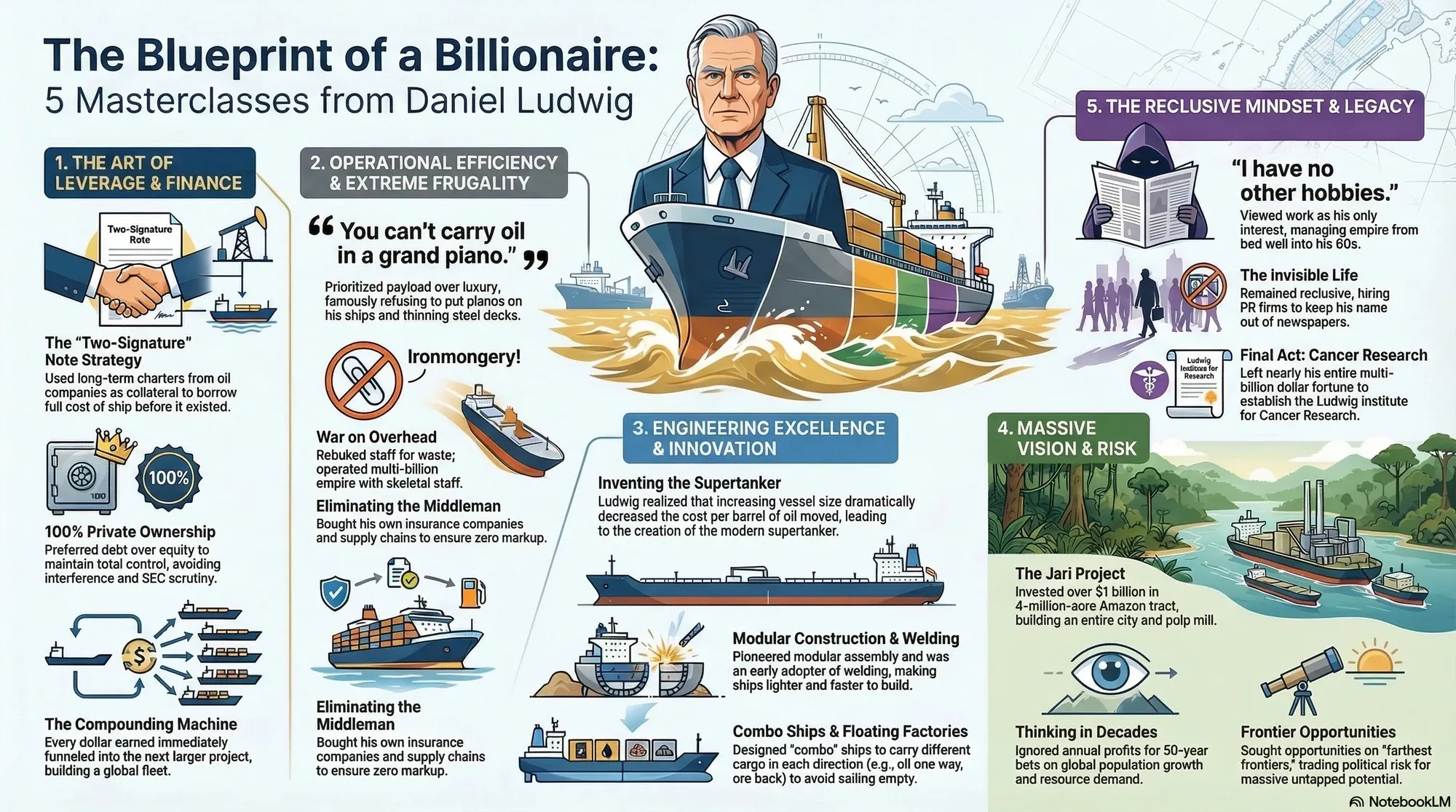
Part 1: The Art of Leverage and Finance
- Charter-Backed Financing: Ludwig arranged long-term oil-company charters before financing new vessels; banks lent against the contracted income stream. — Ludwig Cancer Research — The Making of a Magnate.
- Leveraging Future Earnings: Charter payments serviced the loans over time, leaving Ludwig with owned vessels after the debt was repaid. — Ludwig Cancer Research — The Making of a Magnate.
- Ownership Through Debt: The charter-and-loan structure let Ludwig retain ownership of newly financed ships; it does not mean he held every company in his empire outright. — Ludwig Cancer Research — The Making of a Magnate.
- Recovery From Near Bankruptcy: Early shipping downturns and a failed tanker conversion repeatedly strained Ludwig’s finances before a 1937 vessel sale helped him clear debt and build a staff. — Ludwig Cancer Research — The Making of a Magnate.
- Following Better Freight Economics: After World War I, Ludwig shifted from hauling molasses toward oil when he found tanker freight more profitable. — Ludwig Cancer Research — The Making of a Magnate.
- Relationships Across the System: Contemporary reporting found Ludwig dealing with government leaders and international bankers as well as the captains of his own ships. — TIME — Twilight of a Tycoon.
- A Modest Office: Even as his fleet expanded, a 1957 report described Ludwig’s Manhattan office as modest; the record does not establish a uniformly skeletal workforce. — TIME — The Biggest Tankers.
- Controlled Ownership: He owned many enterprises outright while holding partial stakes in others; contemporary reporting identifies both wholly owned shipping firms and a majority interest in American-Hawaiian Steamship. — TIME — The Biggest Tankers.
- Jurisdictional Structuring: Ludwig used foreign-incorporated shipowning companies, including in Liberia and Panama, where registration and tax treatment could lower operating costs. — TIME — Twilight of a Tycoon.
- Compartmentalized Organization: A former executive described Ludwig’s businesses as separate cells whose members often knew little about the other parts of the empire. — TIME — Twilight of a Tycoon.
Part 2: Operational Efficiency and Extreme Frugality
- Attention to Small Expenses: A Jari project manager recalled Ludwig objecting to the cost of his hotel stay and offering guest quarters instead. — Farid Habeishi — Grateful.
- Lighter Ship Design: Contemporary reporting credits Ludwig with using thinner tanker decks as one way to reduce cost and increase useful load. — TIME — This Man Ludwig.
- Unostentatious Habits: Contemporary reporting and his institution’s history describe Ludwig walking to work and remaining little recognized despite his wealth. — TIME — Twilight of a Tycoon.
- Interchangeable Designs: Ludwig’s tankers used interchangeable parts, reducing construction and maintenance costs and making it easier to move crews between ships. — TIME — Twilight of a Tycoon.
- Overlapping Businesses: When his ships needed insurance, Ludwig established an insurance company; his broader holdings also connected ore shipping, steel supply, ports and refineries. — Ludwig Cancer Research — The Making of a Magnate.
- Austere Ships, Durable Machinery: Ludwig’s tankers omitted many comforts while he invested heavily in mechanical and structural reliability and capable officers. — Ludwig Cancer Research — The Making of a Magnate.
- Finding Value in Salvage: As a child, Ludwig raised and repaired a sunken boat, then chartered it for more than its purchase price. — Ludwig Cancer Research — The Making of a Magnate.
Part 3: Innovation and Engineering Excellence
- Supertanker Scale: Ludwig pursued larger tankers because their operating costs rose less rapidly than capacity; ASME later honored his role in developing the modern supertanker. — Ludwig Cancer Research — The Making of a Magnate.
- Welded Construction: Ludwig used and advanced welded construction in his shipyards; the historical record does not make him the inventor of welding. — Ludwig Cancer Research — The Making of a Magnate.
- Sectional Assembly: At Kure, National Bulk Carriers used prefabrication and sectional pre-assembly to streamline tanker production, with important contributions from its Japanese engineering team. — Ludwig Cancer Research — The Making of a Magnate.
- Combined Cargo Capability: The Kure-built Sinclair Petrolore combined oil transport with self-unloading ore capability; its record does not show that it never sailed empty. — T2Tanker — Sinclair Petrolore.
- Floating Industrial Plant: Ludwig had a pulp mill and power plant built in Japan and towed to Brazil for the Jari project, avoiding the difficulty of constructing them in the remote Amazon. — TIME — Daniel Ludwig’s Floating Factory.
- Businesses Beyond Ships: His holdings expanded into shipyards, insurance, mining, refining, hotels and real estate; some operations served or supplied others. — Ludwig Cancer Research — The Making of a Magnate.
- Engineering Experience: Ludwig’s training in marine engines and hands-on ship conversions became part of the technical foundation of his shipping business. — Ludwig Cancer Research — The Making of a Magnate.
- Attention to Technical Details: A 1963 report described his thin-deck and welded-ship innovations and quoted a Japanese aide recalling that he knew the details of the Kure operation. — TIME — This Man Ludwig.
Part 4: Risk, Vision, and the Jari Project
- The Jari Gamble: Ludwig bought a vast Amazon tract in 1967 to build a forest-products enterprise, committing substantial capital to a pulp plan that later incurred severe losses. — Ludwig Cancer Research — The Making of a Magnate.
- The Limits of Persistence: Despite warnings and growing political obstacles, Ludwig continued the Jari project until 1982; the institutional history estimates losses approaching $1 billion in 1981 dollars. — Ludwig Cancer Research — The Making of a Magnate.
- Resource Businesses: Alongside shipping, Ludwig developed salt production in Mexico and interests in Australian coal, iron and oil; the record does not prove a stated belief that resources were the only source of wealth. — Ludwig Cancer Research — The Making of a Magnate.
- Long-Horizon Development: Ludwig bought the Westlake Village ranch before a nearby highway was built, anticipating that access and proximity to Los Angeles would support a major planned community. — Ludwig Cancer Research — The Making of a Magnate.
- Geographic Breadth: His holdings spanned Panama, Bermuda, Mexico, Australia and other markets, though no inspected original supports the profile’s specific Middle Eastern oil-well example. — Ludwig Cancer Research — The Making of a Magnate.
- Infrastructure for Jari: At Jari, Ludwig’s organization built roads, worker housing, a hospital and a school to support the remote industrial operation. — TIME — Ludwig’s Wild Amazon Kingdom.
Part 5: The Reclusive Mindset and Work Ethic
- Business as His Main Interest: The institutional history reports that Ludwig described having no hobbies or interests beyond business; this is a paraphrase, not an authenticated quotation. — Ludwig Cancer Research — The Making of a Magnate.
- Deliberate Privacy: Ludwig worked to keep his name out of the press and lived with a far lower public profile than his fortune might suggest. — Ludwig Cancer Research — The Making of a Magnate.
- Impatience With Small Talk: Accounts from a longtime acquaintance and the institute describe Ludwig as impatient with small talk, although not literally every conversation was about work. — TIME — Twilight of a Tycoon.
- Early Partnerships: Despite his later reputation as a lone operator, Ludwig enlisted partners in some early tanker ventures. — Ludwig Cancer Research — The Making of a Magnate.
- Cancer Research Legacy: Ludwig established his cancer-research institute in 1971 with major international holdings; his estate later funded separate U.S. cancer-research centers. — Ludwig Cancer Research — History.
Learn more:
- Ludwig Cancer Research — The Making of a Magnate
- TIME — Twilight of a Tycoon
- TIME — This Man Ludwig
- TIME — Ludwig’s Wild Amazon Kingdom
- TIME — Daniel Ludwig’s Floating Factory
- ASME — Sperry Award Record
- Ludwig Cancer Research — History
- T2Tanker — Sinclair Petrolore
- Los Angeles Times — Ludwig Obituary
- TIME — The Biggest Tankers
- Farid Habeishi — Grateful