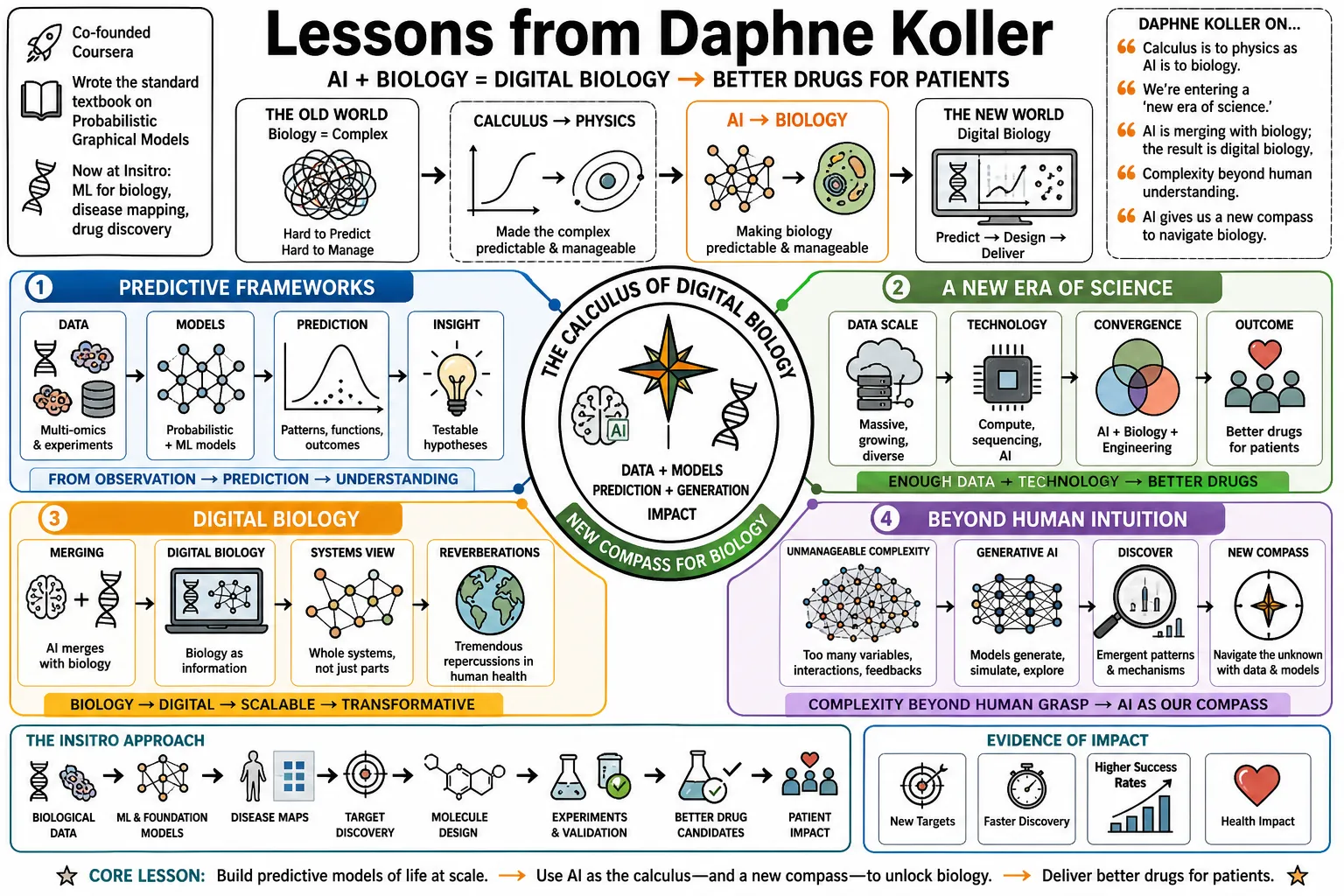
Lessons from Daphne Koller
Daphne Koller co-founded Coursera, coauthored Probabilistic Graphical Models with Nir Friedman, and founded insitro, where she combines machine learning with human biological data and experiments to investigate disease. — Regeneron Nucleus Podcast.
Part 1: The Calculus of Digital Biology
- Predictive frameworks: Koller compares AI for biology to calculus for physics: measurement and predictive models may make some biological outcomes more tractable, though not perfectly predictable. — Fortune Leadership Next.
- The new era: Koller argues that larger, more useful biological datasets and improved measurement tools make a different approach to drug discovery possible; she presents this as an opportunity, not an accomplished industry-wide result. — McKinsey Interview.
- Digital biology: Koller describes digital biology as combining fine-scale biological measurement with machine learning and then using experimental tools to intervene in biological systems. — a16z Digital Biology.
- Unmanageable complexity: Koller says modern measurements can produce biological patterns and dimensions that people cannot readily integrate unaided; machine learning can interrogate those datasets. — Regeneron Nucleus Podcast.
- A new compass: Koller likens models built from extensive data to compasses that can improve choices at drug-discovery decision points; she does not claim they guarantee success. — McKinsey Interview.
- Human limitations: Koller distinguishes machine learning that finds subtle patterns in cells or DNA from tasks humans can perform by inspection alone. — Regeneron Nucleus Podcast.
- Bits meeting atoms: In digital biology, models must connect to physical experiments and human biology; computation alone cannot establish whether an intervention works. — a16z Digital Biology.
- Accelerating testing: Koller describes human-derived cell systems as a relatively rapid way to test candidate interventions; this does not compress the full clinical-development process into weeks. — McKinsey Interview.
- The data tidal wave: Koller points to converging advances in biological measurement and machine learning that make large, detailed datasets newly useful for discovery. — Regeneron Nucleus Podcast.
- Defining disease: Insitro tries to separate patient groups that share symptoms but have different underlying disease mechanisms, using imaging, molecular data and cell experiments. — McKinsey Interview.
Part 2: Fixing Drug Discovery
- Failure rates: Koller puts late-stage clinical success in a range of roughly five to ten percent in this interview and argues that many failures originate in earlier biological assumptions. — Possible Podcast.
- The primary goal: Koller aims to improve the quality of decisions and the eventual success rate in drug discovery, not merely to make failed experiments run faster. — McKinsey Interview.
- Clinical trial waste: Koller describes using patient imaging and molecular data to identify biologically distinct subgroups; this may inform which interventions to test, rather than guarantee trial success. — McKinsey Interview.
- Engineering medicine: Koller wants a more engineered drug-discovery process in which data helps identify likely productive paths and improve the odds of useful treatments. — McKinsey Interview.
- Disease-in-a-dish: Insitro uses human-derived induced pluripotent stem cells, differentiates them into relevant cell types and tests possible interventions; these models complement rather than replace human trials. — McKinsey Interview.
- Closing the loop: Koller describes perturbing cells, measuring the result and using machine learning to guide further questions, joining computational and physical experiments. — Regeneron Nucleus Podcast.
- Early intervention: Koller wants to move beyond broad symptom labels toward biological causes and disease-relevant patient groups. — McKinsey Interview.
- Reversing Eroom’s Law: Koller cites Eroom’s Law as a description of rising drug-discovery cost without matching output and proposes ML as one route to better decisions; reversal is a goal, not a demonstrated industry result. — McKinsey Interview.
- The gender data gap: Koller warns that male-skewed clinical datasets and unmodeled sex-related variation can bias conclusions; she calls for accounting for sex and other covariates, without assigning a universal effect size to all drugs. — WEF Meet the Leader.
Part 3: The Importance of Data Quality
- Data infrastructure: Koller says AI systems need investment in data collection, aggregation and quality; powerful models can learn artifacts as readily as useful signal. — WEF Meet the Leader.
- Biological data realities: Koller cautions that stronger algorithms can amplify both meaningful biological patterns and artifacts created by noisy or inconsistent data. — WEF Meet the Leader.
- Haphazard data collection: Koller warns that combining datasets collected under inconsistent assays and definitions can create misleading models whose errors surface only later in expensive trials. — McKinsey Interview.
- Web-scale limitations: Koller contrasts early biomedical datasets of a few hundred samples with today’s larger cohorts and purpose-built measurements; useful biological data still require deliberate collection. — McKinsey Interview.
- Generating novel data: Insitro combines selected public datasets with complementary data it generates in-house, enabling experiments that can probe causality. — McKinsey Interview.
- Avoiding artifacts: Before modeling, Koller checks whether outcomes correlate with batch, day or instrument; such associations can reveal experimental artifacts. — WEF Meet the Leader.
- Tight coupling: Koller argues that biological datasets are most valuable when computation and experiments inform one another throughout a project. — a16z Digital Biology.
- Resolution: Advances such as single-cell sequencing, super-resolution microscopy and proteomics now measure aspects of disease biology in greater detail. — McKinsey Interview.
Part 4: Navigating Uncertainty with Probabilistic Models
- The probabilistic framework: Koller and Friedman present graphical models as a general framework for representing complex uncertain systems and reasoning from available evidence. — MIT Press PGM Book.
- Modeling reality: Because observations are partial and noisy, probabilistic models explicitly represent uncertainty instead of treating every relationship as deterministic. — MIT Press PGM Book.
- The zero-probability trap: A rare event should not automatically be modeled as impossible: probability models preserve low-likelihood possibilities for later evidence to update. — MIT Press PGM Book.
- Solving two problems: A graphical representation uses variables and their interactions to describe a high-dimensional probability distribution compactly. — MIT Press PGM Book.
- Interpretable AI: Graphical models make represented probabilistic relationships inspectable; those relationships are not automatically causal without additional assumptions or interventions. — MIT Press PGM Book.
- Structured environments: Koller describes combining logic’s relational expressiveness with probabilistic reasoning to represent networks of interacting entities. — ACM Interview.
- Medical diagnosis applications: A diagnostic model can combine uncertain symptoms, tests and patient characteristics to compare possible diseases without treating one noisy sign as decisive. — MIT Press PGM Book.
- Early skepticism: Koller recalls that probability-oriented AI was seen as fringe in the early 1990s, before machine learning became central to the field. — Regeneron Nucleus Podcast.
- Continuous learning: Koller argues that systems which learn from accumulating observations offer a more promising route to useful intelligence than manually entering facts alone. — Daily Maverick Interview.
Part 5: Transforming the Classroom
- Outdated models: Koller argues that long lectures with passive listeners are an insufficient default when technology can free class time for engagement and practice. — TEDGlobal 2012 Talk.
- Active engagement: Koller emphasizes practice and feedback rather than passive video viewing; the familiar vessel-and-fire aphorism is not presented as her original insight. — TEDGlobal 2012 Talk.
- The flipped classroom: Move some content delivery online and use scarce classroom time for interaction with students and active learning. — TEDGlobal 2012 Talk.
- Data-driven teaching: Online platforms can reveal patterns in how students learn from clicks, submissions and discussion, complementing rather than replacing hypothesis-driven education research. — TEDGlobal 2012 Talk.
- Teaching to the medium: Design online lessons as short coherent modules with practice and feedback rather than posting an unchanged hour-long lecture. — TEDGlobal 2012 Talk.
- Mastery learning: Digital systems can let learners repeat material and demonstrate mastery before moving on; Koller presents this as a possibility to develop, not automatic mastery for every student. — TEDGlobal 2012 Talk.
- Benjamin Bloom’s 2-sigma problem: Koller invokes Bloom’s comparison of lecture, mastery-based and individual tutoring to motivate scalable personalization; she frames technology as a way to explore the gap, not proof that it matches tutors. — TEDGlobal 2012 Talk.
- Hybrid models: Koller argues against simply reverting to pre-pandemic lectures; well-designed hybrid learning can combine flexibility with active peer and instructor engagement. — Daphne Koller in THE.
- Removing the lecture burden: If digital lessons carry some content delivery, instructors can spend more face-to-face time guiding discussions, addressing confusion and coaching students. — TEDGlobal 2012 Talk.
Part 6: Democratizing Opportunity & Lifelong Learning
- The right to learn: Koller frames broad access to high-quality education as a potential right rather than a privilege, while recognizing technology alone does not erase all barriers. — TEDGlobal 2012 Talk.
- Hidden potential: In discussing the Coursera mission, Koller asks whether undiscovered talent in remote places could flourish with access to strong teaching. — Coursera TEDGlobal Report.
- Opening doors: Online courses can open educational opportunities for learners who cannot reach high-quality in-person instruction; access is a possibility, not a guarantee of completion. — TEDGlobal 2012 Talk.
- Continuous skills: Koller argues that widely available courses can support learning after school or college, whether for curiosity or career change. — TEDGlobal 2012 Talk.
- Degree obsolescence: Koller warns that skills learned years earlier may not fit a later job, making continuing education important; the 15-year number is an example, not a universal expiry date. — Recode Decode Interview.
- Bridging the skills gap: Koller connects rapidly changing job requirements with the need for accessible courses that help workers refresh relevant skills. — Recode Decode Interview.
- Motivation as a credential: In a 2012 interview, Koller argued that completing rigorous courses could demonstrate motivation and skills to employers; that is a historical claim about a possible signal, not proof all certificates improve jobs. — AFP Coursera Interview.
- Universal talent: Koller argues that ability exists far beyond elite campuses while access to instruction is uneven; scalable courses may help more learners use their potential. — TEDGlobal 2012 Talk.
- Upskilling the educated: Koller notes that people who already attended college may still need later skill refreshes for changing jobs. — Recode Decode Interview.
- Silicon Valley ethos: In a 2012 Coursera interview, Koller described a then-common Silicon Valley hope that a highly engaging site could find a sustainable revenue model later; this was a historical startup view, not a general law. — Marketplace Interview.
Part 7: Building a "Bilingual" Culture
- Bridging disciplines: Koller says life scientists and ML specialists start with different languages and habits; integrated teams need deliberate translation and a shared vision. — a16z Digital Biology.
- Speaking both languages: Koller saw an opportunity to bridge life sciences and machine learning because few people worked fluently across both domains. — a16z Digital Biology.
- Early collaboration: Insitro organizes cross-functional project teams so biologists and computational experts engage early instead of waiting for a finished dataset to be handed over. — a16z Digital Biology.
- Hiring for humility: Koller looks for people willing to learn across disciplines and to ask naive questions respectfully; a few bilingual colleagues can also translate between specialties. — Future Interview.
- Structural parity: Insitro set behavioral norms for people with different expertise to engage openly, constructively and respectfully rather than becoming second-class disciplines. — McKinsey Interview.
- The 50/50 split: Koller emphasizes interdisciplinary translators and cross-functional teams; the inspected sources do not establish a mandatory 50/50 staffing ratio between life scientists and computational engineers. — a16z Digital Biology.
- Organizational synthesis: Koller argues that joint work can combine biological questions, machine-learning methods and experimental design into a shared workflow rather than treating them as separate specialties. — a16z Digital Biology.
Part 8: Leadership & Navigating the Unknown
- Culture over technology: Koller says models and tools change, while people and the culture that attracts and enables them can persist. — Big Think+ Video.
- Defining high performance: Koller prizes a culture of collaboration, innovation, boldness and moving quickly; she presents these as organizational capabilities that outlast one technology. — Big Think+ Video.
- Dealing with chaos: Koller and Friedman design probabilistic models for noisy, incomplete observations rather than pretending complex real-world systems are certain. — MIT Press PGM Book.
- Persistence: Koller recalls starting Coursera despite unfamiliar obstacles and recommends moving forward rather than waiting for complete certainty. — Coursera Interview.
- Human-machine collaboration: Koller expects people and machines to work together; AI may displace some tasks, but she still sees human creativity and innovation as important. — Fortune Leadership Next.
- Testing AI personally: In a Big Think+ clip, Koller urges leaders to try AI themselves so they can understand its capabilities before directing organizational change. — Big Think+ Clip.
- Picking partners: In advice addressed to women balancing family and career, Koller says a supportive life partner can be crucial; it is personal guidance, not a universal rule for every career. — HuffPost Interview.
- Leaving academia: Koller says she left academia partly because she wanted to affect the world more directly than through papers or students alone, and Coursera’s early reach made the opportunity concrete. — Future Interview.
- The academic scaling trap: Koller contrasts academia’s more free-form research with industry’s need for durable, reusable work that teammates can build on; the inspected interview does not support a fixed employee-count threshold. — Future Interview.