Dave Kline, a former Bridgewater executive, teaches practical management systems through MGMT Accelerator and his MGMT Playbook. His work focuses on delegation, expectations, feedback, team performance and leadership habits. — MGMT Accelerator.
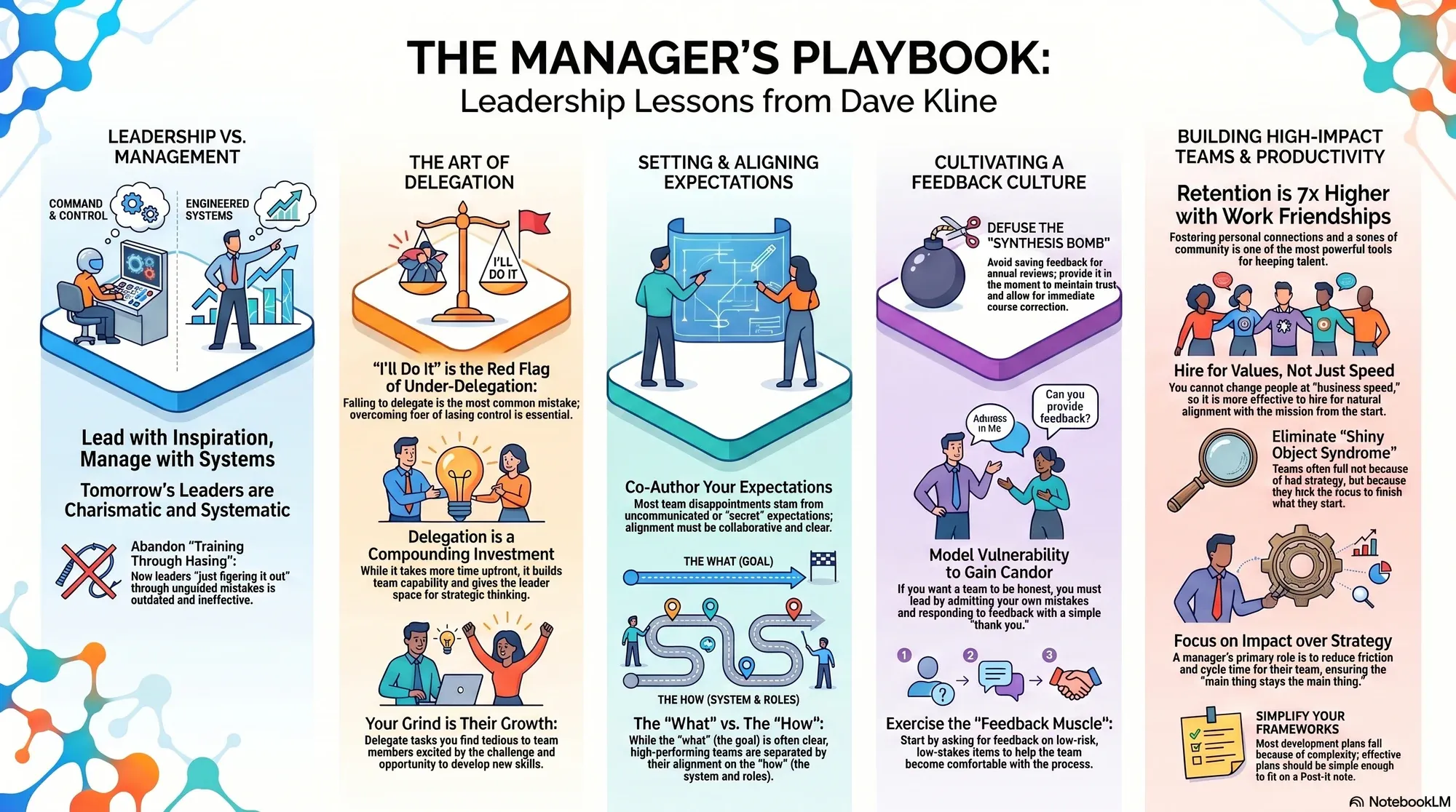
On Leadership vs. Management
- Separate Management From Leadership: Management systems coordinate work; leadership also asks people to commit to a direction and perform beyond what a command-and-control approach alone can achieve. — The Knowledge — Dave Kline.
- Be Kind, Not Merely Nice: Kline distinguishes kindness from conflict avoidance: candid, respectful challenges can help someone grow even when the conversation is uncomfortable. — SYCK Career Podcast — Dave Kline.
- Move From Intuition to Intention: Leadership improves when managers articulate deliberate expectations and practices instead of relying only on instinct. — The Knowledge — Dave Kline.
- Be Charismatic and Systematic: Kline and Marsden position effective leadership as both inspiring people and building repeatable management systems. — MGMT Accelerator.
- Design Team Culture Deliberately: Culture is expressed through everyday behavior, and leaders should choose and reinforce the norms that fit their team rather than let those norms form unnoticed. — MGMT Playbook — Team Culture.
- Do Not Train Leaders by Hazing: Kline criticizes leaving new managers to figure out leadership through unguided mistakes; management skills can be taught and practiced. — The Knowledge — Dave Kline.
- Build a Management Operating System: The execution habits that made someone a strong individual contributor may cap their impact as a manager unless they build a repeatable system for team leadership. — MGMT Playbook — Operating System.
- Manage Up Using Information: Kline observes that a boss may hold more authority while the manager closest to the work holds more information; use that knowledge to frame useful proposals. — MGMT Playbook — Corporate Jiu Jitsu.
On Delegation
- Notice the “I’ll Do It” Trap: When a manager routinely says “That’s okay, I’ll do it,” they may prevent their team from taking ownership and learning the work. — Run the Numbers — Dave Kline.
- Treat Delegation as an Investment: Giving someone ownership may require more explanation initially, but it builds the team’s future capacity instead of keeping the manager as the bottleneck. — MGMT Playbook — Leader as Matchmaker.
- Make Your Grind Someone Else’s Growth: A task that drains the manager may stretch a teammate; match work to people who can learn from owning it. — Behind the Craft — Dave Kline.
- Delegate Until It Stretches You: Kline urges managers to delegate more ambitious work, freeing time for strategic responsibilities while giving team members room to develop. — Behind the Craft — Dave Kline.
- Name the Fear Behind Micromanagement: Managers may retain tasks because they fear losing control or distance from their craft; recognizing that fear helps them delegate deliberately. — Behind the Craft — Dave Kline.
- Give Autonomy With Clear Boundaries: Delegation works best when the outcome, quality bar, timeline and decision rights are explicit, with oversight calibrated to the person and task. — Dave Kline — Delegation.
On Setting Expectations
- Coauthor Expectations: Kline asks managers and employees to agree on clear expectations instead of leaving success criteria implicit. — Run the Numbers — Dave Kline.
- Specify the How as Well as the What: A team can agree on an outcome yet still need a shared approach and clear roles to execute well. — Run the Numbers — Dave Kline.
- Avoid Secret Expectations: Unspoken assumptions can create avoidable disappointment; articulate standards before judging someone against them. — Run the Numbers — Dave Kline.
- Set Expectations Collaboratively: Kline proposes a short, collaborative expectations exercise covering outcomes and approach rather than a vague job description. — MGMT Playbook — Clear Expectations.
- Reward Outcomes, Not Mere Effort: Kline argues that visible busyness should not outweigh meaningful results when evaluating work. — MGMT Playbook — Effort vs Outcomes.
On Feedback
- Give Feedback Before Reviews: Kline warns that withholding observations until a formal review creates a “synthesis bomb”; discuss issues close to when they happen. — Future of HR — Dave Kline.
- Thank People for Constructive Feedback: His direct interview advises receiving criticism without immediate defensiveness and thanking the person who offered it. — Behind the Craft — Dave Kline Interview.
- Model Candor Yourself: If a leader wants a candid and vulnerable team, they must admit their own mistakes and share honest feedback first. — Culture of Feedback and Safety — Dave Kline.
- Use Feedback to Learn: Kline says he received 12,385 feedback observations during his Bridgewater tenure; he presents that environment as a way to surface improvement opportunities. — MGMT Playbook — Honest Feedback.
- Practice Giving Low-Stakes Feedback: Kline uses requests for feedback on his course as a way for participants to exercise the habit of candid response in a lower-stakes setting. — Growth in Reverse — Dave Kline.
On Team and Culture
- Look for the Right A-Player Context: Kline argues that people can perform differently across environments; leaders should match strengths, training and context rather than assume talent is fixed. — Dave Kline — Management Non-Negotiables.
- Hire for Alignment Before Coaching: Kline says the easier path to a strong team is to hire people whose values, mission interest and capabilities already fit the work. — Run the Numbers — Dave Kline.
- Finish the Right Initiatives: Kline calls repeated shifts to new initiatives “shiny object syndrome”; define done and protect the current bottleneck before starting more work. — MGMT Playbook — Shiny Object Syndrome.
- Build a Compatible Team Subculture: A team can develop its own mission and norms while remaining compatible with the larger organization’s values. — The Knowledge — Dave Kline.
- Connect Safety to Shared Purpose: In his safety discussion, Kline links a common purpose with the willingness to move through the discomfort of candid feedback. — Culture of Feedback and Safety — Dave Kline.
- Help Colleagues Form Connections: Kline encourages managers to help employees develop friendships and a sense of community at work. — Run the Numbers — Dave Kline.
- Diagnose the Team Before Replacing People: Kline says “Do I have the right people?” is the wrong first question; clarify the game and system before judging individual fit. — MGMT Playbook — Right Team.
- Pair Safety With Productive Discomfort: High-performing teams need enough safety to speak up and enough candor to challenge complacency. — MGMT Playbook — Psychological Safety.
On Hiring and Promotions
- Hire for Values and Capability: Kline favors candidates aligned with a team’s values and mission who also have, or can build, the required capabilities. — Run the Numbers — Dave Kline.
- Diagnose Before Adding Headcount: Kline warns that extra people can add coordination complexity; first ask what to stop, simplify or automate. — Dave Kline — More People Paradox.
- Make Promotion Work Visible: Good work matters, but Kline also advises helping the relevant decision-makers understand its impact. — Behind the Craft — Dave Kline Interview.
- Identify Promotion Decision-Makers: At different companies the relevant audience may be a CEO or committee; understand who evaluates advancement and what evidence they use. — Behind the Craft — Dave Kline Interview.
- Do Not Surprise Your Manager: Kline advises communicating goals and problems early so a manager can support progress instead of being blindsided. — Behind the Craft — Dave Kline Interview.
- Win the First Two Onboarding Weeks: Kline argues that the early weeks set the feedback pattern for a new hire, even when a full ramp takes longer. — MGMT Playbook — Onboarding.
- Reward Prevention, Not Heroics: Evaluate people for preventing recurring problems, not just for visible late-night rescues after problems escalate. — MGMT Playbook — Effort vs Outcomes.
On Personal Growth and Self-Awareness
- Understand Your Own Strengths and Biases: Self-awareness helps a leader decide when to step in, when to rely on others and how personal biases affect those judgments. — The Knowledge — Dave Kline.
- Do Not Assume You Are Best at Every Task: Kline challenges managers who micromanage because they believe they can do each job best; rely on the team’s strengths. — The Knowledge — Dave Kline.
- Go Beyond the Minimum Strategically: Kline argues that some career rewards follow demonstrated contribution; selectively take on work that builds the role you want without saying yes to everything. — MGMT Playbook — Career Boundaries.
- Own Your Development: Do not wait for a manager to design your career path; identify the next capability and build a repeatable development system. — MGMT Playbook — CEO of You.
- Treat Influence as a Project: Kline says influence can be built deliberately by understanding stakeholders, earning trust and communicating for impact. — MGMT Playbook — Power Project.
On Productivity and Impact
- Reduce Friction to Increase Impact: Kline frames a manager’s value in terms of team impact and removing friction that slows the work. — Future of HR — Dave Kline.
- Focus on the Main Thing: Kline explicitly cites Ray Dalio’s principle that one can pursue many possibilities but not all of them, using it to argue for focus. — Behind the Craft — Dave Kline Interview.
- Choose Work That Compounds: Kline distinguishes simply executing, improving a task and changing the system so future work gets easier. — Run the Numbers — Dave Kline.
- Teach Through Application: Kline’s management program pairs frameworks with short practical exercises so participants can apply them to their own work. — MGMT Accelerator.
- Persuade Rather Than Dominate the Room: Kline argues that the ability to win support depends more on clear, audience-aware persuasion than volume. — MGMT Playbook — AI-Powered Influence.
- Surface the Gap Before Pushing Change: Kline advises helping colleagues see the gap between current and expected performance, then coauthoring a small experiment instead of imposing a solution. — MGMT Playbook — Leading Change.
- Keep Development Plans Simple: Kline proposes three bullets—a capability gap, an action plan and a review—rather than a long document few people use. — MGMT Playbook — Three-Bullet Plans.
- Onboard Yourself as a New Manager: A new manager should plan their first 90 days, learn the team’s reality and pursue early wins instead of waiting for HR to direct the transition. — MGMT Playbook — Onboard Yourself.
- Diagnose Root Causes: Kline recommends using the symptom as a signal and tracing the underlying cause before selecting a fix. — MGMT Playbook — Better at Getting Better.
- Allocate Leadership Attention Deliberately: Kline urges leaders to balance long-term strategy with present operational needs so neither strategic thinking nor daily guidance disappears. — MGMT Playbook — Leadership Energy.
- Connect Work to Meaningful Impact: Kline says motivation is stronger when people can see impact they care about and how their work connects to the mission. — Run the Numbers — Dave Kline.
- Do Not Use Planning to Avoid Shipping: Kline warns that repeated roadmap refinement can become disguised procrastination when the team ships nothing. — MGMT Playbook — Planning Hack.
- Use AI for Leadership Work: Kline argues that AI can help managers prepare for feedback, synthesize context and focus attention beyond basic drafting tasks. — MGMT Playbook — Superhuman Leadership.
- Use AI to Free Higher-Value Management Time: Kline’s AI argument is to automate coordination and routine information work so managers spend more time on judgment and people leadership. — MGMT Playbook — AI and Managers.
- Do Not Hide in Coordination Work: Kline argues that AI exposes managers whose contribution is mostly status reporting and email forwarding rather than judgment and team leadership. — MGMT Playbook — AI and Managers.
- Value Faster Problem-Solving Over Face Time: Kline’s outcome-based approach rewards useful results rather than the appearance of effort, such as being first in the office. — MGMT Playbook — Effort vs Outcomes.
Learn more:
- Dave Kline (ex-Bridgewater): How to Manage Up and Build High Impact Teams
- MGMT Fundamentals by Dave Kline and Marsden Kline on Maven
- Building Your Management Playbook — Future of HR Podcast
- World-class leadership playbook with Dave Kline - YouTube
- Establish Clear Employee Expectations in Under an Hour — MGMT Playbook
- The #1 Killer of Great Teams: Shiny Object Syndrome — MGMT Playbook
- The Path to Effective Leadership with Dave Kline - YouTube
- The Path to Effective Leadership with Dave Kline - The Knowledge
- Leadership Lessons from Bridgewater Associates and More — SYCK Career Podcast
- MGMT Accelerator: AI-Enhanced Leadership by Dave Kline and Marsden Kline on Maven
- From High-Flying Corporate Career To Creator With Sold-Out Courses w/ Dave Kline | MGMT Accelerator - YouTube
- Proven Tactics to 10x Your Impact as a Leader | David Kline (ex-Bridgewater) - YouTube
- Delegation Is Not About Handing Off Work — Dave Kline
- The Ultimate People Manager's Playbook with Dave Kline - YouTube
- Creating a Culture of Feedback and Safety with David Kline - YouTube
- How to Give Honest Feedback That Drives High Performance - MGMT Playbook
- How Dave Kline Built a Million Dollar Business With <30k Subscribers - Growth in Reverse
- Corporate Jiu Jitsu: How to Turn Your Boss’ Strength Into Leverage — MGMT Playbook
- The More People Paradox — Dave Kline