Dave Snowden created the Cynefin framework and originated SenseMaker. His work on complexity and sensemaking asks leaders to distinguish contexts before choosing how to act. — The Cynefin Company — Dave Snowden.
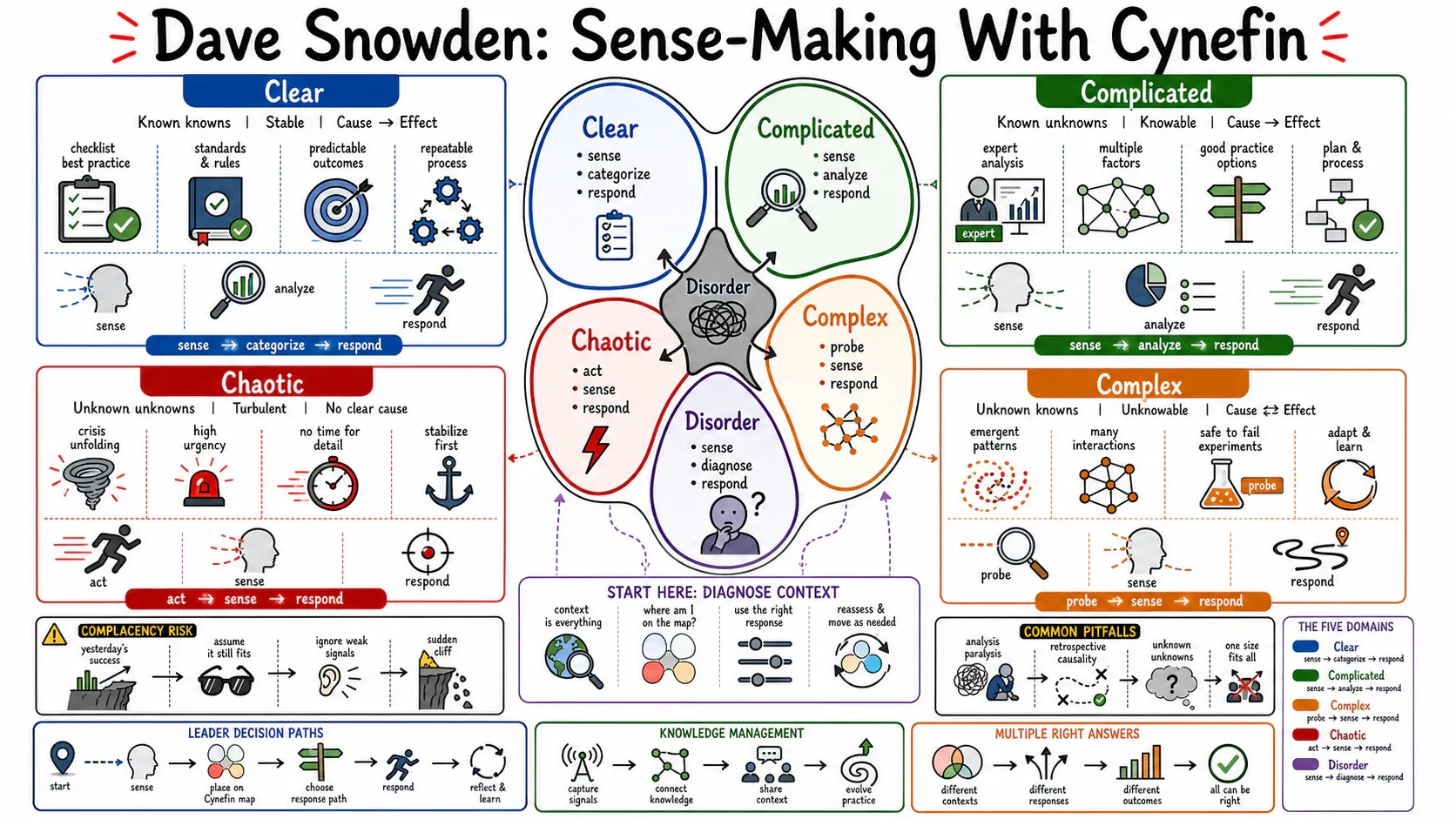
Lesson 1: Not All Problems Are the Same — Understand Your Context
Cynefin distinguishes contexts with different patterns of causality and different appropriate responses. Its domain names have evolved over time; the framework is a sensemaking aid, not one universal management recipe. — Cynefin as of St David’s Day.
- Clear (formerly Simple or Obvious): Where cause and effect are self-evident and the situation is stable, use established best practice: sense the situation, categorize it, and respond. First check that the context really is clear rather than forcing a complex problem into a familiar rule. — Cynefin, St David’s Day 2019.
- Complicated: Cause and effect can be understood through analysis or expertise, and more than one sound practice may exist. Sense, analyze, then respond; consult relevant experts rather than assuming a single obvious answer. — Cynefin, St David’s Day 2019.
- Complex: Causal patterns become clearer retrospectively, so deterministic prediction is limited. Run multiple coherent, survivable probes, observe emerging patterns, then amplify helpful effects and dampen harmful ones. — 7 Principles of Intervention.
- Chaotic: When no usable causal pattern is discernible, a crisis may require prompt action to establish enough constraints to regain sensemaking. Snowden also describes bounded uses of chaos for innovation; not every chaotic setting is an emergency. — Chaos & Disorder.
- Confused (formerly Disorder): Recognize when it is not yet clear which domain applies, or when the situation is moving between domains. Pause the habitual response and gather enough context to choose an appropriate approach. — Disabling Disorder.
Lesson 2: "Sense-Making" Precedes Decision-Making
Sensemaking is about interpreting a situation well enough to take context-appropriate action, not waiting for perfect information. Snowden draws on naturalistic approaches that take real human cognition and constraints seriously. — Twelfetide 2011.
- Naturalistic Sensemaking: Snowden uses insights from natural sciences and naturalistic decision-making as constraints on method. People often recognize patterns under real conditions rather than surveying every possible option. — Twelfetide 2011.
- First-Fit Pattern Recognition: Drawing on Gary Klein’s research, Snowden describes how experienced decision-makers may recognize a workable pattern and test a first plausible response rather than optimize across every theoretical alternative. This is a description of cognition, not a rule to accept any first idea. — Managing for Serendipity.
Lesson 3: In Complexity, You Manage the Constraints, Not the People
In complex settings, leaders can shape constraints and run monitored interventions, but cannot count on a fully predetermined path from cause to outcome. — 7 Principles of Intervention.
- Enabling Constraints: Set boundaries that let people interact and discover workable patterns, while monitoring effects. Snowden contrasts such enabling constraints with directing every local decision from the top. — My Bit in the Flow Book.
- Shape Interactions and Conditions: Instead of prescribing each individual action, leaders can alter the conditions and coordination through which many local decisions are made; emerging patterns then become visible through feedback. — My Bit in the Flow Book.
- Explore the Adjacent Possible: Map the present situation, identify a nearby more desirable pattern, act, and reassess with feedback. In complex change, this is more reliable than assuming a detailed distant outcome is already knowable. — The Adjacent Possible.
Lesson 4: Narrative and Micro-Stories are Critical Data
Short first-person accounts can reveal situated experiences, patterns, and weak signals that a predetermined category may miss. SenseMaker combines such narratives with participants’ own interpretations; stories are evidence to examine, not guaranteed truth. — SenseMaker.
- Narrative as a Sensing Network: Distributed short accounts from people close to events can help an organization notice patterns and weak signals. Leaders should interpret those signals with context rather than treat a few anecdotes as a precise forecast. — SenseMaker.
- Participants Interpret Their Own Accounts: SenseMaker asks contributors to signify their own short experiences. This preserves their perspective and makes large-scale pattern exploration possible, while still requiring careful interpretation. — Describe, Don’t Evaluate.
- Stories Preserve Decision Context: Snowden argues that narrative can surface tacit, contextual knowledge that decontextualized direct questions may miss. Use stories alongside other evidence; do not assume they are always more accurate than a survey. — Managing for Serendipity.
Lesson 5: Design for Resilience, Not Robustness (Safe-to-Fail, Not Fail-Safe)
Snowden distinguishes robustness from resilience: a robust arrangement resists change, while a resilient one can change and retain its identity. The right design depends on context, and complex interventions should be survivable when they fail. — The R Words.
- Robustness Versus Resilience: In Snowden’s terms, robustness means continuing without changing; resilience means adapting while retaining identity. A sea wall and a salt marsh illustrate different strategies, not proof that every robust system is brittle. — Resilience.
- Safe-to-Fail Probes: In a complex domain, try several coherent interventions whose individual failure can be survived. Monitor outcomes, dampen harmful effects, and amplify promising patterns; do not confuse safe-to-fail with guaranteed success. — 7 Principles of Intervention.
Lesson 6: Leadership is Contextual and Often Indirect
Leadership should fit the context. Some moments call for decisive action; others call for creating conditions in which people closer to the situation can make informed local decisions. — New Thought Piece.
- Do Not Centralize Every Decision: Snowden has argued that senior leaders deciding everything is often a sign of failure. In crises, however, he also describes rapid initial decisions followed by distributed action and centralized coordination; the lesson is contextual, not an absolute ban on leaders deciding. — Dave Snowden on Crisis Leadership.
- Distribute Decisions, Coordinate Centrally: Many context-rich micro-decisions can be made close to the work, with escalation when exceptions arise. Leaders can coordinate the whole without requiring approval for every local action. — Distributed Decision-Making.
- Leaders as Pattern Sensors: Use people across the organization as a sensing network for weak signals and emerging patterns. Leaders then coordinate responses and manage constraints instead of relying only on detached central analysis. — My Bit in the Flow Book.
Sources
- The Cynefin Company — Dave Snowden
- Harvard Business Review — A Leader’s Framework for Decision Making
- The Cynefin Company — Cynefin as of St David’s Day 2019 (1 of 5)
- The Cynefin Company — Cynefin, St David’s Day 2019 (2 of 5)
- The Cynefin Company — Chaos & Disorder
- The Cynefin Company — Disabling Disorder
- The Cynefin Company — 7 Principles of Intervention in Complex Systems
- The Cynefin Company — The Adjacent Possible
- The Cynefin Company — My Bit in the Flow Book
- The Cynefin Company — SenseMaker
- The Cynefin Company — Describe, Don’t Evaluate
- The Cynefin Company — The R Words
- The Cynefin Company — Resilience
- The Cynefin Company — Resilience Is Sinuous
- The Cynefin Company — New Thought Piece
- Red Team Thinking — The Thinking Leader: Dave Snowden
- Red Team Thinking — Dave Snowden on Four Things Leaders Need to Do in a Crisis
- The Cynefin Company — Distributed Decision-Making: Flagging a New Area of Development
- The Cynefin Company — Twelfetide 2011: Coherent to What?
- Dave Snowden — Managing for Serendipity (paper)