As Waymo's co-CEO, Dmitri Dolgov turned Google's self-driving project from an experiment into a commercial ride-hailing business. He argues that full autonomy requires verifiable AI systems rather than pure end-to-end learning. This profile examines his decisions on sensor fusion, simulation scale, and hardware design to explain how driverless fleets actually operate in cities.
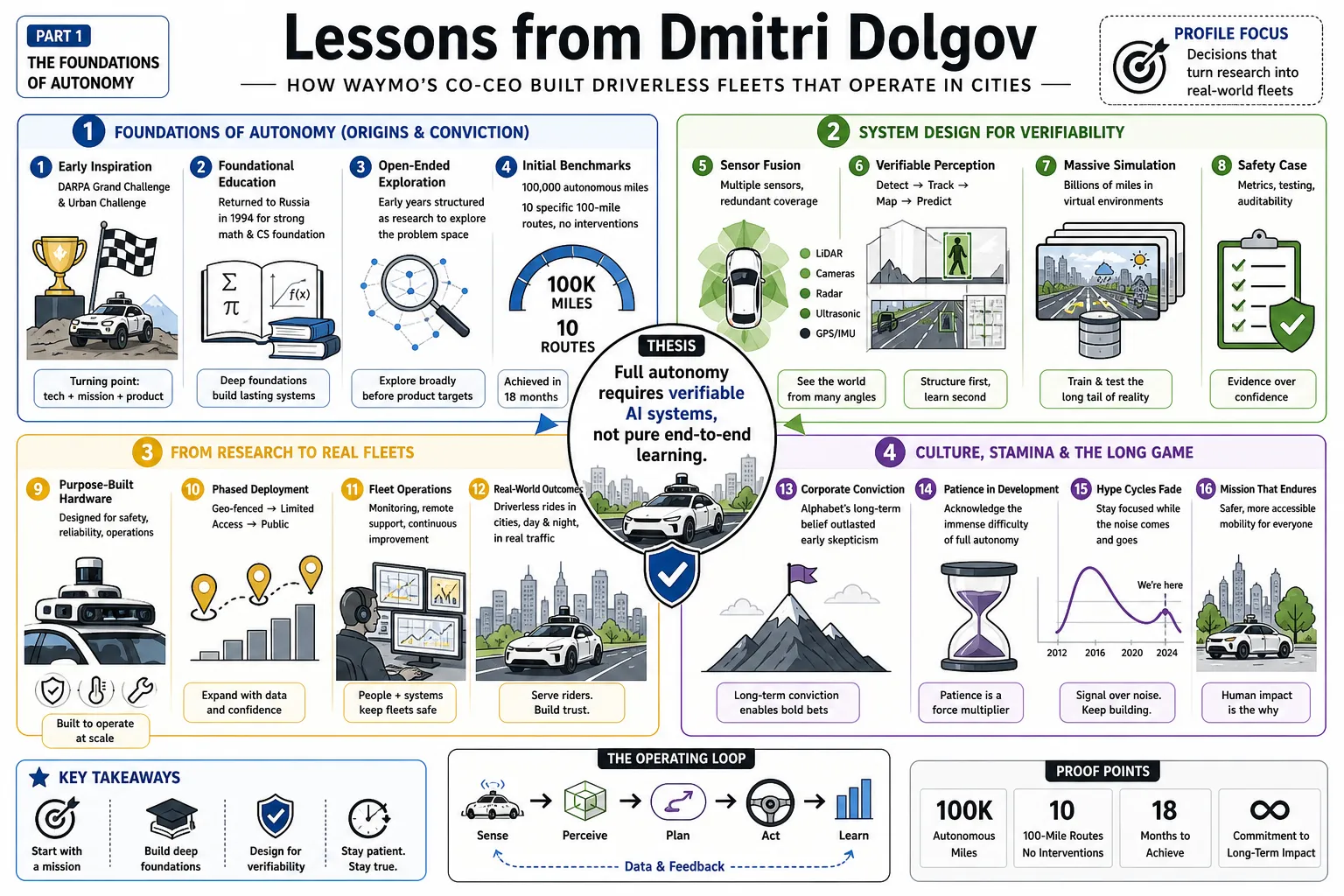
Part 1: The Foundations of Autonomy
- On early inspiration: The DARPA Grand Challenge and Urban Challenge served as a turning point, combining compelling technology with a clear mission and tangible product that prompted Dolgov to join the Stanford team. — Reference: BigGo Finance
- On foundational education: Despite having a green card in the US, Dolgov returned to Russia in 1994 to study math and computer science because he valued the extremely strong foundation of Russian physics education. — Reference: Stripe
- On early exploration: The first years of the Google self-driving project were deliberately structured as an open-ended research endeavor aimed at exploring the problem space before setting product targets. — Reference: No Priors
- On setting initial benchmarks: In the early startup days of Project Chauffeur, the team aimed for 100,000 fully autonomous miles and 10 specific 100-mile routes without interventions, achieving both goals within 18 months. — Reference: BigGo Finance
- On corporate conviction: Surviving the long journey of self-driving development required immense stamina, supported by the long-term conviction of Alphabet's leadership to push past initial skepticism. — Reference: Teahose
- On patience in development: A cultural commitment to acknowledging the immense difficulty of full autonomy provided the stamina needed to persist when broader industry hype cycles faded. — Reference: BigGo Finance
- On the inflection point of full autonomy: Around 2013, the team made the major decision to abandon advanced driver-assistance systems and pivot entirely toward developing fully autonomous technology. — Reference: No Priors
Part 2: The AI Architecture
- On the AI backbone: Moving from the fourth generation to the fifth generation hardware marked a massive architectural shift, replacing numerous smaller machine learning models with a unified AI backbone. — Reference: Teahose
- On foundation models: Waymo's core intelligence relies on a multimodal, end-to-end world-action-language model that comprehends 3D spatial structures, vehicle dynamics, and social driving norms. — Reference: BigGo Finance
- On teacher and student models: The technical architecture originates from a large off-board foundation model that branches into three teachers (the Driver, Simulator, and Critic), which are then distilled into smaller, faster student models running in the car. — Reference: Teahose
- On real-time inference: While some post-ride tasks like checking for left items use the cloud, all real-time processing and inference for driving decisions happen entirely locally on the vehicle. — Reference: Stripe
- On the limits of pure end-to-end: "The basic vanilla end‑to‑end system is insufficient if you want a fully autonomous safe product superhuman level of performance deployed at scale." — Source: BigGo Finance
- On intermediate representations: Rather than a simple pixels-to-actions pipeline, the system uses learned representations paired with explicit intermediate steps, like object trajectories and occupancy grids, to ensure verifiable safety. — Reference: BigGo Finance
- On verifiable decisions: By maintaining structured intermediate representations, the autonomous system can continuously validate its own downstream driving decisions in real time. — Reference: BigGo Finance
- On early deep learning integration: Early collaborations with the Google Brain team allowed Waymo to apply deep neural networks to pedestrian detection, cutting error rates by 100x in just a few months. — Reference: Waymo Blog
Part 3: Sensor Fusion and Hardware
- On sensor complementarity: Cameras, LiDAR, and radar are all necessary components because they offer highly complementary physical properties that cover each other's blind spots. — Reference: Stripe
- On the necessity of radar: Unlike camera-only setups that fail in poor visibility, radar remains completely unaffected by conditions like heavy fog, successfully identifying vehicles that are otherwise invisible. — Reference: Teahose
- On sensor fusion logic: Combining multiple sensors allows the machine learning models to reason deeply about anomalies, such as using LiDAR to confirm if a camera's detected stop sign is actually a reflection in a storefront window. — Reference: Waymo Blog
- On filtering weather noise: Neural networks and machine learning are deployed to filter out the sensor noise created by raindrops and snowflakes, allowing the system to accurately identify pedestrians and vehicles in heavy weather. — Reference: Waymo Blog
- On the evolution of hardware: The zero-to-one moment for autonomy occurred in 2015 when a custom-designed Firefly vehicle equipped with the third-generation hardware suite completed a ride without a human driver. — Reference: No Priors
- On designing for the rider: The sixth-generation hardware platform, built on the Zeekr Ohai, was designed entirely around the passenger experience with features like automatic sliding doors and extensive interior space. — Reference: BigGo Finance
- On long-range reasoning: High-density sensor data allows the vehicle to detect subtle long-distance movements, such as recognizing a truck door cracking open in traffic before a person emerges. — Reference: Waymo Blog
- On cost reduction: The sixth-generation sensor suite was engineered to simultaneously boost overall performance while drastically cutting costs for high-volume manufacturing. — Reference: BigGo Finance
Part 4: Real-World Testing and Simulation
- On the deception of progress: "It's deceptively easy to get started. But it is super hard to go, you know, the full distance." — Source: Teahose
- On infrastructure efficiency: Utilizing the TensorFlow ecosystem and specialized TPUs in Google's data centers allowed the team to train neural networks up to 15 times more efficiently. — Reference: Waymo Blog
- On simulation scale: The company conducts continuous rigorous testing in simulation environments, completing the driving equivalent of 25,000 cars operating all day, every day. — Reference: Waymo Blog
- On disengagements as teachers: Rather than simply minimizing human interventions, developers historically used every conservative disengagement event to generate hundreds or thousands of synthetic simulation variations to isolate root causes. — Reference: Waymo on Medium
- On adapting to local behaviors: Through extensive real-world exposure, the software learns distinct local nuances, such as matching the tendency of San Francisco residents to drive slightly slower on steep uphill slopes. — Reference: Waymo Blog
- On intersection nuances: The autonomous planner adjusts its staging position when executing turns by pulling from historical data of how human drivers uniquely navigate specific local intersections. — Reference: Waymo Blog
- On intuitive caution: Building trust requires the vehicle to adopt natural, cautious behaviors, such as slowing down near occluded crosswalks or blind hillcrests. — Reference: Waymo Blog
- On scaling velocity: While accumulating the first 100 million fully autonomous miles took over 16 years, the platform achieved the next 100 million miles in just six months. — Reference: BigGo Finance
- On launching new markets: With a highly generalizable driver, deploying in new cities shifts from a deep engineering challenge to one centered on high-fidelity operational validation and community engagement. — Reference: BigGo Finance
Part 5: Strategy, Business, and the Future
- On driver assist vs. full autonomy: "I see it just as fundamentally two different problems. There's driver assist systems. And then there is full autonomy." — Source: Teahose
- On the myth of convergence: The industry expectation that partial automation and driver-assistance features will eventually evolve organically into fully autonomous systems is a flawed assumption. — Reference: Teahose
- On sequential de-risking: Product strategy was driven by answering the single most important open question for each hardware generation, allowing the team to intentionally de-risk the project before attempting massive scaling. — Reference: Teahose
- On prioritizing ride-hailing: Waymo intentionally paused its commercial operations and technical development for autonomous trucking in order to focus all investments entirely on the immediate opportunity of ride-hailing. — Reference: Waymo Blog
- On the residual benefits to trucking: Even with commercial trucking paused, continuous investment in the core software for freeway driving naturally translates into capabilities that will eventually benefit trucking platforms. — Reference: Waymo Blog
- On city design: Widespread adoption of autonomous vehicles has the potential to eliminate the need for vast parking lots and garages, allowing for a reshaping of city land use. — Reference: Teahose
- On challenging the status quo: The reality that someone loses their life in a car crash every 26 seconds provided the enduring moral imperative to push through the hardest phases of research and development. — Reference: BigGo Finance
- On generalizability: Expanding early autonomous operations to the public in Arizona generated foundational frameworks for safety evaluation that readily transfer and scale into vastly different metropolitan environments. — Reference: Waymo Blog
Part 6: Experience, Trust, and Public Deployment
- On the disproportionate final stretch: Producing a convincing autonomous-driving demonstration is relatively easy; mastering the final fraction of complex urban situations takes far more time, data, and experience than the first 90 percent. — Reference: Waymo Blog
- On calibrating for human comfort: Safety alone is not enough for a natural ride, so feedback on acceleration, braking distance, spacing, speed, and turning angles should continuously shape the vehicle's behavior. — Reference: Waymo Blog
- On driving as social negotiation: Merging and yielding depend on silent exchanges among drivers, cyclists, and pedestrians, which means an autonomous system must predict intentions and communicate its own through subtle movement. — Reference: Waymo Blog
- On accessibility as core product value: Autonomous mobility can create independence for riders who face discrimination or practical barriers in conventional ride-hailing, including people traveling with guide dogs. — Reference: Waymo Blog
- On operating with community humility: Deploying into a city creates a responsibility to learn from riders and local organizations, not merely a technical requirement to map roads and validate software. — Reference: Waymo Blog
- On earning trust with public evidence: A safety claim becomes credible when it is supported by transparent comparisons with human driving, insurance and police-report outcomes, and a sustained body of published research. — Reference: Waymo Blog
Part 7: AI Progress and Long-Horizon Leadership
- On successive waves of AI: Convolutional networks transformed perception, while transformers extended machine learning into behavior prediction, planning, and simulation by making global scene context easier to model. — Reference: Andreessen Horowitz
- On driving as sequence modeling: Predicting road users and planning a vehicle's trajectory resembles language modeling: local continuity matters, but every action must also be interpreted within the wider scene. — Reference: Andreessen Horowitz
- On confidence built through milestones: Progress toward autonomy came through accumulated proof rather than one eureka moment, from a first public driverless ride to fully autonomous operations and a paid daily service. — Reference: Michigan Engineering
- On practical autonomy over speculative universality: The useful distinction is whether a human driver is required; expanding reliable Level 4 service within defined domains matters more than predicting when a vehicle will handle every road and condition imaginable. — Reference: Michigan Engineering