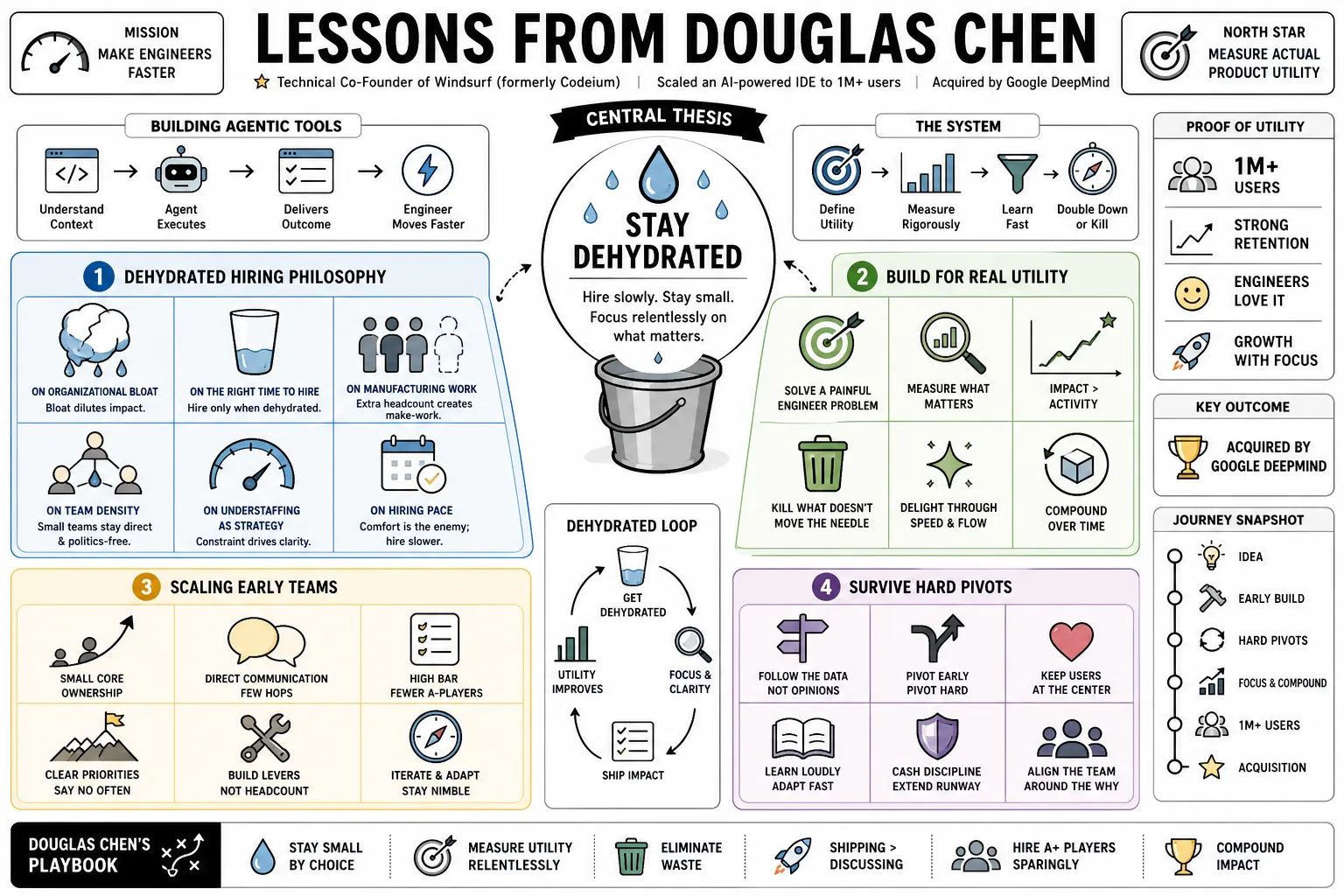
Lessons from Douglas Chen
As the technical co-founder of Windsurf (formerly Codeium), Douglas Chen scaled an AI-powered IDE to over a million users before Google DeepMind acquired it. Known for his "dehydrated" hiring philosophy, he builds agentic tools that simply make engineers faster. This collection details his rules for scaling early teams and surviving hard pivots, anchored by a strict focus on measuring actual product utility.
Part 1: The Dehydrated Hiring Philosophy
- On Organizational Bloat: "I wanted the company to almost be like this dehydrated entity; every hire is like a little bit of water." — Source: [Lenny's Podcast]
- On the Right Time to Hire: "We only go back and hire someone when we're back to being dehydrated." — Source: [Lenny's Podcast]
- On Manufacturing Work: "Hiring ahead of the curve simply encourages managers to manufacture work to keep their large teams busy." — Source: [Lenny's Newsletter]
- On Team Density: "Keeping the team artificially small forces communication to stay direct and prevents office politics from taking root." — Source: [20VC]
- On Understaffing as Strategy: "Being slightly understaffed is not a bug; it is a constraint that forces clarity on what actually matters." — Source: [Lenny's Podcast]
- On Hiring Pace: "If you are comfortable with your headcount growth, you are probably growing your team too fast." — Source: [Lenny's Newsletter]
- On Early Stage Discipline: "The most dangerous time for a startup is right after raising money, because the temptation to solve problems with headcount is at its highest." — Source: [20VC]
- On Scaling Culture: "Culture is not what you write down; it is the natural byproduct of twenty people desperately trying to ship a product that requires fifty." — Source: [Lenny's Podcast]
- On the Cost of Coordination: "Every new person added to a project increases the communication overhead faster than it increases the output." — Source: [Lenny's Newsletter]
Part 2: Ruthless Prioritization
- On the GPA Analogy: "In school you optimize for your total GPA. But for companies I just need to get an A+ on the one class that matters." — Source: [Lenny's Podcast]
- On Failing Strategically: "I can get an F in all the other classes if my product is world-class in the single dimension the user actually pays for." — Source: [Lenny's Newsletter]
- On Feature Completeness: "Aiming to be well-rounded as a startup is a guaranteed path to mediocrity." — Source: [Codeium Blog]
- On Ignoring Distractions: "You have to be comfortable letting fires burn if those fires are not in your core critical path." — Source: [20VC]
- On Saying No: "The hardest part of prioritization is telling a major customer that their highly specific feature request is not going to happen." — Source: [Forbes]
- On Market Entry: "You do not enter a crowded market by matching competitors feature for feature. You enter by completely dominating a single unaddressed pain point." — Source: [Lenny's Podcast]
- On Resource Allocation: "If you look at where your engineers spend their time and it does not match your stated top priority, your strategy is a lie." — Source: [20VC]
- On Minimum Viable Products: "An MVP should embarrass you slightly, but its core technical differentiator must be flawless from day one." — Source: [Codeium Blog]
- On Competitive Focus: "Do not track what your competitors are doing unless it directly invalidates your core thesis." — Source: [Forbes]
Part 3: Cannibalization and Obsolescence
- On Self-Disruption: "We should be cannibalizing the existing state of our product every 6 to 12 months." — Source: [Lenny's Podcast]
- On Historical Perspective: "Your goal should be to look back at the product you shipped last year and feel that it looks silly." — Source: [Lenny's Newsletter]
- On the AI Timeline: "In the generative AI space, stagnation is measured in weeks, not years. If you aren't disrupting yourself, an open-source model will." — Source: [20VC]
- On Sunk Costs: "The codebase you spent six months perfecting is a liability the moment a new architectural paradigm proves to be faster." — Source: [Codeium Blog]
- On Aggressive Shipping: "If your users aren't complaining about how fast the interface is changing, you are leaving innovation on the table." — Source: [Lenny's Podcast]
- On Legacy Support: "Refusing to kill old features is how modern software turns into enterprise bloatware." — Source: [Codeium Blog]
- On Product Life Cycles: "Assume every feature has an expiration date, and build your backend so it can be discarded cleanly." — Source: [Forbes]
- On Market Speed: "The market does not care how hard it was to build your original version when the next version is suddenly possible for a fraction of the cost." — Source: [20VC]
- On Technical Debt: "Sometimes the fastest way to clear technical debt is to throw away the system and rebuild it with a new generation of tooling." — Source: [Codeium Blog]
- On Risk Tolerance: "Cannibalizing a revenue-generating product requires the founders to absorb the panic of their own sales team." — Source: [Lenny's Newsletter]
Part 4: Engineering in the AI Era
- On the Value of Engineers: "The ROI of building technology has gone up because engineers can now produce more with the same amount of effort." — Source: [Lenny's Podcast]
- On Job Replacement: "AI will not replace engineers; it will replace engineers who refuse to use AI as a force multiplier." — Source: [Forbes]
- On Output Metrics: "We are moving from a world where we measure lines of code to a world where we measure complete system deployments per engineer." — Source: [Codeium Blog]
- On Tooling Adoption: "If a tool makes your top performer ten percent faster, it is worth whatever the vendor is charging." — Source: [20VC]
- On Developer Ergonomics: "The best AI tools disappear into the background. If a developer has to pause and think about the AI, the interface has failed." — Source: [Forbes]
- On Code Quality: "AI generation means we will have ten times as much code. The primary skill of an engineer is shifting from writing code to reading and verifying it." — Source: [Codeium Blog]
- On Debugging: "A developer's ability to debug complex state transitions is the last moat against automated code generation." — Source: [Lenny's Podcast]
- On Architectural Taste: "When code becomes cheap, architectural taste becomes the most expensive commodity in the industry." — Source: [20VC]
- On the Feedback Loop: "We want to compress the time between a developer having an idea and seeing it run in production to near zero." — Source: [Codeium Blog]
Part 5: High-Agency Execution
- On Defining Agency: "A person’s value to a company should not be tied to the size of their team, but to their ability to execute without asking for permission." — Source: [Lenny's Podcast]
- On Role Boundaries: "The most valuable employees are those who can execute complex projects across disciplines with as few people as possible." — Source: [Lenny's Newsletter]
- On Problem Solving: "High-agency individuals treat a blocked path as an invitation to build a new road, not a reason to wait for management." — Source: [20VC]
- On Titles: "Titles are irrelevant if the person holding them cannot ship." — Source: [Codeium Blog]
- On Delegation: "You cannot delegate the hardest problems; you can only hire people who inherently want to steal the hardest problems from you." — Source: [Lenny's Podcast]
- On Ownership: "True ownership means losing sleep over a bug that no one else has noticed yet." — Source: [Forbes]
- On Speed of Execution: "The primary advantage of a high-agency hire is that they remove the need for status updates." — Source: [Codeium Blog]
- On Hiring Signals: "When interviewing, look for candidates who describe what they built, not who they managed." — Source: [20VC]
- On Company Constraints: "If your best people are spending time navigating internal approvals, you are bleeding talent without them even leaving." — Source: [Lenny's Newsletter]
Part 6: Evaluating AI and Meaningful Metrics
- On Measurement Philosophy: "Measuring and evaluating our systems over time is what allows us to steer in the direction of growth." — Source: [Codeium Blog]
- On Vanity Metrics: "If you can't measure it, you can't manage it, but aggregate statistics are misleading because not all code is created equal." — Source: [Codeium Blog]
- On Acceptance Rates: "Judging an AI coding assistant by its character acceptance rate is like judging a novel by the number of vowels used." — Source: [Forbes]
- On Real-World Value: "Without rigorous evaluation, we wouldn't be able to have the confidence we have that we are shipping a great product." — Source: [Codeium Blog]
- On Feature Value: "We do not believe in shipping capabilities for the sake of shipping capabilities." — Source: [Codeium Blog]
- On Wasted Development: "If the capabilities don't drive meaningful value, we are doing you a disservice by investing a bunch of development time productionizing the capability." — Source: [Codeium Blog]
- On Synthetic Benchmarks: "A model that performs flawlessly on a synthetic benchmark will often fail catastrophically in a ten-year-old enterprise codebase." — Source: [20VC]
- On User Feedback: "The only metric that truly matters is whether the developer uninstalled your plugin after the first hour." — Source: [Lenny's Podcast]
- On Evaluation Culture: "Building a rigorous evaluation pipeline is boring, unglamorous work, which is why it is our greatest competitive advantage." — Source: [Codeium Blog]
- On Context Windows: "A massive context window is useless if the model cannot retrieve the specific function definition buried on line four thousand." — Source: [Forbes]
Part 7: The Art of the Pivot
- On Changing Core Assumptions: "Be willing to bet the company when your core assumptions change. If a new technology commoditizes your offering, pivot immediately." — Source: [Lenny's Podcast]
- On Abandoning Ideas: "Pivoting away from GPU virtualization to AI coding meant walking away from a business that was already generating revenue." — Source: [Lenny's Newsletter]
- On Speed of the Pivot: "The longer you debate a necessary pivot, the more runway you burn on an idea you already know is dead." — Source: [20VC]
- On Ego and Sunk Cost: "Founders fail when their ego is tied to the original idea rather than the survival of the company." — Source: [Lenny's Podcast]
- On Identifying the Signal: "You pivot when you realize your side project is growing faster with zero marketing than your main product is with a dedicated sales team." — Source: [Forbes]
- On Rebuilding Trust: "When you pivot, you have to re-sell the vision to your team, your investors, and yourself. You cannot half-commit." — Source: [Codeium Blog]
- On the Value of Infrastructure: "The infrastructure we built for our first idea was the only reason we could move so fast on the second." — Source: [20VC]
- On Recognizing Commoditization: "If you are competing entirely on price for a software tool, you are in the wrong market." — Source: [Codeium Blog]
- On the Founder's Duty: "Your loyalty is to the problem space and your users, not the specific technical implementation you started with." — Source: [Lenny's Newsletter]
Part 8: The Agentic Future of Software
- On Human-AI Collaboration: "The goal of Windsurf was never to replace the developer, but to meld the minds of the developer and the AI." — Source: [Forbes]
- On Agentic Workflows: "We are moving away from autocomplete and moving toward agents that can navigate a repository, run tests, and debug their own failures." — Source: [Codeium Blog]
- On Context Awareness: "An AI agent is only as good as the context it is fed. The real engineering challenge is building the retrieval system behind the scenes." — Source: [20VC]
- On Trusting the AI: "Developers will only hand over complex tasks to an agent if they trust that the agent will not quietly break the build." — Source: [Forbes]
- On the DeepMind Acquisition: "We are proud of what Windsurf has built over the last four years and are excited to see it move forward with their world-class team." — Source: [Codeium Blog]
- On IDE Integration: "The editor is the final frontier. You cannot build a great AI tool if it lives in a browser tab; it has to live where the code is written." — Source: [Lenny's Podcast]
- On Future Barriers: "The barrier to entry for software creation will approach zero, but the barrier to building reliable, scaleable systems will remain high." — Source: [20VC]
- On System Prompts: "The difference between a toy and an enterprise tool often comes down to the hidden architecture dictating how the model reasons about file structures." — Source: [Codeium Blog]
- On Managing Agents: "In the near future, senior engineers will spend their time reviewing pull requests submitted entirely by autonomous agents." — Source: [Forbes]
- On the Next Phase: "We have solved code generation. The next five years will be entirely focused on code orchestration and architectural reasoning." — Source: [Lenny's Newsletter]