Ed Bastian joined Delta Air Lines in 1998 and became CEO in 2016, leading the company through the pandemic and routine industry turbulence. He ignored the standard playbook of competing on rock-bottom fares, betting instead on clear communication and his own workforce to improve the customer experience. This profile breaks down his practical approach to running a global airline.
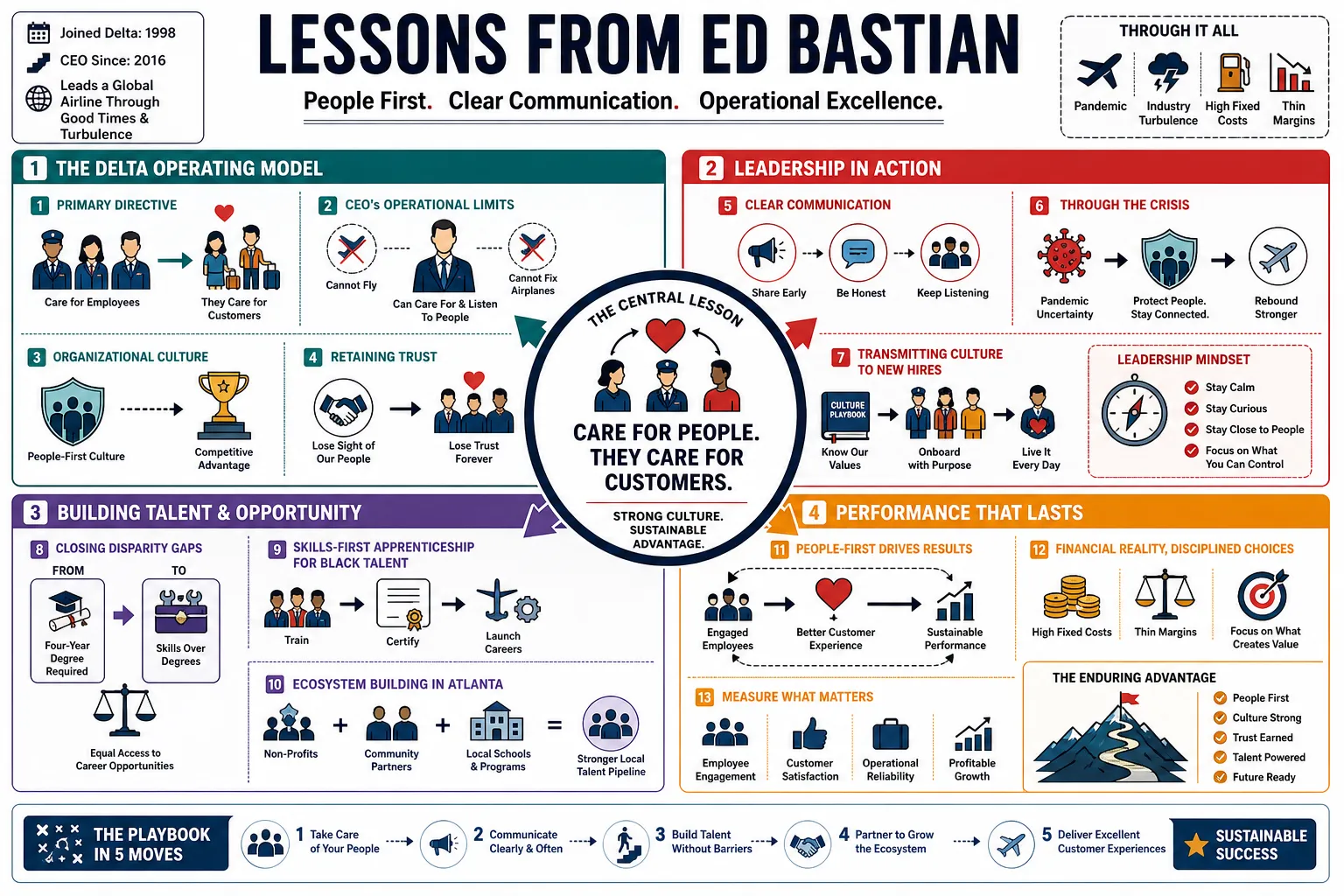
Part 1: The Delta Operating Model
- On the primary directive: He operates on the foundational principle that if management takes good care of the employees first, those employees will in turn take care of the customers. — Reference: The Vertical Space
- On the CEO's operational limits: He acknowledges that while he cannot fly or fix the airplanes, his primary role is to care for and listen to his people so they have the tools to serve customers. — Reference: The Vertical Space
- On organizational culture: Sustaining a people-first culture is critical for maintaining a competitive advantage in an industry characterized by high fixed costs and thin margins. — Reference: Harvard Business School
- On retaining trust: The company's original founder warned early management that losing sight of their own people would permanently cost them the trust of their customers. — Reference: The Vertical Space
- On closing disparity gaps: Providing equal access to career opportunities requires shifting the corporate talent architecture to prioritize skills over four-year degrees. — Reference: HBR On Leadership
- On ecosystem building: He launched a skills-first apprenticeship program for Black talent and actively built relationships with non-profits to create a broader local talent pipeline in Atlanta. — Reference: Harvard Business School
- On transmitting culture to new hires: As travel rebounded after the pandemic, Delta hired over 40,000 new employees, forcing leadership to actively institutionalize its "service from the heart" culture to an entirely new generation of frontline workers. — Reference: Harvard Business School
- On the workforce composition: The airline relies heavily on a workforce where 90% of its 100,000 employees serve on the frontline, underscoring the critical need to maintain a positive corporate culture. — Reference: Harvard Business School
- On the true differentiator: While competitors can easily match an airline's product offerings and ticket prices, the unique experience created by a dedicated workforce remains impossible to replicate. — Reference: How Leaders Lead
Part 2: Executive Leadership & Communication
- On casting vision: It is the sole responsibility of the CEO to look five to ten years ahead and communicate that direction consistently, enabling the workforce to pivot early when conditions change. — Reference: How Leaders Lead
- On approachability: Maintaining accessibility and actively listening to the workforce are non-negotiable elements of his everyday leadership style. — Reference: The Vertical Space
- On earning success daily: "The accolades are nice, but it's totally irrelevant. It's really what you do today and tomorrow that matters, and you got to go out and prove it and do it better every single day." — Source: How Leaders Lead
- On leadership vulnerability: A strong executive must have the humility to openly admit when they do not know the answer, combined with the firm confidence to assure the team they will figure it out together. — Reference: Inside the Strategy Room
- On optimism as a force multiplier: Drawing inspiration from Colin Powell, he believes optimism is essential for getting people to follow you and invest their energy, whereas cynicism repels followers. — Reference: Masters of Scale
- On communicating vision: A leader's job is not just to cast a bold vision, but to communicate it consistently so that the entire organization understands where they are headed and why. — Reference: How Leaders Lead
- On surrounding oneself with talent: Choosing to be around individuals who elevate expectations and align with long-term goals is a crucial step in shaping a successful leadership path. — Reference: How Leaders Lead
Part 3: Navigating Crisis & Resilience
- On prioritizing safety in a crisis: When the September 11 attacks occurred, the immediate instinct was not about business continuity, but ensuring every crew member was safe and safely grounding planes wherever possible. — Reference: Elevate Podcast
- On the silence of disruption: Experiencing the sudden, complete halt of regular background noise—like planes taking off near headquarters—was a numbing reminder of how quickly established industries can be paralyzed. — Reference: Elevate Podcast
- On building customer confidence: The airline removed change fees during the pandemic to eliminate the friction and fear of booking during uncertain times, a consumer-friendly move they decided to make permanent. — Reference: Fortune
- On post-crisis demand: The surge in travel following the pandemic was not just revenge travel, but the release of a quantifiable $300 billion gap between historical demand and actual capacity during the disrupted years. — Reference: Fortune
- On preparing for turbulence: In good times, teams should prepare for the next problem because it probably won't be good; in bad times, avoid despair by leaning on resilience and experience to power through. — Reference: Masters of Scale
- On avoiding involuntary furloughs: During the 2020 collapse of global air travel, Delta avoided involuntary furloughs, instead relying on voluntary measures that reduced its workforce by more than half while preserving morale. — Reference: Harvard Business School
- On proactive hiring: To handle unprecedented post-pandemic demand, the airline proactively hired over 25,000 people to ensure they were trained, experienced, and ready for the crowds. — Reference: Fortune
- On surviving the dot-com bust: The advent of the internet deeply disrupted the traditional airline business model by creating price transparency and disintermediating sales channels, leading to a painful but necessary era of reinvention. — Reference: Elevate Podcast
- On purpose through adversity: The most difficult moments of a crisis test an organization but also provide deep clarity on its core purpose, acting as fuel to keep moving forward. — Reference: How Leaders Lead
Part 4: Strategy, Innovation, & The Premium Experience
- On rejecting commoditization: For years, the industry raced to the bottom on price, but framing air travel as a premium experience worth paying for successfully shifted the market and forced competitors to follow suit. — Reference: The Vertical Space
- On mobile empowerment: Heavy investments in app technology and self-service capabilities give passengers the tools to control their own itineraries, especially during disruptions. — Reference: Fortune
- On capturing attention: Passengers are seated, facing forward, and buckled in for hours at a time. Offering fast, free Wi-Fi turns this captive boredom into a valuable experience for the consumer and the brand. — Reference: The Vertical Space
- On defining innovation: "And while the future in terms of virtual and AI it's all exciting, boy, if having that level of courage and commitment to growth and advancement is a bit of what we took today forward, it'd be wonderful." — Source: Inside the Strategy Room
- On industry agility: Because "our factories fly," competitors can easily relocate their assets to challenge successful routes directly, requiring constant competitive urgency. — Reference: How Leaders Lead
- On brand pricing power: Delta was able to cover about 60% of a massive fuel cost spike through price increases, demonstrating the significant value customers attach to the airline's reliability and brand. — Reference: Masters of Scale
- On discretionary spending resilience: Despite economic concerns, consumers with high discretionary income prioritize travel, seeing an incremental price increase as acceptable for a product they trust. — Reference: Masters of Scale
- On unbundling the premium product: Introducing a basic option for higher-class travel gives customers more choices, shifting the airline from just a transportation provider to a more sophisticated retailer and merchandiser. — Reference: Masters of Scale
- On loyalty partnerships: A lucrative, multi-billion-dollar partnership with American Express acts as a cornerstone of the airline's value proposition, heavily influencing brand trust and customer loyalty. — Reference: Titans and Disruptors
Part 5: Artificial Intelligence & Technology
- On human-centered technology: He views technology as a tool to enhance what employees can achieve and free up their time to provide better service, rather than as a means to replace the workforce. — Reference: Masters of Scale
- On the role of AI: Rather than replacing human workers, artificial intelligence functions as an augmented intelligence that enables teams to perform their jobs more effectively. — Reference: Masters of Scale
- On AI as augmented intelligence: He explicitly refers to AI as "augmented intelligence," focusing on its capacity to rapidly process massive amounts of operational data to assist human teams in making better, faster decisions. — Reference: Masters of Scale
- On the limits of AI in purchasing: While automated agents might handle basic transactions, personal and emotional relationships with brands will prevent price-first AI bots from completely taking over travel decisions. — Reference: Masters of Scale
- On practical AI application: Delta uses algorithmic tools to help manage hundreds of thousands of daily price points around the clock, matching market rates efficiently without implementing invasive surveillance pricing. — Reference: Masters of Scale
- On the soul of communication: After an AI generated a technically proficient commencement speech in seconds, he chose to scrap it entirely, feeling it lacked the soul, spirit, and conscience required for authentic leadership. — Reference: Masters of Scale
- On the ROI of technology: He casts doubt on the massive capital expenditures pouring into AI from tech companies, arguing that unless the investment significantly grows top-line revenue rather than just creating marginal efficiencies, the returns won't justify the cost. — Reference: Masters of Scale
- On the tech industry's misplaced focus: He cautions that many technology companies are driven by a race against international rivals rather than a genuine concern for the people actually using their products. — Reference: Masters of Scale
- On bearing the costs of innovation: As massive capital investments are made in new technologies and energy sources, he warns that the ultimate cost will inevitably fall on consumers and businesses rather than the tech companies themselves. — Reference: Masters of Scale
Part 6: Geopolitics & Corporate Statesmanship
- On focusing on the controllable: Instead of worrying about geopolitical factors beyond his influence, such as the Strait of Hormuz, he emphasizes running the best operation possible and adjusting pricing to navigate external shocks. — Reference: Masters of Scale
- On data-driven economic forecasting: Because the airline holds roughly 70% of its quarterly revenue in advance bookings up to 120 days out, its internal data often acts as an early indicator of consumer confidence that precedes broader economic headlines. — Reference: Masters of Scale
- On corporate statesmanship: He generally avoids political grandstanding, recognizing that taking a side will invariably anger half the consumer base. — Reference: Masters of Scale
- On stepping into controversy: Despite his general reluctance to engage in politics, he will take a public stand—such as suspending travel perks for members of Congress during a government shutdown—when an issue becomes highly relevant to the business and its core constituents. — Reference: Masters of Scale
- On bipartisan appeal: Echoing Michael Jordan's famous sentiment about sneakers, he notes that customers from across the political spectrum fly on his airplanes, reinforcing the value of remaining politically neutral when possible. — Reference: Masters of Scale
Part 7: The Future of Aviation & Global Growth
- On market immaturity: Despite the ubiquity of domestic flights, only one in five people globally have ever been on an airplane, indicating massive untapped potential worldwide. — Reference: Inside the Strategy Room
- On international expansion: With domestic airspace increasingly congested, the next era of growth depends on extending reach into developing aviation markets in the Middle East, Southeast Asia, India, and Africa. — Reference: Inside the Strategy Room
- On the limits of space travel: He believes the long-term growth of the industry lies not in commercial space tourism, but in making terrestrial air travel more accessible and affordable for the billions of people who have never flown. — Reference: Masters of Scale
- On revolutionary aircraft design: The adoption of blended-wing aircraft designs promises to drastically improve the industry's environmental footprint, potentially cutting fuel emissions by up to 50%. — Reference: Masters of Scale
- On new forms of transit: Investments in air taxi companies like Joby signal a near-future shift toward alternative, localized airborne transportation to alleviate congestion in and around major cities. — Reference: Masters of Scale
- On the origins of the industry: Recognizing the industry's roots in a single crop duster airplane that flew one person a century ago provides a humbling perspective on the massive scale of modern global aviation. — Reference: Inside the Strategy Room
Part 8: Personal Foundations & Early Career
- On early foundations: Growing up as the oldest of nine children in a home that doubled as his father's dental practice taught him early survival skills and the responsibility of setting a standard for others to follow. — Reference: Elevate Podcast
- On non-linear paths: He did not step foot on an airplane until he was 25 years old for a business trip, demonstrating that leading a global airline does not require a lifelong immersion in aviation. — Reference: How Leaders Lead
- On learning from other industries: Before joining Delta, he left a secure partnership at PricewaterhouseCoopers to join PepsiCo, specifically seeking to learn from a company renowned for producing great executives and managing change. — Reference: Elevate Podcast