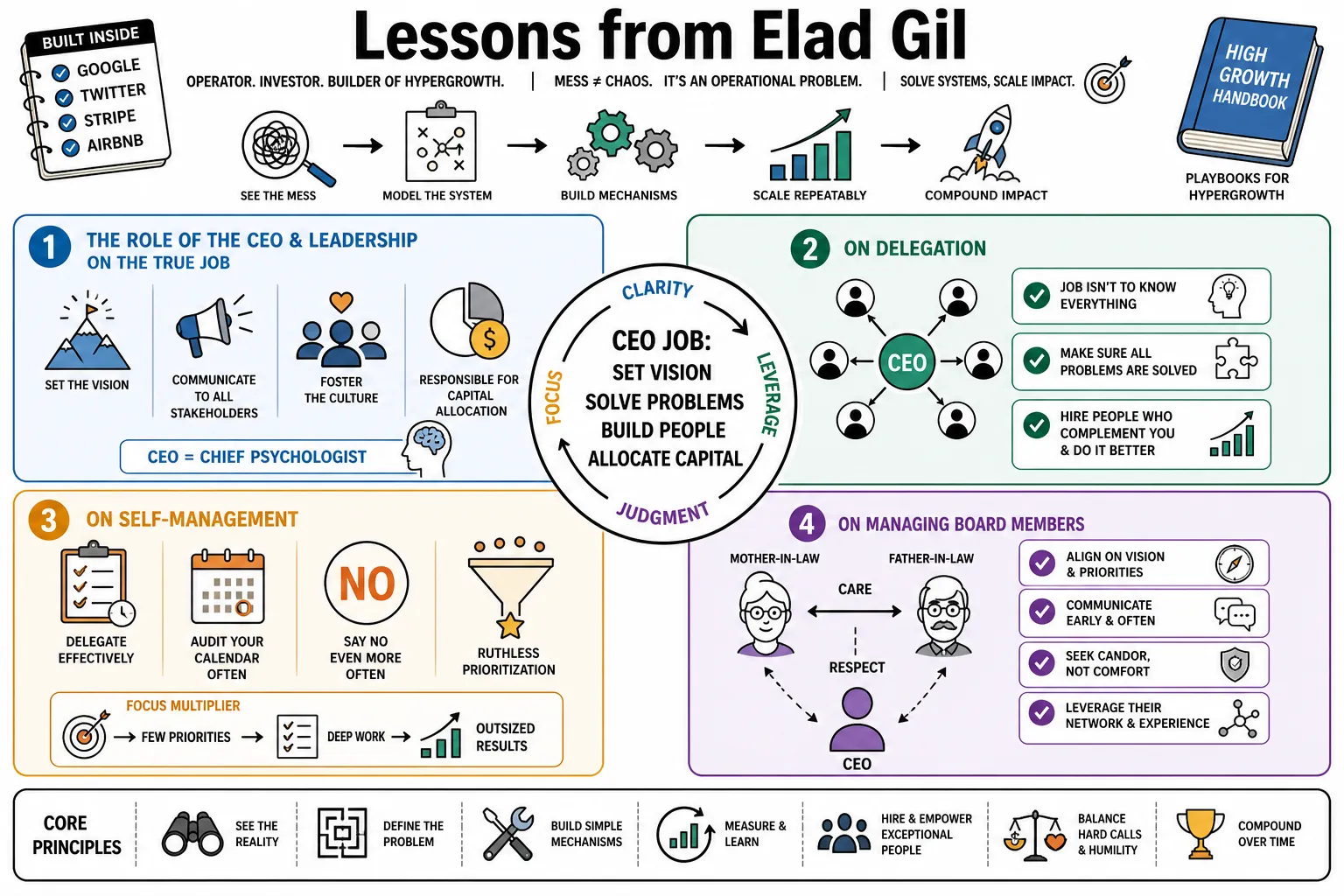
Lessons from Elad Gil
Elad Gil is an operator and investor who worked inside companies like Google, Twitter, Stripe, and Airbnb during their steepest growth phases. He treats the mess of startup hypergrowth as a solvable operational problem, documenting the exact mechanics in his High Growth Handbook. This collection gathers his core rules for hiring, product distribution, corporate development, and organizational scaling.
Part 1: The Role of the CEO & Leadership
- On the True Job: "The CEO sets the vision of the company and communicates that to all stakeholders while hiring, growing, and fostering the culture. They are chief psychologist and need to be responsible for capital allocation." — Source: [Blas]
- On Delegation: "Your job as the CEO is not to know everything but to make sure all problems are solved. Hire people that complement you and can do certain things better than you ever could." — Source: [Blas]
- On Self-Management: "It’s imperative that CEOs manage themselves first. That means effectively delegating tasks, auditing their calendar often, saying no even more often, and ruthless prioritization." — Source: [Conor Dewey]
- On Managing Board Members: "Board members are like your mother-in-law and father-in-law. You are going to see them regularly, they are hard to get rid of, and they can have an enormous impact on your future." — Source: [Conor Dewey]
- On Decision Making: "Sometimes the group thinks they’re the decision-maker and that the goal is consensus. When really the goal is, 'Let’s hash it out together. We may not all agree. One person will be the decision-maker, and then we will all commit to it.'" — Source: [Apple Podcasts]
- On Context Over Control: "As you scale... the danger is getting too process-y instead of outlining the objectives. It’s almost like you want to provide more context versus trying to exert more control." — Source: [Brian's Notes]
- On Evolving as a Leader: "At some point your job becomes more about hiring people and working with them to get what you want done than doing it yourself." — Source: [Conor Dewey]
- On Abdication: "Delegation is not abdication. Setting the company’s direction is just 5% of a CEO’s job. The other 95% is making sure it happens." — Source: [Tremendous]
- On Board Interference: "The board should not be running the company. It’s a group of people and therefore it’s group-think. No committee ever built anything great." — Source: [Conor Dewey]
- On Choosing a Board: Take a lower valuation if it means working with board members you deeply respect and trust. — Source: [Conor Dewey]
Part 2: Scaling & Hypergrowth
- On the More More Moment: "During break-out growth... the pace of everything at the company accelerates. More customers, more support, more interest, more partnership offers — more more more more. Complexity goes up dramatically." — Source: [Elad Gil's Blog]
- On Constant Reinvention: "In high-growth companies, you have a new company every 6–12 months. Headcount is growing rapidly, the product is changing, culture is shifting." — Source: [Brian's Notes]
- On Chaotic Growth: "Going through hyper-growth is very chaotic. Things are going to be messy. If a business is growing rapidly, you are working in a different company every six months." — Source: [25iq]
- On Managing Breakages: "Everything at the company will break at once." Expect operations to fracture and focus on fixing the most critical bottlenecks first. — Source: [Elad Gil's Blog]
- On The 60 Percent Rule: "A good rule of thumb is to limit headcount growth to 50–60% in a given year [to maintain culture and stability]." — Source: [Brian's Notes]
- On Pragmatic Structure: "Organization structure is an exercise in pragmatism... what is the right structure given the talent available and your 12- to 18-month time horizon?" — Source: [Conor Dewey]
- On Executive Readiness: "Hiring bona-fide executives well in advance before things break is the difference between a sudden ongoing meltdown at your company versus not." — Source: [Elad Gil's Blog]
- On The Gap Filler: Rapidly growing companies should hire someone, often a Chief of Staff or COO, to fill the gaps and fix problems until a dedicated executive is hired. — Source: [Blas]
- On Stagnation: "Companies that innovate early keep innovating. And the ones that innovate late never innovate again. eBay never had an Act Two, and PayPal never had an Act Two." — Source: [Apple Podcasts]
- On Fear of Shipping: "You have too much fragility or brittleness in the company... like early Twitter with the 'fail whale' where people were scared to push code because it would break something. It really slowed down innovation." — Source: [Apple Podcasts]
Part 3: Hiring & Team Building
- On The Executive Inversion: "Many founders wait to hire executives 'when we have enough scale to support them,' instead of viewing the executives as crucial to supporting future scale. The thought process is inappropriately inverted. Executives exist to help you scale." — Source: [Elad Gil's Blog]
- On the 18-Month Horizon: "Hire executives that will be a good fit for the next 12–18 months. Don’t project too far out because you don’t know how they will scale, or how your company needs will change." — Source: [Goodreads]
- On the Tightness Rule: "The general philosophy should be, things should always feel tight. You should never feel like, 'Hey, I have too many people.' You should always feel like you have too few people." — Source: [Y Combinator]
- On Doubt: "If there is a doubt, there is no doubt. If a candidate is great for the role but seems borderline or outright bad culturally, the right strategy is to not hire the person." — Source: [Goodreads]
- On The GSD Factor: "The two biggest causes of having to fire an employee at an early stage startup are a lack of culture fit, and the inability to Get Shit Done (GSD). I don’t care how smart someone is—if they are unable to work hard... they will weigh down your startup." — Source: [Elad Gil's Blog]
- On Reference Checking: "Reference checks are often the clearest signal on a candidate. You should reference-check everyone... I have found engineering and other functions to be more direct/honest when providing references for their friends [than businesspeople]." — Source: [Elad Gil's Blog]
- On Work Output Over Interviews: "The best way to assess someone’s skills is to have them complete a task similar to what they’ll do on the job... We had a few candidates that went from 'did OK on interviews' to 'wow, that person is great' when we saw the output." — Source: [Tremendous]
- On Firing Executives: If an executive isn't scaling with the company, the kindest and most efficient action is to replace them promptly rather than letting them flounder. — Source: [High Growth Handbook]
- On The First 100 Employees: The cultural DNA set by the first 10-20 hires will organically attract or repel the next 100, meaning you must guard those initial hires fiercely. — Source: [High Growth Handbook]
- On Compensating Engineers: "Somewhere between 50 and a few hundred people effectively had an IPO, but as a class of people... they experienced the equivalent of an IPO, and that's really unusual." — Source: [Tim Ferriss Show]
Part 4: Product & Markets
- On Distribution Over Product: "Distribution has proven to beat out product time and again... The general model for successful tech companies... is that they become distribution-centric rather than product-centric." — Source: [Alex J. Hughes]
- On Pricing Power: "The best signal of product/market fit and differentiation or moat is the ability to raise prices repeatedly without losing customers." — Source: [25iq]
- On Growth from Pricing: "Higher prices = faster growth. It shows that you have a moat. People have to pay for it... If you charge more you can allocate more to both distribution efforts and R&D." — Source: [Alex J. Hughes]
- On Market Tides: "A great team in a bad market often results in the market prevailing." — Source: [Elad Gil's Blog]
- On the 10X Rule: "To beat an incumbent as a startup you usually need to either build something so dramatically better that you overcome the distribution, capital, and pre-existing product moats... In general you need a 10X better product." — Source: [Glasp]
- On Incumbent Bundling: "An incumbent can be 50% as good as something, but as long as they bundle it with a core pre-existing product with lots of customers they can still win (see e.g. Teams versus Slack)." — Source: [Glasp]
- On Tweak-Driven Disruption: "Often a market will seem crowded, but then there'll be a few small product tweaks that will dramatically differentiate it. And if you can build something that's compelling... that can cause a large number of users to adopt you." — Source: [First Round Review]
- On Identifying the Constraint: "A key job of the founder is to identify the single binding constraint for the startup at any given time." — Source: [Elad Gil's Blog]
- On Design Partners: "If you're building an enterprise-focused application, you probably want to find early test customers or partners that you work with who are... design partners. They'll give you feedback as you build it." — Source: [Y Combinator]
- On Multiple Miracles: "If your startup needs multiple miracles to succeed, you need to go back to the drawing board." — Source: [Elad Gil's Blog]
Part 5: AI and The Misty Frontier
- On the AI Step Function: "When many business people talk about 'AI' today, they treat it as a continuum with past capabilities... In reality it is a step function in new capabilities... It is almost like cars existed, and someone invented an airplane." — Source: [Elad Gil's Blog]
- On the AI Exit Now Thesis: "Founders running successful AI companies should all take a cold, hard look at exiting in the next 12-18 months, which may be a value-maximizing moment for outcomes." — Source: [Business Insider]
- On AI Commoditization: "General Intelligence is a commodity input... The immense economic value, however, will be captured by those who build the specialized appliances that run on that grid." — Source: [Epsilla]
- On Consensus Thinking: "There are moments in time where being contrarian is the smartest possible thing you can do. And I think right now [in AI] we're in a moment in time where being consensus is very right." — Source: [Tim Ferriss Show]
- On Fast Economic Value: "The faster that we get to better and better AI, the more economic value will effectively show up." — Source: [Tim Ferriss Show]
- On Compute Constraints: Memory supply constraints will create an artificial asymptote on model progress until at least 2028, preventing any single lab from pulling decisively ahead. — Source: [Forbes]
- On the AGI Timeline: "Many core AI researchers I know... think true Artificial General Intelligence (AGI) is anywhere from 5 to 20 years away. This may end up like self-driving cars (perpetually 5 years away until it is not), or it may happen much sooner." — Source: [Glasp]
- On Doing the Dumb Thing: "Why are you doing the really hard thing? Just go do the dumb, easy thing... build defensibility because the really hard complex thing is something you should do in three, four years when you run out of the easy." — Source: [Glasp YouTube Summary]
- On Foundation Model Oligopolies: "I always thought the foundation lab market would end up being an oligopoly market... it became a capital game." — Source: [Elad Gil's Blog]
Part 6: M&A and Corporate Development
- On M&A as a Growth Tool: "By the time a given company is worth $1 billion or more, the CEO and board should start to think of M&A as a serious tool for accelerating the company's progress and valuation." — Source: [Elad Gil's Blog]
- On Stock as Currency: "As your valuation increases, your stock may suddenly become a valuable currency with which to buy other companies. If done right, acquisitions can accelerate a company's product and hiring plan." — Source: [Elad Gil's Blog]
- On the Total Deal Value Trap: "Many corporate development teams quote total deal value in their opening bids without mentioning what part goes to the cap table... versus retention. This can materially impact value to founders." — Source: [Elad Gil's Blog]
- On Deal Velocity: "Move quickly. Especially if there are multiple parties bidding on the asset, moving quickly to a conclusion may benefit you enormously by creating time pressure or a sense of inevitability." — Source: [Elad Gil's Blog]
- On Separating the Roles: "It is important that the person negotiating the deal with the founder not be the same person that the founder will eventually report to... There are often bad feelings between a deal person and the entrepreneurs." — Source: [HowToES]
- On CEO Involvement: "The CEO needs to get involved. As CEO, you will need to be part of the relationship building... If your counterparty CEO feels they have a relationship to you, they will trust you with their company's future." — Source: [Elad Gil's Blog]
- On Team Buys: Acqui-hires focus entirely on increasing hiring speed and acquiring talent, typically valued between $1M and $3M per employee. — Source: [Bookey]
- On Product Buys: Product buys exist to fill immediate product gaps or enhance existing capabilities without spending years building in-house. — Source: [Bookey]
- On Late-Stage Planning: "If you're late stage, you can start planning ahead in terms of what are the companies you want to buy and how do you want to start thinking about which founders to get to know... six to 18 months ahead of time." — Source: [Deciphr]
Part 7: Culture, Communication, and Strategy
- On Winning: "People often ask me what is the single biggest determinant of culture in a startup. And I say: winning. It’s not the kombucha, it’s not the ping-pong table. It’s winning." — Source: [Elad Gil's Blog]
- On Desperation: "Startups are an act of desperation. They are the relentless pursuit of doing stuff for customers." — Source: [Elad Gil's Blog]
- On Cohesive Cultures: "Culture acts as an unwritten set of rules and values that drive behavior and cohesion across the company. Cohesive cultures are more resilient and can withstand shocks." — Source: [25iq]
- On Explicit Expectations: "It’s easy to describe things in milquetoast terms without being explicit, like: 'If you work with us, you’re going to have to be okay with your work being repeatedly designated as inadequate.'" — Source: [Brian's Notes]
- On Interestingness: The best founders and investors are driven by "interestingness," a pure curiosity about how technology works and changes the world, rather than just a desire for status. — Source: [Apple Podcasts]
- On Abundance vs. Scarcity: "There’s been sort of the abundance agenda, which is a pro-progress, pro-technology agenda... and then there’s a scarcity agenda... these two things have been at odds for a very long time." — Source: [Apple Podcasts]
- On Momentum: "Momentum is powerful, whether you're talking to a potential investor, customer, or employee. The faster you can be in pushing the process forward... the greater the chance that you will close the deal." — Source: [Morning Brew]
- On Continuous Shipping: "The less building and expansion of the product you do after launch, the more vulnerable you will be... Pace of execution and ongoing shipping post v1 matters a lot." — Source: [Glasp]
- On Early Trajectory: "The things that have done best that I’ve observed... do well quickly; they do well early in the life of a company. One of the big myths of Silicon Valley is that things take a long time to get going." — Source: [Apple Podcasts]
Part 8: Navigating Silicon Valley & Venture Capital
- On Co-Founders: "There’s a bunch of conventional wisdom in Silicon Valley that I think is always wrong, or mostly wrong. An example of that is: you always need a co-founder." — Source: [Elad Gil's Blog]
- On Location: "The single most important thing for anybody wanting to break into any industry is go to the headquarters or cluster of that industry. Move to wherever that thing is. All the advice that you can do anything from anywhere and everything's remote is all BS." — Source: [Tim Ferriss Show]
- On When to Join a Startup: "The best time to join is when a company is probably on the order of 40–50 people and is worth somewhere between $50M and $500M, as long as it can turn into a $10B–$20B company." — Source: [Y Combinator]
- On Cash as a Moat: "In general, as a company, you want to have 2.5 to 3 years of cash on hand—or the ability to get to that point—or to be profitable. Cash is a defensible moat today." — Source: [Podcast Republic]
- On Term Sheets: "The very best thing you can do is keep the round as clean as possible, which means non-participating preferred and 1x liquidation preferences. Avoid the 'dirty' terms that come back to haunt you." — Source: [Podcast Republic]
- On Timing Your Raise: "If I was raising money anytime in the next six months, I may just front-load it to now and raise money while everybody’s still very cheery and optimistic." — Source: [Podcast Republic]
- On Dilution vs. Buffer: "It comes down, when all is said and done, to how badly you need the money and also how much buffer you want, and then how much dilution are you really taking?" — Source: [Podcast Republic]
- On Generic Advice: "All startup advice is only useful in context, and I am a firm believer that the only good generic startup advice is that there is no good generic startup advice." — Source: [High Growth Handbook]