Emmett Shear is the co-founder and former CEO of Twitch, the founder and CEO of AI alignment startup Softmax, and a partner at Y Combinator. Known for turning a failing lifecasting startup into a billion-dollar gaming platform through rigorous user interviews, he also briefly served as interim CEO of OpenAI and remains a prominent voice on AI safety. This compilation organizes his specific frameworks on pivoting, management, and interviewing users to build products people actually want.
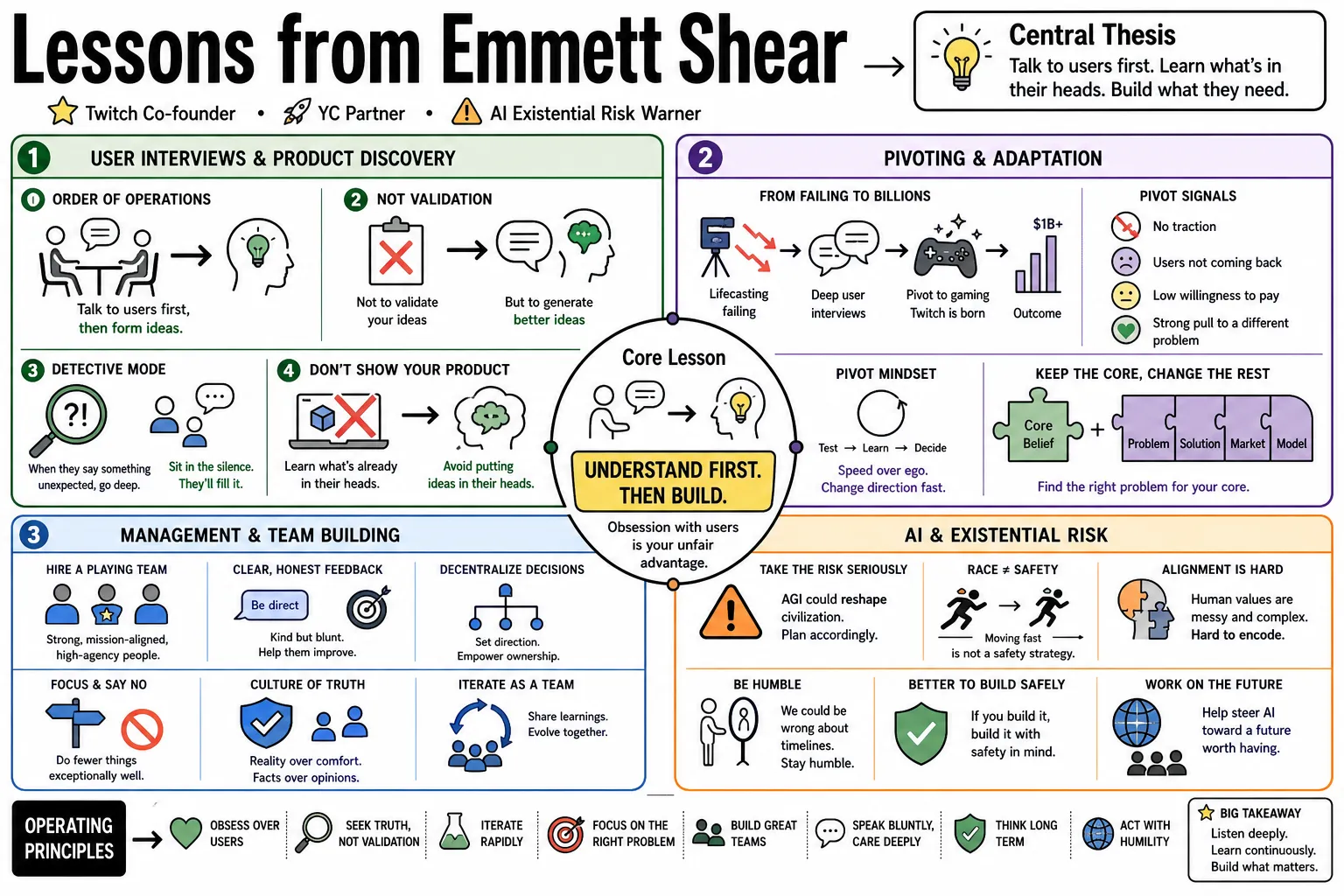
Part 1: User Interviews & Product Discovery
- On the order of operations: Product ideas should be developed after speaking with users, though most people approach it in the reverse order. [1]
- On false validation: User conversations should generate product ideas rather than merely validate preexisting concepts. [1]
- On detective mode: When someone shares unexpected information, pausing and investigating can encourage them to elaborate. [2]
- On showing the product: When gathering user feedback, one should focus on understanding users' preexisting thoughts rather than presenting an offering and influencing them. [2]
- On asking for features: Avoid directly asking users whether a feature is good, as politeness often leads them to answer affirmatively. [2]
- On the right to an opinion: Only people who have consulted users and reviewed data have earned the right to hold product opinions. [1]
- On the horseless carriage effect: Users often ask for familiar incremental improvements, so founders must assess whether an idea is enough. [2]
- On talking to the wrong people: Early users who help launch a product may differ from the audience using it years later, so founders should keep revisiting whom they learn from as the market evolves. [2]
- On the value of churned users: People who deliberately reviewed a product, rejected it, and chose an alternative can be among the most valuable people to interview. [1]
- On recording interviews: Recording user interviews can build team buy-in by letting colleagues hear users' frustration directly rather than through a manager. [2]
Part 2: Startups & Founding
- On starting a company: Anyone who can be persuaded not to start a company by a simple discouraging message should not start one. [3]
- On the true nature of startups: Early development focuses on manifesting a broader vision rather than simply building the thing itself. [4]
- On early commitment: Finding many people with full commitment is difficult, and deep dedication is often limited to very few individuals. [4]
- On finding ideas: There are three paths to a startup idea: building something you want yourself, building something you've directly experienced others needing, or inventing something through rigorous analytic thought. [5]
- On true validation: Getting customers to pay for a product is one of the most validating ways to establish genuine interest. [2]
- On persistence: In startups, under-persisting is often more dangerous than over-persisting, so founders should generally persist longer than seems wise. [6]
- On knowing you have product-market fit: Before product-market fit, building feels like pushing a boulder uphill; after crossing the crest, demand begins to pull the product forward. [4]
- On building for others: Building a startup only for the person using it can sometimes succeed, but often becomes a side project that goes nowhere. [2]
- On starting young: Starting a company soon after college can be attractive because founders have less to lose and ready access to potential cofounders. [7]
Part 3: The Justin.tv to Twitch Pivot
- On the wake-up call: Blunt external feedback about stagnant growth can serve as a critical realization that an internet venture is at risk of failing. [4]
- On hard pivots: To make Twitch work, the team had to lay off half their staff and just mind the store of the dying Justin.tv business. You cannot pivot successfully if you are still half-committed to the old model. [8]
- On building for yourself: Developing a product aligned with personal enthusiasm is easier because the builder acts as their own most demanding customer. [4]
- On interviewing power users: Early Twitch product work included interviewing a small group of key broadcasters about the improvements they needed. [9]
- On data versus vision: The gaming pivot was not especially data-driven; the team chose it because gaming matched their product vision and interests. [9]
- On ignoring competitors: "Ignore your competitors, but don't ignore their customers." [5]
- On participation over consumption: Twitch treated live video as participatory media, with chat, audience interaction, and community central to the experience. [10]
- On adding complexity: Providing users with more capabilities and tools can help a platform grow, even if it introduces greater complexity. [11]
- On the push-button trap: Focusing on high-quality output and treating users as active collaborators can be more valuable than making a tool easy to use, including when users must do substantial work. [11]
- On solving specific problems: Being the spam guy at Hotmail taught that focusing deeply on a single, ugly problem is often more instructive than general product work. [12]
Part 4: Management & Culture
- On first-time managers: First-time managers should expect to struggle initially and deliberately improve through feedback, coaching, peer support, and study. [13]
- On firing too late: Letting an underperforming employee go is difficult and painful, so it will often happen too late. [14]
- On behavioral culture: Company culture is shaped by the behaviors employees perceive leaders reward or punish, not merely by stated values or intended incentives. [15]
- On changing the culture: Because company culture reflects its founders, changing culture starts with changing leader behavior and what leaders genuinely value. [16]
- On the gelled team: A cohesive team is one in which people prioritize collective needs and goals over individual career goals, needs, projects, and preferences. [4]
- On delegation and context: Leadership involves developing people through delegation while discerning which decisions must be right and which can tolerate mistakes. [17]
- On being Head of Product: A leader may realize they need to oversee product directly rather than delegating that responsibility. [17]
- On saying no: "The most important thing you can do as a CEO is decide what not to do. Every 'yes' to a new feature is a 'no' to making the core product better." [18]
- On the stupid one-day fix: Failing to communicate with users can cause companies to overlook straightforward improvements. [1]
Part 5: Hiring & Team Building
- On knowing when to hire: Hire when the workload has clearly outgrown your capacity and a defined part of the job must be handed off. [19]
- On picking co-founders: When seeking a cofounder, start with the smartest person you know and the person you would be most excited to work with. [4]
- On synchronizing mental models: As a team grows, the goal is to convey one's mental model so thoroughly that reports naturally make the decisions one would have made. [17]
- On anticipating decisions: An organization can scale more effectively when team members are trained to ask what the CEO would do in the exact situation. [17]
- On the limits of hiring: A new hire won't solve a fundamental lack of product-market fit; you cannot hire your way out of a product that users don't actually want. [20]
- On the importance of internal alignment: A gelled startup team shifts attention from individual projects and careers to shared goals and needs. [4]
Part 6: Decision-Making & Strategy
- On actionable data: Finding data that guides decisions is more challenging than merely searching for patterns. [9]
- On energy management: "I think about my day in terms of energy, not just time. There are certain tasks that are 'energy-giving' and others that are 'energy-draining.' I try to schedule the draining ones when I have the most capacity." [21]
- On holding context: A chief executive often primarily serves to maintain overarching context so choices reflect the full picture. [17]
- On crisis management: In an uncertain situation, the chosen route was seen as maximizing safety while doing right by all stakeholders involved. [22]
- On investigating failures: In a crisis, first appoint an independent investigator, speak with stakeholders, and then make evidence-based leadership or governance changes. [23]
- On making hard choices: One should distinguish between existential decisions that must be perfect and decisions where mistakes are acceptable. [17]
- On duty to institutions: Shear described accepting the OpenAI interim CEO role as a duty to protect and grow an institution he regarded as important. [23]
- On independent thinking: Good strategy often looks completely irrational to outsiders because it relies on non-obvious truths that the founders have discovered through deep user engagement. [24]
- On the speed of iteration: The gaming pivot improved once the team focused on a specific community, spoke directly with its users, and iterated around their needs. [9]
Part 7: Career Advice & Personal Growth
- On the core career framework: "In general it seems clear ppl should satisfice for cash, optimize for learning/growth, and ignore everything else." [5]
- On the prestige trap: People should secure adequate compensation, optimize for learning and growth, and ignore the rest. [25]
- On borrowed power: Prestige is mostly a trap because it does not itself make someone better or better off. [25]
- On spotting career mirages: Early-career jobs offer borrowed power: the ability to wield an instrument one does not control toward goals one did not choose. [25]
- On interning at giant corps: During a Microsoft internship, each paycheck felt to Shear like payment for a small piece of his soul. [26]
- On early adoption of technology: Identifying massive shifts early—like trying to convince a Hotmail team that Gmail's launch was a paradigm shift—is a critical skill for a technologist's career. [27]
- On avoiding the obvious path: Following the standard, prestigious playbook rarely leads to outsized outcomes; the most valuable experiences often look messy and painful in the moment. [28]
- On humility: Admitting that you do not know the answer is the first required step to dropping the performative aspects of business and actually making progress. [29]
Part 8: Artificial Intelligence & Existential Risk
- On the probability of doom: Shear placed his probability of AI catastrophe in a wide but serious range, roughly 5 percent to 50 percent, and argued that this uncertainty warrants alarm. [30]
- On intelligence as power: Advanced intelligence is dangerous because intelligence confers power; humanity dominates largely because it is smarter than other species. [30]
- On the alien god analogy: Shear warned that a sufficiently advanced AI could appear harmless before a critical threshold and then become capable of destroying the world. [31]
- On universe-destroying bombs: Shear compared the worst AGI outcome to a universe-destroying bomb whose effects could reach species beyond humanity. [30]
- On the sand and bleach metaphor: Shear compared widely accessible AGI to making extremely powerful fusion bombs from ordinary materials such as sand and bleach. [30]
- On the urgency of alignment: AI alignment is an urgent problem that cannot safely be deferred until after more capable systems arrive. [30]
- On prioritizing safety over everything: "I'd rather the actual literal Nazis take over the world forever than flip a coin on the end of all value." [32]
- On the birth of AGI: Shear described the coming AI transition as a difficult birth and argued that humans should take a consciously subjective stake in its outcome. [33]
- On organic alignment: Shear argues that durable AI alignment requires systems able to recognize a shared we and genuinely care about the collective they belong to. [17]
Learn more:
- On the order of operations — youtube.com
- On detective mode — youtube.com
- On starting a company — x.com
- On the true nature of startups — youtube.com
- On finding ideas — twitter.com
- On persistence — youtube.com
- On starting young — youtube.com
- On hard pivots — datascienceweekly.org
- On interviewing power users — datascienceweekly.org
- On participation over consumption — youtube.com
- On adding complexity — youtube.com
- On solving specific problems — metacast.app
- On first-time managers — x.com
- On firing too late — x.com
- On behavioral culture — x.com
- On changing the culture — x.com
- On delegation and context — youtube.com
- On saying no — theobservereffect.com
- On knowing when to hire — x.com
- On the limits of hiring — ycombinator.com
- On energy management — theobservereffect.com
- On crisis management — x.com
- On investigating failures — x.com
- On independent thinking — medium.com
- On the prestige trap — x.com
- On interning at giant corps — businessinsider.com
- On early adoption of technology — metacast.app
- On avoiding the obvious path — businessinsider.com
- On humility — airtree.vc
- On the probability of doom — youtube.com
- On the alien god analogy — x.com
- On prioritizing safety over everything — en.wikipedia.org
- On the birth of AGI — youtube.com