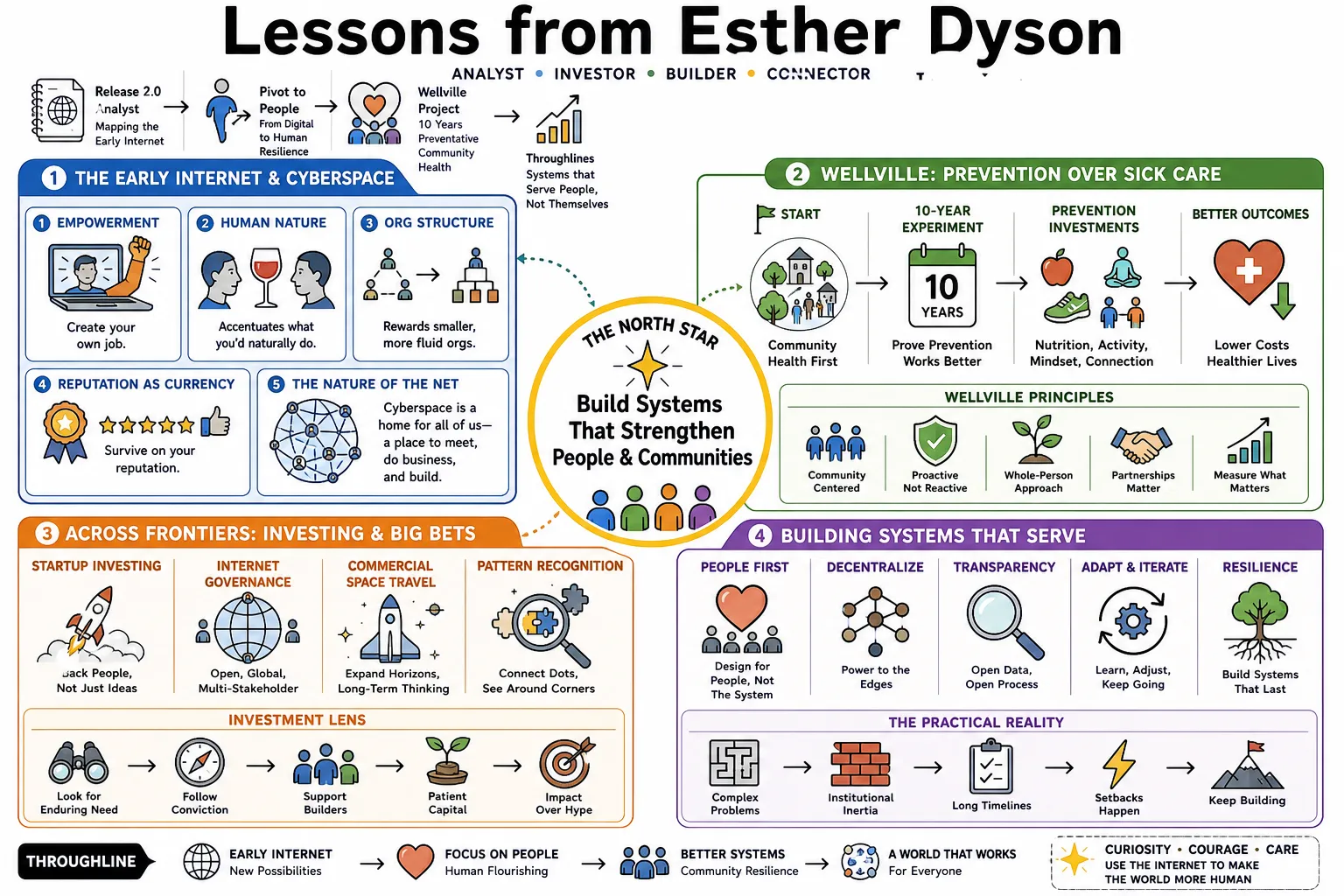
Lessons from Esther Dyson
Esther Dyson began as an analyst mapping the early internet in Release 2.0 before shifting her focus from digital networks to human resilience. She launched the 10-year Wellville project to prove that preventative community health works better than paying for sick care. This collection tracks her thinking across startup investing, internet governance, commercial space travel, and the practical difficulty of building systems that actually serve people.
Part 1: The Early Internet & Cyberspace
- On Empowerment: "The internet allows you to create your own job instead of waiting for someone else to give you one." — Source: [AZ Quotes]
- On Human Nature: "The internet acts like alcohol; it accentuates what you would naturally do anyway, whether isolating or connecting." — Source: [AZ Quotes]
- On Organizational Structure: "The internet rewards smaller, more fluid organizations over self-perpetuating surplus-building governments and corporations." — Source: [AZ Quotes]
- On Reputation as Currency: "In a digital world where content is often free, individuals and companies survive based on their reputation." — Source: [Observer]
- On the Nature of the Net: "Cyberspace is a home for all of us—a place to meet, do business, form committees, and even pass rumors." — Source: [Observer]
- On Genuine Interaction: "The true power of the Net lies in its capacity for genuine, two-way interaction, allowing users to build their own communities." — Source: [i-Scoop]
- On Intellectual Property: "Content providers will eventually be paid for ancillary services or products rather than the digital works themselves." — Source: [Observer]
- On Global Impact: "The internet's greatest power is efficiency; for example, giving farmers in Africa instant access to crop prices." — Source: [AZ Quotes]
- On Digital Meaning: "Words online are not carriers of meaning in themselves, but merely pointers to a shared understanding." — Source: [Observer]
Part 2: Angel Investing & Evaluating Startups
- On The Best Capital: "The best investor you can have is your own customer." — Source: [QuoteFancy]
- On Founder Motivation: "Saying 'I've always wanted to be CEO' or 'I want to be a billionaire' is the wrong motivation; founders must want to solve a specific problem." — Source: [Inc.]
- On Market Noise: "The sheer number of young, inexperienced founders attempting to create redundant startups makes it harder to find real value through the fluff." — Source: [Inc.]
- On Taking Jobs: "I never take a job for which I am already qualified; I only do things where I will learn something and produce value." — Source: [QuoteFancy]
- On Startup Goals: "Startups should aim for actual real-world behavior change rather than focusing on vanity metrics." — Source: [Substack]
- On Wealth and Effort: "I made a lot of money investing in Google not through personal effort, but through luck in a venture fund." — Source: [PowerPlays]
- On Focused Opportunities: "As an investor in small companies, I don't care how rich massive corporations like Microsoft are; I only care about what my specific opportunities are." — Source: [QuoteFancy]
- On Picking Investments: "Evaluating companies is like parenting; you have to consider the long-term consequences and the time it takes to guide them to success." — Source: [B612 Foundation]
- On Evaluating Risk: "Angel investing requires looking at whether a company is trying to fix an ugly reality rather than just ignoring it." — Source: [Inc.]
Part 3: Health, Resilience, & Wellville
- On Prevention vs. Care: "Prevention is fundamentally cheaper than care because it works over the long term." — Source: [Business Insider]
- On Rethinking Spending: "Why are we spending so much money fixing things with people who shouldn't have been sick in the first place?" — Source: [Business Insider]
- On Prevention: Dyson argues that health work should stop problems before they become medical crises, focusing on prevention rather than late cures. — Source: [4sight Health]
- On Health as an Asset: "Health should be viewed as an asset that provides benefits over time, whereas healthcare is a cost spent trying to recover that asset." — Source: [Health Rosetta]
- On Resilience: "The goal is not finding a cure for an illness, but building community resilience so people do not succumb to the illness at all." — Source: [Wellville]
- On Absentee Landlords: "Communities should not rent their health from outside absentee landlords; they must invest in building local capacity." — Source: [Worth]
- On Naming Mistakes: "I realized that naming a health initiative 'HICCup' was a terrible idea because a hiccup is a minor medical annoyance, which led to the rebrand to Wellville." — Source: [Forbes]
- On Innovation: "Healthcare startups are the next great innovators because the system is deeply broken and requires massive overhauls." — Source: [Inc.]
- On Behavior Change: "The real challenge in health is not merely giving people information, but successfully motivating them to change their behavior." — Source: [Business Insider]
- On Executive Structure: "As an executive founder, I prefer to work within the communities I serve rather than sitting on top of them as a traditional CEO." — Source: [QuoteFancy]
Part 4: Information Quality & Attention
- On Human Attention: "The only factor becoming truly scarce in a world of digital abundance is human attention." — Source: [i-Scoop]
- On Information Diabetes: "Consuming addictive, low-quality digital content is akin to eating processed food—it damages our mental metabolism." — Source: [RUSSOFT]
- On AI and Learning: "Children are beginning to learn like Large Language Models—absorbing superficial summaries rather than developing deep understanding." — Source: [Substack]
- On Money Diabetes: "Wealth generated from useless or harmful work destroys our moral instincts just as junk food destroys physical health." — Source: [RUSSOFT]
- On Bad Information: "Garbage data, hallucinations, and manipulative online content directly damage human curiosity and attention spans." — Source: [RUSSOFT]
- On Post-Pandemic Reality: "The digital future requires dealing with ambiguity and moving beyond sheer self-interest." — Source: [Wharton]
- On the Limits of the Net: "Whatever future the Internet brings us, it will not merely be an upgraded version of today with luxury options." — Source: [William Calvin]
- On Data Privacy: "I remain deeply concerned over how casually personal data is treated and aggregated by modern tech platforms." — Source: [Wharton]
- On Digital Immortality: "I explicitly reject the desire to digitize my consciousness or live forever, preferring a finite, useful life." — Source: [Substack]
- On Human Scalability: "Humans are finite, which makes our time priceless, in stark contrast to the endless, cheap scalability of Artificial Intelligence." — Source: [RUSSOFT]
Part 5: Internet Governance & ICANN
- On Digital Consensus: "Achieving consensus in digital governance is significantly harder than early internet pioneers anticipated." — Source: [Wharton]
- On Fake Purity: "ICANN was conceived not so much in original sin, but in an original, flawed fake purity." — Source: [PowerPlays]
- On Institutional Decay: "Over time, ICANN devolved into a difficult and convoluted cesspool." — Source: [Wharton]
- On True Policy Making: "Organizations need to invite users to help make policy, not just demand they submit to policies without having a voice." — Source: [PowerPlays]
- On Community Reflection: "Governance bodies like ICANN are ultimately nothing more than the reflection of the community's consensus—or lack thereof." — Source: [ICANN]
- On Domain Names: "The expansion of new top-level domains is often just a money-making scheme for registries, rather than a necessary technical evolution." — Source: [Domain Mondo]
- On Regulation: "The internet was best served by a grassroots system of social and commercial shunning rather than heavy-handed government intervention." — Source: [Observer]
- On Government Excess: "Having served on numerous boards, I have observed that there is just as much disgusting excess in Washington as there is in business." — Source: [QuoteFancy]
- On Corporate IP Maintenance: "Owning intellectual property is like owning land; you must keep investing in it to get a payoff instead of just collecting rent." — Source: [QuoteFancy]
- On Honest Feedback: "The modern tech industry needs a court jester figure to provide independent, honest feedback to those in power." — Source: [Substack]
Part 6: Aerospace & The Cosmonaut Experience
- On Ceding Control: "Training as a cosmonaut taught me how to cede control with dignity, a challenging lesson for someone used to managing their own life." — Source: [B612 Foundation]
- On Mars Retirement: "I hope to retire on Mars and live in low gravity, but I prefer to wait until others have built the infrastructure." — Source: [B612 Foundation]
- On Weightlessness: "Being completely weightless is tremendous fun and provides the genuine sensation of flying." — Source: [B612 Foundation]
- On the Long View: "The people who actually change the future are the ones who are willing to take the long view, such as investing in asteroid detection." — Source: [B612 Foundation]
- On Space Logistics: "The most practical lessons from cosmonaut training were about mundane realities, like space plumbing and logistics." — Source: [B612 Foundation]
- On Flight School: "The emergence of air taxis and commercial space flight represents a new frontier for private aviation and investment." — Source: [Commercial Space]
- On Accessible Space: "I became a customer of the Russian space program because training was an order of magnitude cheaper than actually buying a flight to orbit." — Source: [B612 Foundation]
- On the Aerospace Mindset: "Aviation and space exploration require a disciplined approach to risk that contrasts sharply with the software industry's habit of moving fast and breaking things." — Source: [Commercial Space]
- On Generational Misattribution: "I constantly have to remind people that the famous quote about aviation being unforgiving of mistakes was actually said by my father, Freeman Dyson." — Source: [Commercial Space]
Part 7: Corporate Strategy & Scale
- On Corporate Darwinism: "The pace at which companies are created, grow, and disappear will continue to accelerate." — Source: [Observer]
- On the Advantage of Darwinism: "The good news about rapid economic changes is that Darwinian destruction applies more heavily to companies than to individual people." — Source: [Observer]
- On Predatory Models: "Many modern tech businesses rely on predatory models that extract value rather than creating community resilience." — Source: [Substack]
- On Scaling by Copying: "True social impact shouldn't always scale by growing a massive organization, but by serving as a successful model for others to copy locally." — Source: [LDV]
- On Institutional Longevity: "The nature of traditional business and government is to self-perpetuate and build a surplus, which actively limits innovation." — Source: [AZ Quotes]
- On Long-Term Outcomes: "The true measure of a company's success isn't its initial valuation, but whether it leaves behind something fundamentally valuable." — Source: [Substack]
- On Redundant Innovation: "Too much venture capital is wasted on redundant startups chasing minor efficiencies rather than tackling deep structural problems." — Source: [Inc.]
- On Funding Externalities: "Society cannot keep relying on temporary outside funding to fix chronic local problems; sustainable local institutions must be built." — Source: [Wellville]
- On the Limits of Software: "While software scales infinitely, the human capacity to absorb, govern, and utilize that software remains strictly finite." — Source: [RUSSOFT]
Part 8: Philosophy, Mistakes, & Legacy
- On Making Mistakes: "Always make new mistakes." — Source: [Meaning Ring]
- On Childhood Resilience: "Everything we do now should be focused on giving children a secure present so they can navigate a resilient future." — Source: [LDV]
- On Societal Crises: "We must invest in equity and resilience so that the next global crisis doesn't crumble our society as badly as the last one did." — Source: [LDV]
- On Living Uncomfortably: "I deliberately seek out situations and investments where I am the least knowledgeable person in the room." — Source: [QuoteFancy]
- On Meaningful Work: "The ultimate goal of a career is not massive accumulation of wealth, but doing work that leaves the room cleaner than you found it." — Source: [Everyone.org]
- On Constant Evolution: "My transition from analyzing the early internet to local healthcare reflects a core belief in evolving one's focus as systems mature." — Source: [Aurelia Institute]
- On Acknowledging Reality: "It is far better to invest in solutions that acknowledge an ugly, difficult reality than those that offer a clean, false panacea." — Source: [Inc.]
- On Leaving a Mark: "The measure of a life is found in what is built for others to inherit, not in what is extracted for oneself." — Source: [Substack]
- On Her Epitaph: "I want my tombstone to read: I wasn't done yet! There is still more to learn and to fix... but over to you!" — Source: [LDV]