Lessons from Ev Williams
Ev Williams co-founded Blogger, Twitter, and Medium by making it progressively easier to publish online. He spent much of his career wrestling with the consequences of that frictionless sharing, particularly what it does to human attention. These are his notes on clean product design, resisting distraction, and the actual mechanics of running startups.
Part 1: The Engine of Convenience
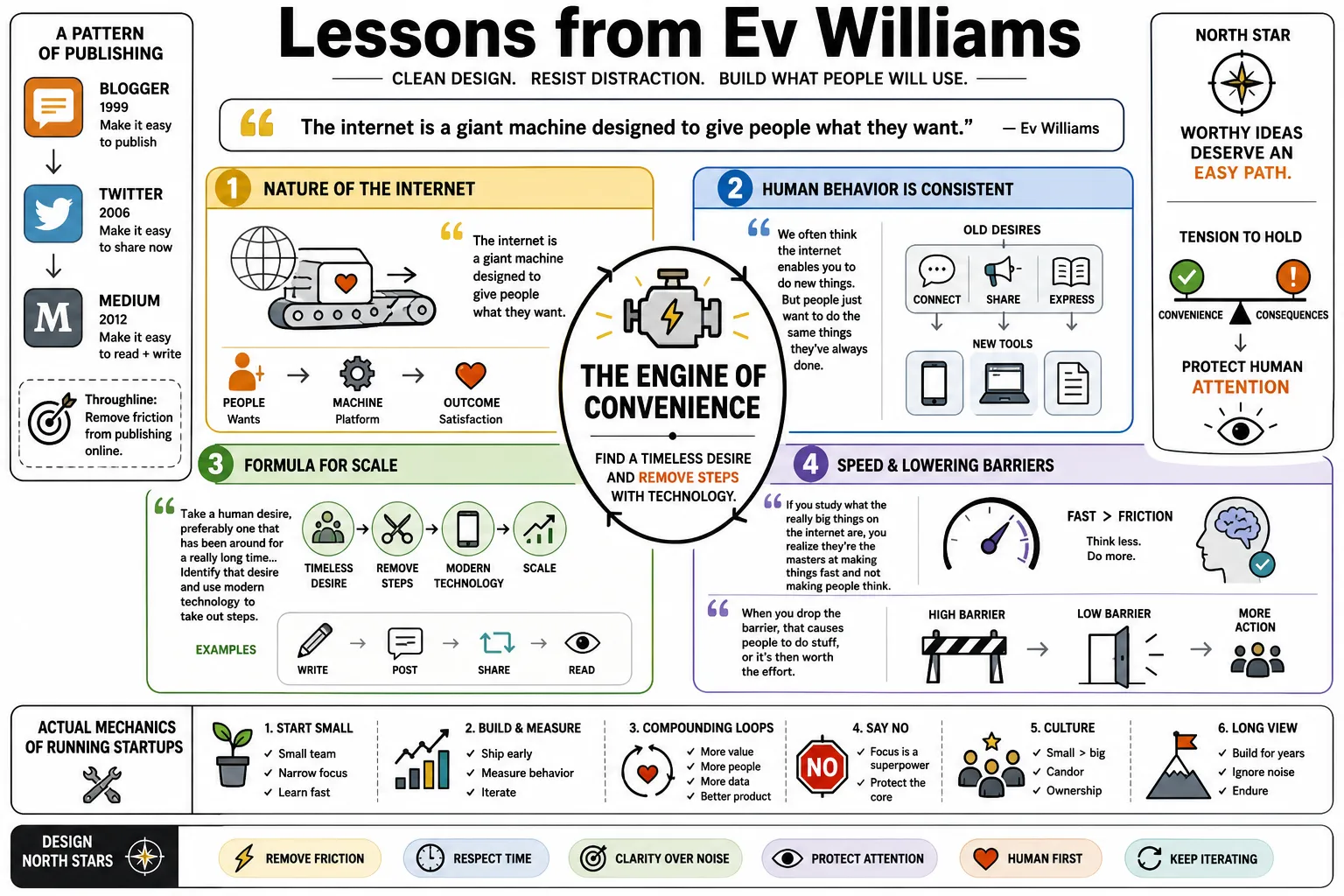
- On the nature of the internet: "The internet is a giant machine designed to give people what they want." — Source: [James Clear]
- On behavioral shifts: "We often think the internet enables you to do new things. But people just want to do the same things they’ve always done." — Source: [Dolphins Group]
- On the formula for scale: "Take a human desire, preferably one that has been around for a really long time... Identify that desire and use modern technology to take out steps." — Source: [LSE Blog]
- On speed as a feature: "If you study what the really big things on the internet are, you realize they’re the masters at making things fast and not making people think." — Source: [James Clear]
- On lowering barriers: "When you drop the barrier, that causes people to do stuff, or it’s then worth the effort." — Source: [XOXO Talk Transcript]
- On the internet as a tool: "It’s not a utopia. It’s not magical. It’s simply an engine of convenience." — Source: [Live Fan Chat]
- On the etymology of convenience: "I learned that the Latin root of 'convenience' actually means assembling and agreeing. Isn't that what the people who created the internet did?" — Source: [James Clear]
- On the dark side of metrics: "Convenience is only bad if we miss the point... and if we only focus on the clicks and the connections and the retweets and the likes for the sake of more and more connections." — Source: [XOXO Talk Transcript]
- On qualitative balance: "Just as there is still great artisanal, healthy, amazing food choices despite the industrialization of agriculture, there is the potential and reality of amazing, positive, good things coming from the internet." — Source: [XOXO Talk Transcript]
- On defining the core desire: Focus on fundamental human needs like learning, loving, and connecting, then figure out how to make them significantly more accessible. — Source: [James Clear]
Part 2: Product Design and Simplicity
- On user experience as a priority: "User experience is everything. It always has been, but it’s undervalued and underinvested in." — Source: [AZQuotes]
- On hiring for design: "If you don’t know user-centered design, study it. Hire people who know it. Obsess over it." — Source: [Addicted 2 Success]
- On building for yourself: "I think some people can build products for other people, and thank goodness they do. But I just build products for myself." — Source: [AZQuotes]
- On avoiding addiction loops: "Medium doesn’t need to be the thing you check all day, every day. We’re not looking for addiction." — Source: [The Guardian]
- On depth over breadth: "Most internet companies would build better things and create more value if they paid more attention to depth than breadth." — Source: [Medium]
- On iterative discovery: "The things that keep nagging at you are the ones worth exploring." — Source: [Addicted 2 Success]
- On removing friction: The key to consumer products is finding where people are stuck and taking away the friction of thinking or deciding. — Source: [James Clear]
- On hard problems: "Hard things are valuable; easy things are not so valuable. Reaching the mountaintop is rewarding because it is hard." — Source: [AZQuotes]
- On the illusion of easy wins: "If it was easy, everybody would do it." — Source: [AZQuotes]
- On the purpose of technology: The ultimate role of tech is to free people up so they can spend time doing better, more nourishing things. — Source: [James Clear]
Part 3: Attention and The Information Diet
- On the flawed metric of time spent: "Taking people’s time isn’t really the goal. And people wasting time is actually the opposite of the goal." — Source: [Medium]
- On junk food media: "We put junk food in front of them and they ate that, so that must be what they want." — Source: [The Guardian]
- On ignoring the news cycle: "News in general doesn’t matter most of the time, and most people would be far better off if they spent their time consuming less news." — Source: [AZQuotes]
- On lasting ideas: Consume ideas that have more lasting import rather than fleeting daily updates. — Source: [AZQuotes]
- On the superpower of audiences: "Once you develop your readership on your blog, and you can put something out there or direct traffic or get attention, it’s like a super power." — Source: [Medium]
- On designing Twitter: "Twitter, we never saw as necessarily social... We borrowed from blogs for Twitter." — Source: [Tim Ferriss Blog]
- On status-building platforms: Many networks have devolved from connection into performative arenas, moving away from real relationships. — Source: [Tim Ferriss Blog]
- On moving ideas forward: The initial vision for Medium was a platform focused on a system that moves ideas and stories forward rather than just a feed. — Source: [Medium]
- On subscription versus ads: Advertising incentives inherently conflict with depth and quality, prompting Medium's shift to a subscription model. — Source: [The Guardian]
- On the pace of information: A healthy media environment requires spaces for thoughts that are neither too short nor too long. — Source: [How I Built This]
Part 4: Entrepreneurship and Building
- On the reality of founders: All farmers are basically entrepreneurs because they have to manage their own business and mitigate massive independent risks. — Source: [How I Built This]
- On impatience: Dropping out of college was driven by a tremendous rush to get out into the world and build something immediately. — Source: [How I Built This]
- On serial building: "Every time you start a company... you have the opportunity to screw up in whole new ways." — Source: [Bookey]
- On delusional thinking: "My life has been a series of well-orchestrated accidents; I’ve always suffered from hallucinogenic optimism." — Source: [AZQuotes]
- On early pivots: A successful founder must recognize when early ideas are sketchy and move on. — Source: [How I Built This]
- On refusing the wrong path: Even when running out of money, he refused to pivot Blogger into enterprise software because it wasn't the kind of company he wanted to build. — Source: [How I Built This]
- On team dynamics: "Work with amazing people. Don't compromise on who you choose to found your company with and hire." — Source: [Addicted 2 Success]
- On avoiding toxicity: "Do not put up with ego-centric personalities or downer attitudes." — Source: [Addicted 2 Success]
- On the paradox of trust: "Assume the best but hire paranoid people." — Source: [AZQuotes]
Part 5: Focus and Strategic Quitting
- On doing less: "When I meet with the founders of a new company, my advice is almost always, 'Do fewer things.'" — Source: [AZQuotes]
- On superficial solutions: "If you have too many things to think about, you'll get to the superficial solution, not the brilliant one." — Source: [Addicted 2 Success]
- On the nature of distractions: "The vast majority of things are distractions, and very few really matter to your success." — Source: [AZQuotes]
- On what to cut: "Focus is about saying no to most things: features, people, partnerships, 'coffees,' projects." — Source: [Addicted 2 Success]
- On strategic quitting: Many people stay in bad situations just because they were taught to keep going, but quitting the wrong things is the only way to find the right ones. — Source: [Tim Ferriss Blog]
- On identifying what matters: Only a tiny fraction of the opportunities presented to you will actually move the needle. — Source: [Addicted 2 Success]
- On taking a clean slate: "Don't be afraid to start over. It's a chance to build something better." — Source: [Bookey]
- On personal performance: "When you don’t sleep, eat crap, don’t exercise, and are living off adrenaline for too long, your performance suffers." — Source: [AZQuotes]
- On the compounding cost of burnout: Self-care is a business necessity, not a luxury, because your decisions will directly impact the company. — Source: [AZQuotes]
Part 6: Failure and Resilience
- On defining failure: "Failure of your company is not failure in life. Failure in your relationships is." — Source: [AZQuotes]
- On surviving the crash: Surviving the dot-com bust meant working entirely alone on Blogger when the company literally ran out of money. — Source: [How I Built This]
- On losing your company: Being ousted as CEO of Twitter was devastating and felt momentarily like nothing achieved prior mattered. — Source: [How I Built This]
- On conflict avoidance: Avoiding conflict early in his career led directly to slow decision-making and his eventual ouster. — Source: [How I Built This]
- On the nature of ideas: Odeo became obsolete the moment Apple launched native podcasting, forcing a complete pivot. — Source: [How I Built This]
- On inner conviction: "Believe in your dreams, even when no one else does. They are yours for a reason." — Source: [Addicted 2 Success]
- On continuous improvement: "Success is not about being the best, it’s about being better than you were yesterday." — Source: [Bookey]
- On internal limitations: "The only limits in life are the ones we set for ourselves." — Source: [Bookey]
- On forward momentum: "Success is not measured by how far you've come, but by how far you're willing to go." — Source: [Bookey]
Part 7: Human Connection and Relationships
- On redefining "social": "Remember when social used to mean getting together in real life, getting to know people? And now social is just this catchall word that kind of just means the internet." — Source: [Tim Ferriss Blog]
- On misallocated energy: "After a lifetime working at mattering, I realized I had under-invested in what really mattered: Relationships." — Source: [Medium]
- On sliding doors: "I think it’s tough to appreciate how much relationships determine the course of our lives — and how randomly many of them come to be." — Source: [Medium]
- On treating teams right: "Your employees are your most important customers." — Source: [Addicted 2 Success]
- On the purpose of management: Management isn't a necessary evil but the primary mechanism to ensure your team is happy and highly productive. — Source: [Addicted 2 Success]
- On shifting focus from media to connection: It is time to build tools that facilitate real-world relationships rather than endless media consumption. — Source: [Tim Ferriss Blog]
- On predicting the future: "The best way to predict the future is to create it." — Source: [Addicted 2 Success]
- On the isolation of building: The lonely phase of building Blogger single-handedly underscored that technology without human support systems is deeply hollow. — Source: [How I Built This]
- On authentic interactions: The internet was designed to bring us together, but over-indexing on convenience can accidentally strip the warmth out of human exchange. — Source: [James Clear]
Part 8: World Positive Investing
- On the new investing paradigm: The most valuable companies of the 21st century will be those that actively solve humanity’s biggest problems rather than just capturing attention. — Source: [Obvious Ventures]
- On purpose and profit: There is no required trade-off between social impact and financial returns; purpose-driven startups have a distinct advantage. — Source: [Fast Company]
- On investing as world-building: "We should invest in companies we wish existed in the world." — Source: [Obvious Ventures]
- On funding frontiers: Investors must look for categories that don't fit into traditional venture capital boxes but have massive potential to become systemic flywheels. — Source: [Obvious Ventures]
- On structural alignment: Committing to B Corp status ensures that an investment firm's legal accountability matches its stated social values. — Source: [Gilion]
- On planetary health: Venture capital must focus heavily on decarbonizing the global supply chain, looking at sustainable resources and renewable mobility. — Source: [Obvious Ventures]
- On human health: Investment should shift toward scalable interventions that make humans healthier through nutrition, biopharma, and accessible care. — Source: [Obvious Ventures]
- On economic empowerment: Technology should be funded when it provides real people power via accessible financial services and modern workforce tools. — Source: [Obvious Ventures]
- On systemic solutions: We need to back solutions to global challenges that are obvious but often overlooked by traditional financiers looking for quick software flips. — Source: [Obvious Ventures]