Farhan Thawar is an esteemed engineering leader, currently serving as VP and Head of Engineering at Shopify, with a legacy of building high-velocity teams at Xtreme Labs, Pivotal Labs, and Helpful. Known for his contrarian views on hiring, his advocacy for pair programming, and his radical simplification of corporate processes like the "Meeting Armageddon," his management philosophies have reshaped how modern software is built. The following 75 insights distill his approach to cultivating intense, high-trust "crafter's paradises" where engineers can do their best work.
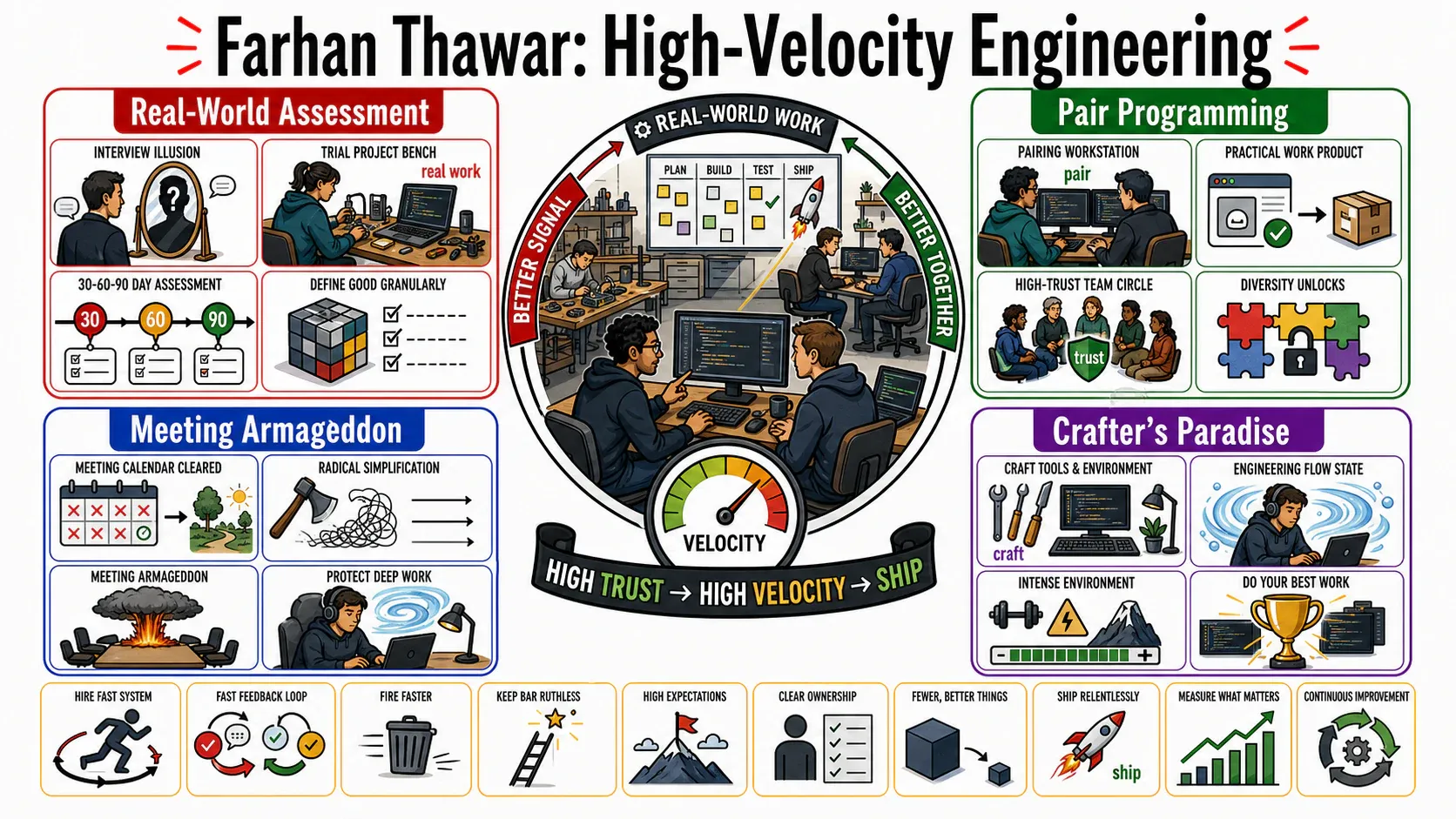
Part 1: The Hiring Philosophy & Radical Assessment
- On Traditional Interviews: "Interviews are not a good predictor of performance... people who interview well may not perform well in the job, and vice versa." — Source: Lenny's Newsletter
- On Real-World Assessment: "The best way to assess a candidate's skills is to put them in a real-world situation, rather than relying on interviews." — Source: GetRecall.ai
- On Hiring Fast, Firing Faster: "I think this method of hiring fast and firing faster gets us more high quality candidates in the long run." — Source: Medium
- On The Interview Illusion: "Technical interviews are a fantastic tool... if you want to hire candidates that are great at interviewing. But if you want people who are good at the job? Not so much." — Source: Lenny's Newsletter
- On Candidate Diversity: "Diversity helps us win. If you want to win too, you'll knock it off with the interviews." — Source: Lenny's Newsletter
- On The True Interview Window: "The job interview is like 30, 60, 90 days... getting married after the first date [is a mistake]." — Source: YouTube
- On De-risking Hires: "Extended trials or looking at real, tangible work products are far more effective ways to de-risk a hire than algorithmic brain teasers." — Source: Lenny's Newsletter
- On Defining Good: "It always comes back to defining what you're looking for and what good looks like on a very granular level. Answering that will help you better understand how to find, hire, motivate, and grow folks." — Source: Notion
- On Non-Traditional Backgrounds: "High-performing staff can often be found in non-tech backgrounds, such as the hospitality industry, where 'intensity' and learning speed are highly developed." — Source: Lenny's Newsletter
- On The "Life Story" Interview: "Rather than relying purely on coding tests, spend time exploring a candidate's trajectory, past pivots, and the intrinsic motivations behind their career moves." — Source: Simple Leadership
Part 2: Interview Myths & Finding True Talent
- On Action Over Applications: "What are you doing to try to find a job? Are you really learning anything from sending out 10 resumes a day? Why don't you look at the API docs and build something..." — Source: TelcoDR
- On The Power of Building: "...even if you don't get a job, you've learned something by building instead of just applying." — Source: TelcoDR
- On Process, People, Technology: "When hiring engineering leaders, use these three pillars to establish granular, objective qualities you expect a candidate to possess." — Source: Notion
- On Intensity in Candidates: "Look for candidates who naturally optimize for spending 'more kilojoules per hour' rather than simply clocking more hours at a desk." — Source: YouTube
- On Interns as a Pipeline: "Treating interns as full-time contributors from day one is the most effective way to build a massive, long-term talent pipeline." — Source: YouTube
- On Reverse Mentorship: "Senior engineers often learn just as much, if not more, from the 'AI-reflexive' habits of new interns as the interns learn from them." — Source: Lenny's Newsletter
- On Evaluating Problem Solving: "Look for candidates who have intentionally chosen difficult paths in their past, as these experiences forge better problem-solving skills than smooth, easy successes." — Source: YouTube
- On The Limits of Leetcode: "Standard technical riddles and whiteboard algorithms are often orthogonal to the actual day-to-day work of shipping production software." — Source: Lenny's Newsletter
- On Recognizing Drive: "True engineering talent is often revealed by a candidate's self-directed projects and open-source contributions, which demonstrate intrinsic motivation." — Source: GetRecall.ai
Part 3: Pair Programming & The Underhanded Free Throw
- On The Perception of Pairing: "Pair programming is the underhanded free throw of engineering. Underhanded free throws have been proven to be better... at everything except one thing: they look stupid. And pair programming does look stupid, to everybody." — Source: Hybrid Hacker
- On Throughput Illusions: "Wait a sec, we have two engineers on one computer, won't they write half as much code? And the answer is: Oh no no, they write even less than that. Because it's not about lines of code." — Source: GetRecall.ai
- On The 15% Overhead: "The research shows that it's about a 15% overhead to do pair programming... but for that 15%, you get better architecture, better knowledge sharing, happier engineers, less bugs, higher quality, faster time to market." — Source: TelcoDR
- On Intensity of Pairing: "I'd never seen this level of intensity or learning that I saw in people pairing... they are talking and coding and intensely doing that eight hours a day and doing nothing else." — Source: YouTube
- On Mandatory Pairing: "We hired a thousand people in four years and we exclusively did pair programming... we just had desktops and we would only give one desktop to every two people. So there wasn't a choice." — Source: Lenny's Newsletter
- On Driver and Navigator Dynamics: "The person whose hands are on the keyboard at the moment is the driver, operating similarly to a pilot and co-pilot checking blind spots and strategy." — Source: Lenny's Newsletter
- On Pairing as Mentorship: "Pairing functions as a continuous, high-bandwidth apprenticeship model that accelerates onboarding and deep knowledge transfer far faster than documentation." — Source: YouTube
- On Unblocking Teams: "Pair programming is the ultimate tool for unblocking; when two minds are on a single problem, getting stuck on syntax or minor logic errors is drastically reduced." — Source: GetRecall.ai
- On Collective Genius: "Alone we're okay, but together we're a genius." — Source: GetRecall.ai
- On Knowledge Silos: "By constantly rotating pairs, you systematically dismantle knowledge silos, ensuring no single engineer is a critical point of failure for any part of the codebase." — Source: YouTube
Part 4: Cultivating High-Intensity Engineering
- On Energy vs. Time: "I care about the kilojoules of energy you bring to the problem, not the number of hours you sit at your desk." — Source: YouTube
- On Monotasking: "Your brain is best when it works on one task at a time, to save itself from being overwhelmed whenever additional unplanned circumstances change." — Source: Herbert Lui
- On High-Bandwidth Environments: "Find ways to be around smart people in a high bandwidth way. Working directly with smart people just like you makes it more productive to learn while staying on task." — Source: YouTube
- On Focusing on the Hard Stuff: "Make your job easy to do the hard stuff. If you spend all your time on busywork, you have no energy left for actual engineering." — Source: Join Enrich
- On Feature Prioritization: "When customers say, 'Here are the must-have features, and here are the ones that are nice to have,' we don't even look at the nice-to-have features." — Source: Join Enrich
- On The Value of Laziness: "I want people to share how lazy they can be... 'Look at this thing I built—it only took me five minutes with Claude or GPT.'" — Source: YouTube
- On Choosing the Hard Path: "Choosing the harder path in life can make it easier down the road, as it allows for learning and growth, even if the chosen path doesn't work out." — Source: GetRecall.ai
- On Winning Through Failure: "If you choose the most difficult technical path and fail, you still win because you've worked with smarter people and learned more than you would have taking the easy route." — Source: YouTube
- On Pathfinding: "High-velocity teams prioritize rapid 'pathfinding' over perfect initial planning, trusting that the right solution will emerge through iterative discovery." — Source: Lenny's Newsletter
Part 5: Meeting Armageddon & Reclaiming Time
- On Deleting Meetings: "Executing a 'Meeting Armageddon' by deleting all recurring meetings with more than two people forces an organization to justify its synchronization habits from scratch." — Source: Global News
- On The Difficulty of Subtraction: "It is socially effortless to add a meeting, but incredibly difficult to decline or cancel one; leadership must step in to forcefully subtract them." — Source: Global News
- On Protecting Maker Time: "If you don't aggressively cull meetings, engineers are forced into a 'manager schedule' during the day, pushing their actual coding work into the night." — Source: Global News
- On Meetings as a Symptom: "An excess of meetings is often a symptom of a deeper organizational bug, such as a lack of trust, unclear goals, or missing internal APIs." — Source: Global News
- On The Cooling-Off Period: "After a mass calendar deletion, enforce a mandatory two-week moratorium where no recurring meetings can be re-added, forcing teams to feel the absence and adapt." — Source: Global News
- On Asynchronous Defaults: "Moving status updates to asynchronous platforms like Slack or Notion frees up synchronous time for high-leverage, complex problem solving." — Source: Darewell
- On No-Meeting Days: "Maintaining strict 'No-Meeting Wednesdays' is critical for preserving uninterrupted deep work and flow states across the entire engineering org." — Source: Darewell
- On Consolidating Distractions: "Force large organizational gatherings into a specific weekly window so they don't fracture the rest of the week." — Source: Darewell
- On The Chaos Monkey of Calendars: "Meeting creep is inevitable; you must run 'calendar bankruptcy' exercises annually to keep the organizational arteries clear." — Source: Darewell
- On The Burden of Sync: "Every recurring meeting is a tax on organizational velocity; treat calendar invites with the same scrutiny as production deployments." — Source: Lenny's Newsletter
Part 6: Leadership, Mentorship, and Looking Dumb
- On The Superpower of Ignorance: "Not everyone can look stupid in public over and over. But I believe it's my superpower... My goal there is not to annoy the person, but is to understand the content." — Source: TelcoDR
- On Leading by Asking: "By asking the 'dumb' or fundamental questions in public, leaders give permission to their entire team to prioritize genuine understanding over performative competence." — Source: TelcoDR
- On Junior to Senior Progression: "The fastest way to move from junior to senior is to drastically increase the bandwidth of your environment—sit closer to the smartest people and absorb their context." — Source: YouTube
- On Removing Roadblocks: "The primary function of an engineering manager is not to assign tasks, but to ruthlessly identify and eliminate the friction that prevents engineers from doing their best work." — Source: YouTube
- On Measurements vs. Goals: "If you turn a measure into a goal, it stops measuring the thing you wanted to measure." — Source: YouTube
- On Avoiding "Work About Work": "Great leaders automate or delegate the administrative overhead of management so they can reserve their mental energy for complex architectural or cultural problems." — Source: Join Enrich
- On The Value of Transparency: "Leadership requires making your decision-making process visible; when teams understand the 'why' behind a hard choice, they execute with far greater conviction." — Source: LeadDev
- On Mentorship Through Proximity: "True mentorship rarely happens in scheduled 1-on-1s; it happens organically when junior developers observe how seniors navigate ambiguity in real-time." — Source: YouTube
- On Embracing Radical Simplification: "A leader's job is to continually ask, 'What is the simplest version of this process that could possibly work?' and then implement it." — Source: LeadDev
Part 7: Code Craftsmanship & Radical Simplification
- On Code as a Liability: "Code lives a long time; code is a liability. And the right solution—the usually shorter lines, more elegant solution—tends to appear after you've done a bunch of pathfinding." — Source: GetRecall.ai
- On The "Delete Code" Culture: "Implement a 'Delete Code Club' where engineers are actively celebrated for removing unnecessary, complex, or legacy code from the codebase." — Source: YouTube
- On The "Strong Version" of Pairing: "If an engineer writes code solo while their pair is out, it is often best practice to delete it the next day and rewrite it together to ensure shared understanding." — Source: Lenny's Newsletter
- On AI and the Crafter's Paradise: "Leveraging AI tools like GitHub Copilot isn't about replacing engineers; it's about eliminating toil so developers can focus purely on high-level craftsmanship." — Source: LeadDev
- On Throughput Limiters: "The bottleneck in software engineering is rarely typing speed; the true limiter is cognitive load, architectural decision-making, and alignment." — Source: GetRecall.ai
- On Elegance Through Iteration: "The most elegant solutions are rarely the first ones drafted; they are discovered only after aggressive pruning and refactoring." — Source: GetRecall.ai
- On Reducing Toil: "Every line of code requires maintenance, testing, and eventual refactoring; the best engineers solve problems by adding the minimum amount of code possible." — Source: YouTube
- On The Danger of 'Nice-to-Haves': "Allowing non-essential features to creep into a sprint dilutes the focus required to execute the core value proposition flawlessly." — Source: Join Enrich
- On Shared Code Ownership: "When you index heavily on pair programming and aggressive code deletion, you naturally cultivate an environment where code is owned by the team, not the individual." — Source: Lenny's Newsletter
Part 8: The Trust Battery & Organizational Culture
- On The Trust Battery Concept: "Every single interaction with a colleague either charges or drains a 'battery' of trust between you; it is the fundamental currency of a healthy culture." — Source: YouTube
- On Speed and Trust: "When a team's trust battery is fully charged, decision-making happens instantly; when it is depleted, everything requires meetings, approvals, and endless documentation." — Source: YouTube
- On Direct Communication: "High trust environments allow for radically direct communication, bypassing the need for excessive politeness or corporate posturing." — Source: Substack
- On Recharging Trust: "You do not recharge a trust battery through team-building exercises; you recharge it by consistently delivering high-quality work and acting with integrity." — Source: YouTube
- On Culture as Action: "Company culture is not a set of values written on a wall; it is the sum of the behaviors you reward and the behaviors you tolerate." — Source: LeadDev
- On Eliminating Friction: "The ultimate goal of optimizing organizational culture is to reduce the friction between an engineer having a great idea and that idea running in production." — Source: LeadDev
- On Building a "Crafter's Paradise": "To attract the best talent in the world, you must create an environment where builders are insulated from bureaucracy and empowered to do the best work of their lives." — Source: LeadDev
- On The Impact of Transparency: "An organization that operates with default transparency naturally builds higher trust batteries, as there is no room for hidden agendas or office politics." — Source: LeadDev
- On Sustaining Intensity Without Burnout: "A truly great engineering culture sustains high intensity by fiercely protecting deep work, eliminating wasted time, and ensuring every kilojoule of effort creates impact." — Source: Lenny's Newsletter