Francis J. Greenburger is a pioneering real estate developer, literary agent, and philanthropist whose multi-decade career is defined by his willingness to embrace calculated risk. As the founder of Time Equities, Inc., the chairman of Sanford J. Greenburger Associates, and the visionary behind the Art Omi arts center and the Greenburger Center for Social and Criminal Justice, he has continually bridged the worlds of business, culture, and social reform. This collection distills his contrarian investment strategies, his commitment to long-term value, and his profound belief in using entrepreneurship to drive meaningful societal change.
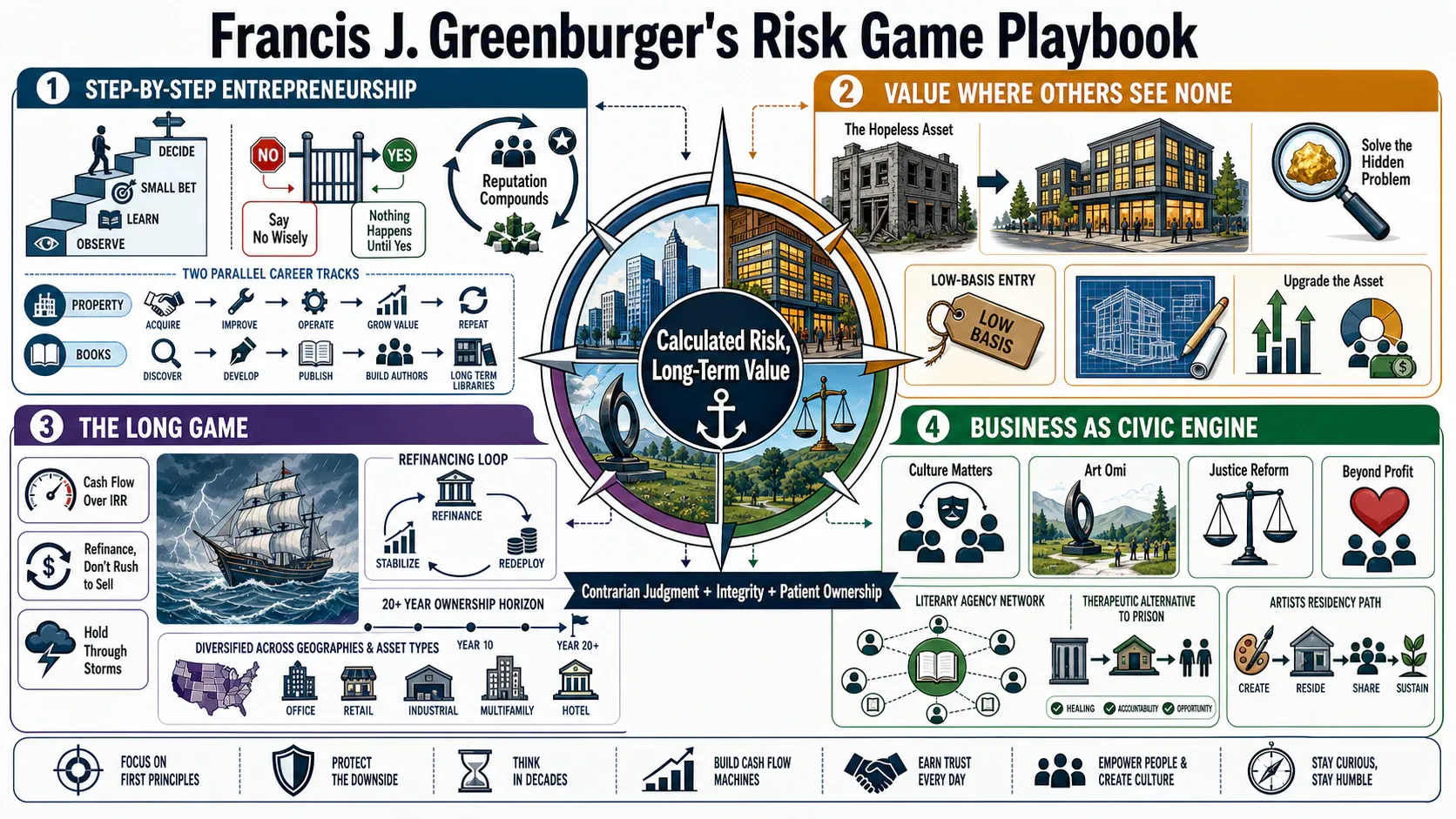
Part 1: Early Life and the Entrepreneurial Mindset
- On Incremental Growth: "I operate less on vision and more on steps... Things evolved step by step as opposed to being guided by some grand plan." — Source: [Leaders Magazine]
- On Saying No: "Saying no is the most important judgment you make." — Source: [The Real Deal]
- On Saying Yes: "On the other hand, nothing happens until you say yes." — Source: [The Real Deal]
- On Financial Motivation: "I was motivated to make enough money that I didn’t have to struggle, which I had watched my father do his whole life." — Source: [Wikipedia]
- On Early Experience: Entering the adult professional world at age 15 taught him the immense value of hands-on experience over traditional academic paths. — Source: [Simon & Schuster]
- On Reputation: "Reputation matters... you start building your reputation from the first moment that you enter into the world. As you build reputation, your power increases significantly." — Source: [Time Equities]
- On Persistence: "I just think if you put one foot in front of another... you can accomplish a lot." — Source: [Time Equities]
- On The "Parallel Career": Managing two vastly different businesses—a literary agency and a real estate firm—provided both financial stability and intellectual variety. — Source: [Sanford J. Greenburger Associates]
- On Overcoming Setbacks: Regardless of personal tragedies or professional crises, lasting success requires the willingness to "sign up and show up" every single day. — Source: [Simon & Schuster]
- On Choosing Your Own Path: "I wasn’t going to let any author, not even James Patterson, put an end to my real estate ventures." — Source: [The Real Deal]
Part 2: Real Estate Strategy and Finding Value
- On the "Hopeless" Asset: A central strategy of his career has been identifying immense value in properties where the broader market sees none. — Source: [Simon & Schuster]
- On Problem Solving: "If you can find that problem, that nugget, and the price is right, and then you can solve the problem—that’s a credo." — Source: [Leaders Magazine]
- On Real Estate Realities: "Real estate is a tough business where you can lose money even when prices are going up." — Source: [Goodreads]
- On The Unexpected: "Like so much else in life, there are always unforeseen variables, and it is never as easy as it looks." — Source: [Goodreads]
- On Residential Conversions: He earned the nickname "the co-op king of New York" by pioneering the transformation of struggling rental buildings into highly desirable cooperatives. — Source: [Wikipedia]
- On Adaptive Reuse: Converting underperforming or outdated office buildings into mixed-use or residential spaces is a primary method for creating sustainable new value. — Source: [Time Equities]
- On Value-Add Upgrades: Purchasing "C quality" spaces and aggressively upgrading their architectural and design standards makes them competitive and "sticky" for tenants. — Source: [Time Equities]
- On Vision and Detail: True success in complex development projects requires a "great independent vision" paired with an obsessive "attention to detail." — Source: [Simon & Schuster]
- On Maintaining Control: "Easy—I would own 100% of a $10 million asset... you want to have control." — Source: [The Real Deal]
Part 3: Investment Philosophy and the Long Game
- On Long-Term Ownership: "We have a fundamental belief in long-term ownership... it might not be unusual for us to hold properties for 20 years or more." — Source: [Leaders Magazine]
- On Cash Flow vs. IRR: "We’re less IRR-oriented than we are cash flow oriented. If we can build a property into a good cash flow position, I’m not watching our IRR return." — Source: [Leaders Magazine]
- On Refinancing Over Selling: He strongly prefers to liquefy investments through refinancing rather than selling, allowing him to maintain ownership of quality assets while returning capital. — Source: [Time Equities]
- On The "Seaworthy Ship": He views real estate as a "seaworthy ship" designed to survive any economic storm through conservative, disciplined debt management. — Source: [Simon & Schuster]
- On Steady Yields: Prioritizing consistent cash flow over speculative appreciation makes a portfolio exponentially more resilient during sudden market downturns. — Source: [Time Equities]
- On Patience During Crises: His refusal to abandon the 50 West Street project during the devastating 2008 financial crisis eventually led to the completion of a landmark 780-foot skyscraper. — Source: [Simon & Schuster]
- On Resisting the Herd: Avoiding overpriced markets driven by popular consensus is absolutely key to surviving decades of volatile economic cycles. — Source: [Simon & Schuster]
- On Private Equity Timelines: Rejecting the standard 3-to-5 year private equity exit window allows for a much more sustainable, organic approach to property growth. — Source: [Time Equities]
- On Low-Basis Entry: Entering a deal at a significantly lower basis protects against macroeconomic volatility far better than overpaying for a "prime" asset. — Source: [Time Equities]
Part 4: The Risk Game and Contrarian Investing
- On Calculated Risk: The "Risk Game" is never about reckless betting; it is about rigorous, deep analysis and having the courage to act on your convictions. — Source: [Simon & Schuster]
- On Standing Alone: It is vital to trust your own independent assessments, even when they directly contradict the "consensus-driven inclination" of the market. — Source: [Simon & Schuster]
- On Opportunistic Investing: "Our sweet spot is being opportunistic, which means being able to go to different markets and respond to different conditions." — Source: [Leaders Magazine]
- On Counter-Cyclical Buying: Entering markets when they are at their absolute lowest point—such as buying depressed industrial properties in Detroit—creates unmatched long-term value. — Source: [Time Equities]
- On Risk Perception: Buying a "high-risk" asset at a very low price is often much safer than buying a perceived "low-risk" asset at a steep premium. — Source: [Time Equities]
- On Extreme Diversification: Mitigating systemic risk requires holding properties across multiple geographic regions, currently including over 30 U.S. states and several European countries. — Source: [Wikipedia]
- On Asset Variety: A portfolio must balance residential, office, retail, and industrial spaces so that a sudden downturn in one sector is offset by stability in another. — Source: [Time Equities]
- On Hedging Domestic Risk: Investing deeply in international markets like Germany and the Netherlands provides a necessary buffer against localized economic slumps in the United States. — Source: [Time Equities]
- On Integrity in High Stakes: Long-term survival in cutthroat industries like New York real estate relies heavily on personal integrity and building lasting strategic partnerships. — Source: [Simon & Schuster]
Part 5: The Literary World
- On Preserving Legacy: Assuming management of his father's literary agency in 1972, he successfully transitioned a historic family business into a modern powerhouse. — Source: [Sanford J. Greenburger Associates]
- On The Agents' Collaborative: He structured the literary agency as a collaborative where individual agents work independently but deeply share resources, connections, and expertise. — Source: [Sanford J. Greenburger Associates]
- On Editorial Scouting: He helped maintain and expand the firm’s historical and pioneering role in the specialized business of international editorial scouting. — Source: [Sanford J. Greenburger Associates]
- On Representing Icons: His agency has represented and launched the careers of global blockbuster authors, demonstrating a keen eye for mass-market narrative appeal. — Source: [Wikipedia]
- On Nurturing Talent: Fostering a highly supportive, stable environment allows agents to build and sustain decades-long, prolific careers for their authors. — Source: [Sanford J. Greenburger Associates]
- On Global Rights: Maintaining a strong focus on representing translation and international publishing rights ensures that authors can maximize their global reach and revenue. — Source: [Sanford J. Greenburger Associates]
- On Managing Duality: He views his daily shift between the ruthless world of real estate and the creative world of publishing as a key source of his intellectual vitality. — Source: [Simon & Schuster]
- On Cultural Impact: Representing literature is fundamentally about shaping culture, a mission that closely parallels his lifelong work in the arts and social justice. — Source: [Sanford J. Greenburger Associates]
- On Empowering Agents: By giving partner agents the complete autonomy to run their own lists, he ensures the agency remains incredibly dynamic and diverse in its representation. — Source: [Sanford J. Greenburger Associates]
- On Historical Continuity: The agency’s early representation of legendary figures like Franz Kafka and Jean-Paul Sartre set a standard of literary excellence that still guides the firm today. — Source: [Sanford J. Greenburger Associates]
Part 6: Leadership and Organization
- On Flat Structures: Maintaining a relatively flat corporate hierarchy at Time Equities is absolutely essential for encouraging "bottom-up" innovation from employees. — Source: [Time Equities]
- On Entrepreneurial Teams: Empowering acquisition managers to act like independent entrepreneurs allows the firm to pivot quickly and aggressively to niche sub-market opportunities. — Source: [Time Equities]
- On Decisiveness: He possesses the rare ability to make major, complex financial decisions rapidly—sometimes in a five-minute cab ride—once all the essential facts are presented. — Source: [Simon & Schuster]
- On Delegation: Trusting exceptionally capable partners to run the daily operations of the literary agency is exactly what makes his demanding dual-CEO lifestyle possible. — Source: [Sanford J. Greenburger Associates]
- On Continuous Learning: Real estate is an intensely localized game; you must never assume you know everything about a new regional market before fully entering it. — Source: [Time Equities]
- On Recognizing Talent: He applies the exact same "contrarian" lens to people as he does to real estate, often finding exceptional leadership potential where others overlook it. — Source: [Time Equities]
- On Resilience in Leadership: Leading a multi-billion dollar firm safely through multiple deep recessions requires a steady hand and a firm refusal to panic alongside the broader market. — Source: [Leaders Magazine]
- On Building Trust: In both publishing and property development, your word must be absolute; multi-million dollar transactions ultimately depend on interpersonal trust. — Source: [Simon & Schuster]
- On Adaptability: A successful organization must be structurally flexible enough to shift from residential conversions to international industrial acquisitions without breaking its stride. — Source: [Time Equities]
Part 7: Social Justice and Systemic Reform
- On Beyond Profit: He firmly believes that buildings and businesses should ultimately be utilized to accomplish "something truly important" beyond mere financial gain. — Source: [Simon & Schuster]
- On Social Impact: Entrepreneurship is not just a mechanism for wealth creation; it is a highly effective vehicle for driving systemic, large-scale social change. — Source: [Greenburger Center]
- On Common Sense Reform: Mass incarceration is not only a profound human rights failure but also an entirely unsustainable economic burden on American society. — Source: [Greenburger Center]
- On Mental Health and Justice: The justice system must legally prioritize diverting individuals with serious mental illness away from prisons and directly into dedicated treatment facilities. — Source: [Greenburger Center]
- On Personal Motivation: His commitment to criminal justice reform was deeply influenced and catalyzed by his own family's harrowing experience navigating the system with a mentally ill son. — Source: [Greenburger Center]
- On Hope House: Developing Hope House in the Bronx serves as a vital proof-of-concept for secure, therapeutic alternatives to incarceration for those facing felony-level charges. — Source: [Greenburger Center]
- On Solitary Confinement: He actively and financially advocates for a complete legislative ban on the use of solitary confinement, viewing it as a deeply harmful and inhumane practice. — Source: [Greenburger Center]
- On Sentencing Laws: Ending mandatory minimum sentencing and reforming rigid, outdated drug laws are absolutely critical steps toward building a more humane justice system. — Source: [Greenburger Center]
- On Re-entry: The entire penal system fails if it does not invest heavily in re-entry programs designed to help formerly incarcerated people successfully reintegrate into society. — Source: [Greenburger Center]
- On Civil Legal Access: True justice requires aggressively improving the general public's access to the civil legal system, preventing small disputes from unnecessarily ruining lives. — Source: [Greenburger Center]
Part 8: Philanthropy and The Arts
- On Artistic Exchange: He founded Art Omi in 1992 to provide a rural sanctuary where international artists can engage in cross-cultural, undisturbed creative development. — Source: [Art Omi]
- On Dynamic Curation: Designing a 120-acre sculpture park with a rotational collection ensures the landscape remains a living, constantly breathing dialogue of contemporary art. — Source: [Art Omi]
- On Multidisciplinary Support: Expanding the residency programs to include writers, musicians, and dancers creates a truly holistic, cross-pollinating environment for artistic incubation. — Source: [Art Omi]
- On Architecture as Art: Launching the "Architecture Omi" program allowed him to explicitly explore the dynamic intersection of natural landscape, structural design, and experimental pavilions. — Source: [Art Omi]
- On Recognizing the Overlooked: The Francis J. Greenburger Awards were specifically established to honor and fund older artists of extraordinary merit who inexplicably lack broad public recognition. — Source: [Art Omi]
- On "Inner Circle" Validation: He utilizes the recommendations of established art world peers to issue these unrestricted grants, entirely trusting the critical judgment of fellow creators. — Source: [Art Omi]
- On Permanent Legacies: His expansive vision for the Art Omi Pavilions project is to pair specific artists with architects to build permanent, dedicated legacy spaces for their work. — Source: [Chronogram]
- On Environmental Integration: Ensuring structural developments like the Benenson Visitors Center are LEED-certified heavily reflects a commitment to harmonizing modern architecture with raw nature. — Source: [Art Omi]
- On The Patron's Duty: True, effective philanthropy in the arts requires providing creators with unrestricted space and resources, completely free from the immediate, stifling pressures of the commercial market. — Source: [Art Omi]