Simon Hørup Eskildsen is a pragmatic software engineer, former Shopify infrastructure director, and the co-founder of turbopuffer. Known for his advocacy of "napkin math," extreme system simplicity, and deeply structured reading habits, his work emphasizes first-principles thinking in both code and life. Below is a curated collection of his most impactful insights across engineering, architecture, and personal learning.
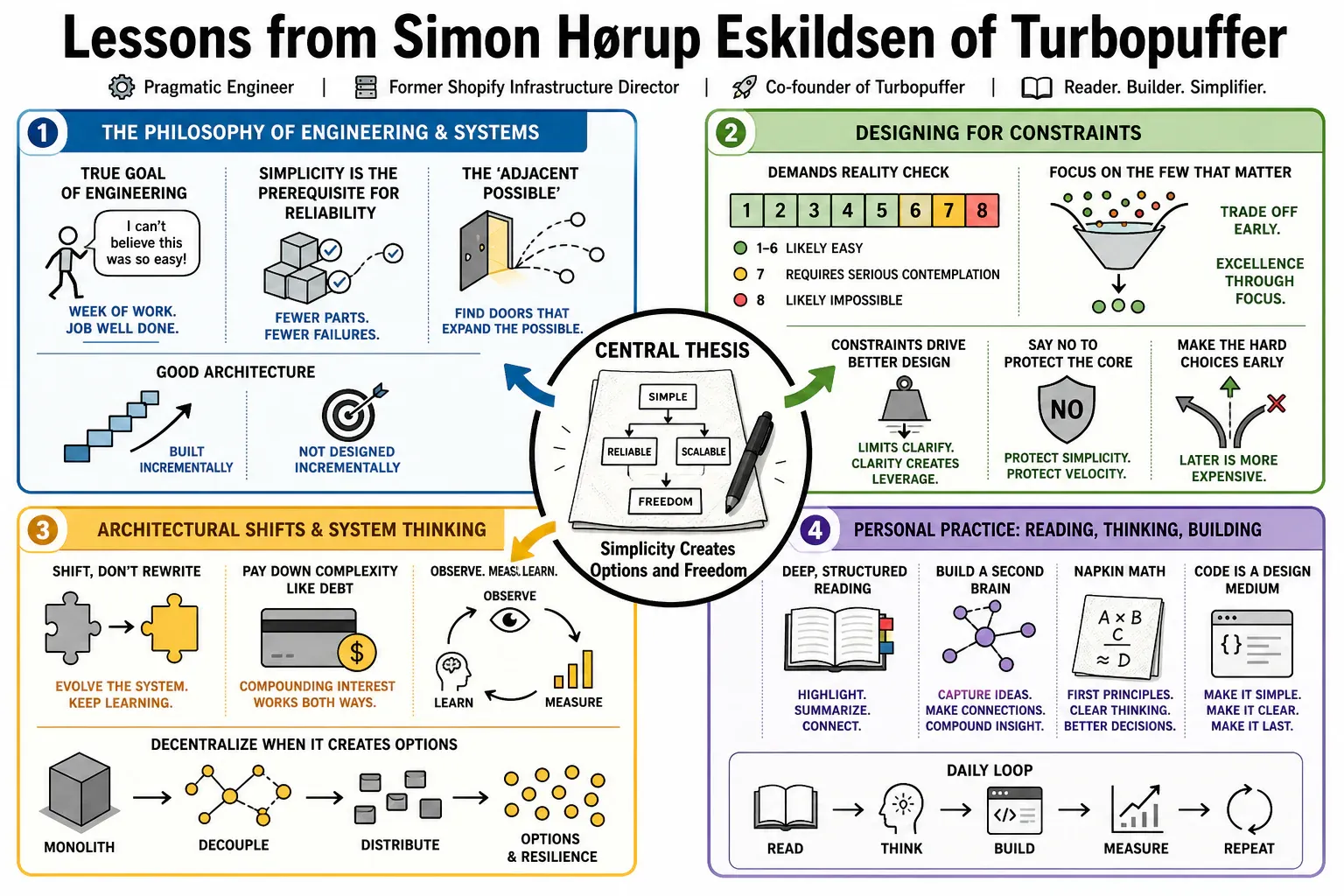
Part 1: The Philosophy of Engineering and Systems
- On the True Goal of Engineering: "They [great engineers] understand that if a change is met with 'I can’t believe this was so easy!' despite it taking a week—they’ve done their job well." — Source: [sirupsen.com]
- On Simplicity and Reliability: "Simplicity is the prerequisite for reliability." — Source: [sirupsen.com]
- On the 'Adjacent Possible': "Framing problems as the 'adjacent possible' has been a liberating idea to me. I try to find the doors that lead to the biggest possible expansion of the possible." — Source: [sirupsen.com]
- On Architectural Shifts: "Good architecture is built incrementally, but not designed incrementally." — Source: [sirupsen.com]
- On Designing for Constraints: "If you are designing for 8 demands it's likely that 6 are easy, 7 requires serious contemplation, and that doing all 8 results in a worse system overall." — Source: [sirupsen.com]
- On Platform Thinking: "Focus on changing underlying assumptions to create cascading positive effects across a whole platform." — Source: [sirupsen.com]
- On Iterative Growth: "I believe that first-principle thinking is required to break out of iterative improvement cycles and make order of magnitude improvements." — Source: [sirupsen.com]
- On Moldable Architecture: "You need to mold your app to the infrastructure, not the infrastructure to the app." — Source: [sirupsen.com]
- On P99 Engineering Traits: "The traits of P99—P99 is obsessive, right? Like, you'll find traits of that... we do an interview at turbopuffer that just tries to screen for some of these things." — Source: [turbopuffer.com]
- On Danish Engineering Pragmatism: "Danish pragmatic philosophy fundamentally shapes an aesthetic of building simple, practical tools that just solve the problem without unnecessary academic overhead." — Source: [Latent.Space]
Part 2: Simplicity and Code Quality
- On the 'Shitty First Draft': "While you may have figured out how to make the machine do what you want, it takes more effort to express your intents to humans clearly. It is tempting to stop when it works, but it is only the beginning." — Source: [sirupsen.com]
- On Foundational Complexity: "If you don’t make the foundational pieces as simple as possible, the complexity will compound rapidly for the lifetime of the code." — Source: [sirupsen.com]
- On Mental Models in Code: "You damage people’s mental models with undigested ideas, poor abstractions, and noise." — Source: [sirupsen.com]
- On Allergies to Complexity: "Great engineers are allergic to complexity because they know that complexity is the enemy of execution." — Source: [sirupsen.com]
- On Rewriting from Scratch: "If you can't rewrite your work from scratch in an hour, you haven't found the simplest solution yet." — Source: [sirupsen.com]
- On Refactoring: "Rewrite or refactor is a judgment call once you've arrived at the model for what you need." — Source: [sirupsen.com]
- On Digesting Ideas: "Now you must go through the process to make it as simple as possible for others to understand." — Source: [sirupsen.com]
- On Simplification as an Output: "The ultimate output of a senior engineer isn't more code, but a simpler, more legible system for everyone else." — Source: [sirupsen.com]
- On Removing the Noise: "Clean architecture means aggressively removing noise so that the core intent of the program is immediately obvious to any reader." — Source: [sirupsen.com]
- On Stopping Too Early: "Stopping when the code simply compiles and passes tests is a failure to complete the actual work of engineering." — Source: [sirupsen.com]
Part 3: First Principles and Napkin Math
- On Acquiring the Conceptual Model: "The hardest part of napkin math isn't the calculation itself: it's acquiring the conceptual understanding of a system to come up with an equation for its performance." — Source: [sirupsen.com]
- On Bridging the Gap: "If there's a significant gap between the expected performance from the napkin math and reality, that gap represents an opportunity... Either there's room for optimization, or your first-principle model is wrong." — Source: [sirupsen.com]
- On Collaborating with Models: "It is far easier to collaborate on a first principle model. At this level, all discussions are at the level of data structures, key operations, sources of complexity, and so on." — Source: [sirupsen.com]
- On Hardware Constants: "Knowing basic hardware constants—like L1 cache latency versus SSD read speed—is essential to breaking out of iterative improvements." — Source: [sirupsen.com]
- On Language Independence: "It is good to separate this from the database, programming language, or library you may use to execute those operations, which elegantly avoids those minefields." — Source: [sirupsen.com]
- On Refusing to Compromise: "Simon refused to compromise on architecture just to close a deal faster, prioritizing a rigorous foundation over a quick hack." — Source: [The PMF Show Podcast]
- On Real-World Math: "A normal database can do a write in hundreds of microseconds... but multiplying that by hundreds of checkout operations ends up taking tens of seconds." — Source: [The PMF Show Podcast]
- On Diagnosing Issues: "Napkin math allows you to quickly diagnose whether a system is inherently flawed or just poorly tuned." — Source: [sirupsen.com]
- On Order of Magnitude Gains: "You won't get order of magnitude improvements without first-principle thinking." — Source: [sirupsen.com]
Part 4: Performance, Cost, and Architecture
- On Cost as a Constraint: "The infrastructure just fundamentally wasn't at a price point where they could earn a return... The fact that they didn't ship a feature told me it should be much cheaper." — Source: [The PMF Show Podcast]
- On Challenging Exorbitant Prices: "Surely these exorbitant prices weren't rooted in some immutable law of physics. Had we simply failed to create a search engine that truly harnessed the power of modern hardware?" — Source: [turbopuffer.com]
- On the Power of Ten-X Cheaper: "We want to make it possible for our customers to search every byte they have... customers feel constrained by retrieval costs in their product ambition." — Source: [turbopuffer.com]
- On Storage Architecture: "The storage architecture of the current generation of search engines simply doesn't map closely enough to the performance characteristics and cost constraints of search." — Source: [turbopuffer.com]
- On Modern Storage Solutions: "We can do better by moving from the old world of replicated SSDs to object storage with SSD and memory caching." — Source: [turbopuffer.com]
- On Scaling Economics: "Vector search on 100m+ documents would've cost $20k/month+! This wasn't just expensive; it meant we had to shelve a desired feature." — Source: [turbopuffer.com]
- On Database Efficiency: "Traditional relational databases often mask the underlying efficiency possible when data access patterns are optimized for object storage." — Source: [Software Engineering Daily]
- On Search Engine Design: "A vector database should just be viewed as a search engine for unstructured data." — Source: [Latent.Space]
- On Pure Sources of Pain: "It really came from a very pure source of pain, of just imagining what we would be on call for... The worst outages are the ones where you have state in multiple places that's not syncing up." — Source: [Latent.Space]
Part 5: Infrastructure Resilience at Shopify Scale
- On Flash Sales as Canaries: "We chose to see these sales as a way to identify bottlenecks, and as a bit of a canary in the coal mine as to what is going to break next." — Source: [sirupsen.com]
- On Building Antifragility: "If you drop a piece of glass, it breaks. If you drop a rock, it’s indifferent. But what can you drop that becomes stronger as a result? Flash sales was a way for our infrastructure to become stronger." — Source: [sirupsen.com]
- On Chaos Engineering: "We have a very strong culture internally of trying to inject chaos into various parts of the organization and try to come out stronger as a result." — Source: [sirupsen.com]
- On Pod Isolation: "All shops must be isolated from each other... doing things across hundreds of shops, hundreds of pods in multiple regions is not something that’s going to scale." — Source: [sirupsen.com]
- On Sleep-Friendly Failovers: "If there’s an incident, someone should just be able to come in the middle of the night, fail over all the pods, and go back to bed." — Source: [sirupsen.com]
- On Future Traffic Patterns: "The flash sales of today tell us something about what the traffic is going to look like one or two years from now." — Source: [sirupsen.com]
- On Solving Problems at the Edge: "Solving throttling and traffic analysis at the edge with tools like OpenResty is critical to protecting the application stack." — Source: [sirupsen.com]
- On the Cost of Scaling: "It takes thousands of engineering hours to be able to scale to these sales when you haven’t architected for it from day one." — Source: [sirupsen.com]
- On Containerization Impact: "Adopting Docker early significantly reduced deployment times from over 10 minutes to just 3 minutes across hundreds of servers, fundamentally changing how fast we could iterate." — Source: [sirupsen.com]
Part 6: Turbopuffer and the Startup Journey
- On the Accidental Company: "Turbo Puffer started as a blog post, and then it became a project and then sort of almost accidentally became a company." — Source: [Latent.Space]
- On Startup Ambition: "The intentions were very pure. It's just like, why hasn't anyone done this? And I wanna be the first person to do it." — Source: [Latent.Space]
- On Angel Engineering: "Investing time and code for equity in startups allows you to solve deep infrastructure problems and truly understand their pain points before building a product." — Source: [The PMF Show Podcast]
- On PMF Promises: "If this doesn't have PMF by the end of the year, like we'll just return all the money to you. We don't wanna work on this unless it's really working." — Source: [The PMF Show Podcast]
- On Hustle and Acquisition: "Flying to San Francisco unannounced to help a customer migrate their entire workload in a week is sometimes what it takes to prove your value." — Source: [The PMF Show Podcast]
- On the 'V1' Prototype: "The current team makes fun of my original prototype, which I built alone over one all-consuming summer, but it proved the core concept." — Source: [The PMF Show Podcast]
- On Playing with Open Cards: "When I don't know how to play a game, I just play with open cards." — Source: [turbopuffer.com]
- On Bootstrapping Value: "Turning down massive Series A rounds to stay lean and profitable keeps you focused entirely on the customer's pure source of pain." — Source: [The PMF Show Podcast]
- On Canadian Startups: "Canadian startups do not compound... because it's high status in Canada to retire to the cottage." — Source: [BetaKit Podcast]
- On the Mission: "turbopuffer's mission is to make every byte searchable, tearing down the financial barriers to product ambition." — Source: [turbopuffer.com]
Part 7: Reading, Retention, and Note-Taking
- On Retention vs. Uptake: "Reading, to me, is worth the most if I can remember the ideas... just because you can’t summarize Thinking Fast and Slow eloquently, doesn’t mean it didn’t influence you." — Source: [sirupsen.com]
- On the Value of Long Books: "It’s a cliché to complain about the length of books: 'This idea could be explained in five pages!'... This statement bothers me to no end." — Source: [sirupsen.com]
- On the 1:1 Ratio: "If a book takes 5 hours to read, I will spend another 5 hours writing about it, creating cards, and reflecting." — Source: [sirupsen.com]
- On Learning vs. Reading: "While books are useful, the ultimate goal here is not to read books—but to learn. There are other ways to learn than books." — Source: [sirupsen.com]
- On Topic Selection: "I would like to not choose the next book but the next topic." — Source: [sirupsen.com]
- On Commonplace Books: "I keep coming back to the ideas that unfolded in that writing [commonplace book], and this is a habit I’m going to make another effort to cultivate further." — Source: [sirupsen.com]
- On Spaced Repetition for Books: "It turns out, if a book is 200 pages, it's going to take you a few spaced repetition cycles to read it, which raises the probability it'll stick for you." — Source: [sirupsen.com]
- On the 'Trunk' of Information: "I kicked the news habit years ago. I found the tidbits of incoherent information with no trunk to associate it with difficult to remember." — Source: [sirupsen.com]
- On Spending Time with Ideas: "Spending time with an index card means writing at least 4–5 paragraphs about the idea to ensure I have fully internalized and can explain it." — Source: [sirupsen.com]
Part 8: Culture, Learning, and Management
- On the Pursuit of Perspective: "By the end of the year, it felt like a race to an arbitrary finish line rather than a pursuit of perspective." — Source: [sirupsen.com]
- On Effective Listening: "When you can articulate someone's point of view better than they can, it's de facto proof that you are really listening." — Source: [sirupsen.com]
- On Operating Systems for Thinking: "Books like Poor Charlie's Almanack act as an operating system for structuring your thinking and mental models." — Source: [sirupsen.com]
- On Rejecting the Status Quo: "Reject candidates by default unless someone on the team feels strongly enough to fight for the candidate, aiming for extreme talent density." — Source: [The PMF Show Podcast]
- On Management Rocks: "Books like High Output Management by Andy Grove can become your rock when navigating the complexities of organizational leadership." — Source: [sirupsen.com]
- On Empathy and Perspective: "Reading books like Between the World and Me provides perspective that is required for everyone." — Source: [sirupsen.com]
- On Sourcing Information: "I used to have a habit of buying the books I wanted to read instead of simply sourcing them... Inevitably, it grew into a dread of unread books." — Source: [sirupsen.com]
- On Format Heuristics: "Audiobooks for narrative, Kindle for anything else. If a book has a narrative... it falls in the Audiobook bucket for me." — Source: [sirupsen.com]
- On Killing Arbitrary Goals: "The obvious first step to improve absorption is to kill the goal of N books per year." — Source: [sirupsen.com]