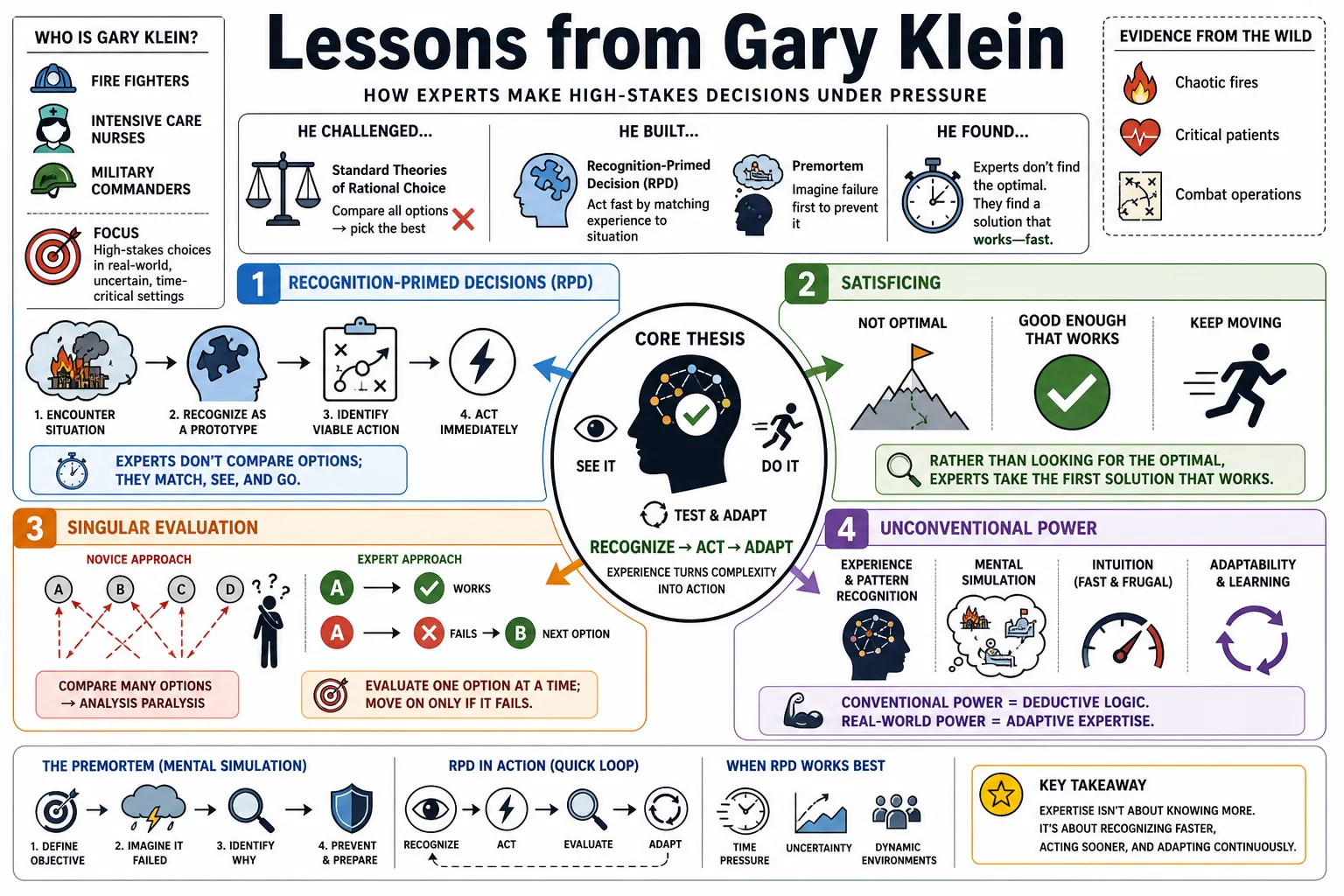
Lessons from Gary Klein
Cognitive psychologist Gary Klein spent decades observing how firefighters, intensive care nurses, and military commanders make high-stakes choices under extreme pressure. He developed the premortem and the Recognition-Primed Decision model to explain why standard theories of rational choice fail in the wild. This profile breaks down his findings on how experts actually use pattern recognition and mental simulation to act.
Part 1: Naturalistic Decision Making
- On Recognition-Primed Decisions: "Experts don't compare options; they use their experience to recognize a situation as a prototype and immediately identify a viable course of action." — Source: [Sources of Power]
- On Satisficing: "Rather than looking for the optimal solution, experts operating under pressure look for the first solution that works." — Source: [Sources of Power]
- On Singular Evaluation: "Novices try to compare multiple options, leading to analysis paralysis, while experts evaluate one option at a time, moving to the next only if the first fails." — Source: [Sources of Power]
- On Unconventional Power: "Conventional sources of power include deductive logical thinking... yet the abilities needed in natural settings are usually not conventional at all." — Source: [Sources of Power]
- On Real-World Choices: "The most valuable insight I have made about how people make decisions is that when they become skilled they don't have to make decisions—choices between options." — Source: [Sources of Power]
- On Speed and Execution: "It is better to make a good decision fast and prepare to execute it well than agonizing over a 'perfect' choice that comes too late." — Source: [The Power of Intuition]
- On the Value of Process: "The actual decision is less important than the thinking that went into it." — Source: [The Power of Intuition]
- On Metaphor: "Experts use parallels from past experiences to quickly understand and categorize a new, unfamiliar situation." — Source: [Sources of Power]
- On Storytelling: "Consolidating experience into narratives allows teams to share lessons and build a collective mental model." — Source: [Sources of Power]
- On the Zone of Indifference: "If the advantages and disadvantages are almost perfectly balanced, it doesn’t matter which one we pick. It’s more productive to just pick one instead of further analysis-by-paralysis." — Source: [The Knowledge Project]
Part 2: The Pre-mortem Technique
- On Psychological Safety: "The premortem technique is a sneaky way to get people to do contrarian, devil’s advocate thinking without encountering resistance." — Source: [McKinsey Quarterly]
- On Prospective Hindsight: "Unlike a typical critiquing session, in which project team members are asked what might go wrong, the pre-mortem operates on the assumption that the patient has died, and so asks what did go wrong." — Source: [Harvard Business Review]
- On Timing: "A premortem in a business setting comes at the beginning of a project rather than the end, so that the project can be improved rather than autopsied." — Source: [Harvard Business Review]
- On the Crystal Ball: "I'm looking in a crystal ball... We are now three months into the effort and it's clear that this project has failed. There's no doubt about it. Now, write down all the reasons why." — Source: [Freakonomics Radio]
- On Liberating Dissent: "The pre-mortem is liberating: everyone is unified in exploring risks. No one is being singled out for not being a good 'team player' by asserting the counterfactual truth." — Source: [Freakonomics Radio]
- On Competitive Pressure: "The pressure in a pre-mortem—it's a competitive pressure—is to come up with important problems and barriers that others haven't identified." — Source: [What Got You There Podcast]
- On the Common Mistake: "A common mistake people make when running pre-mortems is asking the non-challenging question, 'What can go wrong?' instead of using the crystal ball to affirm that the plan has been a disaster." — Source: [Cognitive Edge]
- On Core Beliefs: "We are much more likely to explain away any anomalies rather than revise our beliefs in the face of them, which makes prospective hindsight essential." — Source: [Seeing What Others Don't]
- On Marginalizing Disagreement: "What concerns me is the tendency to marginalize people who disagree with you at meetings. There's too much intolerance for challenge." — Source: [McKinsey Quarterly]
Part 3: Intuition and Expertise
- On Defining Intuition: "I define intuition as the way we translate our experience into action." — Source: [The Power of Intuition]
- On Intuition vs. Insight: "Intuition is the use of patterns they've already learned, whereas insight is the discovery of new patterns." — Source: [The Knowledge Project]
- On the 90 Percent Rule: "Roughly 90 percent of critical decisions made by experts in high-pressure environments are based on intuition rather than formal analysis." — Source: [The Power of Intuition]
- On Analysis as a Passenger: "Put intuition in the driver's seat so that it directs our analysis of our circumstances." — Source: [The Power of Intuition]
- On Meaningful Experience: "The key to using intuition effectively is meaningful experience that allows us to recognize patterns and build mental models." — Source: [The Power of Intuition]
- On the Litmus Test for Expertise: "Ask someone, 'When was the last mistake you made?' If they can’t think of a mistake, they are not an expert. Experts are well-aware of their mistakes; their mistakes eat away at them." — Source: [The Knowledge Project]
- On Suppressing Intuition: "We shouldn't simply follow our intuitions... Yet we shouldn't suppress our intuitions either, because they are essential to our decision making and can't be replaced by analyses or procedures." — Source: [The Power of Intuition]
- On Building Patterns: "Intuition is not a mystical sixth sense but a highly developed cognitive skill rooted in experience and pattern recognition." — Source: [The Power of Intuition]
- On Recognizing Leverage Points: "Often, the key to a creative solution is noticing a leverage point that others have overlooked." — Source: [The Power of Intuition]
- On Emotions as Data: "Emotions are our way of drawing on the mental patterns that we’ve built." — Source: [The Knowledge Project]
Part 4: Gaining Insights and Seeing What Others Don't
- On the Definition of Insight: "Insight is an unexpected shift in the way we understand things." — Source: [Seeing What Others Don't]
- On the Permanence of Insight: "Insight is when it happens. Everything that happens afterward is different." — Source: [Seeing What Others Don't]
- On Desperation: "If necessity is the mother of invention, then desperation is the father of insight." — Source: [Seeing What Others Don't]
- On the Connection Path: "One way to gain insight is by linking a new piece of information to existing knowledge to form a completely new pattern." — Source: [Seeing What Others Don't]
- On the Contradiction Path: "Spotting an anomaly or inconsistency that proves a current belief is flawed often forces a paradigm shift." — Source: [Seeing What Others Don't]
- On Creative Desperation: "When trapped by a problem, you must discard your current assumptions to find a way out, as seen in the Mann Gulch fire." — Source: [Seeing What Others Don't]
- On Transforming Actions: "A true insight doesn't just change what we know; we begin to see new possibilities for what we can do." — Source: [Seeing What Others Don't]
- On Shift in Perception: "After an insight, we start looking for completely different things in our environment than we did before." — Source: [Seeing What Others Don't]
- On the Difficulty of Reverting: "Insight cannot be taken back. You cannot return to the moment you were in before." — Source: [Seeing What Others Don't]
- On Disorientation: "Insights are disorienting and they make you change the way you think." — Source: [The Knowledge Project]
Part 5: Mental Simulation and Sensemaking
- On Running the Movie: "Mental simulation is the ability to imagine people and objects consciously and to transform those images through several transitions." — Source: [Sources of Power]
- On Testing Viability: "Instead of comparing options, experts mentally simulate a single course of action to see if it will work before executing it." — Source: [The Power of Intuition]
- On Missing the Mark: "If a mentally simulated plan fails to work in the expert's imagination, they simply tweak it or move to the next most likely option." — Source: [The Power of Intuition]
- On the Limits of Imagination: "Rigor is not a substitute for imagination." — Source: [Sources of Power]
- On Fixing Beliefs: "People sometimes are so confident in their flawed beliefs that they get stuck—fixated—and as a result are blinded to insights that are right in front of them." — Source: [Sources of Power]
- On Active Curiosity: "Insights often require an active 'What's going on here?' stance rather than a passive acceptance of incoming data." — Source: [Seeing What Others Don't]
- On Shifting Goals: "Our goals and ambitions shift based on the new reality revealed through sensemaking and insight." — Source: [Seeing What Others Don't]
- On Building Mental Models: "My idea of a mental model started out with how something works and now it includes... how it works, what its limitations are, how to work around them, and how to anticipate confusion." — Source: [The Knowledge Project]
- On Emotional Responses: "Sensemaking changes our emotional response to a situation, rapidly shifting us from confidence to caution." — Source: [Seeing What Others Don't]
Part 6: Flaws in Standard Decision-Making
- On Hyperrationality: "Hyperrationality is the attempt to apply deductive logic and statistical analysis to situations where they don't fit, such as under extreme time pressure." — Source: [Sources of Power]
- On the Cost of Perfection: "When we put too much energy into eliminating mistakes, we’re less likely to gain insights. Having insights is a different matter from preventing mistakes." — Source: [Seeing What Others Don't]
- On the Down Arrow: "Performance depends on two activities: the Down Arrow, which is improving performance by eliminating mistakes through checklists and bureaucracy." — Source: [Seeing What Others Don't]
- On the Up Arrow: "The Up Arrow is improving performance by gaining new insights, which is fundamentally at odds with an obsession over error reduction." — Source: [Seeing What Others Don't]
- On Traditional Biases: "Biases are related to our experiences; we don’t dismiss our experiences, why should we dismiss our biases?" — Source: [The Knowledge Project]
- On Positive Heuristics: "Researchers tend to only analyze the negative side of heuristic biases, and they never consider the positive side." — Source: [The Knowledge Project]
- On Ignoring the Real World: "The rational choice model suggests we should list all options and weigh them, but this fails to capture how experts actually decide under pressure." — Source: [Sources of Power]
- On Decision Journals: "I think the idea of a decision journal is a great idea... to track when an employee is making a decision, what it is, and what goals they want to achieve." — Source: [The Knowledge Project]
- On the Illusion of Certainty: "We are taught to analyze probabilities, yet natural settings are fraught with ill-defined goals and missing information that defeat formal methods." — Source: [Sources of Power]
Part 7: Training, Unlearning, and Cognitive Apprenticeship
- On Stagnation: "People tend to reach a certain level of performance and then they stagnate; the ones that continue improving engage in a process of 'unlearning'." — Source: [The Knowledge Project]
- On Questioning Notions: "Continued improvement requires individuals to systematically question their previously held notions and deeply ingrained habits." — Source: [The Knowledge Project]
- On Pain and Progress: "Making mistakes is painful, and making them without reflection will not result in progress." — Source: [The Knowledge Project]
- On Deliberate Practice for Intuition: "Intuition is a trainable skill built through active reflection on successes and failures to construct more accurate mental models." — Source: [The Power of Intuition]
- On Lack of Experience: "Without a base of expertise, novices cannot recognize when a connection or contradiction is actually meaningful." — Source: [Seeing What Others Don't]
- On Developing Metaphors: "Training must go beyond procedures to help people build a repertoire of experiences they can use as metaphors." — Source: [Sources of Power]
- On Explaining Away Data: "The more central a belief is to our thinking, the harder it is to give up, meaning we often need external cognitive support to notice when we are ignoring anomalies." — Source: [Seeing What Others Don't]
- On Experience vs. Time: "Meaningful experience is not just time on the job; it requires deliberate sensemaking out of the events that occur." — Source: [The Power of Intuition]
- On Cognitive Blindness: "Strong prior beliefs act as insight inhibitors because they cause us to explain away anomalies just to protect our current story." — Source: [Seeing What Others Don't]
Part 8: Organizations and Innovation
- On the Organizational Conflict: "Most organizations are so obsessed with reducing errors that they accidentally stifle insights, because insights are disruptive and unpredictable." — Source: [Seeing What Others Don't]
- On the Innovation Paradox: "Executives declare that they want more innovation but then ask, 'Who else is doing it?' They claim to seek new ideas but shoot down every one brought to them." — Source: [The Knowledge Project]
- On Fear of Change: "Organizations think they want insights and innovation... but in reality, they don’t, because insights force them to change." — Source: [The Knowledge Project]
- On the Fragility of Ideas: "Good ideas are fragile, precious, and easily discarded. Innovations have a track record of failure until they ultimately succeed." — Source: [The Knowledge Project]
- On Suppressing the 'Up Arrow': "Organizations actively punish the flawed or weird ideas that are often the necessary starting points for massive insight generation." — Source: [Seeing What Others Don't]
- On Autopsies vs. Premortems: "Business settings routinely autopsy failed projects at the end, entirely missing the opportunity to use prospective hindsight to alter the outcome beforehand." — Source: [Harvard Business Review]
- On Safe Leadership: "As a leader, you can say the right things to encourage dissent, but people are too smart to actually do it because it's too risky." — Source: [McKinsey Quarterly]
- On Six Sigma Limits: "Systems like Six Sigma are excellent at the Down Arrow of error reduction but mathematically cannot produce the Up Arrow of paradigm-shifting insight." — Source: [Seeing What Others Don't]
- On True Innovation: "The 'Aha!' moment is to insight as orgasm is to conception; companies focus too much on the thrill of brainstorming rather than the permanent structural change that must follow." — Source: [Seeing What Others Don't]