As CEO of Booking Holdings, Glenn Fogel oversees a travel portfolio that includes Booking.com, Kayak, Priceline, and OpenTable. He drove the early acquisitions that turned a dot-com survivor into a global network, and is now using AI to build a fully connected trip. This profile covers his take on navigating industry crises, fighting corporate complacency, and rethinking customer service for the AI era.
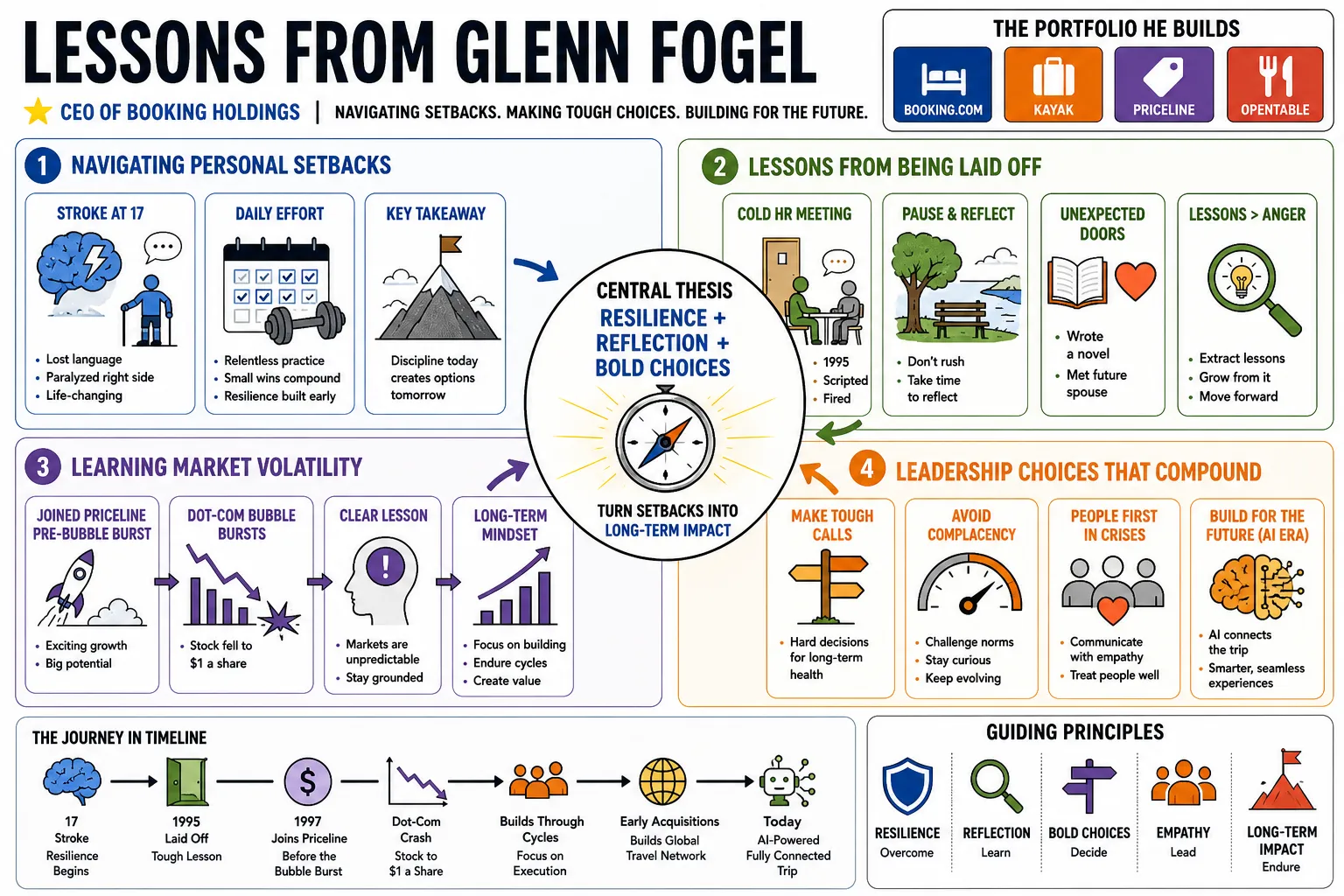
Part 1: Navigating Career Setbacks and Crises
- On recovering from a stroke: Experiencing a severe stroke at 17 that wiped out his language capabilities and paralyzed his right side taught him the value of daily effort and resilience. — Reference: The CEO of Booking Holdings On Making Tough Choices & Battling Back From Having A Stroke
- On handling layoffs: Getting fired from an investment bank in 1995 with a cold, scripted HR meeting left a lasting impact that informed his approach to managing corporate layoffs years later. — Reference: The CEO of Booking Holdings Shares What Being Laid Off Taught Him - Business Insider
- On pausing after failure: Losing a job is traumatic, but taking time to reflect instead of rushing into a new role can open unexpected doors, like writing a novel and meeting a future spouse. — Reference: The CEO of Booking Holdings Shares What Being Laid Off Taught Him - Business Insider
- On avoiding anger: Experiencing a job loss should never be something you wish for, but if it happens, it is important to extract lessons from the situation rather than simply letting it make you angry. — Reference: The CEO of Booking Holdings Shares What Being Laid Off Taught Him - Business Insider
- On market timing: Joining Priceline just before the dot-com bubble burst and watching the stock plummet to a dollar a share was a clear lesson in market volatility that convinced him he was not meant to be a trader. — Reference: An Interview with Booking CEO Glenn Fogel About Travel and Aggregation – Stratechery by Ben Thompson
- On surviving crises: Having steered through the dot-com crash, 9/11, and the SARS outbreak, he learned that enduring past crises prevents panic and helps leaders calmly assess their options during new emergencies like the pandemic. — Reference: An Interview with Booking CEO Glenn Fogel About Travel and Aggregation – Stratechery by Ben Thompson
- On managing adversity: Everyone faces daily obstacles of varying sizes, and since life offers no guarantees of constant good times, building resilience is necessary to navigate inevitable difficulties. — Reference: The CEO of Booking Holdings On Making Tough Choices & Battling Back From Having A Stroke
- On playing the long game: He attributes his success less to speed and more to discipline and endurance, recognizing his ability to try harder and work longer than the competition. — Reference: The CEO of Booking Holdings On Making Tough Choices & Battling Back From Having A Stroke
- On self-improvement: Realizing early on that he lacked natural athletic exceptionalism taught him that reaching an elite level requires a deliberate, structured plan of action rather than just putting in the hours. — Reference: Booking Holdings CEO Glenn Fogel: Why Deliberate Practice Beats Just Putting In The Hours
- On career pivoting: Realizing early that you lack natural talent for a specific technical role, like coding, can be the necessary catalyst to pivot toward a more fitting career path in finance or management. — Reference: An Interview with Booking CEO Glenn Fogel About Travel and Aggregation – Stratechery by Ben Thompson
Part 2: Leadership, Empathy, and Talent Management
- On delivering bad news: Even though layoffs are a corporate necessity, approaching them with respect and humanity is important for helping affected employees transition to their next roles. — Reference: The CEO of Booking Holdings Shares What Being Laid Off Taught Him - Business Insider
- On retaining staff: Before making cuts, a company should make a real effort to find new positions for employees within the broader organization. — Reference: The CEO of Booking Holdings Shares What Being Laid Off Taught Him - Business Insider
- On the limits of empathy: While leaders should execute layoffs with as much care as possible to minimize hurt, no words can completely fix the pain of a corporate decision made for the entity's future. — Reference: The CEO of Booking Holdings On Making Tough Choices & Battling Back From Having A Stroke
- On intellectual humility: True leadership means resisting the urge to weigh in on every issue; when reviewing marketing campaigns like Super Bowl ads, he defers to his team's expertise rather than his own opinions. — Reference: Glenn Fogel | How Leaders Lead
- On authentic communication: During turbulent times, projecting a false sense of optimism is unhelpful; sharing the painful truth helps employees grasp the reality of the situation. — Reference: The CEO of Booking Holdings On Making Tough Choices & Battling Back From Having A Stroke
- On corporate purpose: Transitioning from Wall Street, where the primary goal was generating wealth, to travel, where the mission is helping people experience the world, provided him with a much deeper source of motivation. — Reference: Glenn Fogel | How Leaders Lead
- On balancing risk: Managing a global business requires constantly weighing the costs of mitigation against the actual likelihood of negative scenarios occurring. — Reference: The CEO of Booking Holdings On Making Tough Choices & Battling Back From Having A Stroke
- On short-term execution: You have to consistently hit short-term financial targets so that investors and stakeholders trust your ability to execute on long-term goals. — Reference: The CEO of Booking Holdings On Making Tough Choices & Battling Back From Having A Stroke
- On workforce evolution: Instead of viewing AI purely as a tool for job displacement, he stresses the importance of upskilling employees so they can adapt to these new technologies in their careers. — Reference: Travel Through the Lens of AI with with Booking.com CEO Glenn Fogel - No Priors: Artificial Intelligence | Technology | Startups | Podcast on Spotify
Part 3: The Connected Trip and AI as a Travel Agent
- On travel logistics: The mechanics of travel resemble a game of dominoes, where a single disruption can knock over an entire itinerary, highlighting the need for a fully connected booking system. — Reference: The Agentic Travel Agent with Glenn Fogel, CEO of Booking Holdings | Bain & Company
- On AI assistants: Generative AI has the ability to act as a highly personalized, always-on travel agent that lives directly in a user's pocket. — Reference: Booking Holdings CEO Glenn Fogel Talks AI and the Future of Travel – Washington AI Network
- On seamless disruption management: A fully integrated connected trip powered by AI will be able to automatically adjust itineraries, rebook flights, and salvage dining reservations when unexpected disruptions like weather occur. — Reference: Booking Holdings CEO Glenn Fogel Talks AI and the Future of Travel – Washington AI Network
- On customer service speed: AI tools are poised to reduce wait times heavily, with the ultimate goal of eliminating hold times entirely so travelers receive instant assistance. — Reference: Booking Holdings CEO Glenn Fogel Talks AI and the Future of Travel – Washington AI Network
- On dealing with angry customers: An overlooked benefit of AI in customer support is that a chatbot lacks emotional fragility and will not care if a frustrated traveler swears at it during a crisis. — Reference: The head of Booking and Priceline wants you to yell at AI chatbots, not humans | The Verge
- On AI returns: While there is an ongoing debate over the high capital expenditures required for AI, his platforms are already demonstrating concrete numerical benefits and improved returns from these technologies. — Reference: Booking Holdings CEO Glenn Fogel at Skift Global Forum – Full Video
- On dual-sided benefits: To be truly effective, AI implementations in the travel sector must be designed to deliver value to both the end traveler and the service supplier. — Reference: Booking Holdings CEO Glenn Fogel at Skift Global Forum – Full Video
- On regulatory lag: The dawn of the AI era is moving so fast that policymakers and global regulators are struggling to keep up with the shifting rules. — Reference: Booking Holdings CEO Glenn Fogel Talks AI and the Future of Travel – Washington AI Network
- On retaining humans: Even as AI takes over routine planning and support tasks, preserving a layer of human assistance remains necessary for dealing with highly complex or sensitive user problems. — Reference: Travel Through the Lens of AI with with Booking.com CEO Glenn Fogel - No Priors: Artificial Intelligence | Technology | Startups | Podcast on Spotify
Part 4: Competitive Advantage and Industry Dynamics
- On defensibility: Because true defensive moats do not exist, an organization cannot rely on its current advantages to permanently protect it from innovation. — Reference: Travel Through the Lens of AI with with Booking.com CEO Glenn Fogel - YouTube
- On continuous innovation: Because any current competitive advantage can vanish overnight, long-term survival demands a constant focus on developing new services and better ways to operate. — Reference: No Priors: Artificial Intelligence | Technology | Startups - Travel Through the Lens of AI with with Booking.com CEO Glenn Fogel Transcript and Discussion
- On complacency: The comfort of success is dangerous; leaders must keep a restless mindset and accept that yesterday's winning formula will not guarantee tomorrow's results. — Reference: Glenn Fogel | How Leaders Lead
- On the value of intermediaries: Despite major hotel chains pushing for direct bookings, platforms like Booking remain valuable because they manage the immense complexity of offering customer service in a hundred languages and processing dozens of regional payment methods. — Reference: The head of Booking and Priceline wants you to yell at AI chatbots, not humans | The Verge
- On hidden complexity: Outsiders and new entrants often vastly underestimate the operational details of the global travel business, committing capital before they truly understand the market. — Reference: No Priors: Artificial Intelligence | Technology | Startups - Travel Through the Lens of AI with with Booking.com CEO Glenn Fogel Transcript and Discussion
- On interpreting data: While data is an essential tool, it is not infallible and should never be followed blindly without experienced human synthesis to contextualize it. — Reference: Glenn Fogel | How Leaders Lead
- On global forces: The travel industry is highly sensitive to external shocks, with geopolitics and global conflicts acting as constant forces that reshape worldwide travel patterns. — Reference: Booking Holdings CEO Glenn Fogel Talks AI and the Future of Travel – Washington AI Network
- On avoiding delisting: Doing a reverse split when stock plummets below a dollar can save a company from being delisted during a major market crash. — Reference: An Interview with Booking CEO Glenn Fogel About Travel and Aggregation – Stratechery by Ben Thompson
Part 5: M&A Strategy and Business Scale
- On corporate roll-ups: His approach to mergers departed from the traditional Wall Street roll-up model; instead of aggressively slashing costs and consolidating operations, he focused on letting acquired brands thrive on their own. — Reference: The head of Booking and Priceline wants you to yell at AI chatbots, not humans | The Verge
- On founder autonomy: To successfully integrate entrepreneurial companies, it is helpful to offer their founders an independent management structure that preserves their original culture and agility. — Reference: The head of Booking and Priceline wants you to yell at AI chatbots, not humans | The Verge
- On structural growth: The acquisition of Booking.com was highly important, scaling an initially small European entity into a powerhouse that now accounts for roughly 90 percent of the parent company's profits. — Reference: The head of Booking and Priceline wants you to yell at AI chatbots, not humans | The Verge
- On physical scale as an asset: Amassing and managing a large, complicated portfolio of physical hotel properties across the globe creates a durable barrier to entry that is exceptionally difficult for digital-only competitors to bypass. — Reference: Travel Through the Lens of AI with with Booking.com CEO Glenn Fogel - No Priors: Artificial Intelligence | Technology | Startups | Podcast on Spotify
- On multidisciplinary backgrounds: His varied career path, spanning IT, law, and investment banking, equipped him with a blend of technical and financial literacy that proved valuable when executing Priceline's early M&A strategy. — Reference: An Interview with Booking CEO Glenn Fogel About Travel and Aggregation – Stratechery by Ben Thompson
- On capital allocation: A company can successfully fund massive investments in emerging technologies like AI while simultaneously returning value to shareholders through dividends and stock buybacks. — Reference: Travel Through the Lens of AI with with Booking.com CEO Glenn Fogel - YouTube
- On M&A success: Analyzing patterns in both successful and failed deals is essential for mastering acquisitions, especially when navigating complex regulatory hurdles. — Reference: EP 125: Glenn Fogel (CEO, Book… - The Logan Bartlett Show - Apple Podcasts
Part 6: Discipline, Distribution, and Durable Growth
- On cash-flow discipline: Coming close to running out of cash forced the company to identify hotels as its strongest profit engine and concentrate there instead of spreading scarce resources across every travel category. — Reference: Thirty Minute Mentors
- On marketplace flywheels: A two-sided marketplace compounds when each improvement helps both groups: more travelers create demand for suppliers, while more suppliers give travelers greater selection. — Reference: Thirty Minute Mentors
- On executive boundaries: The leader of a large organization should set the vision, choose strong unit leaders, and hold them to their commitments; taking over their specialist work becomes micromanagement and drives good people away. — Reference: Thirty Minute Mentors
- On hiring for drive: Intelligence matters, but disciplined execution, ambition, and a real desire to win are what keep a company competitive after smart people have joined it. — Reference: Thirty Minute Mentors
- On individual personalization: The goal of modern travel marketing should be to treat each traveler as an individual rather than as a generic member of an age, income, gender, or geographic cohort. — Reference: Fortune Leadership Next
- On earning awareness: Before spending heavily to make travelers associate Booking with homes and apartments, he wants the product and supplier experience to be as strong as the category leader's. — Reference: Fortune Leadership Next
- On planning under uncertainty: Scenario plans cannot predict whether a shock will end quickly or overturn an entire forecast, so leaders must adjust as events unfold while keeping their long-term thesis intact. — Reference: Fortune Leadership Next
- On loyalty that helps suppliers: A loyalty program is more durable when it creates incremental demand rather than merely discounting existing demand; Genius members improve visibility and occupancy for participating properties, especially in off-peak periods. — Reference: Booking Holdings Q3 2025 Earnings Call
- On measuring AI: AI progress should be judged by operating outcomes such as faster search, higher conversion, fewer cancellations, and stronger customer satisfaction, not by the novelty of the model itself. — Reference: Booking Holdings Q3 2025 Earnings Call
- On owning customer relationships: Growing direct traffic and loyalty reduces dependence on continually renting demand from search platforms, while new media channels should be added wherever traveler attention moves. — Reference: Skift Global Forum 2024
- On regulating collective-action problems: When no hotel can reveal mandatory fees upfront without making its headline price look worse, a uniform federal transparency rule can create the fair baseline that competitors cannot coordinate privately. — Reference: Skift Global Forum 2024