Gordon Ramsay is a chef, restaurateur and television host whose work spans fine-dining kitchens, restaurant operations and training other chefs. The lessons below distinguish his own words and experiences from the quotation-site aphorisms that previously filled this profile. — Bon Appétit Interview.
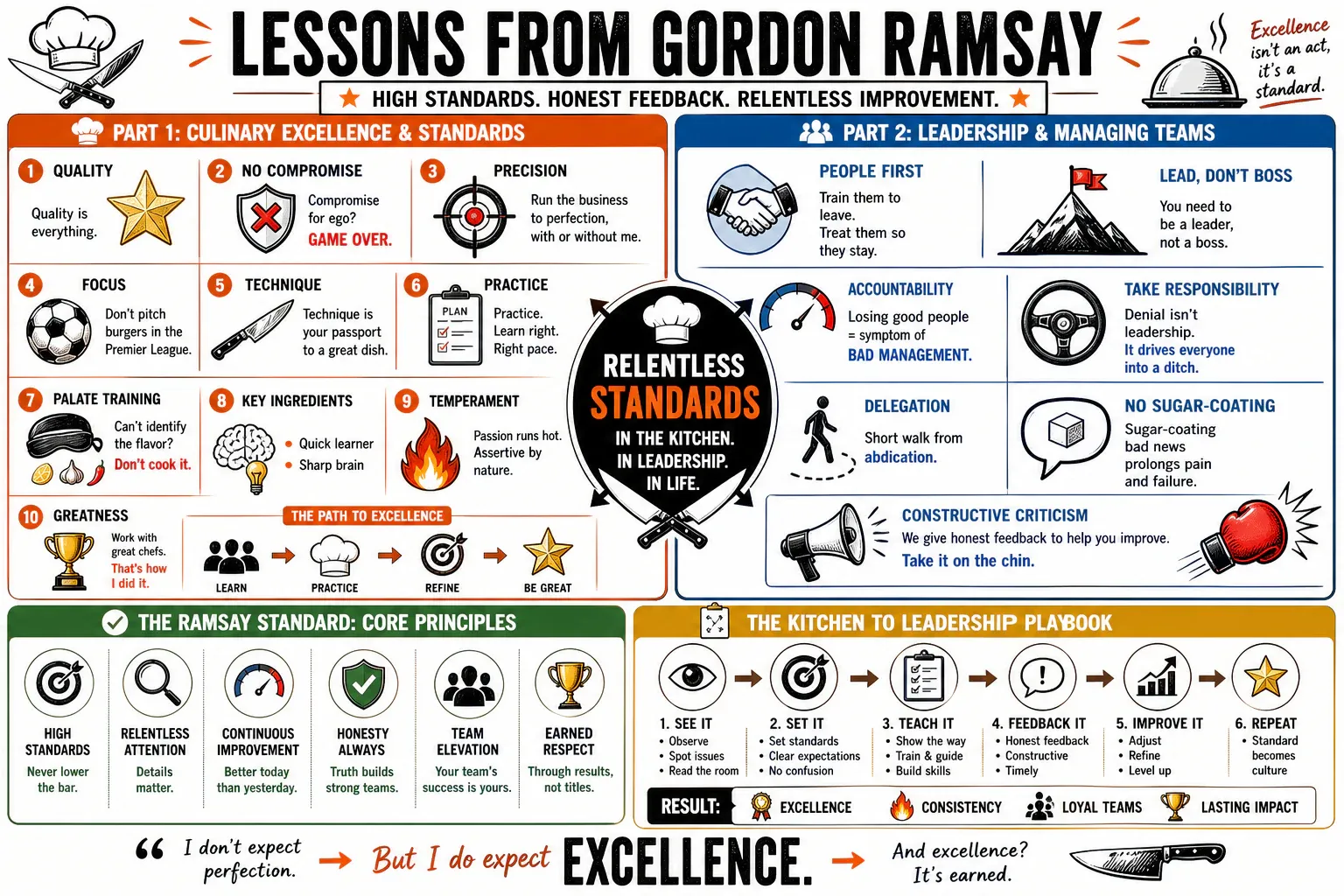
Part 1: Culinary Excellence & Standards
- Protect the standard: Ramsay treats consistent food and service quality as a standard that must hold even when he is not personally in the kitchen. — Variety Interview.
- Do not sacrifice flavour for display: Ramsay warns that excessive visual finesse can compromise a dish’s flavour and integrity; the existing ego-compromise aphorism is not authenticated. — Gentleman’s Journal Interview.
- Make the team capable without you: Ramsay says the same kitchen team must deliver the expected standard whether he is present or not. — Variety Interview.
- Know which league you are entering: Ramsay distinguishes relaxed casual cooking from the pressure and preparation demanded by top-flight restaurant service. — Futon Critic Interview.
- Master repeatable technique: In his cooking guidance Ramsay stresses advance preparation, seasoning and repeated tasting so the final dish is controlled rather than improvised in a rush. — Ramsay’s Cooking Secrets.
- Learn in stages: Ramsay looks for cooks who absorb instruction, learn in demanding kitchens and build enough skill before taking senior roles. — Robb Report Interview.
- Train the palate first: Ramsay says he teaches young chefs to taste and understand flavour before he asks them to compose dishes. — Robb Report Interview.
- Hire people eager to absorb: Ramsay identifies a new chef’s ability to absorb teaching and love of cooking as early hiring signals; the legacy two-ingredient quote is not verified. — Robb Report Interview.
- Channel passion under pressure: Ramsay describes restaurant kitchens as pressured environments in which his frustration reflects demanding quality expectations; passion does not excuse every outburst. — Bon Appétit Interview.
- Study great chefs directly: Ramsay credits Marco Pierre White, Guy Savoy and other mentors with shaping his craft, and says he moved between kitchens to keep learning. — Robb Report Interview.
Part 2: Leadership & Managing Teams
- Lead the service: Ramsay likens the chef’s leadership role to a team captain who must rally people during a demanding service. — Esquire: What I’ve Learned.
- Retention requires development: Ramsay says keeping a strong team together and helping chefs advance are essential to sustaining Restaurant Gordon Ramsay; he does not make the legacy blanket-management quotation. — Savour Chef Interview.
- Ask for problems early: Ramsay says staff should report mistakes promptly so the team can solve them; concealment is worse than an honest kitchen error. — Human Resources Online Interview.
- Delegate without micromanaging: Ramsay says growth required handing responsibility to talented chefs while staying available to support them when mistakes occurred. — Robb Report Interview.
- Use negative feedback quickly: Ramsay reviews mystery-diner reports soon after service because waiting weeks for an outside review would delay correction. — Human Resources Online Interview.
- Treat criticism as information: Ramsay says adverse reviews and correction can teach a chef, though the original gendered television line is not preserved as general advice. — British GQ Interview.
- Inspire a team to sustain quality: Ramsay credits the persistence and inspiration of his team, rather than his television persona, for the flagship restaurant’s standards. — Savour Chef Interview.
- Stand up for staff: Ramsay recounts barring a critic who treated his staff badly, distinguishing legitimate food criticism from abuse of the team. — Gentleman’s Journal Interview.
- Simplify an overcomplicated menu: The Fenwick Arms owner recounts Ramsay paring back a menu and returning to straightforward dishes as part of a turnaround; this is a specific case, not a universal efficiency formula. — Fenwick Arms Case.
Part 3: Business & Entrepreneurship
- Earn the local market first: Ramsay advises a new business to understand regional customers and become excellent locally before chasing expansion. — Entrepreneur Interview.
- Test the small version: Ramsay suggests a short pop-up or limited version of a concept—about 48 hours in his example—to expose problems before a full launch. — Entrepreneur Interview.
- Learn who stopped coming: When rescuing a restaurant, Ramsay asks why former or potential customers are absent, not only whether loyal regulars still show up. — Robb Report Interview.
- Reputation is earned at each service: Ramsay warns his chefs that one poor service can damage a reputation built over years, so the kitchen needs ongoing self-criticism. — Human Resources Online Interview.
- Learn without repeating the mistake: Ramsay says a mistake can be acceptable if the chef understands it and does not make the same one again. — Robb Report Interview.
- Make opportunity through effort: Ramsay attributes his progress to stamina, hunger and sustained work rather than waiting for an easy opening. — British GQ Interview.
- Strengthen the restaurant with talent: Ramsay says growing beyond one kitchen required developing chefs, handing over responsibility and keeping strong teams in place. — Robb Report Interview.
- Every role supports the result: Ramsay attributes restaurant consistency to chefs and waiters working as a team, not to his name on the door alone. — Robb Report Interview.
Part 4: Passion & Drive
- Notice the desire to learn: Ramsay looks for absorbent, motivated young chefs and develops their palate; the precise 15-minute diagnostic in the old quotation is not established. — Robb Report Interview.
- Keep passion in the craft: Ramsay describes cooking as a passionate career that becomes stale if a chef stops learning and exploring other food cultures. — Human Resources Online Interview.
- Turn difficult origins into drive: Ramsay links his determination to an unstable childhood and watching his mother work hard; the existing polished childhood quotation is not independently authenticated. — Esquire: What I’ve Learned.
- Care about what leaves the kitchen: Ramsay argues that chefs should be self-critical when customers are not and should respond seriously to a failed service. — Human Resources Online Interview.
- Stretch talent with support: Ramsay describes challenging a chef according to that person’s level and staying ready to help when the challenge exposes a mistake. — Robb Report Interview.
- Keep creating: Ramsay describes still developing new restaurant and cooking-school concepts instead of treating his past accolades as a stopping point. — Robb Report Interview.
- Use pressure deliberately: Ramsay regards some pressure as healthy in a professional kitchen, but says it becomes stress when a cook cannot handle it. — Futon Critic Interview.
Part 5: Handling Failure & Criticism
- Take a lesson from failure: Ramsay says poor reviews and setbacks can reveal what needs changing, including the response to his New York restaurant. — British GQ Interview.
- Do not make the review your identity: Ramsay says he took something useful from difficult reviews, while continuing to let the food—not arguments with critics—make the case. — British GQ Interview.
- Correct the error the first time: Ramsay tells developing chefs it is acceptable to make an error, but not to repeat it without learning. — Gentleman’s Journal Interview.
- Let trainees stumble safely: Ramsay advises giving talented people room to make mistakes while being ready to restore confidence and help them solve the problem. — Robb Report Interview.
- Separate useful critique from noise: Ramsay has described learning from an adverse New York review while rejecting criticism of his family or staff unrelated to the meal. — British GQ 2023 Interview.
- Return to work after setbacks: Ramsay describes recovering from periods when he had fallen hard by dusting himself off and returning to work the next day. — Esquire: What I’ve Learned.
- Keep confidence grounded in skill: Ramsay encourages young chefs’ confidence but distinguishes it from arrogance that is not backed by cooking ability. — Futon Critic Interview.
- Use immediate customer signals: Ramsay describes mystery diners and rapid reports as a way to learn from negative experiences before they become lasting reputation damage. — Human Resources Online Interview.
Part 6: Mentorship & Developing Talent
- Teach instead of hoarding talent: Ramsay says he wants chefs he developed to succeed independently, as earlier mentors gave him room to advance. — Savour Chef Interview.
- Move from star cook to coach: Ramsay says he moved from personally cooking every service toward teaching chefs, delegating responsibility and supporting their independent growth. — Robb Report Interview.
- Nurture people who may surpass you: Ramsay argues a chef should not hold talented colleagues back for fear they will take ideas or leave; their success reflects good mentoring. — Savour Chef Interview.
- Take a lower rung to learn more: Ramsay says he repeatedly moved into demanding kitchens and lower-ranked positions to learn from excellent chefs before pursuing the top job. — British GQ 2023 Interview.
Part 7: Work Ethic & Discipline
- Work hard enough to learn faster: Ramsay recalls working long hours in France and studying the language on days off to advance in demanding kitchens. — Esquire: What I’ve Learned.
- Start again the next day: Ramsay describes taking a setback, dusting himself off and returning to the work rather than treating failure as a permanent identity. — Esquire: What I’ve Learned.
- Maintain perfection through routine: Ramsay says consistency at Restaurant Gordon Ramsay is a repeatable team discipline rather than luck or occasional brilliance. — Robb Report Interview.
- Use exercise to process pressure: Ramsay describes cycling and training as protected time to review decisions and handle the demands of his work. — Robb Report Interview.
Part 8: Life, Family, & Balance
- Balance the chef role with family: Ramsay distinguishes his intense kitchen persona from his role at home, and describes family as the bedrock of a measured life. — Robb Report Interview.
- Give family real priority: Ramsay says family matters deeply and that planning time carefully helps him be present with his children; the aphorism from Playing with Fire is not quoted. — Robb Report Interview.
- Taste outlasts presentation: Ramsay warns chefs not to add visual flourish once it starts compromising flavour and the integrity of a dish. — Gentleman’s Journal Interview.
- Kitchen bonds come from shared work: Ramsay describes the social sacrifices of kitchen work and the importance of keeping a team together; the old family-time comparison is not authenticated here. — Savour Chef Interview.
- Organize work around family: Ramsay says his household deliberately organizes time and work while treating family as its foundation; the legacy provider quotation is not preserved. — Robb Report Interview.
- Judge the chef beyond television: Ramsay emphasizes that the restaurants and the teams running them come before his television identity. — Bon Appétit Interview.