Graham Weaver founded Alpine Investors and teaches at Stanford Graduate School of Business. His own writing and interviews discuss PeopleFirst investing, talent development, asymmetric opportunities, self-management, and the long-term pursuit of meaningful goals. — Adam Mendler — Interview with Graham Weaver.
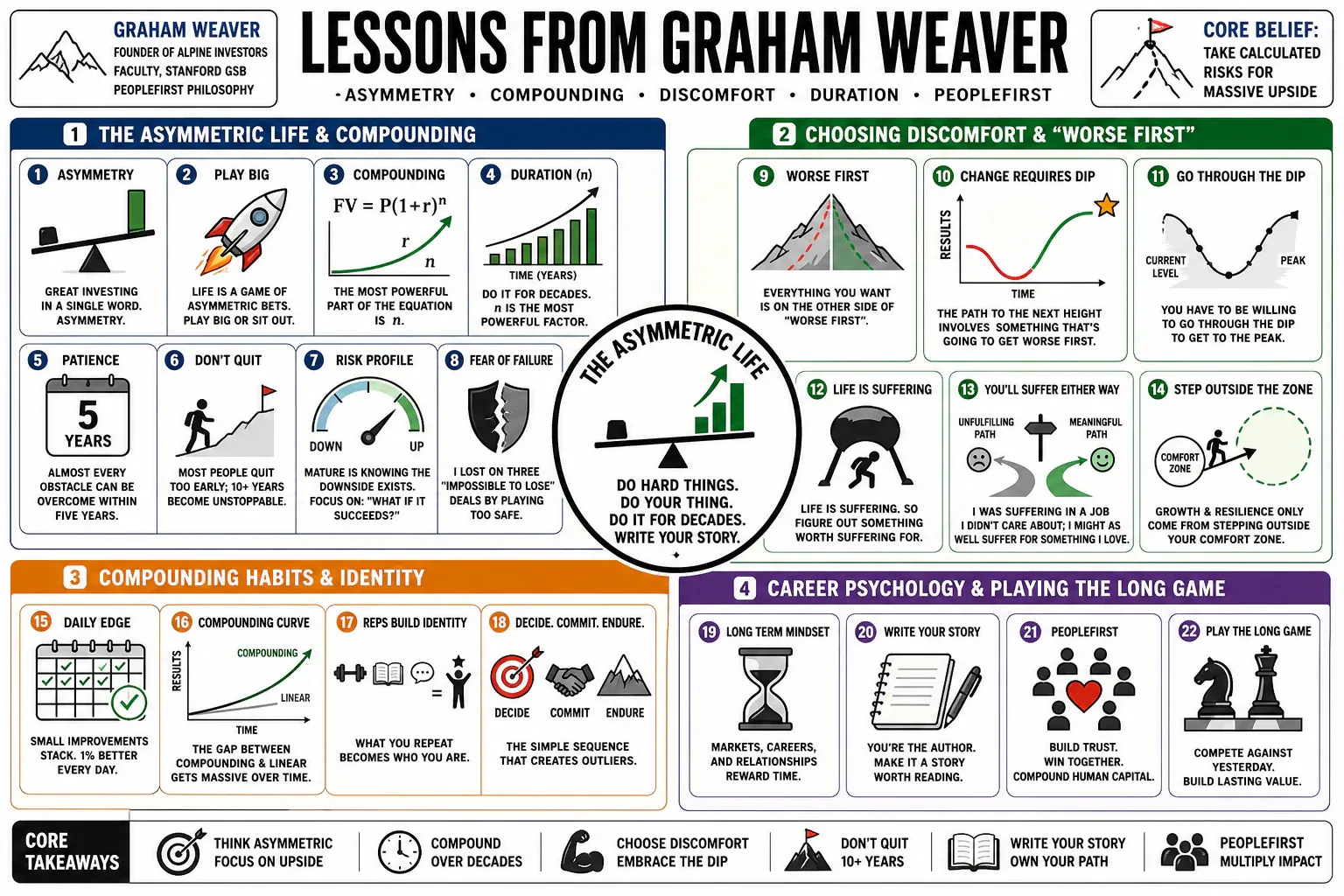
Part 1: The Asymmetric Life & Compounding
- Look for asymmetric upside: Weaver says great investing seeks a limited downside with potential gains that are much larger, rather than trying to remove downside entirely. — Graham Weaver — How to Live an Asymmetric Life.
- Choose a game worth playing: He argues that an ambitious goal can change how a person or team acts, whom it attracts, and how long it persists. — Graham Weaver — How to Design and Play a Winnable Game.
- Let improvement compound over years: Weaver uses an exponential improvement model to argue that time spent getting better matters as much as the improvement rate. — Graham Weaver — How to Live an Asymmetric Life.
- Commit for the long term: He says sustained interest in a pursuit allows decades of effort and gives improvements time to compound. — Graham Weaver — How to Live an Asymmetric Life.
- Combine four asymmetric-life practices: Weaver’s framework is to do hard things, pursue work that energizes you, stay with it for decades, and write your own story. — Graham Weaver — How to Live an Asymmetric Life.
- Consider upside without pretending risk disappears: After early losses, Weaver concluded that investors can reduce but not eliminate downside, so the potential upside matters. — Graham Weaver — How to Live an Asymmetric Life.
- Learn from supposedly safe losses: Weaver recalls three investments he had called mathematically impossible to lose money on; all three lost money. — Graham Weaver — How to Live an Asymmetric Life.
Part 2: Choosing Discomfort & "Worse First"
- Expect change to get worse first: Weaver says difficult conversations, career changes, and new habits often involve an initial decline before improvement. — Graham Weaver — How to Live an Asymmetric Life.
- Choose what is worth the effort: Reflecting on a draining private-equity job, Weaver says no path is free of difficulty and urges choosing work worth that difficulty. — Graham Weaver — How to Live an Asymmetric Life.
- Do not mistake the familiar path for an easy one: The apparently safe job Weaver chose after business school demanded long hours yet did not give him the energy he saw in peers who loved the work. — Graham Weaver — How to Live an Asymmetric Life.
- Practice being uncomfortable: Weaver’s rowing example distinguishes early psychological adaptation to discomfort from slower gains in physical fitness. — Graham Weaver — How to Live an Asymmetric Life.
- Let repeated action shape identity: Weaver describes writing an Olympic rowing goal daily and taking three related actions, which changed how he saw himself even though he did not become an Olympian. — Graham Weaver — How to Design and Play a Winnable Game.
- Question the crowded path: Weaver says the accepted private-equity playbook concealed optional conventions; Alpine looked for a different game it could win. — Graham Weaver — How to Design and Play a Winnable Game.
Part 3: Goals, Vision & The Genie Methodology
- Ask what you would choose without fear of failure: Weaver used the question of what Alpine would do if it knew it could not fail to replace a defensive goal with a more ambitious one. — Graham Weaver — How to Design and Play a Winnable Game.
- Write the desired outcome before the method: In the Great Recession, Weaver’s coach asked him to describe the company five years ahead before resolving how each part would happen. — Graham Weaver — How to Live an Asymmetric Life.
- Design your own game: Weaver argues that teams can challenge assumed industry rules and build a strategy around work competitors are unwilling to do. — Graham Weaver — How to Design and Play a Winnable Game.
- Beware “not now”: Weaver says students rarely reject an exciting goal outright; delaying it until conditions are perfect can quietly become never. — Graham Weaver — How to Live Your Life at Full Power.
- Give yourself permission to begin: His asymmetric-life lecture closes by urging readers to stop living someone else’s life and give themselves permission to pursue their own. — Graham Weaver — How to Live an Asymmetric Life.
- Use aspirational goals to change behavior: Weaver says Alpine’s ambitious goals changed the decisions the team made, rather than merely describing an outcome. — Adam Mendler — Interview with Graham Weaver.
- Write a new company story: Weaver describes outlining a five-year turnaround and then taking its first concrete step: hiring a new CEO. — Graham Weaver — How to Live an Asymmetric Life.
Part 4: The Inner Battle & Self-Management
- Manage yourself before trying to lead others: Weaver says facing his own fears and limiting beliefs was necessary before he could become a better leader. — Adam Mendler — Interview with Graham Weaver.
- Protect time for inner work: Weaver describes coaching, journaling, sleep, exercise, and reflection as investments in his own ability to lead and live well. — Adam Mendler — Interview with Graham Weaver.
- Notice the voice of fear: In his 2024 lecture, Weaver says fear can sound like practical caution while steering someone toward a life smaller than they want. — Graham Weaver — How to Live Your Life at Full Power.
- Follow the voice of energy: Weaver contrasts fear with an internal signal of excitement and interest that can point toward work worth pursuing. — Graham Weaver — How to Live Your Life at Full Power.
- Remove self-imposed constraints: Weaver’s “nail” metaphor includes habits, unresolved experiences, assumptions, and fear that keep someone stuck. — Graham Weaver — How to Live Your Life at Full Power.
- Chip away the false rules: Using Michelangelo’s angel-in-marble image, Weaver says fears and inherited rules can obscure rather than create a person’s potential. — Graham Weaver — What I Learned at 50.
- Speak your truth directly: Weaver tells Stanford interviewer Matt Abrahams that authenticity and direct communication can prevent the cost of avoiding difficult truths. — Stanford GSB — Speak Your Truth.
- Do not expect external wins to settle self-doubt: Weaver writes that achieving goals did not silence his inner doubts; coaching helped him separate that voice from his own values. — Graham Weaver — What I Learned at 50.
Part 5: The "PeopleFirst" Philosophy & Talent
- Treat talent as an investment driver: Weaver says Alpine’s financial returns depend on selecting and developing people, not just transaction models. — Adam Mendler — Interview with Graham Weaver.
- Trace outcomes back to people and roles: Weaver says Alpine’s root-cause reviews often return to whether the right person was in the right role with adequate training. — Adam Mendler — Interview with Graham Weaver.
- Hire people before fitting them to companies: Alpine explains PeopleFirst as recruiting leaders first, then finding companies for them to lead, while investing in their development. — Alpine Investors — What Is PeopleFirst?.
- Build value through training, not only deal terms: Weaver describes attributes-based hiring and extensive training as Alpine’s path to returns that a spreadsheet alone cannot capture. — Adam Mendler — Interview with Graham Weaver.
- Help employees use more of their capacity: Alpine’s PeopleFirst approach aims to create alignment, support, and opportunity so employees can contribute more fully. — Alpine Investors — What Is PeopleFirst?.
- Take employee engagement seriously: Weaver says disengagement affects both company results and employees’ lives, so Alpine tries to connect work to mission and individual contribution. — Win the Day — Graham Weaver Interview.
- Become a workplace talented people choose: Weaver names becoming a place where the best people want to work as one of Alpine’s enduring aspirational goals. — Adam Mendler — Interview with Graham Weaver.
- Hire for durable attributes: In Alpine’s hiring discussion, Weaver emphasizes will to win, self-awareness, getting along with others, and grit over prior experience. — Win the Day — Graham Weaver Interview.
Part 6: Leadership & Building Great Teams
- Make culture a leadership responsibility: Weaver says creating a strong team and culture belongs to top leadership rather than being delegated entirely to HR. — Adam Mendler — Interview with Graham Weaver.
- Put talent development on the calendar: He recommends that top leaders spend roughly 30–50% of their time recruiting, training, or developing top talent. — Adam Mendler — Interview with Graham Weaver.
- Treat management selection as an investment decision: Weaver calls putting the right management team in place Alpine’s most important investment decision. — Adam Mendler — Interview with Graham Weaver.
- Empower strong people with decision rights: Weaver argues that clearly delegated decisions let capable people move faster and enjoy their work more. — Adam Mendler — Interview with Graham Weaver.
- Address chronic underperformance: Weaver argues that keeping people who underperform or damage the culture can weaken a team, and that leaders must make difficult personnel decisions. — Adam Mendler — Interview with Graham Weaver.
- Put the right people in the right roles: Weaver says changing an underperforming company often starts by correcting who is leading it and where people work. — Adam Mendler — Interview with Graham Weaver.
- Sell with conviction and preparation: Weaver borrows Tony Robbins’s formulation about conviction while advising sellers to make a few memorable points and address objections directly. — Adam Mendler — Interview with Graham Weaver.
- Watch the reporting hierarchy: Weaver says strong performers are unlikely to remain long under weaker leaders, making department-head selection consequential. — Adam Mendler — Interview with Graham Weaver.
Part 7: Business Strategy & Winnable Games
- Design a winnable game: Weaver defines a winnable game as one that combines a realistic path to success with work that energizes the people playing it. — Graham Weaver — How to Design and Play a Winnable Game.
- Focus on one important goal: Weaver calls sustained attention to a single goal a route to excellence and urges protecting that focus on the calendar. — Graham Weaver — Why Focus Is a Superpower.
- Scale the bright spots: Weaver explicitly borrows Dan and Chip Heath’s “find what is working” question and applies it to strategic choices rather than only fixing weaknesses. — Graham Weaver — The Single Best Strategic Question.
- Set an ambitious performance goal: Weaver says Alpine adopted an aspiration to become the highest-returning private-equity firm, changing how the team made decisions. — Adam Mendler — Interview with Graham Weaver.
- Include social good in the goal: Alpine’s 2009 goals also included becoming a force for social good, which Weaver presents as part of the firm’s intended direction. — Adam Mendler — Interview with Graham Weaver.
- Align the game with who you are: Weaver says a winnable game joins external achievement with internal fulfillment and an activity a person is excited to sustain. — Graham Weaver — How to Design and Play a Winnable Game.
- Change the operating process deliberately: Weaver describes Alpine’s “pass or sprint” diligence rule as a concrete process change that reduced time spent on deals it did not close. — Graham Weaver — How Lean Manufacturing Transformed Alpine.
- Ask why not you: Weaver’s essay challenges readers to lengthen their timeframe and imagine becoming the best in their chosen field. — Graham Weaver — Three Practices to Become the Best.
Part 8: Habits, Energy & Intentional Living
- Follow what currently gives you energy: Weaver argues that a single lifelong passion is an unhelpful demand; his alternative is to notice present sources of energy. — Graham Weaver — How to Live Your Life at Full Power.
- Use energy as a personal signal: In the Stanford lecture, Weaver calls energy the language of the soul to describe how excitement directs attention toward meaningful possibilities. — Stanford GSB — How to Live Your Life at Full Power.
- Energy can grow through commitment: Weaver says the energy he gives teaching has increased as he has committed to it, rather than behaving like a finite fuel. — Graham Weaver — How to Live Your Life at Full Power.
- Make progress through repeated practice: Weaver connects long-run improvement to recurring learning, coaching, and work over years rather than a single breakthrough. — Graham Weaver — How to Live an Asymmetric Life.
- Write the goal and daily actions: Weaver describes writing his rowing goal in the present tense and three steps toward it each morning. — Graham Weaver — How to Design and Play a Winnable Game.
- Schedule the big rocks first: Weaver applies the rocks-and-sand parable by reserving calendar time for his most important priorities before smaller obligations fill the space. — Graham Weaver — Time Management and Big Rocks.
- Choose the people shaping your environment: Weaver says the people around you shape your goals, values, and identity, so choose close collaborators deliberately. — Graham Weaver — How to Design and Play a Winnable Game.
- Try the nine-lives exercise: Weaver asks listeners to imagine eight alternative lives beginning today, alongside their present life, to surface current sources of energy. — Graham Weaver — How to Live Your Life at Full Power.
- Show up as your best self: Weaver says managing fear and investing in personal habits help him bring a stronger version of himself to other people. — Adam Mendler — Interview with Graham Weaver.