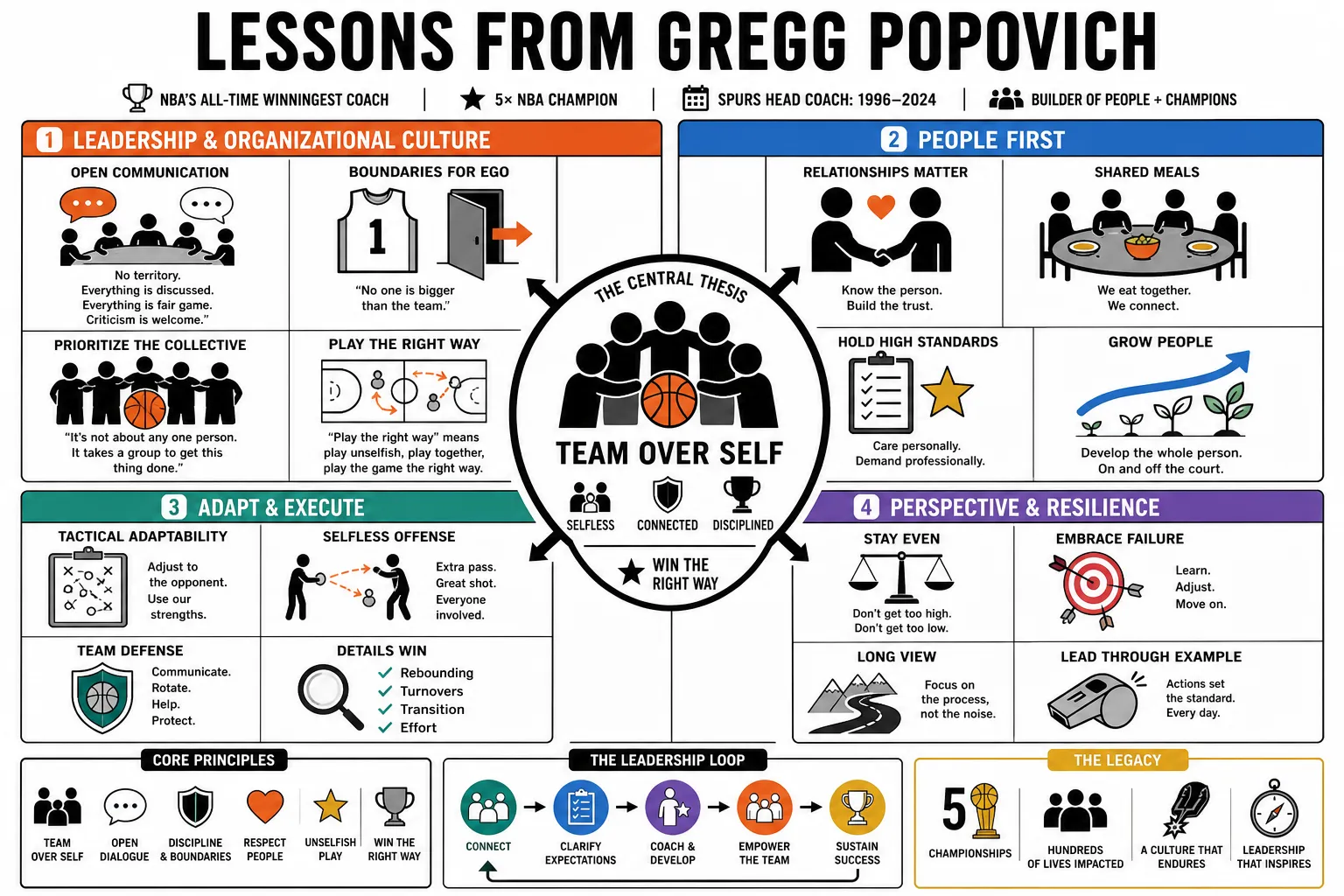
Gregg Popovich is the all-time winningest coach in NBA history, having led the San Antonio Spurs to five championships over a tenure that began in 1996. Beyond his tactical adaptability on the court, he is known for building a unique organizational culture rooted in human connection, shared meals, and the strict demand that players and staff prioritize the group over their own egos. The following compilation outlines his practical approach to team building, leadership, and maintaining perspective through both success and failure.
Part 1: Leadership and Organizational Culture
- On establishing open communication: "There is no territory. Everything is discussed. Everything is fair game. Criticism is welcome, and when you have that, then you have a hell of an organization." — Source: [Basketball Mindset Training]
- On setting boundaries for ego: "No one is bigger than the team. If you can't do things our way, you're not getting time here and we don't care who you are." — Source: [Medium]
- On prioritizing the collective: "It's not about any one person. You've got to get over yourself and realize that it takes a group to get this thing done." — Source: [AZ Quotes]
- On defining the right way to play: "'Play the right way' means play unselfishly, respect each other's achievements, play hard, fulfill your role." — Source: [Medium]
- On the simplicity of winning: "Basketball is a pretty simple game. What wins is consistency and competitiveness." — Source: [Medium]
- On trusting players to solve problems: "I can't make every decision for you. I don't have 14 timeouts. You guys got to get together and talk." — Source: [Basketball Mindset Training]
- On not needing to be liked by everyone: "It's never been my goal to be king of the prom. It's been my goal to do the right thing and get the job done." — Source: [Medium]
- On recognizing the limits of coaching: "Sometimes being quiet and letting the player play is much more important than trying to be Mr. Coach and teach him this or teach him that." — Source: [Business Insider]
- On weeding out toxic personalities: "I don't want to go to practice with a bunch of problem players. Life is short, I can't imagine traveling around for 100 games with guys who are jerks." — Source: [Basketball Mindset Training]
- On total honesty over strategy tricks: "I don't trick players. I give them total, brutal, between-the-eyes honesty, so I don't have to change my story the following week." — Source: [Business Insider]
Part 2: The "Pound the Rock" Philosophy
- On the value of the stonecutter metaphor: "When nothing seems to help, I go and look at a stonecutter hammering away at his rock perhaps a hundred times without as much as a crack showing in it. Yet at the hundred and first blow it will split in two, and I know it was not that blow that did it, but all that had gone before." — Source: [SLAM Online]
- On avoiding cliché motivation: Popovich adopted the stonecutter quote specifically because it avoided the trite, silly nature of typical sports clichés while conveying a deep truth about daily habits. — Source: [SLAM Online]
- On trusting the process over the immediate result: The mantra serves to remind players that success is rarely an overnight event, but rather the result of repeated, disciplined effort over a long timeline. — Source: [SLAM Online]
- On the cumulative effect of daily habits: The focus must remain on the act of hammering the rock each day, knowing that the structural breakthrough will only come if the preceding baseline of effort is established. — Source: [Business Insider]
- On viewing setbacks as part of the hammering process: A missed shot or a lost game is simply another necessary strike on the rock; it does not mean the overall effort is failing. — Source: [Basketball Network]
- On patience during long seasons: The philosophy dictates that a team cannot skip steps; they must persistently work through the grueling mid-season stretch without losing faith in their eventual breakthrough. — Source: [Basketball Network]
- On the quiet work before the breakthrough: True progress is made during the invisible hundreds of strikes where no visible improvement or public recognition is present. — Source: [SLAM Online]
- On persistence rather than sudden talent: It is not a sudden influx of talent or a single magical adjustment that splits the rock, but the relentless application of fundamental principles. — Source: [Basketball Network]
- On adopting Jacob Riis's mindset for sports: By utilizing a quote from a 19th-century social reformer, Popovich frames the NBA grind as an arduous, patient, and necessary labor rather than just an athletic contest. — Source: [SLAM Online]
Part 3: Basketball Strategy and Evolution
- On constant ball movement: "Either you move it or you die." — Source: [Basketball Network]
- On upgrading shot selection: "We're always trying to move the ball from good to great. Penetrate for a teammate, not necessarily for yourself." — Source: [Medium]
- On prioritizing assists over isolation: The Spurs' motion offense is designed to break defenses down through continuous cutting and screening, strictly avoiding static, hero-ball possessions. — Source: [Basketball Network]
- On the necessity of defensive effort: Popovich famously roots his teams in team defense, demanding that all five players fulfill their rotational assignments to even earn time on the court. — Source: [Express News]
- On the blunt truth of poor defense: "We suck on 'D.' Both individually and team-wise, we suck. We're pretty consistent that way. I don't know if I have an answer to that." — Source: [Express News]
- On the misconception that losing is just a lack of effort: "If you lose, you were less aggressive, and you didn't have the effort; that's all baloney. That's psycho-babble... They played better than we did. It's got nothing to do with effort." — Source: [Medium]
- On adjusting the system to fit the talent: Popovich successfully transitioned the Spurs from a slow, post-up heavy scheme centered on big men to a fast-paced, perimeter-oriented motion offense as the league and his roster evolved. — Source: [Business Insider]
- On adapting to the modern three-point era: Despite personally disliking the aesthetic of the three-point shot, he pragmatically rebuilt his team's entire offensive philosophy to maximize three-point efficiency. — Source: [Business Insider]
- On equal opportunity offense: The playbook is built on reading the defense and reacting, ensuring that any player who is open becomes the primary option rather than forcing the ball to a single star. — Source: [Basketball Network]
- On balancing defensive roots with high-efficiency offense: He demands absolute adherence to defensive fundamentals while allowing ultimate freedom and creativity on the offensive end, provided the ball keeps moving. — Source: [Express News]
Part 4: Evaluating Character and "Getting Over Yourself"
- On the central question for evaluating draft picks: "The phrase that we use is seeing whether people have 'gotten over themselves.' For those people, we think, 'Has this person gotten over himself?'" — Source: [Business Insider]
- On diagnosing selfishness during interviews: "When there's a guy who talks about himself all day long, you start to get the sense that he doesn't listen real well." — Source: [Business Insider]
- On the necessity of enjoying others' success: "Being able to enjoy someone else's success is a huge thing." — Source: [NBC Sports]
- On the danger of a player who only talks about himself: Players who obsess over personal accolades or blame others for their shortcomings invariably become a cancer to the team's culture. — Source: [NBC Sports]
- On accepting one's role without complaint: "We believe in people executing their role and caring about the team more than anything individually." — Source: [Medium]
- On separating adult behavior from childish egos: He insists on treating his players like adults, which requires them to act like mature professionals who do not need constant coddling. — Source: [Basketball Network]
- On the futility of trying to change a player's core personality: "You're not going to take a jerk and turn him into someone who embraces the community. That's a waste of time." — Source: [Business Insider]
- On creating a "no walls" environment for feedback: True team cohesion requires an environment where anyone can accept critique without their ego actively blocking the message. — Source: [Medium]
- On self-deprecation as a key character trait: Popovich heavily scouts for players who possess a sense of humor and the ability to laugh at their own mistakes, viewing it as a prime indicator of coachability. — Source: [Business Insider]
Part 5: Handling Success, Failure, and Adversity
- On the true measure of character: "The measure of who we are is how we react to something that doesn't go our way." — Source: [Business Insider]
- On processing the devastating 2013 Finals loss: "The elephant in the room is that we're all hurting because we had an opportunity to win a championship right in the palm of our hands and it didn't happen." — Source: [Sportsnet]
- On rejecting the "loser" label after falling short: "In today's world, if you don't win the whole thing... people have a tendency to paint you as a loser or act like you just robbed the cookie jar. Well that's baloney." — Source: [Business Insider]
- On taking personal responsibility after defeat: "You're in charge of yourself. There are always things you can do better." — Source: [Business Insider]
- On finding perspective by comparing sports to real-world struggles: He frequently reminds his team that a bad game of basketball pales in comparison to the genuine hardships people face daily around the world. — Source: [Business Insider]
- On refusing to blame bad luck for losing: After heartbreak, he forces his teams to confront their own tactical and mental mistakes on film rather than writing off the loss to bad breaks. — Source: [Basketball Network]
- On maintaining pride in a team despite a championship loss: He told the media he was just as proud of his team for their fight in the 2013 Finals loss as he was when they won it all the following year. — Source: [Business Insider]
- On gratitude for the mere opportunity to compete again: People should be "thankful every day that you have the opportunity to come back from a defeat, because some people never even have the opportunity." — Source: [Business Insider]
- On using painful film sessions to ensure future discipline: By spending hours reviewing the darkest moments of a crushing loss, he effectively utilizes pain to eradicate entitlement for the upcoming season. — Source: [Basketball Network]
Part 6: Life Beyond Basketball and Team Dinners
- On treating basketball as just a game: He consistently reminds his players that basketball is just a silly game with a ball, and that their true fulfillment must come from their families and character. — Source: [Fox Sports]
- On the purpose of extended team dinners: He utilizes long, highly curated dinners on the road to resuscitate the team's spirit and forge authentic human friendships outside the confines of the locker room. — Source: [Fox Sports]
- On fostering human connection over professional duty: By picking up the tab and prioritizing conversation, he ensures his players connect as human beings first and coworkers second. — Source: [Business Insider]
- On engaging players about their families and the world: He intentionally uses off-court time to discuss global events, history, and personal lives, turning his roster into well-rounded individuals rather than just athletes. — Source: [Fox Sports]
- On utilizing food and wine to build psychological safety: His deep knowledge of wine and fine dining is used as a tool to create relaxed environments where players feel safe dropping their competitive guards. — Source: [Business Insider]
- On the importance of shared experiences off the court: The trust required to execute complex motion offenses in high-stress playoff games is built quietly over hundreds of shared meals across the country. — Source: [Fox Sports]
- On demonstrating loyalty through off-court generosity: He is famous for quietly taking care of his staff, leaving massive tips, and treating the people around him with intense, unspoken loyalty. — Source: [Business Insider]
- On treating restaurant staff with the same respect as superstars: His habit of leaving cash for the kitchen staff and engaging deeply with waitstaff reflects his core belief in universal human dignity. — Source: [Business Insider]
- On showing a deeply empathetic side away from the cameras: While the media often sees a gruff, dismissive figure during sideline interviews, his inner circle knows a man defined by warmth, empathy, and fierce dedication to his friends. — Source: [Fox Sports]
Part 7: Speaking Out on Politics and Racism
- On racism as America's national sin: He frequently refers to racism as the original and ongoing national sin of the United States, requiring relentless public confrontation. — Source: [The Guardian]
- On the uncomfortable necessity of discussing race: "Unless it is talked about constantly, it's not going to get better... There has to be an uncomfortable element in the discourse for anything to change." — Source: [The Guardian]
- On the reality of systemic white privilege: "If you were born white, you automatically have a monstrous advantage educationally, economically, culturally, in this society." — Source: [Washington Post]
- On refusing to be "tired of talking" about inequality: He openly challenges white Americans who claim fatigue over racial discussions, noting that it is a profound privilege to be able to simply ignore the issue. — Source: [The Nation]
- On the moral responsibility of leaders in times of crisis: He demands that national leaders provide empathetic, unifying guidance during tragedies rather than retreating into divisive, self-serving rhetoric. — Source: [Express News]
- On the systemic roadblocks built into education and zoning: He highlights that inequality is not just interpersonal but baked into the very infrastructure of neighborhoods, laws, and educational funding. — Source: [Washington Post]
- On criticizing political cowardice publicly: He has repeatedly used his press conferences to call out political figures he views as soulless or cowardly, regardless of the potential backlash from fans. — Source: [The Guardian]
- On holding authorities accountable for disparate treatment of protesters: Following the U.S. Capitol breach, he publicly contrasted the lenient treatment of the mob with the aggressive policing typically deployed against Black Lives Matter protesters. — Source: [Express News]
- On using a sports platform to force difficult civic conversations: He leverages his immense security and status within the NBA to act as a truth-teller, shifting the media's focus from basketball minutiae to urgent societal flaws. — Source: [The Guardian]
Part 8: Relationships, Tim Duncan, and The Big Three
- On tracing all organizational success back to Tim Duncan: "Before you start handing out applause and credit to anyone else in this organization... remember it all starts with and goes through Timmy. As soon as he retires, I'll be ten steps behind." — Source: [Basketball Network]
- On Duncan's ultimate selflessness setting the team standard: Popovich frequently credits Duncan as the most selfless individual he has ever been around, noting that when your best player willingly takes criticism, the rest of the team has no choice but to follow. — Source: [Basketball Network]
- On relying on Duncan, Parker, and Ginobili to save his career: "This Duncan guy, this Ginobli guy, and this Parker guy, they are pretty important to me being successful. Like, if I didn't have them, I would be coaching in the Budweiser League someplace." — Source: [Basketball Network]
- On the impossibility of replicating the Big Three's intelligence and character: He acknowledges that his system only worked because the three foundational stars were exceptionally intelligent and completely devoid of destructive selfishness. — Source: [Basketball Network]
- On pushing superstars hardest to establish team-wide accountability: By intentionally directing his harshest coaching at Parker and Ginobili, he proved to every role player that absolutely no one was above the team's standards. — Source: [Basketball Network]
- On apologizing to Tony Parker for years of intense mental demands: "Tony, I want to apologize for all the physical and mental abuse I gave you over the years. Thank you. I've been wanting to say that for a long time." — Source: [Basketball Network]
- On Manu Ginobili being the ultimate competitive stud: "We would have two less championships here if it was not for Manu Ginobili. In my eyes, he's the stud of the world." — Source: [Basketball Network]
- On his coaching bond with Duncan resembling a long marriage: Their relationship evolved far beyond basketball, characterized by silent understandings, mutual wit, and a bond that mirrored a lifelong partnership. — Source: [Fox Sports]
- On implementing Mike Krzyzewski's "next play" mentality for Team USA: "Nobody cares. You don’t have that right. You owe your team, and you’re responsible to your team to move on to the next play." — Source: [Basketball Network]
- On defying critics after winning Olympic Gold: "I would just like to say to all those people out there: How the f--- do you like us now?!" — Source: [Express News]