Guillaume Lample is a co-founder and Chief Scientist of Mistral AI, and previously an AI researcher at Meta who led the development of the LLaMA language models. He is known for advancing state-of-the-art multilingual and open-weights AI architectures that rival proprietary systems. This profile highlights his technical strategies for training large language models, overcoming enterprise deployment hurdles, and building highly efficient models.
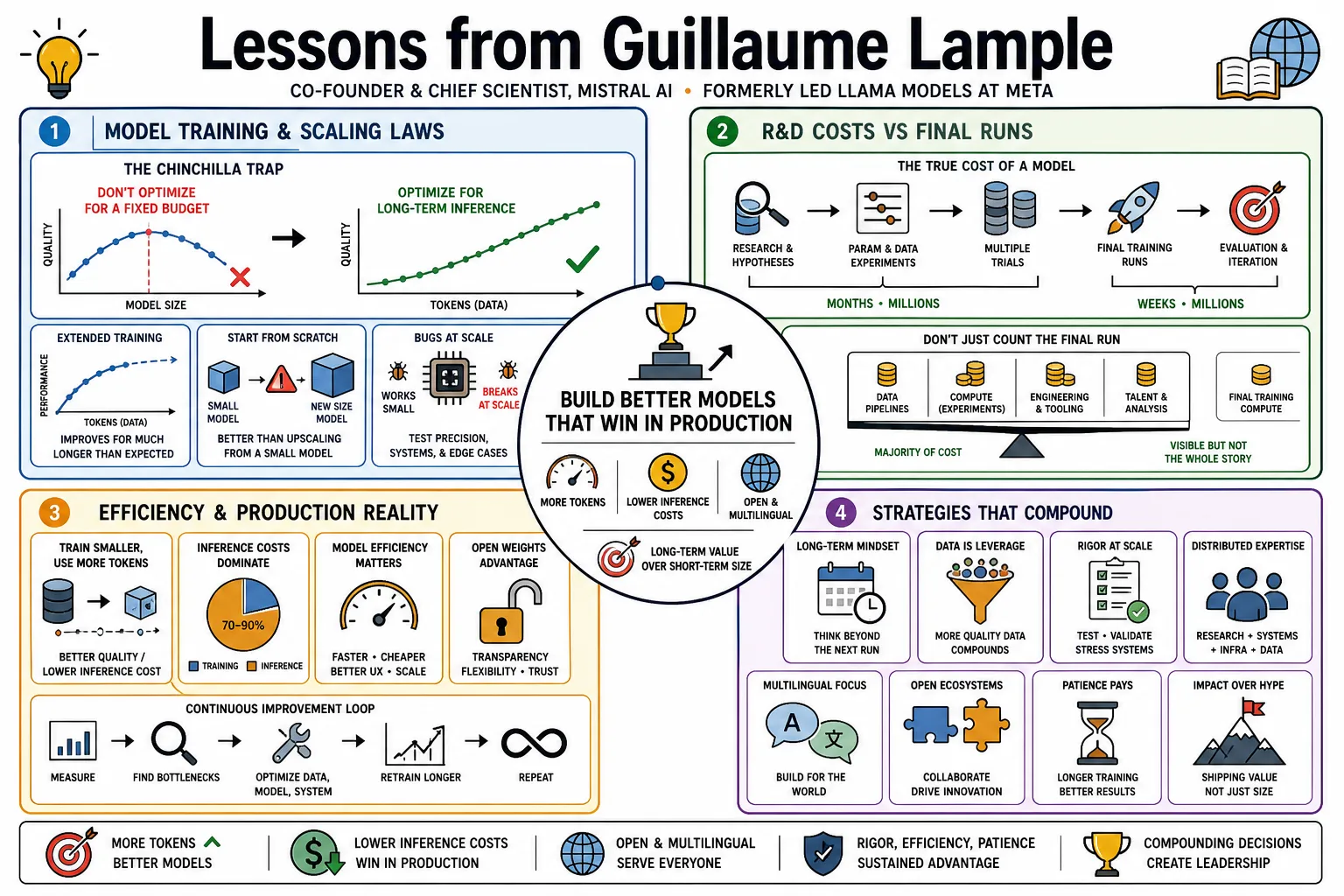
Part 1: Model Training and Scaling Laws
- On the Chinchilla trap: Many practitioners misunderstood early scaling laws by asking what the optimal model size was for a fixed compute budget, rather than what the best model was for long-term inference. Because inference costs dominate in production, training smaller models on significantly more tokens produces better practical results. — Reference: ZenML
- On extended training: Models can be trained much longer than previously thought. Even for very small models, performance does not saturate quickly and continues to improve when trained on vast amounts of data. — Reference: Data Driven 101
- On R&D costs vs final runs: Highlighting only the cost of the final training run is misleading. An initial research phase to test parameters and datasets can take months and cost millions before the final multi-week training run even begins. — Reference: Data Driven 101
- On starting from scratch: When training a new model size, it is generally better to start from scratch rather than trying to initialize a larger model from a smaller one, as those tricks carry risks when compute resources are limited. — Reference: Data Driven 101
- On bugs at scale: Distributed training systems can produce bugs that only manifest at extreme scales. For instance, using float16 precision instead of float32 worked fine on small models but caused training loss to diverge after two weeks on massive models. — Reference: ZenML
- On sliding window attention: Utilizing a sliding window architecture allows models to look extremely far into the past, enabling a small model to process and synthesize information across 100,000 tokens of context. — Reference: Data Driven 101
- On Mixture-of-Experts (MoE): By routing each text token to a specific subset of the model's parameters based on context, a model with a huge total parameter count can remain relatively cheap to serve since only a small fraction is activated per token. — Reference: Bismarck Brief
Part 2: Open Source and the AI Ecosystem
- On open AI safety: "We really don't want to be living in a world where the smartest models are only behind closed doors, only accessible to a few companies that have the power to decide who can use them or not. It's a scary future we don't want to live in." — Source: Singularity Moments
- On the hybrid business model: Combining open-source base models with proprietary enterprise services can capture market share much faster than taking a purely closed or purely open approach. — Reference: 22Astronauts
- On community-driven improvement: Giving everyone access to AI software creates a flywheel effect. The open-source community runs, tests, fine-tunes, and optimizes models, helping to build cheaper and safer software infrastructure. — Reference: Andreessen Horowitz
- On democratizing access: Taking an open-source model and deploying or fine-tuning it internally requires expertise that most businesses simply do not have, creating a need for specialized services that facilitate this transition. — Reference: Data Driven 101
- On the myth of proprietary data: You can reach extremely high performance levels using exclusively public datasets available on the internet, showing that hidden proprietary data isn't strictly required to train a highly capable model. — Reference: Data Driven 101
Part 3: Multilingual and Audio Models
- On cross-lingual pretraining: Early multilingual models often saw performance drop as they handled more languages. Transferring knowledge between languages during training allows a single model to excel across dozens of languages without sacrificing quality. — Reference: Gene Dai
- On language representation: To build a successful global model, you must balance language representation in the training data to ensure all languages receive adequate attention, rather than heavily over-representing English. — Reference: Gene Dai
- On neural audio codecs: To handle audio generation, Mistral converts audio into a 12.5 hertz set of discrete latents containing both semantic and acoustic tokens. — Reference: Latent Space
- On flow matching for audio: Rather than using a standard depth transformer to predict multiple tokens at each time step in parallel, Mistral achieved better results by developing an autoregressive flow matching architecture. — Reference: Latent Space
- On the path to real-time voice: "Ultimately what we want to do is to be this full duplex model, but we are not going to start there directly. We decided to take it step-by-step, starting with transcription, then speech generation, then real-time, and then combining everything." — Source: Singularity Moments
- On audio embeddings: In an audio understanding model, audio is fed through an encoder that produces continuous embeddings, which are then passed as tokens into the main transformer decoder. — Reference: Latent Space
- On speech generation efficiency: The Voxtral TTS model proves that a small 3 billion parameter model can perform at the same level as the best proprietary models, but at a fraction of the cost. — Reference: Latent Space
Part 4: Enterprise Deployment and Fine-Tuning
- On the deployment gap: Raw model weights are virtually useless to the vast majority of companies. Deploying an AI solution requires complementary infrastructure like inference optimization, evaluation systems, and synthetic data generation. — Reference: ZenML
- On unused corporate data: "Many companies have trillions of tokens of data in a very specific domain that you will not find on the public internet. If they are using closed-source models, they are basically not benefiting from all these insights." — Source: Singularity Moments
- On the power of fine-tuning: "Fine-tuning can make a model go much further than an off-the-shelf closed model." — Source: Singularity Moments
- On custom deployment: "We don't just release an endpoint and say 'do some stuff on top of that.' We work very closely with customers, look at the issues they have, and make tailored solutions." — Source: Singularity Moments
- On real-world evaluation loops: "The applied scientists and engineers will go and make the model better for specific customer edge cases, and then from those learnings, we incorporate it into the base model itself." — Source: Singularity Moments
- On identifying weaknesses: Collecting real user interactions helps pinpoint areas where models underperform. For instance, discovering that half of English requests are code-related allows engineering teams to prioritize specific capabilities. — Reference: ZenML
- On software verification: "With coding agents, the industry for software verification is going to be much larger in the future." — Source: Singularity Moments
Part 5: Data Quality and Preparation
- On the dominance of data quality: Preparing and cleaning data can feel alienating and unrewarding, but it is the most critical factor in a model's success. High data quality allowed a model trained on just 500 GPUs to become an industry favorite. — Reference: ZenML
- On historical web archives: Using historical web crawl data collected over 15 years yields significantly more usable text than simply scraping the modern internet as it exists today. — Reference: Photoroom
- On processing HTML: Instead of relying on pre-extracted text formats which retain noise like cookie warnings and menus, it is far more effective to re-process raw HTML using navigation tags to properly clean the data. — Reference: Photoroom
- On synthetic data generation: Because manual data annotation is expensive and difficult to scale, generating custom synthetic training data is a crucial service for adapting models to specialized enterprise tasks. — Reference: ZenML
- On handling unknown words: Tokenizers that recursively split uncommon words into sub-words eliminate the problem of unknown vocabulary, making it possible to tokenize complex sequences like code using the same foundational vocabulary. — Reference: Photoroom