Isaiah Taylor dropped out of high school to write software for a major hedge fund before a ten-year obsession with nuclear physics led him to found Valar Atomics. Based in El Segundo, the hard-tech company plans to mass-manufacture high-temperature nuclear reactors. His manufacturing-first model challenges the traditional industry by producing synthetic hydrocarbon fuels rather than relying on the electrical grid.
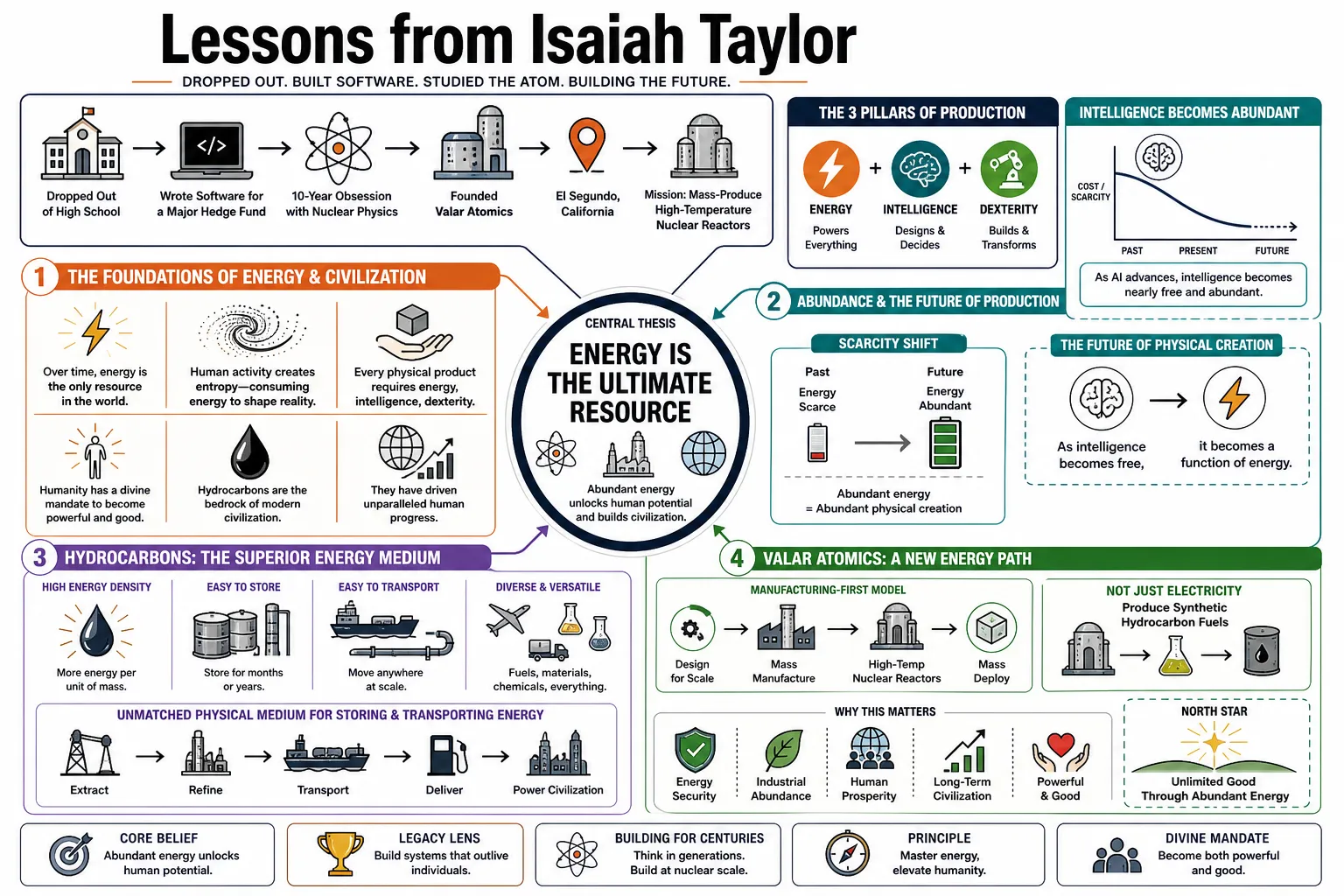
Part 1: The Foundations of Energy and Civilization
- On energy as the ultimate resource: "I would actually argue that over time, energy is the only resource in the world." — Source: podscripts.co
- On the creation of entropy: Human activity in the universe is fundamentally a process of creating entropy, consuming energy to transform the environment into what we desire. — Reference: podscripts.co
- On the three pillars of production: Every physical product requires a combination of three essential inputs: energy, intelligence, and dexterity. — Reference: podscripts.co
- On intelligence becoming abundant: As artificial intelligence advances, the intelligence component of physical production is becoming nearly free and abundant. — Reference: podscripts.co
- On the future of physical creation: "As intelligence becomes free, it actually just becomes a function of energy." — Source: podscripts.co
- On human potential: Humanity has a divine mandate to become both powerful and good, utilizing energy to achieve that end. — Reference: infinitedominion.substack.com
- On the role of hydrocarbons in history: Hydrocarbons have been widely misunderstood, yet they remain the bedrock of modern civilization and have driven unparalleled human progress over the last two centuries. — Reference: infinitefrontiers.io
- On energy transmission: Hydrocarbons are unmatched as a physical medium for storing and transporting energy around the globe. — Reference: infinitefrontiers.io
- On space as a canvas: With abundant energy and intelligence, space exploration becomes a necessary new canvas for human imagination and physical creation. — Reference: podscripts.co
Part 2: Reimagining Nuclear Power and Manufacturing
- On the failures of the nuclear industry: "The nuclear industry has gotten stuck. It’s become expensive and slow. I think the reason for that is because it’s been so tightly coupled with electricity production." — Source: infinitefrontiers.io
- On scaling production: The industry must move toward a single standardized reactor design constructed thousands of times, applying lessons from aerospace and automotive manufacturing. — Reference: valaratomics.com
- On hardware focus: "We are not focused on hardware iteration, we are focused on building the simplest and safest reactor that allows us to scale" — Source: startuphub.ai
- On theoretical versus practical costs: Engineers often chase high power density designs because they appear cheaper on paper, but practical construction costs rely heavily on whether a system can be built safely and efficiently. — Reference: infinitefrontiers.io
- On the SpaceX parallel: Building and manufacturing nuclear reactors at scale requires a similar mindset and operational model to SpaceX's approach to mass-producing rockets. — Reference: open.spotify.com
- On reactor sizing: A single 25-megawatt electric reactor is capable of powering a small town of roughly 15,000 residents. — Reference: podscripts.co
- On cost reduction targets: By mastering scalable manufacturing and mass production, nuclear energy costs could be driven down by a factor of ten. — Reference: startuphub.ai
- On returning to classic architectures: Gas-cooled, graphite-moderated reactors are an older design tracing back to Chicago Pile-2 that offer significant safety and efficiency advantages over widely used light water reactors. — Reference: infinitefrontiers.io
- On material costs vs. software: In the context of building physical infrastructure, steel and raw materials can be significantly cheaper than hiring armies of software engineers. — Reference: open.spotify.com
Part 3: The Gigasite Model and Synthetic Fuels
- On bypassing the grid: Instead of merely selling electricity to the power grid, nuclear energy should be directed toward producing globally traded physical commodities. — Reference: infinitefrontiers.io
- On synthetic fuel production: Nuclear reactors can be used to generate high-temperature heat to split water, yielding hydrogen that is then combined with captured CO2 to produce carbon-neutral gasoline and jet fuel. — Reference: infinitefrontiers.io
- On competing with oil: Valar aims to sell synthetic, carbon-neutral fuels directly into the existing oil and gas marketplace at prices competitive with refined crude, entirely without carbon subsidies. — Reference: infinitefrontiers.io
- On vertical integration: A significant advantage in the energy sector comes from internally integrating the manufacturing of reactors, the generation of hydrogen, and the production of synthetic fuels. — Reference: infinitefrontiers.io
- On the concept of the Gigasite: Grouping hundreds of nuclear reactors on large industrial campuses allows operators to amortize site security and environmental review costs across gigawatts of capacity. — Reference: chartercitiesinstitute.org
- On supplying heavy industry: Gigasites are uniquely suited to provide dedicated, uninterrupted power for advanced manufacturing, metal refining, and large-scale electrolysis. — Reference: chartercitiesinstitute.org
- On achieving a fundamental cost edge: A synthetic fuel refinery powered by proprietary nuclear reactors has a core cost advantage because its primary external input is cheap water, not crude oil. — Reference: infinitefrontiers.io
- On fulfilling immediate milestones: "Nine months ago, this was an empty site. Today, there's a critical reactor on it, built and operated by the Valar team. We met the milestone the executive order set. This reactor was built to make power, and that's exactly where we're headed." — Source: world-nuclear-news.org
Part 4: The Regulatory Landscape and Iterative Building
- On the illusion of paper safety: Iterating exclusively in software and on paper is a tempting trap, but physical prototyping is necessary to truly understand a reactor's practical engineering constraints. — Reference: open.spotify.com
- On speed as a safety mechanism: "building quickly and building iteratively and actually getting testing with a real thing gives you this element of safety that just designing on paper does not." — Source: chartercitiesinstitute.org
- On the meaning of safety: "Safety is non-negotiable, but also safe and slow are not the same thing" — Source: upstartsmedia.com
- On state-level regulation: The authority to regulate nuclear reactors should ideally reside at the state level, allowing regions like Texas, Utah, and West Virginia to iterate on their own regulatory methods. — Reference: chartercitiesinstitute.org
- On decentralized governance: Allowing individual states to test different regulatory regimes for nuclear energy aligns with the original vision of American federalism and accelerates overall innovation. — Reference: chartercitiesinstitute.org
- On objective regulation: Nuclear oversight should be source term-based and technology agnostic, focusing strictly on calculating worst-case scenarios for a specific volume of radioactive material. — Reference: chartercitiesinstitute.org
- On taking aggressive legal action: When federal bureaucracies stand in the way of necessary progress, bold companies must be willing to directly challenge them, as evidenced by Valar Atomics suing the Nuclear Regulatory Commission. — Reference: valaratomics.com
- On building rapidly: Valar constructed a 100,000-pound non-nuclear prototype test reactor in Los Angeles within a single year to gather real-world data and validate its structural theories. — Reference: chartercitiesinstitute.org
Part 5: Artificial Intelligence and Human Drive
- On powering the AI boom: Artificial intelligence infrastructure is currently driving unprecedented energy demand, requiring single data centers to consume upwards of a full gigawatt of power. — Reference: podscripts.co
- On grouping reactors for scale: To supply a gigawatt data center, energy providers can stack approximately 40 small modular reactors side-by-side on a unified campus. — Reference: podscripts.co
- On the national security imperative: Securing abundant energy for artificial intelligence is not merely a commercial opportunity; it is a critical national security requirement to prevent adversaries like China and Russia from taking the lead. — Reference: upstartsmedia.com
- On early personal investments: Taylor attributes his ambition and capability not to inherited wealth, but to his father's intensive investment of time, education, and attention. — Reference: podscripts.co
- On long-term dedication: Deeply technical breakthroughs rarely happen overnight; the foundation for his company was built over a decade of obsessive, independent research into the mechanics and economics of nuclear energy. — Reference: shawnryanshow.com
- On historic AI milestones: Valar Atomics achieved a historic milestone by becoming the first startup to power an NVIDIA Blackwell unit directly from a nuclear reactor. — Reference: open.spotify.com
- On the value of unreasonableness: Achieving paradigm-shifting results in hard tech requires founders to embrace unreasonable expectations and push past established industry boundaries. — Reference: open.spotify.com
Part 6: Safety Architecture and Industrial Abundance
- On rebuilding around current capabilities: When an economy is better at manufacturing than at megaproject construction, nuclear systems should be redesigned around repeatable factory production instead of preserving a 1960s civil-works model. — Reference: Rational Optimist Society transcript
- On earning the right to build bigger: Small reactors make early cycles faster and more repeatable; larger designs should come only after a manufacturing system has learned how to build many smaller units reliably. — Reference: Rational Optimist Society transcript
- On safety through geometry: Smaller cores have more surface area relative to their volume, making passive decay-heat removal more practical and reducing dependence on forced-cooling systems that can fail. — Reference: Rational Optimist Society transcript
- On distributing containment: TRISO fuel moves containment from one enormous concrete structure to ceramic shells around individual fuel particles, creating tiny barriers that tolerate high temperatures and resist damage. — Reference: Rational Optimist Society transcript
- On designing negative feedback: Graphite moderation makes reactor reactivity fall as temperature rises, while graphite's thermal inertia absorbs substantial post-shutdown heat before dangerous temperatures develop. — Reference: Rational Optimist Society transcript
- On avoiding dangerous phase changes: Helium remains a gas across operating conditions, does not become radioactive by capturing neutrons, and avoids the severe pressure spikes that water can create when it flashes into steam. — Reference: Rational Optimist Society transcript
- On compressing the learning curve: Meaningful manufacturing learning may begin after roughly five builds; keeping each unit small can compress those five cycles into a year instead of stretching them across decades. — Reference: Rational Optimist Society transcript
- On refusing to skip prerequisites: Commercialization cannot be reached by designing around prototypes and operational learning; teams have to build, test, discover failures, and earn competence step by step. — Reference: Rational Optimist Society transcript
- On cheap energy becoming cheap food: Lower-cost energy reduces the cost of hydrogen and ammonia, which can reduce fertilizer costs and ultimately make food production cheaper. — Reference: Rational Optimist Society transcript
- On industrial complementarity: A gigasite can allocate energy across electricity, hydrogen, process heat, metals, and fuels, letting adjacent industrial processes reinforce one another instead of treating power generation as an isolated product. — Reference: Rational Optimist Society transcript
- On making the physical world composable: Advanced manufacturing, robotics, cheaper energy, and more precise engineering can make physical creation increasingly modular and recombinable, more like building with software components. — Reference: Rational Optimist Society transcript
- On dexterity beyond humanoids: Flexible physical automation may matter more than copying the human form; the key is building systems that can manipulate matter precisely and adaptably under intelligent control. — Reference: Rational Optimist Society transcript