Ivan Burazin is a serial entrepreneur, the co-founder and CEO of Daytona, and the founder of the globally recognized Shift Conference. His career has been defined by a relentless focus on Developer Experience (DX), pioneering cloud-based IDEs with Codeanywhere, and now building the fundamental computing infrastructure for autonomous AI agents.
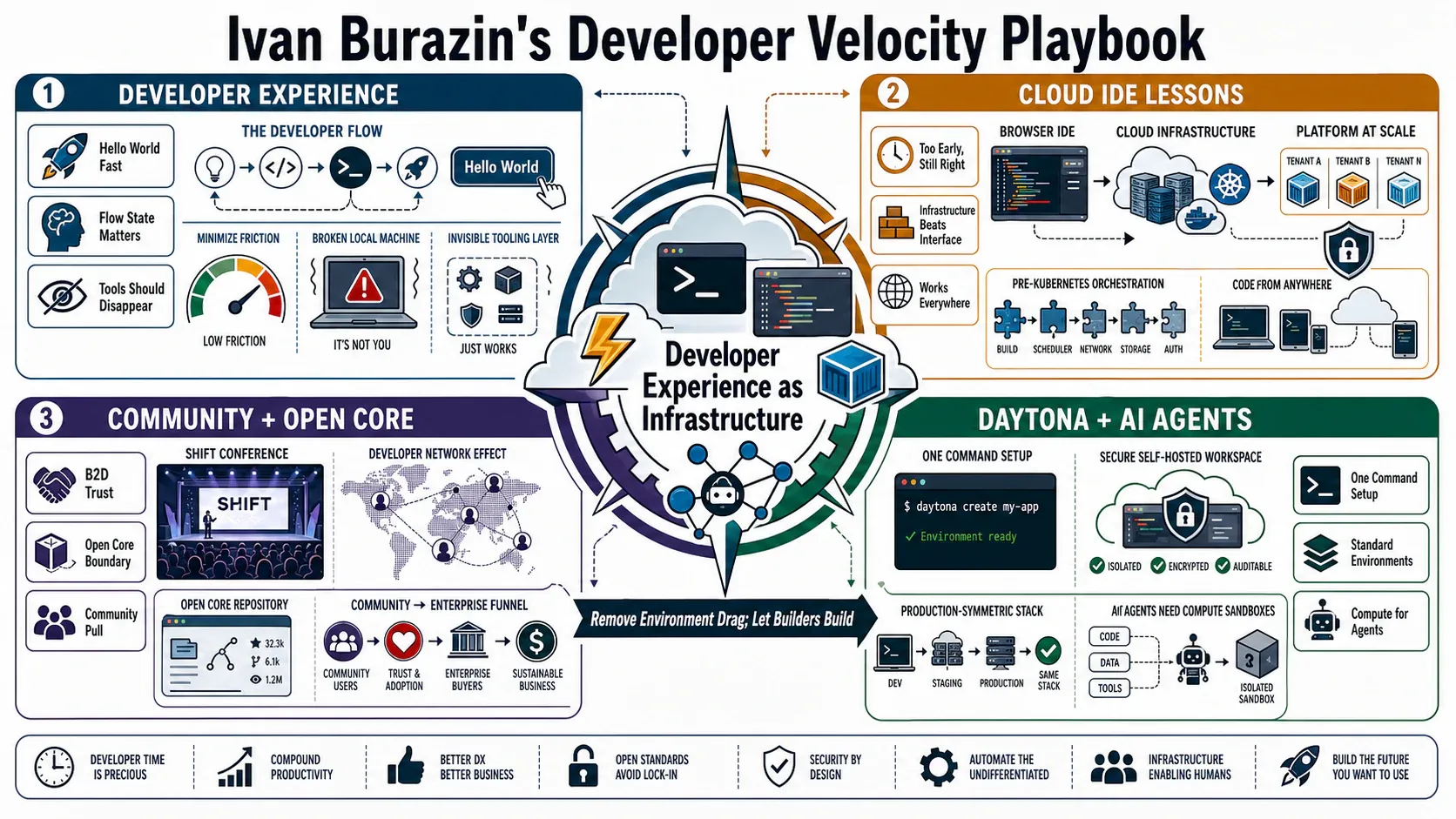
Part 1: The Foundations of Developer Experience (DX)
- On Developer Velocity: "Improving software development performance directly impacts business success; it is where developer velocity meets economic velocity." — Source: [Forbes]
- On the Definition of DX: "DX is essentially another layer to UX, a layer that only a developer using your tool can enjoy—or not enjoy, as is too often the case... when DX lacks, UX does, too." — Source: [Forbes]
- On the 'Hello World' Moment: "It should be the goal of any software provider to help developers reach their 'Hello World' moment as quickly and painlessly as possible. The longer it takes, the more likely they are to jump ship." — Source: [Forbes]
- On Developer Productivity Loss: "Developers waste around 56% of their productive time working around dev environment issues... if you get that productivity back, you're at co-pilot AI level of productivity." — Source: [Secrets of Tech Startup Success]
- On the 'Works on My Machine' Problem: "I'm sure you've all had this experience... it doesn't work, he says 'well works on mine, go figure it out.' And hence, waste your time." — Source: [Secrets of Tech Startup Success]
- On Internal vs. External DX: "There is a fundamental difference between internal DevEx—how efficiently a company's own engineers can work—and external DevEx, which dictates how easily outside developers can adopt your APIs." — Source: [Infobip]
- On Invisible Tooling: "In my opinion, developers should almost not see tools like Daytona at all. Rather, it just magically works in the background." — Source: [Daytona]
- On DX as a Business Driver: "A superior developer experience is not just a perk; it directly correlates with higher development velocity and fundamentally better customer outcomes." — Source: [Forbes]
- On Developer Happiness: "What actually affects an individual developer's day-to-day happiness is really productivity, almost that flow state that you think about." — Source: [Runtime News]
Part 2: Building and Scaling Codeanywhere
- On Being Too Early to Market: "When we founded Codeanywhere in 2009, long before VS Code or Docker, we had to build everything from scratch—the IDE, orchestration, and authentication—which preceded the market's readiness." — Source: [devtools.fm]
- On the True Value of Cloud IDEs: "While people liked the idea of a browser IDE, enterprises were actually more interested in the underlying infrastructure that automates development environments." — Source: [devtools.fm]
- On the Mission of Codeanywhere: "Our core mission was always to increase developer velocity by leveraging the cloud, allowing developers to code from any device." — Source: [Codeanywhere]
- On Developer Time Allocation: "We learned early on that developers spend a massive portion of their time—often over 50%—debugging their environments rather than actually writing code." — Source: [Secrets of Tech Startup Success]
- On Building Before Kubernetes: "We were trying to solve container orchestration and environment management years before Kubernetes became the industry standard." — Source: [devtools.fm]
- On Transitioning from Browser to Infrastructure: "The big takeaway from Codeanywhere that led to Daytona was realizing that developers want standard local IDEs like VS Code, but powered by cloud infrastructure." — Source: [The Craft of Open Source]
- On Early Cloud Adoption: "Pioneering the cloud IDE space meant constantly educating the market on why software creation needed to join the cloud." — Source: [Forbes]
- On Bootstrapping Innovation: "We had to solve complex technical hurdles like multi-tenant isolation long before modern cloud-native tools made it accessible." — Source: [devtools.fm]
- On the Evolution of Tooling: "If you are building developer tools, you have to constantly adapt; the transition from browser-centric to infrastructure-centric tooling was a necessary evolution." — Source: [Neuralab]
Part 3: The Power of Community and Shift Conference
- On Community Obligation: "I have a feeling that everyone who is successful has a need and obligation to bring something back to their community. This is SHIFT." — Source: [The Recursive]
- On the True Value of Conferences: "The content you can consume on a conference you can probably watch on YouTube on the flight home... the power is actually meeting the people." — Source: [Software Engineering Daily]
- On Founding Shift: "We started Shift in 2012 because we realized Croatia lacked a high-energy tech event, and we wanted to bring international speakers and investors to Split." — Source: [Neuralab]
- On Pivoting the Conference: "Shift started as a startup competition and conference, but in 2016 we pivoted to focus specifically on developers, which fueled its massive growth." — Source: [Neuralab]
- On the 'Vibe' of Events: "The energy of an event matters immensely; we focus heavily on the vibe—everything from the music to the stage design—to create a unique experience." — Source: [YouTube]
- On Connecting B2D (Business to Developer): "Running Shift helped me hone the ability to connect with a B2D audience by encouraging genuine, in-person connections within the developer community." — Source: [Infobip]
- On Giving Back: "Initiatives like providing free Codeanywhere accounts to CoderDojo kids, or building the Shift conference, stem from a core obligation to support the next generation." — Source: [Codeanywhere]
- On Local Ecosystems: "By bringing global industry leaders to Split, we provided local developers with access and networking opportunities they might not otherwise ever have." — Source: [Entrepreneur]
- On the Acquisition by Infobip: "Joining forces with Infobip in 2021 allowed Shift to scale globally, expanding our mission of community building to places like Miami." — Source: [Infobip]
Part 4: Entrepreneurship and Decision Making
- On Making Decisions: "I feel it's better to make a wrong decision than no decision at all, especially when you're leading other people. They expect you to know what you're doing... and it stops them from worrying." — Source: [The Kubelist Podcast]
- On Perseverance: "My company Shift... almost failed twice! But when you believe in your product—the only thing you can do is persevere." — Source: [Medium]
- On Product-Market Fit (PMF): "I've done multiple companies; I've never actually felt pure PMF which I think it is now [with Daytona]... where you have so much work and so much demand that you just can't finish the day." — Source: [EUVC Podcast]
- On Capital: "You shouldn't be receiving any more capital than you need. If you do, it will turn into a liability versus an asset down the line." — Source: [The Kubelist Podcast]
- On Opportunistic Action: "When all the stars align, you have to walk under them." — Source: [Daytona]
- On Learning from Failure: "Every near-failure in my career, from the early days of Shift to the technical hurdles of Codeanywhere, ultimately refined my approach to building products." — Source: [Medium]
- On Leading Teams: "Leadership in a startup requires projecting confidence and direction, even when the path forward is ambiguous." — Source: [The Kubelist Podcast]
- On Serial Entrepreneurship: "Building multiple companies teaches you that the mechanics of company building change, but the core requirement of solving a painful problem remains constant." — Source: [EUVC Podcast]
- On Recognizing True Demand: "True product-market fit isn't just about positive feedback; it's a visceral state where the market is pulling the product out of your hands faster than you can deliver." — Source: [Split Tech City]
Part 5: The Open Source Business Model
- On the Open Core Strategy: "We employ an 'Open Core' model to balance community-driven innovation with enterprise-grade security and monetization." — Source: [devtools.fm]
- On Differentiating Users and Buyers: "If you open source the entire enterprise product... it's useless to the individual developer. The only person it's useful for is someone in the enterprise. And that's the person you want to sell it to." — Source: [devtools.fm]
- On Protecting Revenue (The Elastic Problem): "We design our licensing so that companies like J.P. Morgan can use the open-source version internally, but hyperscalers like Amazon or Google can't just take it and launch a competing managed service." — Source: [Heavybit]
- On Community Value: "We do believe that open source is really important to get the community on board and to help them build these things." — Source: [devtools.fm]
- On Traction and Growth: "Launching our open-source version in early 2024 proved the immense demand, as we amassed over 3,000 GitHub stars within 48 hours." — Source: [Pulse 2.0]
- On Democratizing Access: "The base open-source product democratizes access for individual developers, fostering a grassroots ecosystem that drives organic enterprise adoption." — Source: [AlleyWatch]
- On Proprietary Enterprise Features: "Features that the actual enterprise buyer wants—such as advanced security, resource management, dedicated support, and compliance—are strictly kept proprietary." — Source: [devtools.fm]
- On Self-Hosting as a Differentiator: "A key advantage of our model is that the platform is designed to be self-hosted on a user's own infrastructure, providing the absolute control that large organizations require." — Source: [AlleyWatch]
- On Navigating Open Source Business: "Building a business around open source requires a clear, unambiguous boundary between what serves the community's workflow and what solves the enterprise's compliance and scaling headaches." — Source: [Heavybit]
Part 6: The Transition to Daytona and Standardized Environments
- On Empowering Developers: "Our goal with Daytona is simple: to empower every developer to be able to, with a single command, set up and start coding in an instant, scalable, and secure development environment." — Source: [Daytona]
- On the Need for Standardization: "The developer community needs and wants the standardization of development environments to eliminate the zero learning curve for new hires." — Source: [Daytona]
- On the Codespaces Alternative: "We built Daytona to act as a self-hosted, secure, and production-symmetric alternative to tools like GitHub Codespaces, specifically tailored for enterprise needs." — Source: [Y Combinator]
- On Peak Velocity: "By automating the entire environment setup process, companies can simultaneously achieve peak developer velocity and stringent security." — Source: [YouTube]
- On Environment Parity: "Daytona aims to solve the configuration drift problem by ensuring that every developer works in an environment that is perfectly identical to production." — Source: [JuliaLang]
- On IDE Flexibility: "A standardized environment manager must support any IDE—whether it's VS Code, JetBrains, or Vim—and deploy on any infrastructure." — Source: [Pulse 2.0]
- On Eliminating Friction: "Developers should spend their time writing business logic, not managing dependencies, configuring Docker containers, or debugging local networking issues." — Source: [Daytona]
- On Security and Compliance: "For enterprises, the ability to self-host development environments behind their own firewall is not a luxury; it is a hard compliance requirement." — Source: [Pulse 2.0]
- On 'Production-Symmetric' Code: "If your dev environment doesn't mirror your production environment exactly, you aren't really testing your code; you are testing your local machine." — Source: [Y Combinator]
- On the One-Command Philosophy: "The ultimate metric for onboarding a new developer is how quickly they can run `daytona create` and push their first commit." — Source: [Daytona]
Part 7: AI Agents and the Future of Computing
- On the Agentic Future: "We're going to go from people-majority to agent-majority... It's going to be like 90%." — Source: [Runtime News]
- On Agent Sandboxes: "Every single agent in the world will need a sandbox for every single task it's doing." — Source: [Runtime News]
- On Agent Computers: "I actually like to think of them as composable computers for agents... an AI agent is only as good as the machine it runs on." — Source: [Evil Martians]
- On Agent Scale: "I strongly believe the number of agents in the world will be the number of humans to the power of n." — Source: [YouTube]
- On Hardware Needs for Agents: "The agent should be able to at create time say: I need this many CPUs, I need this much RAM, I need this much disk... do I need a GPU... do I need a Linux machine, a Mac, or Windows?" — Source: [WorkOS]
- On Winning the AI Space: "The company that will dominate the AI coding agent space won't be the one that builds the best AI models. Instead, it will be the one that perfects the human interface and effectively manages the middleware." — Source: [Beehiiv]
- On Human vs. Agent Environments: "While humans tolerate 30-second spin-ups for their environments, autonomous agents require millisecond response times to function efficiently." — Source: [EUVC Podcast]
- On AI Independence: "Instead of theoretical suggestions, AI agents can now independently experiment, iterate, and solve complex coding challenges in real-time." — Source: [PR Newswire]
- On the 'Human Emulator': "When you give an agent a full digital identity inside a sandbox, complete with email and 2FA, it is literally equal to a remote person you're working with." — Source: [WorkOS]
- On Hardware Heterogeneity: "Production inference is moving toward heterogeneous hardware — no single chip type is optimal for every stage of an agentic workflow." — Source: [Financial Content]
Part 8: Developer Relations, Web3, and the Tech Ecosystem
- On Developer Relations: "DevRel is a helping hand when internally and externally communicating to developers, acting as a critical bridge between company culture and the community." — Source: [WeAreDevelopers]
- On Web3 Skills: "Developers should invest in Web3 skills because understanding decentralized application development is becoming a fundamental layer of modern tech architecture." — Source: [Forbes]
- On NFTs Beyond Hype: "NFT technology is revolutionizing creativity not through monkey business, but by fundamentally changing digital ownership and provenance." — Source: [Forbes]
- On Croatian Entrepreneurship: "My Croatian heritage fuels my entrepreneurial passion, providing a unique, resilient perspective on building global tech companies from Southeast Europe." — Source: [Entrepreneur]
- On Ecosystem Growth: "By nurturing the tech scene in Croatia through events and startups, we've helped put the region on the global map for serious software engineering." — Source: [Split Tech City]
- On the Dual Audience of Dev Tools: "Building developer tools is like selling children's toys: you need the parent (the developer/buyer) to choose the product and the child (the user/agent) to perform well inside it." — Source: [Evil Martians]
- On Developer Focus: "If you're building dev tools exclusively for humans today, you're building for the past; the future requires infrastructure that serves both human developers and AI systems." — Source: [YouTube]
- On Shifting Paradigms: "The transition from local machines to cloud IDEs to standardized environments to agentic computers represents a continuous quest to abstract away operational friction." — Source: [The Kubelist Podcast]
- On Building for Scale: "You must design your Developer Experience so that an individual contributor loves it, but a Fortune 500 CISO will approve it." — Source: [Pulse 2.0]
- On the Future of Coding: "We believe that AI will automate the majority of programming tasks in the future, changing the developer's role from writing syntax to orchestrating systems." — Source: [Bret Fisher Podcast]