John Ternus, Apple's Senior Vice President of Hardware Engineering, represents the modern paradigm of deep hardware-software integration. Known as an "engineer's engineer," his philosophy centers on making technology invisible to elevate the core user experience. Through his leadership during the Apple Silicon transition and his uncompromising approach to product durability, Ternus provides a masterclass in patient, user-centric engineering.
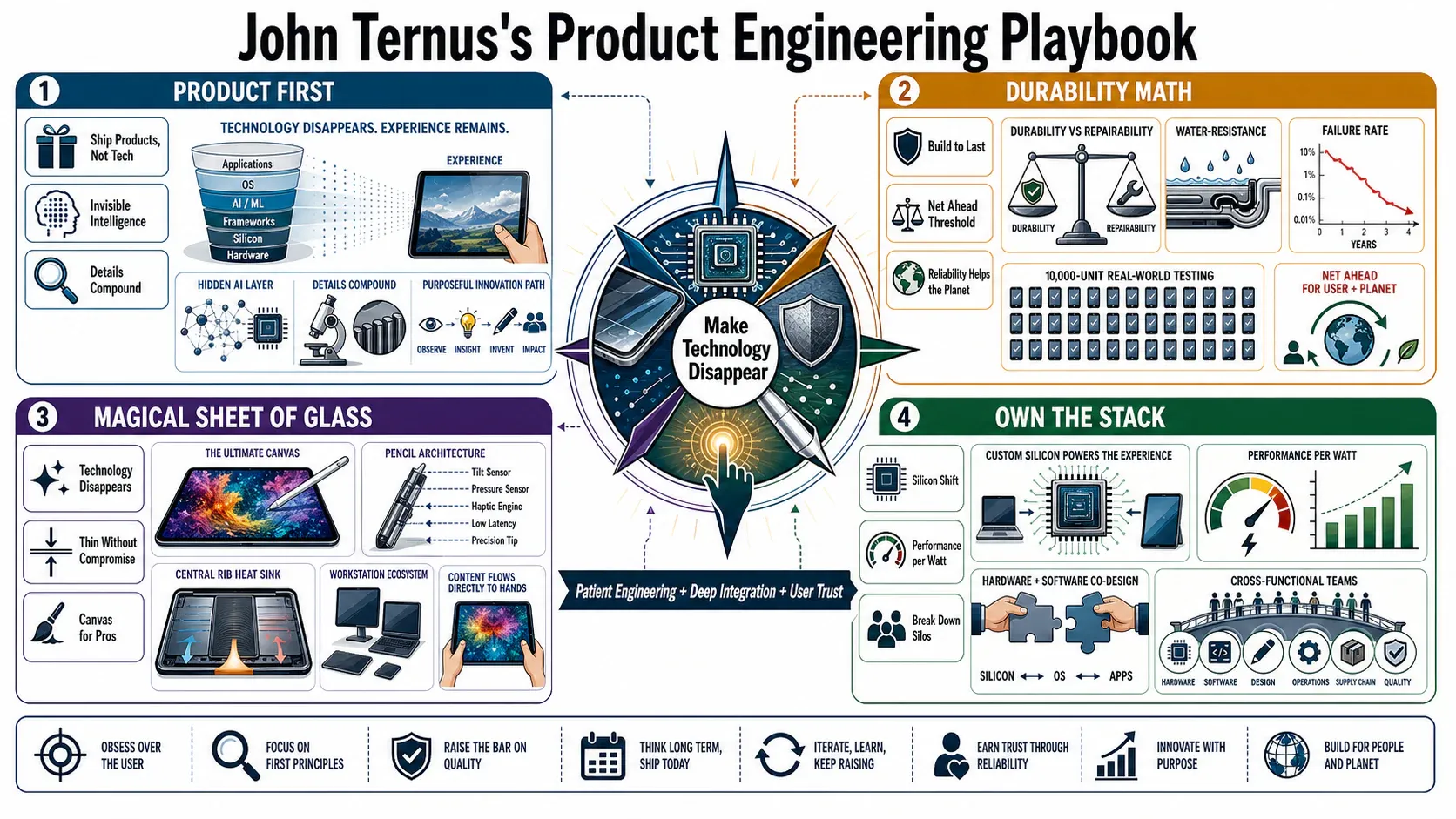
Part 1: The Product-First Philosophy
- On Invisible Technology: "I love it when those things are happening and somebody doesn’t even necessarily know that it’s AI. It’s just better." — Source: [thenextweb.com]
- On the True Goal of Engineering: "We never think about shipping a technology... we always think about how we can leverage technology to ship amazing products." — Source: [thenextweb.com]
- On User-Centricity: "We want the technology to come to you." — Source: [thenextweb.com]
- On Uncompromising Quality: A supplier's screw having 35 grooves instead of the specified 25 represents the stark difference between "excellence and compromise." — Source: [businessworld.in]
- On the Obsession with Details: Perfection hides in the granular details that users may never see; compromising on the invisible eventually compromises the entire product. — Source: [longbridge.com]
- On Purposeful Innovation: Technology is merely a tool to enable a specific experience, not an end in itself. — Source: [youtube.com]
- On Apple Intelligence: "If we’re doing it right, people won’t even really notice or think about it." — Source: [thenextweb.com]
- On Patience in AI Development: Developing foundational artificial intelligence is "a marathon, not a sprint." — Source: [thenextweb.com]
- On Practical AI Use Cases: The ultimate goal of AI integration is to "just make things you do better and easier." — Source: [thenextweb.com]
- On Focus and Hype: Don't chase chatbot hype; focus instead on solving specific hardware-software friction points. — Source: [thenextweb.com]
Part 2: Durability, Repairability, and Environment
- On the Ultimate Environmental Goal: "A product that never fails is obviously better for the customer—better for the environment." — Source: [techradar.com]
- On Repairability Context: "Repairability in isolation is not always the best answer... The goal is to build products that last." — Source: [appleinsider.com]
- On the Net Ahead Threshold: "You can actually do the math and figure out there's a threshold at which if I can make it this durable, then it's better to have it a little bit harder to repair because it's going to net out ahead." — Source: [wccftech.com]
- On Water Resistance: The push for IP68 water resistance—though making phones harder to open—significantly drove down the overall failure rate of iPhones. — Source: [indiatoday.in]
- On the Value of Reliability: "It's objectively better for the customer to have that reliability, and it's ultimately better for the planet." — Source: [wccftech.com]
- On Reducing Failures: Because of purposeful durability improvements, the failure rate for water damage has "plummeted." — Source: [wccftech.com]
- On Striking a Balance: "Designing the best, longest-lasting products in the world requires striking a balance between durability and repairability." — Source: [apple.com]
- On The Bookend Argument: Repairability is a "means to an end," with the ideal opposite bookend being a device that literally never breaks. — Source: [appleinsider.com]
- On Unseen Engineering Trade-offs: Extensive seals and adhesives are necessary to prevent environmental damage, making durability the logical priority over easy battery replacement. — Source: [indiatoday.in]
- On Rigorous Testing Standards: True reliability requires testing up to 10,000 pre-release units of a single model to ensure long-term durability. — Source: [9to5mac.com]
Part 3: The Magic of the iPad
- On the iPad Vision: "We’ve always had this vision of an iPad being this magical sheet of glass that allows you to interact directly with your content." — Source: [appleinsider.com]
- On the Ultimate Expression: The iPad Pro represents the "ultimate expression" of the platform's potential. — Source: [apple.com]
- On the Technology Disappearing: The goal is to create a device where "the technology disappears" and becomes a pure canvas for the user. — Source: [fastcompany.com]
- On Pushing Boundaries: "We were excited to do with this new iPad Pro is push the boundaries of how thin and light we could go without compromise." — Source: [fastcompany.com]
- On Professional Utility: "There is no more professional drawing application in the world than Procreate—I mean, they’re the lifeblood of artists." — Source: [appleinsider.com]
- On Redesigning the Pencil: Moving the front-facing camera meant the engineering team "had to come up with a completely new architecture" for the Apple Pencil Pro. — Source: [fastcompany.com]
- On Shrinking Components: To achieve structural goals, Apple reduced the Pencil's inductive charging solution to less than half its original size. — Source: [appleinsider.com]
- On Structural Integrity: A "central rib" in the incredibly thin iPad Pro acts as a heat sink and significantly improves the chassis' stiffness. — Source: [fastcompany.com]
- On Advanced Accessories: The Magic Keyboard and Apple Pencil are not just add-ons, but integral components necessary to create a high-performance workstation. — Source: [telecoms.com]
- On Unlocking Potential: The iPad's immense hardware capabilities were previously held back by phone-centric software, leading to the necessary creation of iPadOS. — Source: [zdnet.com]
Part 4: Apple Silicon and The Mac
- On the Apple Silicon Shift: The M-series transition stands as "one of the most successful platform shifts in computing history." — Source: [thenextweb.com]
- On Accessibility in Computing: "We saw an opportunity here to really just reach a lot, a lot more people than we ever have before." — Source: [9to5mac.com]
- On Product Pride: "We didn’t want to do it until we could do it really, really well, and build a Mac that we were proud of." — Source: [9to5mac.com]
- On Silicon Parity: "iPad Pro has always had the best Apple Silicon we make," ensuring absolute parity with the Mac line. — Source: [appleinsider.com]
- On Distinct Device Lanes: The focus is on making the "best Mac" and "best iPad" as distinctly separate experiences, avoiding compromises like a touch screen Mac. — Source: [appleinsider.com]
- On Owning the Stack: The transition to custom silicon allowed Apple to "own its primary technology stack" for the first time in modern history. — Source: [zdnet.com]
- On Performance Efficiency: The architecture of the M-series was driven by an uncompromising pursuit of maximum performance-per-watt across all tiers. — Source: [macworld.com]
- On Deep Integration: The true power of the modern Mac comes from a deeply ingrained philosophy of frictionless hardware-software integration. — Source: [pulse2.com]
- On the iPhone Evolution: "The all-new iPhone Air is so powerful, yet impossibly thin and light, that you really have to hold it to believe it's real." — Source: [thenextweb.com]
- On Foundational Shifts: Moving to Apple Silicon fundamentally shifted how the entire organization builds its most critical products. — Source: [zdnet.com]
Part 5: Leadership, Persistence, and The Future
- On Mentorship: "I have been lucky to have worked under Steve Jobs and to have had Tim Cook as my mentor." — Source: [thenextweb.com]
- On the Right Path Forward: "Never ask what I would do, just do the right thing." — Source: [financialexpress.com]
- On the Future: "I am telling you we are about to change the world once again." — Source: [theapplepost.com]
- On Enthusiasm: "This is the most exciting time to be building products and services at Apple in my entire career." — Source: [theapplepost.com]
- On Persistence Through Failure: "If you have the vision and you’re persistent and you keep working at it, you can take something that has a rocky start and turn it into something great." — Source: [tomsguide.com]
- On Problem Solving: Mistakes on the engineering floor should be viewed as "systemic rather than punitive." — Source: [youtube.com]
- On Fixing the Machine: Operational failures are leadership or process problems to be solved at the root, not individual engineer errors to be punished. — Source: [youtube.com]
- On True Collaboration: Actively breaking down historical silos between hardware and software teams is critical for building modern, cohesive products. — Source: [macworld.com]
- On Cross-Functional Advocacy: Hardware teams cannot work in a vacuum; they must actively lobby software teams to write code that unlocks new hardware potential. — Source: [macworld.com]
- On Upholding Core Values: "I promise to lead with the values and vision that have come to define this special place." — Source: [thenextweb.com]