Jack Butcher is a designer and entrepreneur who revolutionized digital communication through his minimalist brand, Visualize Value. By transitioning from a traditional agency career to a product-based solopreneur, he became a leading voice on permissionless leverage, visual communication, and Web3 culture. The following insights distill his philosophies on design, wealth creation, and building in public.
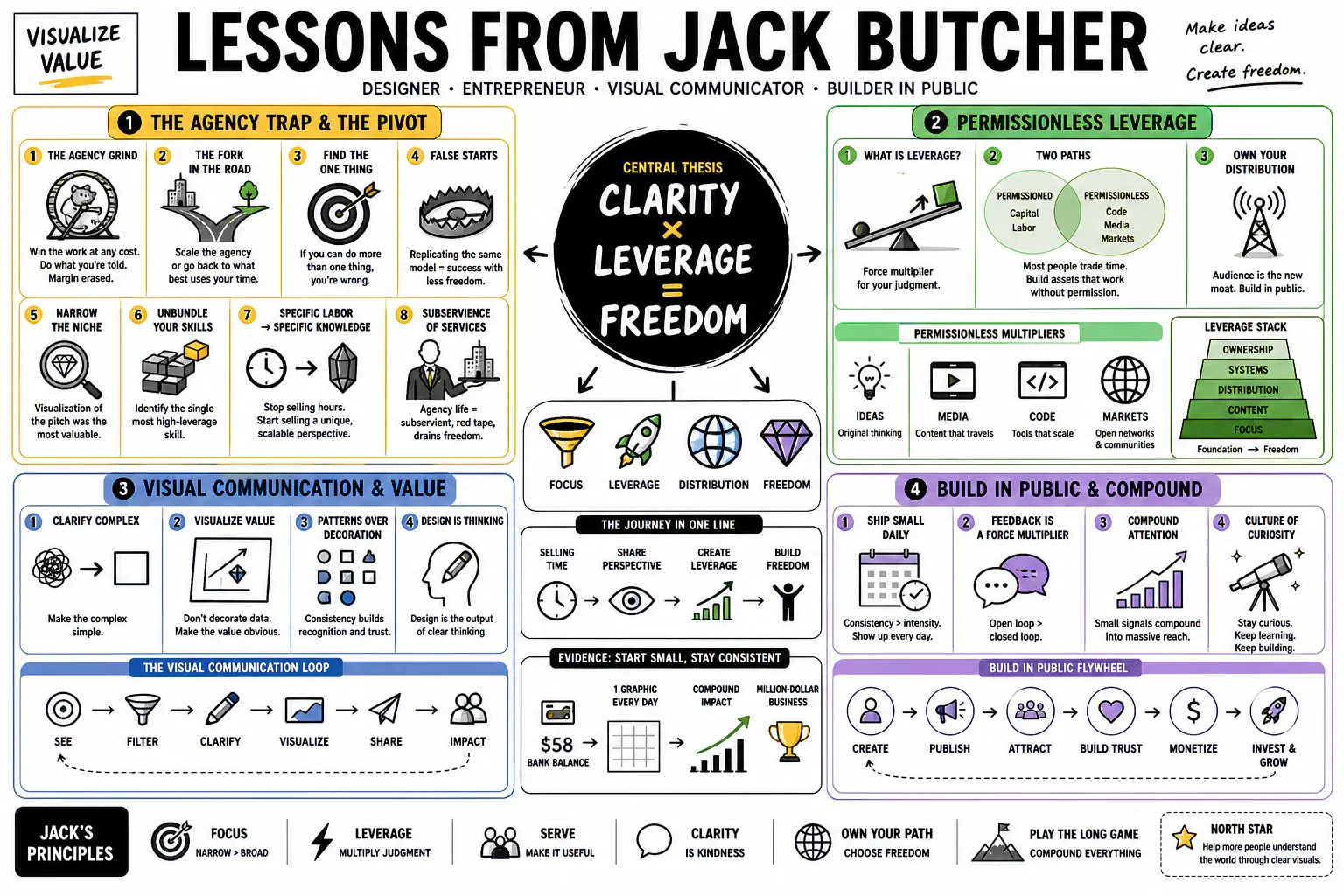
Part 1: The Agency Trap & The Pivot
- On the agency grind: "You just try and win the work at any cost, and then just do what you're told until basically, your margin is completely erased." — Source: The Business of Business
- On the fork in the road: "There's this fork in the road where you either hire people and get an office and do all the things that you need to do to serve corporate clients... or you go back to something that is very focused, and at the very least, the best use of my time." — Source: The Learning Leader Show
- On finding the one thing: "Once you do one thing, if you have a modicum of success, and you think you can do a second, third and fourth thing, you're wrong. You can't... if you're ever lucky enough to find it, never take for granted that one thing." — Source: The Learning Leader Show
- On false starts: "When transitioning from corporate, initially replicating the same model of selling time for money leads to a trap where success means less freedom." — Source: Medium
- On narrowing the niche: "The most valuable thing he did at agencies was the visualization of the pitch, not the full-stack execution. Focusing exclusively on 'visualizing value' changed everything." — Source: Growth in Reverse
- On unbundling your skills: "Identify the single most high-leverage skill within your broad job description and build a business entirely around that." — Source: Medium
- On specific labor vs. specific knowledge: "Transitioning out of the agency model requires moving from selling hours (specific labor) to selling a unique, scalable perspective (specific knowledge)." — Source: The Business of Business
- On the subservience of services: "Operating as a traditional agency often leaves you feeling subservient to corporate clients and bogged down by red tape." — Source: The Business of Business
- On starting small: "The transition to a million-dollar business began with a $58 bank balance and a commitment to publishing one simple graphic every day." — Source: The Business of Business
Part 2: Permissionless Leverage
- On the definition of leverage: "Leverage is a force multiplier for your judgment, specifically categorized into permissioned (capital, labor) and permissionless (code, media)." — Source: Medium
- On the leverage of the newly rich: "Code and media are the leverage of the newly rich because they have zero marginal cost of replication and work while you sleep." — Source: Mauricio Heck
- On removing gatekeepers: "You do not need anyone’s permission to write a line of code or create a piece of media; this fundamental shift democratizes wealth creation." — Source: Medium
- On permissionless apprenticeship: "Instead of asking a mentor for a job or advice, 'apprentice' in public by creating value for them without being asked." — Source: Kasia Manolas
- On compounding network effects: "Building things for people you admire and publishing them publicly builds your own brand while leveraging their existing audience." — Source: Kasia Manolas
- On infinite scaling: "While permissioned leverage scales linearly and is difficult to acquire, permissionless leverage scales exponentially and requires only a computer and internet." — Source: Medium
- On visual translation: "Taking complex philosophical and economic ideas and turning them into minimalist illustrations is a profound form of media leverage." — Source: Medium
- On proving the concept: "Using media to build a multi-million dollar business without a large staff or outside capital is the ultimate proof of permissionless leverage." — Source: Medium
- On giving value first: "Give so much away people insist on paying you." — Source: ZenQuotes
Part 3: Build Once, Sell Twice
- On the core philosophy: "'Build Once, Sell Twice' means creating a digital asset that solves a problem and selling it infinitely because it has zero marginal cost of reproduction." — Source: YouTube
- On productizing your process: "Instead of selling a commodity like 'design services,' sell the 'Operating System' or the curriculum behind how you work." — Source: Teachfloor
- On selling your sawdust: "Use the 'by-products' of your daily work—internal tools, checklists, or templates—and turn them into standalone products." — Source: Nathan Barry
- On testing ideas: "Make noise and listen for signal by using social media as a 'real-time laboratory.'" — Source: Medium
- On expanding winners: "Post micro-assets; if one resonates or goes viral, expand it into a comprehensive product like a workbook or course." — Source: Medium
- On decoupling time and money: "The transition from a service-based laborer to a product-based asset owner requires completely decoupling your income from the hours you work." — Source: YouTube
- On zero marginal cost: "Focus your energy exclusively on assets that run on code or media, where the cost to serve the next customer is essentially zero." — Source: Nathan Barry
- On hyper-niching: "Identify your unique 'hyper-niche' topic and build a personal brand around it through consistent visual repetition." — Source: Teachfloor
- On creating a curriculum: "Distill your unique skills into a high-quality digital curriculum that others can replicate." — Source: Teachfloor
- On the ultimate goal: "The ultimate goal of 'Build Once, Sell Twice' is scaling a one-person business to seven figures by leveraging the internet's reach rather than human headcount." — Source: Teachfloor
Part 4: Proof of Work & Publishing
- On degrees vs. output: "Nobody's ever cared about my degree... every interview I've gone to, every project I've gotten... has been because of the thing I did last." — Source: YouTube
- On demonstrating ability: "If you can design something, if you can make things, if you can write things, if you can code and build things, it's very easy for you to put work out into whatever digital environment you operate in." — Source: Substack
- On inbound opportunity: "When people can look at your public proof of work, they will naturally say, 'I want that, help me build that.'" — Source: The Business of Business
- On the purpose of writing: "Write to help yourself, publish to help others." — Source: YouTube
- On the power of a public record: "By consistently publishing high-quality visuals, you create a public record of your ability to think clearly, which exponentially increases your perceived value." — Source: Info Distillery
- On building in public: "Sharing the process of your work—sketches, drafts, logic—builds deep trust and unshakeable authority with your audience." — Source: Info Distillery
- On framing your work: "Never discount what you're doing prior to showing it to them. Frame it right. KNOW YOUR WORK." — Source: The Learning Leader Show
- On owning your story: "To maximize the impact of your proof of work, you must own the full interaction and presentation of your story." — Source: Substack
- On preparation: "Do your research and be prepared. That's how confidence is built. Be consciously competent about your work." — Source: ZenQuotes
- On opportunity creation: "How to get more opportunity: Create more opportunity for others." — Source: ZenQuotes
Part 5: Visualizing Value & Design Constraints
- On the TRAIN framework: "Effective visual communication relies on Typography, Restraint, Alignment, Image Treatment, and Negative Space." — Source: Gumroad
- On the power of constraints: "A creative constraint will be born out of those decisions [picking a style and sticking to it], rather than you spending 80% of the time picking typefaces and textures and color... those decisions eat up hours." — Source: YouTube
- On reducing noise: "The goal of visualization is to increase the 'signal' (the core idea) and aggressively decrease the 'noise' (unnecessary decoration)." — Source: Info Distillery
- On making one decision: "'Make one decision to save a thousand,' especially when it comes to limiting your palette to black, white, and gray to force better thinking." — Source: YouTube
- On shared visual references: "Humans process visuals much faster than text; simple shapes like a snowball rolling down a hill create an instant 'epiphany' that words often miss." — Source: Info Distillery
- On typography: "Choosing a single, clear font and utilizing size and weight is all you need to create perfect visual hierarchy." — Source: Gumroad
- On alignment: "Using invisible grids and strict relationships makes a design feel inherently stable, professional, and trustworthy." — Source: Gumroad
- On negative space: "Use 'white space' not as empty room, but as a deliberate tool to frame and emphasize the absolute most important part of the message." — Source: Gumroad
- On image treatment: "Treating all visual elements with a rigorously consistent style is what builds long-term brand equity and instant recognition." — Source: Gumroad
- On art vs. design: "Design as a process is finding an answer to a question; art is trying to ask a question." — Source: Substack
Part 6: Web3, NFTs & Digital Identity
- On the real value of Web3: "Web3's value is NOT in technology... The technology is enabling this new way for people to interact with a person... it's enabling a deeper connection to the network of this thing that you believe in." — Source: YouTube
- On the concept of Checks: "Checks is an infinite canvas for expression that is designed to challenge the concept of ownership and authorship in the age of the internet." — Source: Binance
- On capturing a cultural moment: "The intent behind Checks was to capture the shifting context of verification in a society increasingly dominated by electronic culture and communication." — Source: Substack
- On generative art experiments: "Opepen serves as a community-driven experiment in curation and abundance, exploring uniqueness and scarcity in Web3." — Source: NFT Now
- On collecting memes: "Collecting conceptual NFTs with deep emotional resonance or meme value is a far better long-term strategy than simply holding traditional profile pictures." — Source: DappRadar
- On dynamic mechanics: "Introducing a 'burn' mechanism in Checks allowed holders to destroy multiple NFTs for rarer versions, creating a participatory economic game." — Source: Bankless
- On "For the Culture": "Redirecting economic energy to massive ecosystem contributors demonstrates how Web3 can be used to unilaterally reward community builders." — Source: NFT Now
- On artifacts of technological shifts: "Digital art projects should be viewed as cultural artifacts that capture and critique the technological shifts happening in real time." — Source: YouTube
- On authentic community: "True Web3 community is built by being yourself unapologetically in public consistently." — Source: YouTube
Part 7: Failure, Feedback & Consistency
- On reframing failure: "When you view failure as feedback, you get more done. When you view failure as a finality, you get nothing done." — Source: ZenQuotes
- On the power of consistency: "You get healthily addicted to the power of consistency... going at something and tackling it again and again and again can produce value and that value can often be quite self-fulfilling." — Source: YouTube
- On the 1% rule: "You only figure out what the 1% is in hindsight... you can write 1,000 blogs, make 100 videos, build 10 products, and experience almost the entirety of the external upside at post 999." — Source: YouTube
- On learning from mistakes: "Failure is feedback. Learn from it and move on." — Source: ZenQuotes
- On iteration: "True mastery comes not from a single stroke of genius, but from the relentless iteration of putting reps in every single day." — Source: YouTube
- On enduring the dip: "You must be willing to endure the long, quiet periods of zero feedback before experiencing exponential compounding." — Source: YouTube
- On letting the market decide: "You cannot predict what will resonate; you must produce volume and let the market dictate what is valuable." — Source: Medium
- On trusting the process: "The friction of creation is eliminated when you establish a strict system and trust it unconditionally." — Source: YouTube
- On building habits: "The value of a daily publishing habit often outweighs the value of any individual piece of content you produce." — Source: YouTube
Part 8: Mindset, Pricing & Perspective
- On obviousness: "What's obvious to you isn't obvious to most people. Operate from this perspective and you'll help more people." — Source: ZenQuotes
- On naming: "A great name communicates the most information in the most compressed way. Generic names often indicate a generic perspective." — Source: Substack
- On the value of simplicity: "The most successful pitches and products aren't the flashiest, but the ones that make complex ideas look the simplest." — Source: Gumroad
- On charging for value: "When you shift from pricing based on hours to pricing based on the value of the outcome, your entire business model transforms." — Source: The Business of Business
- On unlearning corporate habits: "Becoming a successful independent creator requires actively unlearning the subservience and permission-seeking behaviors taught in corporate environments." — Source: The Business of Business
- On finding your perspective: "Your unique perspective is your most defensible asset; no one can compete with you on being you." — Source: Substack
- On the illusion of competition: "When you hyper-niche and operate from a place of specific knowledge, competition becomes irrelevant." — Source: Teachfloor
- On playing long games: "The transition from laborer to owner is fundamentally a shift from short-term transactional thinking to playing long-term compounding games." — Source: Medium
- On the democratization of creation: "The internet has removed all barriers to entry; the only thing standing between you and a global audience is your willingness to publish." — Source: Medium