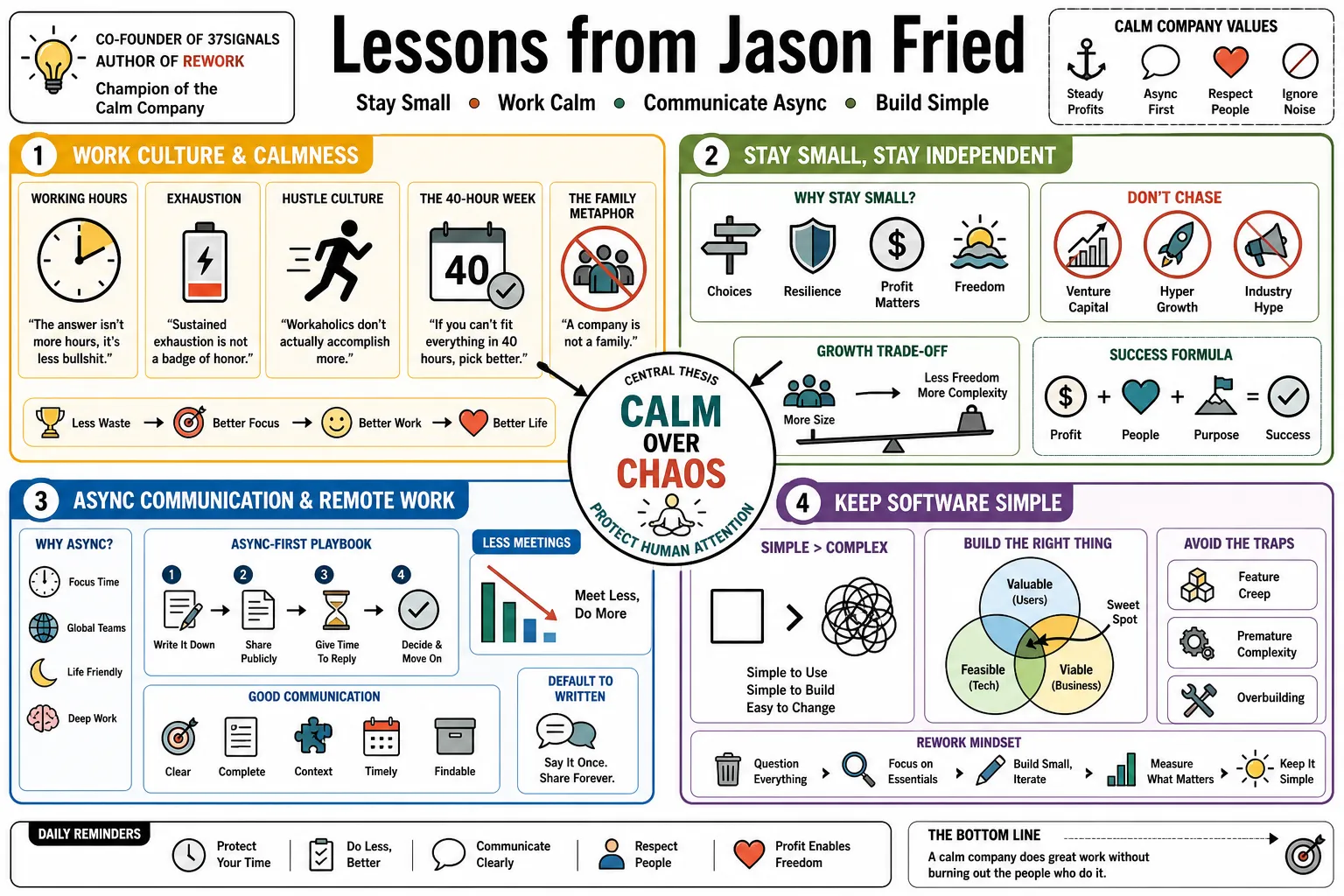
Lessons from Jason Fried
Jason Fried co-founded 37signals and wrote books like Rework to counter the tech industry's obsession with venture capital and frantic growth. He champions the "calm company" model, which relies on steady profitability and asynchronous communication to ruthlessly protect human attention. This profile gathers his practical arguments for intentionally staying small, running sane remote teams, and keeping software simple.
Part 1: Work Culture and Calmness
- On Working Hours: "The answer isn’t more hours, it’s less bullshit. Less waste, not more production." — Source: [It Doesn't Have to Be Crazy at Work]
- On Exhaustion: "Sustained exhaustion is not a badge of honor, it’s a mark of stupidity." — Source: [It Doesn't Have to Be Crazy at Work]
- On Hustle Culture: "Workaholics don't actually accomplish more than nonworkaholics. They may claim to be perfectionists, but that just means they're wasting time fixating on inconsequential details instead of moving on to the next task." — Source: [Rework]
- On The 40-Hour Week: "If you can’t fit everything you want to do within 40 hours per week, you need to get better at picking what to do, not work longer hours." — Source: [It Doesn't Have to Be Crazy at Work]
- On The Family Metaphor: "A company is not a family. It's a professional community. Calling it a family is often a manipulative way to demand unconditional loyalty and overtime." — Source: [It Doesn't Have to Be Crazy at Work]
- On Joy: "Comparison is the death of joy. Focus on your own pace, your own profit, and your own people." — Source: [It Doesn't Have to Be Crazy at Work]
- On Work Ethic: "A great work ethic isn’t about working whenever you’re called upon. It’s about doing what you say you’re going to do, putting in a fair day’s work, respecting the work, and not being a bottleneck." — Source: [It Doesn't Have to Be Crazy at Work]
- On Company As Product: "Your company is a product. Yes, the things you make are products, but your company is the thing that makes those things. That’s why your company should be your best product." — Source: [It Doesn't Have to Be Crazy at Work]
- On Calmness: "Calm is a competitive advantage. Chaos looks energetic, but it’s wasteful." — Source: [It Doesn't Have to Be Crazy at Work]
Part 2: Meetings and Time Management
- On The Office: "A busy office is like a food processor—it chops your day into tiny bits. Fifteen minutes here, ten minutes there, twenty here, five there." — Source: [Rework]
- On Attention: "Time and attention are very different things. While people often say there’s not enough time, remember that you’ll always have less attention than time." — Source: [It Doesn't Have to Be Crazy at Work]
- On The Cost of Meetings: "Remember, there’s no such thing as a one-hour meeting. If you’re in a room with five people for an hour, it’s a five-hour meeting." — Source: [Rework]
- On Meeting Value: "Meetings should be like salt—a spice sprinkled carefully to enhance a dish, not poured recklessly over every forkful. Too much salt destroys a dish." — Source: [Rework]
- On Distractions: "Taking many people’s time should be so cumbersome that most people won’t even bother to try it unless it’s really important." — Source: [Signal v. Noise]
- On Meeting Participants: "Meetings often include at least one moron who inevitably gets his turn to waste everyone's time with nonsense." — Source: [Rework]
- On Real-Time Expectations: "In almost every situation, the expectation of an immediate response is an unreasonable expectation." — Source: [It Doesn't Have to Be Crazy at Work]
- On Productivity Hacks: "Time-management hacks, life hacks, sleep hacks... rearranging your daily patterns to find more time for work isn’t the problem. Too much shit to do is the problem." — Source: [It Doesn't Have to Be Crazy at Work]
- On Quiet Time: "Long stretches of alone time are when you're most productive. Interruption is not collaboration, it's just interruption." — Source: [Remote: Office Not Required]
- On Taking Walks: "When feeling overwhelmed or stuck, taking a long walk on a new route forces the mind to engage with the outside world and reset." — Source: [The Tim Ferriss Show]
Part 3: Product Design and Simplicity
- On Constraints: "Embrace constraints. It's when you're boxed in that you're forced to make tough decisions. You probably won't have enough time, people, or money. These are good things!" — Source: [Getting Real]
- On Feature Requests: "The default answer is always no. Every feature request that comes in to us — or from us — meets a no. We listen but don't act. The initial response is 'not now'." — Source: [Getting Real]
- On Problem Solving: "When you solve your own problem, the light comes on. You know exactly what the right answer is. If you're solving someone else's problem, you're constantly stabbing in the dark." — Source: [Getting Real]
- On Utility vs. Innovation: "Innovation isn't the goal. Useful is the goal. If you can be useful and innovative, then that's especially great. But useful first." — Source: [Getting Real]
- On Polish: "Leave the poetry in what you make. When something becomes too polished, it loses its soul. It seems robotic." — Source: [Rework]
- On Completion: "The design is done when the problem goes away." — Source: [Founders Podcast]
- On Adding Steps: "Simple is a tricky word. To us, it just means clear. That doesn't always mean total reduction, or minimalism—sometimes, to make things clearer, you have to add a step." — Source: [Signal v. Noise]
- On Good Enough: "Knowing when to embrace Good Enough is what gives you the opportunity to be truly excellent when you need to be." — Source: [Signal v. Noise]
- On Editing: "Getting to great starts by cutting out stuff that's merely good." — Source: [Rework]
- On Scope: "If you can't fit everything in within the time and budget allotted then don't expand the time and budget. Instead, pull back the scope." — Source: [Getting Real]
Part 4: Bootstrapping and Business Independence
- On Raising Capital: "What people don't realize is when you raise money, you don't really work for yourself anymore. You work for someone else's schedule, for someone else's fulfillment, for someone else's return." — Source: [Practical Founders]
- On Company Size: "Small is not just a stepping-stone. Small is a great destination itself." — Source: [Rework]
- On Staying Alive: "A business without a path to profit isn't a business. It's a hobby." — Source: [Rework]
- On Valuation: "A valuation is an invented number that ebbs and flows on the basis of how much someone else thinks you're worth, and is nothing more than a distraction." — Source: [Signal v. Noise]
- On Agility: "Big companies cannot do small things. Once you get to a certain size, you can no longer do the small things." — Source: [Signal v. Noise]
- On Cost Control: "Your real competition isn't other companies, but your own costs. If you keep costs low, you have the freedom to stay in business indefinitely." — Source: [Practical Founders]
- On Exits: "A company that's trying to stay in business operates fundamentally differently from a company that's trying to go out of business via an acquisition." — Source: [Mixergy]
- On Industry Norms: "If you pay attention to Twitter and LinkedIn you think everyone's raising money. Most companies are bootstrapped. That is actually the norm." — Source: [Mixergy]
- On Problem Avoidance: "We’ve built our business on avoiding problems. Whenever we make big decisions, we make them in the context of future cost. Basically, how much will things suck later if we do this today?" — Source: [Signal v. Noise]
Part 5: Asynchronous Communication and Remote Work
- On Remote Trust: "If you can't let your employees work from home out of fear they'll slack off without your supervision, you're a babysitter, not a manager." — Source: [Remote: Office Not Required]
- On Performance Evaluation: "When you can't see someone all day long, the only thing you have to evaluate is the work." — Source: [Remote: Office Not Required]
- On Missing Out: "People should be missing out! Most people should miss out on most things most of the time. That's what we try to encourage at Basecamp. JOMO!" — Source: [The Tim Ferriss Show]
- On Group Chat: "Following group chat at work is like being in an all-day meeting with random participants and no agenda." — Source: [It Doesn't Have to Be Crazy at Work]
- On Asynchronous Collaboration: "The big transition with a distributed workforce is going from synchronous to asynchronous collaboration. Real-time sometimes, asynchronous most of the time." — Source: [Remote: Office Not Required]
- On Face Time: "The scarcity of face time in remote working situations makes it seem that much more valuable. And as a result, people don't waste the time." — Source: [Remote: Office Not Required]
- On Urgency: "If it's important, slow down." — Source: [It Doesn't Have to Be Crazy at Work]
- On Library Rules: "The office should function under library rules—a quiet, respectful environment where interruptions are minimized and focus is protected." — Source: [It Doesn't Have to Be Crazy at Work]
- On Solitude: "The ability to be alone with your thoughts is, in fact, one of the key advantages of working remotely." — Source: [Remote: Office Not Required]
Part 6: Writing and Communication
- On Hiring Writers: "If you are trying to decide among a few people to fill a position, hire the best writer. Clear writing is a sign of clear thinking." — Source: [Rework]
- On Software as Marketing: "Marketing is something everyone in your company is doing 24/7/365. Every word you write on your website is marketing. If you build software, every error message is marketing." — Source: [Rework]
- On Abstractions: "The problem with abstractions like reports and documents is that they create illusions of agreement. A hundred people can read the same words, but in their heads, they're imagining a hundred different things." — Source: [Getting Real]
- On Customer Service: "The best feature of a product is actually its customer service. It speaks directly to how you value the people using it." — Source: [Founders Podcast]
- On Persuasion: "The ability to communicate ideas clearly and persuade others is essential for leadership and collaboration, making writing today's currency for good ideas." — Source: [Getting Real]
- On Product Voice: "Your product has a voice — and it's talking to your customers 24 hours a day." — Source: [Getting Real]
- On Saying No: "No is a precision instrument, a surgeon’s scalpel, a laser beam focused on one point. Yes is a blunt object, a club, a fisherman’s net that catches everything indiscriminately." — Source: [It Doesn't Have to Be Crazy at Work]
- On Empathy in Copy: "A helpful, clear error message builds trust; a cryptic one destroys it." — Source: [Rework]
- On Listening: "Dismissing an idea is so easy because it doesn't involve any work. The hard thing to do is protect it, think about it, let it marinate. Give it five minutes." — Source: [Signal v. Noise]
Part 7: Decision Making and Execution
- On Ideas: "Ideas are cheap and plentiful. The real question is how well you execute." — Source: [Rework]
- On Decisiveness: "Whenever you can, swap 'Let's think about it' for 'Let's decide on it.' Commit to making decisions. Don't wait for the perfect solution. Decide and move forward." — Source: [Rework]
- On Temporary Decisions: "If circumstances change, your decisions can change. Decisions are temporary." — Source: [Rework]
- On Planning: "Working without a plan may seem scary. But blindly following a plan that has no relationship with reality is even scarier." — Source: [Getting Real]
- On Action: "What you do is what matters, not what you think or say or plan." — Source: [Rework]
- On Shipping: "You can only iterate on something after it's been released. Prior to release, you're just making the thing. So if you want to iterate, ship." — Source: [Getting Real]
- On Selective Ignorance: "Avoiding industry news, trends, and social media prevents your thoughts from being colored by what everyone else is doing, making it easier to follow your own intuition." — Source: [The Tim Ferriss Show]
- On Future Problems: "Don't waste time on problems you don't have yet. Do you really need to worry about scaling to 100,000 customers today if it will take you two years to get there?" — Source: [Getting Real]
- On The Judo Solution: "Find a judo solution, one that delivers maximum efficiency with minimum effort. When good enough gets the job done, go for it." — Source: [Rework]
Part 8: Management and Trust
- On Micromanagement: "When you treat people like children, you get children's work." — Source: [Rework]
- On Bureaucracy: "When everything constantly needs approval, you create a culture of nonthinkers." — Source: [Rework]
- On Setting Goals: "Goals are often set by a past version of yourself for a future version you haven't met yet. Instead, focus on doing the best job possible in the current situation." — Source: [The Tim Ferriss Show]
- On KPIs: "Avoid setting revenue targets or growth KPIs. Focus on making the product better and staying profitable, and let growth be a side effect of doing good work." — Source: [The Tim Ferriss Show]
- On Self-Sufficiency: "Never hire anyone to do a job until you've tried to do it yourself first." — Source: [Rework]
- On Stoicism: "You only have control over your reactions to external events. Use this to stay calm during business challenges or public criticism." — Source: [The Tim Ferriss Show]
- On Team Structure: "Maintain small teams to prevent 'learned helplessness' in large organizations. A two-person rule for features prevents unnecessary complexity." — Source: [Founders Podcast]
- On Parenting and Paths: "Avoid applying 'Do X or else' pressure on children. It’s more important for them to explore, build self-awareness, and find their own path rather than a predetermined track." — Source: [The Tim Ferriss Show]
- On Cycle Times: "Work in fixed time cycles, like six weeks. If a project can't be done in that time, it's usually too big and needs to be broken down or simplified. Fixed time, flexible scope." — Source: [It Doesn't Have to Be Crazy at Work]
- On Competitor Obsession: "Worrying about the competition quickly turns into an obsession. Focus on your own product and your own customers." — Source: [Rework]