Lessons from Jeff Skoll
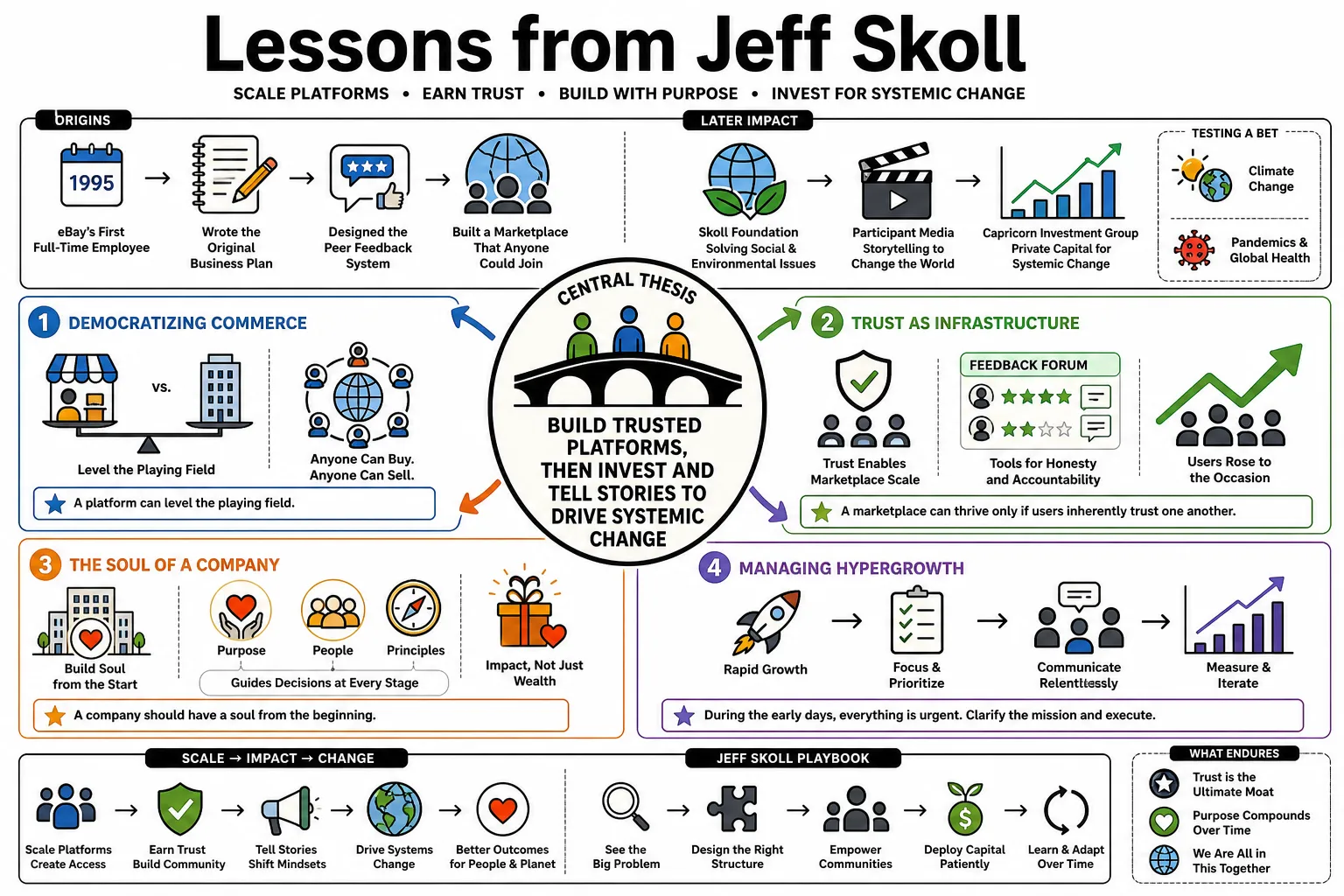
Jeff Skoll was eBay’s first full-time employee and president, writing the original business plan and helping design the peer feedback system that made the marketplace work. He later directed his fortune into the Skoll Foundation, Participant Media, and Capricorn Investment Group to test whether private capital and mass storytelling could actually solve crises like climate change and pandemics. This collection breaks down his approach to scaling early internet platforms and structuring investment firms to fund systemic change.
Part 1: The Foundations of Scale
- On Democratizing Commerce: "We realized early on that a platform could level the playing field, allowing a small-town collector to compete on the same footing as a large corporation." — Source: [Stanford Social Innovation Review]
- On Trust as Infrastructure: "A marketplace can thrive only if users inherently trust one another. We built the Feedback Forum to give people the tools to be honest and accountable, and they rose to the occasion." — Source: [Wikipedia]
- On the Soul of a Company: "A company should have a soul from the beginning, rather than waiting until it is wealthy to start giving back." — Source: [Celebrity Net Worth]
- On Managing Hypergrowth: "During the early days when the site would crash under its own success, I learned that technical and operational scalability must preempt your long term ambition." — Source: [The Guardian]
- On Founder Transitions: "As a company grows into a multi-billion dollar public entity, it requires a different kind of leader. You must learn to hire for the next stage of the lifecycle." — Source: [Forbes]
- On Community Narrative: "The true story of our growth was never about the technology itself. It was the narrative of people helping people, which drove organic, viral adoption." — Source: [Influence Watch]
- On Early Philanthropy: "I convinced the team to allocate pre-IPO stock to create a foundation in 1998 because social impact and profitability are not mutually exclusive from day one." — Source: [The Giving Pledge]
- On Applying Rigor to Good: "The most effective way to address global problems is to apply the exact same entrepreneurial rigor we used to scale the internet to complex social issues." — Source: [Skoll Foundation]
- On Human Nature: "If you give people an environment where reputation matters, the vast majority will choose to do the right thing." — Source: [Grokipedia]
- On Strategic Foresight: "Writing the first formal business plan taught me that without a map, rapid scaling is just a fast path to systemic failure." — Source: [Stanford Business Magazine]
Part 2: The Social Entrepreneur
- On Defining the Social Entrepreneur: "A little bit of good can turn into a whole lot of good when fueled by the commitment of a social entrepreneur." — Source: [Quote Fancy]
- On Maximizing Happiness: "I became a social entrepreneur to maximize my own happiness. Because nothing gave me more happiness than helping someone get out of poverty." — Source: [PBS]
- On Systemic Change: "The world's leading social entrepreneurs pursue system-changing solutions that permanently alter existing patterns of activity." — Source: [Socioeco]
- On Shared Drive: "Social entrepreneurs come from all levels of society. They all share the same underlying drive and passion to see their ideas through." — Source: [Stanford Social Innovation Review]
- On the Role of Business Skills: "Business skills, when well applied, can do more than make money. They can potentially make money and do some real good, which is immensely satisfying." — Source: [AZ Quotes]
- On Outsized Impact: "I like to support causes where a lot of good comes from a little bit of good, where the positive social returns vastly exceed the amount of time and money invested." — Source: [AZ Quotes]
- On Silicon Valley's Responsibility: "With our abundance of talent and resources, we have the opportunity to be the leaders of social change and, ultimately, this may be our greatest contribution." — Source: [AZ Quotes]
- On Boldness: "I admire the sheer guts and moxie of social entrepreneurs who make outrageous requests to change the world." — Source: [Skoll Foundation]
- On Unlikely Origins: "Social innovators emerge from every community, armed with a refusal to accept broken systems." — Source: [Skoll Foundation]
- On Enduring Commitment: "True social entrepreneurship requires a lifelong dedication to dismantling the mechanics of inequality." — Source: [Forbes]
Part 3: Philanthropic Architecture
- On Wealth as Fuel: "Financial success simply provided me with the fuel to tackle existential threats on a global scale." — Source: [The Giving Pledge]
- On Tikkun Olam: "I am guided by the concept of tikkun olam, the obligation to repair the world and address the deep fractures in society." — Source: [Celebrity Net Worth]
- On Individual Power: "Not everyone can be Gandhi, but each of us has the power to make our own lives count, and it is those millions of lives that will ultimately build a better world." — Source: [Quote Fancy]
- On Redefining the Timeline: "The old model was to learn in your 20s, earn in your 40s, and return in your 60s. We need to learn, earn, and return all at the same time." — Source: [Santa Clara University]
- On Resource Allocation: "I don't see philanthropy as a simple cash transfer. It is a calculated resource allocation to an area we know well during an emergency." — Source: [Forbes]
- On Galvanizing Opinion: "My mission through philanthropy and media is to galvanize world opinion to confront problems that are simply too large for any single government." — Source: [The Guardian]
- On The Philanthropist's Obligation: "Those who have benefited the most from our economic systems have an urgent obligation to reinvest in the communities that sustained them." — Source: [The Giving Pledge]
- On Portfolio Approaches to Good: "You need different tools for different timelines. Some foundations focus on long term systemic change, while others must be designed for urgent interventions." — Source: [Stanford Social Innovation Review]
- On the True Definition of Giving: "Philanthropy is all about making a positive difference in the world by devoting your resources and your time to causes you believe in." — Source: [AZ Quotes]
- On Taking Risks for Good: "To truly succeed in making a positive difference, it is important to think outside the box, take risks, and be an entrepreneur in how you give." — Source: [Quote Fancy]
Part 4: Capital as a Tool for Impact
- On the Double Bottom Line: "We want to prove that investing in solutions to global problems can be just as profitable, if not more so, than traditional investing." — Source: [ImpactAlpha]
- On Impact Alpha: "Sustainability and social mission go beyond ethical choices; they are active drivers of superior financial performance." — Source: [Forbes]
- On the Totality of Assets: "Investors should want to deploy capital in places where you will see the return from a double bottom line standpoint across their entire portfolio." — Source: [ImpactAlpha]
- On Early Bets: "Backing companies like Tesla early on was a deliberate strategy to show that transformative environmental tech is highly bankable." — Source: [Forbes]
- On Rejecting the Trade-off: "There is a persistent myth that to do good you must sacrifice financial returns. We built our investment strategy to definitively disprove that." — Source: [London Business School]
- On Market Forces: "You cannot rely entirely on non-profit grants to save the world. You have to harness the scale and speed of private capital markets." — Source: [Capricorn Investment Group]
- On Aligning Wealth: "Managing a fortune shouldn't mean isolating it from your values. The money itself should be working toward the world you want to see." — Source: [The Giving Pledge]
- On Patience in Capital: "Impact investing requires patience. The most transformative technologies, whether in renewable energy or healthcare, take time to reach commercial viability." — Source: [Stanford Social Innovation Review]
- On Influencing Wall Street: "Bridging the gap between traditional venture capital and philanthropy helps pressure the broader financial industry to consider the social consequences of their term sheets." — Source: [Forbes]
Part 5: The Power of Story
- On the Role of Entertainment: "To most people, entertainment is escapism. My goal was to use the power of movies and include important messages while ensuring they remain entertaining." — Source: [The Guardian]
- On Avoiding Preachiness: "If a film isn't well-told and relies too heavily on preaching, audiences will simply click away, regardless of how important the issue is." — Source: [Influence Watch]
- On Measuring Film Success: "Everything I put into Participant, I didn't expect to get back. I expected the money to be refunneled to do more films and more projects with social value." — Source: [Influence Watch]
- On Overcoming Industry Skepticism: "When I arrived in Hollywood, they told me the surest way to turn a large fortune into a small one was to start a film studio. We had to prove them wrong through quality." — Source: [Stanford Magazine]
- On the Impact Campaign Model: "A movie should never end when the credits roll. We release films alongside organized action campaigns to drive real-world policy changes and public awareness." — Source: [Washington Post]
- On the Unique Identity of Participant: "We succeeded in creating something truly one of a kind: an impact media company with a double bottom line." — Source: [Washington Post]
- On the Speed of Narrative: "A story well told can accelerate social change much faster than a traditional non-profit grant." — Source: [Skoll Foundation YouTube]
- On Media Distribution Shifts: "Revolutionary changes in how content is created, distributed, and consumed ultimately forced us to close Participant, but the legacy of the impact model remains." — Source: [Washington Post]
- On the Subversiveness of Story: "You have to embed the medicine in the popcorn. The storytelling has to be the primary hook." — Source: [The Guardian]
Part 6: Existential Threats
- On the Race Against Time: "On urgent threats like climate change, clean drinking water, pandemics, nuclear proliferation, and conflict, we are racing against the clock." — Source: [PBS]
- On Unnatural Disasters: "These global threats are effectively wholly unnatural disasters driven by human activity, which require a unified response." — Source: [Skoll Foundation]
- On Pandemics and Preparedness: "I hoped Contagion would warn the world about the potential dangers of a global pandemic and build support for funding organizations like the CDC." — Source: [Mans World India]
- On the Nature of Disease: "There are so many zoonotic viruses that jump over from animals to humans. If anything, the world is on watch now, but early detection is everything." — Source: [Mans World India]
- On Game Over Scenarios: "I created a separate Global Threats Fund to address issues that were moving so quickly they could reach a game over state within five to ten years." — Source: [Stanford Social Innovation Review]
- On Collective Survival: "The only way we are going to survive as a species is to pull together in our collective self-interest. We are fighting for our collective future, not for national pride." — Source: [Skoll Foundation YouTube]
- On the Ultimate Trophy: "The trophy we are playing for isn't market dominance; it is a sustainable world of peace and prosperity for everyone, everywhere." — Source: [Skoll Foundation YouTube]
- On Water Scarcity: "Access to clean water is a foundational security threat. When regions run out of water, it triggers cascading failures in public health, agriculture, and geopolitical stability." — Source: [Stanford Social Innovation Review]
- On Limiting Institutional Life: "We designed the Global Threats Fund as a limited-life organization to force immediate, aggressive action and spend out its capital against the most pressing timelines." — Source: [Influence Watch]
Part 7: Systemic Solutions
- On Technological Catalysts: "Technology is an unprecedented social catalyst. Six out of seven people on the planet now own a mobile phone, enabling everything from remote diagnosis to mobile banking." — Source: [Skoll Foundation]
- On Reducing Poverty: "Poverty rates are falling in every developing region. We actually have the potential to bring extreme poverty to zero within a single generation." — Source: [Skoll Foundation YouTube]
- On Climate Optimism: "Our job on climate change is by no means done. But I have never been more optimistic that not only will we survive, but we will thrive." — Source: [PBS]
- On Reminding the Public: "We wanted to provide an update on what happened with the climate crisis and remind people that there are solutions at hand. There is actually a lot of good news." — Source: [PBS]
- On Government Cooperation: "We are finally seeing major governments recognize the effectiveness of social entrepreneurship and integrating these models into their public policy." — Source: [Skoll Foundation]
- On the Role of Nations: "Looking at America, which has so much wealth yet deep rooted problems, gives countries like Canada an opportunity to step up and be on the world stage for climate leadership." — Source: [IESE Business School]
- On the Team Sport of Change: "Social change is a team sport. It requires the cooperation of many minds, crossing borders and political divides." — Source: [Forbes]
- On Nuclear Proliferation: "Reducing the threat of nuclear weapons remains one of the most vital, yet under-discussed, prerequisites for ensuring humanity has a future to build." — Source: [Stanford Social Innovation Review]
- On Bridging Divides: "In an increasingly polarized world, the global community of social entrepreneurs reminds us of our shared humanity and our capacity to collaborate." — Source: [Skoll Foundation YouTube]
Part 8: The Personal Compass
- On Writing Your Epitaph: "Imagine the words that you want written about you on your tombstone. Do they say that you did something special to make the world a better place?" — Source: [Santa Clara University]
- On Establishing a Life Lens: "Once you know what you want written on that stone, you have created the lens from which you can make every decision in your life." — Source: [Santa Clara University]
- On Course Correcting: "If a decision that you are about to make gets you further away from the words on that stone, then maybe it isn't the best decision." — Source: [HKSEF]
- On Choosing the Moonshot: "Don't wait to contribute to social good. Challenge yourself to tackle a moonshot like climate change or water scarcity as the primary work of your life." — Source: [Santa Clara University]
- On Resilience: "The people who truly change things are trailblazers who possess a resilient refusal to accept the world as it is." — Source: [Skoll Foundation YouTube]
- On Convening Minds: "It is vital to foster a global meeting of minds, bringing together those bold enough to see broken systems and dare to fix them." — Source: [Skoll Foundation]
- On Recognizing Strengths: "Determine where your specific skills like coding, storytelling, or capital allocation can apply maximum force to a human problem." — Source: [Forbes]
- On Urgency over Ego: "The problems we face are too large for personal ego. We must fund the best ideas, regardless of where or who they come from." — Source: [Skoll Foundation]
- On the Ultimate Goal: "If we are successful, the ultimate legacy isn't a thriving foundation or a profitable fund, but a world that no longer requires either." — Source: [Stanford Social Innovation Review]