Jim Balsillie is the former co-CEO of Research In Motion (RIM, ‘BlackBerry’) and currently chairs the Council of Canadian Innovators (CCI) and the Centre for International Governance Innovation (CIGI). He joined RIM in 1992. He earned an MBA from Harvard Business School in 1989 and a Bachelor of Commerce from the University of Toronto in 1984. I was interested in learning more about Jim Balsillie because of the rise and fall of RIM and his stance on innovation in Canada.
Leadership, Judgment, and Personal Discipline
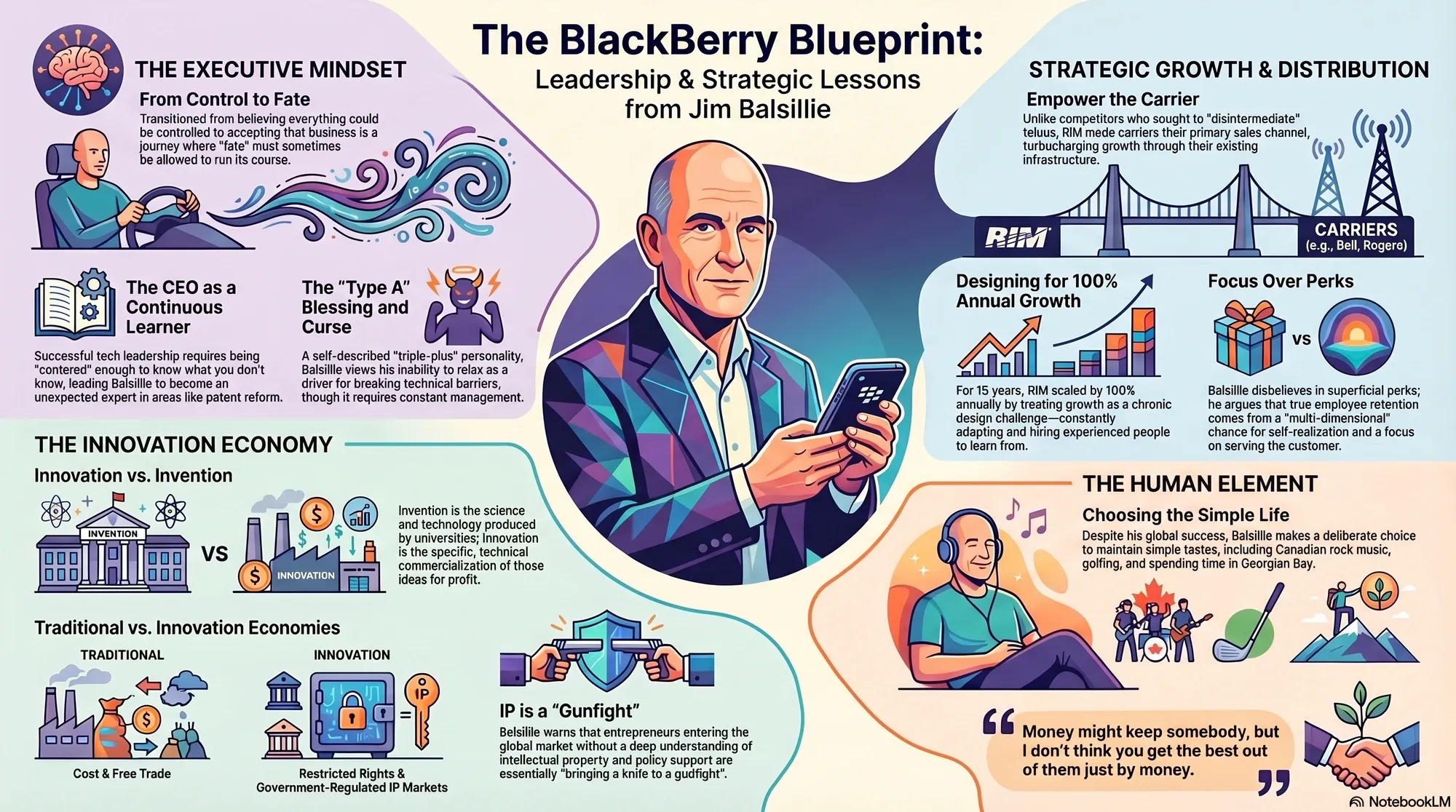
- On Agency and Fate: "Jim Balsillie was never one to believe in fate. Life for him was a journey, not a destination, and the particular stops along the way were always a function of free will. All things could be controlled, Balsillie believed. And then he lost his job as executive vice-president and chief financial officer of a $70M technology contractor based in Kitchener-Waterloo, Ontario. He was 31, and a new father. “I wasn’t scared,” he qualifies. “But I was anxious. When you come from a simple background, trusting how business and your place in it will evolve doesn’t come naturally because you didn’t grow up knowing and understanding it.” But faith in fate doesn’t demand the same kind of attention. And it was fate that took over for Jim Balsillie at this point in his life. As a trial, Balsillie did some work with Waterloo, Ontario-based Research in Motion for a couple of months. At the time, the company was in a financial pinch, and required Balsillie’s decision and his investment dollars to loosen the death grip. “I thought it was a fair investment deal and a reasonable shareholder’s agreement,” Balsillie recalls of the day he said goodbye to control and introduced himself to fate. “So you just close your eyes, put your money in and it disappears in a heartbeat. And there’s no getting it out.”
- On Letting Fate Run Its Course: "Balsillie’s biggest thrill comes with breaking the technical barriers that are constantly being re-adjusted in his business. “It’s a high-growth field that’s always exhilarating and dynamic.” This self-confessed “Type A, triple-plus personality,” who is now a father of two, says his inability to relax is both a blessing and a curse. But he’s grateful to have at least overcome his compunction to control his whole world. “Fate,” he sighs, “sometimes has to be allowed to just run its course.”
- On Knowing What You Know: “You have to be ready with what comes. You’ve got to be passionate and interested. For instance, I never in my wildest dreams thought I would be an expert on patent reform. And yet now I’m testifying before Congress with the Commissioner of the Patent Office. You also have to stay centred and aware enough to know what you do know and what you don’t know. Thatand knowing not to put yourself in the equation are probably the things that I’m pretty good at.”
- On Motivation Beyond Money: “Money might keep somebody, but I don’t think you get the best out of them just by money. We have all the normal compensation mechanisms, but it’s really part of a broader package. People want a chance to realise themselves ultimately, and realising yourself is many-dimensional. I’m not a big believer in perks, because I tend not to be consumptive by nature. We just keep our heads down innovating BlackBerries and selling them and servicing them . . . Round here we don’t check stock markets. It’s amazing how happy you can be if you’re focused on advancing the company and serving your key constituencies.”
- On Choosing a Simpler Life: "Like millions of others, I too own a “CrackBerry,” as his habit-forming devices are known. Nonetheless, I’m caught in this spell: normal 43-year-old guy who’s been married 15 years to the same woman, has two kids and is juking his way through a quintessentially Canadian weekend. “I make a continuous and deliberate choice to lead a simpler life,” he tells me. It helps that his tastes are simple. “I know what things I like,” he says, then lists them: “Canadian rock, Georgian Bay, golfing when I can.”
Scaling Companies and the Innovation Economy
- On Empowering Distribution Partners: “The kings in our game are the [telco] carriers. They’re the channel, they’re the big bill, they brand, they avail, they care, they invest: It is their business. There is a sentiment that they are being disintermediated and knocked down the food chain. But the one very unique thing about RIM is our strategic belief that you must empower the carrier and you must catalyze their ascent up the food chain, not accelerate their demise, through disintermediation, down the food chain. We took our customers, gave them to the carriers - the Bells, Rogers and Teluses of the world - and made the carriers our sales channel,” Balsillie says. “That was a big, big shift. We now have the carriers and their thousands of salespeople and points of presence pushing our products, and that’s largely what’s been turbocharging our business over the last two years.”
- On Designing for Growth: “We’ve been growing at or close to 100% a year for 14 or 15 years. So this is no different. There are new issues and there are issues that are chronic. We’re designed to grow, we’re designed to scale. You plan for it. You keep adapting. You keep bringing in people who have experience and learn from them. Learn and adapt. If we’re not growing, something’s wrong.”
- On Innovation Versus Invention: “The word “innovation” is used in so many contexts that it has almost lost all meaning. When you talk about creating an innovation economy, what are you referring to? Innovation is a very specific thing: the commercialization of ideas across all industries and sectors. It’s a technical, specific, agreed upon economic definition. And we’ve had so much punditry and posturing by people in this country that they’ve taken what is a very specific, technical and surgical concept and made it broad and general. We’ve had catastrophic confusion about innovation for other things. For instance, science and technology is what universities do. That’s invention. Innovation is getting money for ideas. When we confuse those buckets, innovation gets diluted. And we wonder why Canada has had zero growth outputs in innovation over the past 30 years.”
- On Banks for the Scaling Cycle: A stable banking system can still underserve innovative companies when its institutions lack the mandates, risk models, and financing tools required across the full scaling cycle. — Jim Balsillie's 2026 Senate follow-up brief on SME growth capital
- On Financing Every Growth Stage: Domestic ownership is easier to retain when matching capital and co-investment mechanisms support companies throughout the investment cycle instead of disappearing at the growth stage. — Jim Balsillie's 2026 Senate follow-up brief on SME growth capital
- On Retaining Talent During Shocks: Economic crises can become opportunities to reverse brain drain when governments deliberately connect displaced graduates with domestic innovators. — House of Commons testimony on Canada’s pandemic recovery
- On Diversifying Through Products: A country does not truly diversify by selling the same commodities to more places; it diversifies by developing distinctive products that can enter global value chains. — House of Commons testimony on Canada’s pandemic recovery
- On Digital Policy Infrastructure: In a knowledge economy, productivity depends less on shovel-ready physical projects than on policy infrastructure for intellectual property, data, standards, and global value chains. — House of Commons testimony on Canada’s pandemic recovery
- On Crisis-Driven Structural Change: A crisis can compress changes that would normally take years into months, creating a narrow window to redesign institutions and strengthen innovative companies. — House of Commons testimony on Canada’s pandemic recovery
Intellectual Property and Commercialization
- On IP as Public Policy: “Intellectual property (IP) has been on Balsillie’s mind for years. When he ran RIM in the 2000s, he travelled constantly, making sure the company’s IP was locked down and protected in countries that turn a blind eye to patent theft. “Anyone growing a tech company is extensively involved in public policy,” he says. “I learned that.” Intellectual property [IP] works on a principle of restricted rights or constraints—essentially, government-granted monopolies. The government makes the market for ideas and IP. It’s the exact opposite of free trade and of the traditional economy. You only have a market if the government’s there. And you only have a market that advances prosperity if CEOs and the policy community are talking.”
- On Updating Economic Policy: “We’re stuck with 19th- and 20th-century economic policies for prosperity, and we use policies for traditional economies and inaccurately jumble them with innovation. Traditional industries, like resources, agriculture and manufacturing, compete on a cost basis. The government’s job is to create infrastructure and really get out of the way and allow the movement of free trade. Innovation economies function in the opposite fashion of free trade. They’re absolutely, diametrically opposed. We have not updated our policy thinking since the 1980s. Getting money for ideas and managing restriction systems is a very precise, technical and surgical exercise. We’ve had a bunch of failed policies and outcomes. When they didn’t work, the narrative of the policy community—unsubstantiated by any facts—was to say Canadians have a lack of fire in the belly. We’re not outward looking. Too complacent. They say all this stuff and they make it up, because their orthodoxy didn’t work out. If you don’t teach CEOs how the game is played, if you don’t mentor them, if you don’t have an ecosystem that supports the game, how do you expect anybody to scale? When you tell your entrepreneurs that it’s a hands-off, free market out there, you’re sending them to a gunfight with a knife.”
- On Owning Before Opening: Open science requires an appropriation strategy first: knowledge cannot be deliberately shared on open terms unless its creator has secured the rights needed to make that choice. — House of Commons testimony on research commercialization
- On Stewarding IP Over Its Full Life: Patent strategy is not a one-time filing; it requires expert institutions that manage filings, licensing, education, and stewardship for years. — House of Commons testimony on research commercialization
- On Integrating IP, Data, and Algorithms: Innovation policy should manage the interdependence of intellectual property, data, and algorithms instead of treating each as a separate technical domain. — House of Commons testimony on research commercialization
Investment, Spillovers, and Strategic Control
- On Extractive Innovation Investment: Foreign direct investment that once transferred industrial knowledge inward can work in reverse in the innovation economy, extracting intellectual property and data. — House of Commons testimony on modernizing the Investment Canada Act
- On Measuring Spillovers: The importance of a knowledge-economy transaction should be judged by its spillover effects, not merely by the size of the company or assets being acquired. — House of Commons testimony on modernizing the Investment Canada Act
- On Control as Leverage: Ownership of intellectual property and control of data determine who may use them and on what terms, making control itself a source of economic and strategic leverage. — House of Commons testimony on modernizing the Investment Canada Act
- On Protecting Strategic Assets: If an asset is critical to national prosperity, security, or sovereignty, preserving control matters regardless of whether the foreign buyer is state-owned, authoritarian, or privately held. — House of Commons testimony on modernizing the Investment Canada Act
- On Looking Beyond Jobs: Jobs alone are an incomplete test for innovation investment because the largest consequences may arise from knowledge ownership, scarce skills, security, and downstream economic effects. — House of Commons testimony on modernizing the Investment Canada Act
- On Pricing Public Spillovers: Private parties negotiating an intellectual-property or data transaction will not automatically price the wider public consequences into their contract. — House of Commons testimony on modernizing the Investment Canada Act
AI, Privacy, and Democratic Governance
- On Privacy as Affordability Policy: Privacy governance is also economic policy because detailed personal data enables opaque individualized pricing that raises household costs. — Jim Balsillie's 2026 Senate remarks on privacy and affordability
- On Protecting Consumer Surplus: When surveillance lets a seller know each buyer's maximum willingness to pay, the seller can appropriate the value that transparent competition would have left with the consumer. — Jim Balsillie's 2026 Senate remarks on privacy and affordability
- On Algorithmic Monopsony: Data and market power can suppress wages when dominant platforms use opaque algorithms to estimate the minimum compensation an individual worker will accept. — Jim Balsillie's 2026 Senate remarks on privacy and affordability
- On Privacy as a Human Right: Framing privacy as a human right creates a stronger standard than balancing consumer protection against a company's claimed commercial interests. — Jim Balsillie's 2026 Senate remarks on privacy and affordability
- On Sovereign AI Infrastructure: Rules for artificial intelligence cannot be designed independently of computing capacity, sovereign infrastructure, safety, and national prosperity. — House of Commons testimony on artificial intelligence regulation
- On High-Consequence Technology: When a technology affects multiple jurisdictions and groups with potentially conflicting rights, speed should not substitute for getting the framework right. — House of Commons testimony on artificial intelligence regulation
- On Personalized Political Advertising: Because personalized advertising can manipulate individual autonomy, election rules should treat it as a democratic risk rather than ordinary commercial speech. — House of Commons testimony on online election interference
- On Human Commodification: Business models that capture and trade personal experience can impose costs far beyond privacy, including harms to mental health, democracy, social cohesion, and economic dynamism. — National Post on the costs of the digital economy
- On Machine Knowledge as Production: Artificial intelligence is not merely another software tool; machine knowledge is becoming a structural factor of production that can reshape industries and labour markets. — National Post on the costs of the digital economy
Sources for the original lessons
- Canadian Business. Fall 2016, Vol. 89 Issue 12, p38-40. 3p. 1 Color Photograph.
- CA Magazine ; Toronto Vol. 130, Iss. 2, (Mar 1997): 6,7.
- CA Magazine ; Toronto Vol. 133, Iss. 4, (May 2000): 20-26.
- Financial Post Business ; Toronto (Nov 2006): 32-37.
- Financial Times ; London (UK) [London (UK)] 26 Jan 2007: 12.
- Maclean’s ; Toronto (May 2019).
- National Post Business ; Toronto (Apr 2004): 12-13.
- Report on Business Magazine Vol. 21, Iss. 7, (Feb 2005): 10-12.