Jim Farley leads Ford Motor Company through the shift to electric vehicles and rising global competition. A lifelong car enthusiast, he manages 180,000 employees and the engineering and software overhaul of a legacy manufacturer. These lessons cover his approach to organizational structure, product development, and the human side of leadership.
Part 1: Leadership and People Management
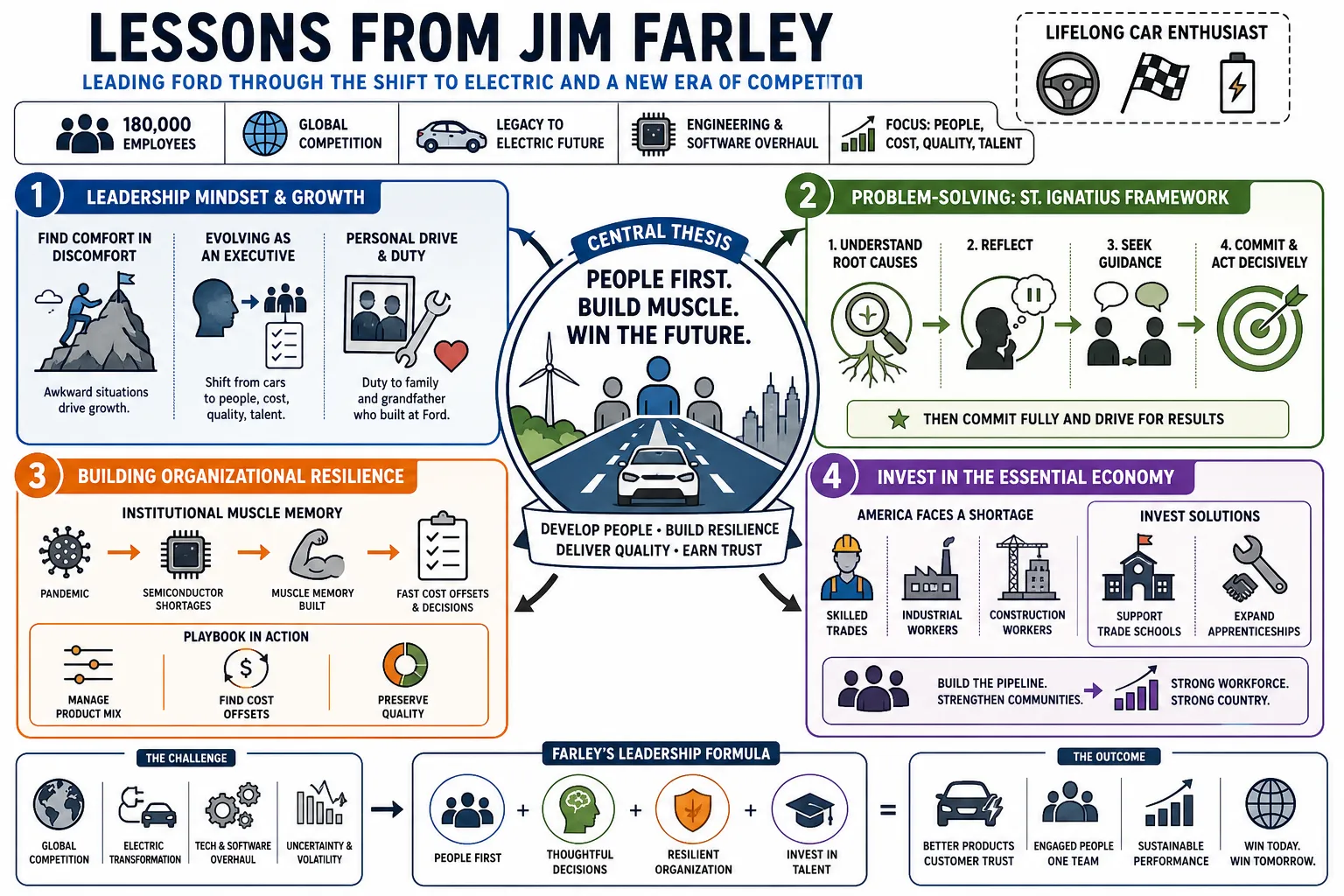
- On problem-solving: Farley relies on a St. Ignatius framework when confronting challenges, which involves understanding root causes, reflecting, seeking guidance, and then committing decisively. — Reference: Georgetown University
- On finding comfort in discomfort: "I have a philosophy of putting yourself in as many awkward situations as possible and growing through your overwhelming situation." — Source: Car and Driver
- On evolving as an executive: Though he entered the industry as a car enthusiast, he realized that successfully leading a massive corporation requires shifting focus away from the physical products and toward developing people and managing cost, quality, and talent. — Reference: Haslam College of Business
- On institutional resilience: When facing global uncertainty or supply chain stress, Ford relies on organizational muscle memory built during past crises like the pandemic and semiconductor shortages to quickly find cost offsets and manage product mix. — Reference: Ford Motor Company
- On the essential economy: He notes a growing vulnerability in America's labor force due to a severe shortage of skilled trade, industrial, and construction workers, advocating for stronger support for trade schools and apprenticeships. — Reference: DRIVE Podcast
- On personal drive: He views his work as a way to fulfill a duty to his family and his grandfather, who started working at a Ford factory in 1913 as employee number 389. — Reference: Spotify Newsroom
- On the reality of success: After speaking with highly accomplished individuals, he observed that very few felt destined for greatness. Instead, they all faced doubts and failures, proving that purpose and passion matter more than certainty. — Reference: Spotify Newsroom
Part 2: Navigating the EV Transition
- On overcoming legacy assumptions: Engineers initially struggled with early EV design because they relied too heavily on internal combustion paradigms, leading to overly complex wiring and expensive battery choices compared to clean sheet competitors. — Reference: Car and Driver
- On misreading the pandemic market: "COVID totally was a false signal." — Source: Car and Driver
- On organizational restructuring: To aggressively scale electric vehicles while maintaining a profitable internal combustion business, Farley split operations into distinct but cooperative units to operate with the speed of a startup alongside traditional industrial mastery. — Reference: Ford Motor Company
- On learning from the used market: To accurately gauge consumer behavior and future demand, he monitors the used car market closely. Its larger size and lower price points offer a more reliable predictor of long term trends than new car sales. — Reference: Masters of Scale
- On the appeal of affordable EVs: Higher fuel prices have driven consumer interest toward electric and hybrid models, but the market heavily favors truly affordable options over expensive luxury models. — Reference: Masters of Scale
- On powertrain strategy: Rather than creating a sprawling lineup of complex new nameplates, the electrification strategy prioritizes offering customers a choice of advanced hybrids, extended range options, and full EVs across existing popular models. — Reference: Ford Motor Company
- On recognizing mistakes: When confronting the shortcomings of early electric models against competitors, Farley admits the company learned valuable lessons and is using those lessons to develop a sharper and more specific electric product range. — Reference: Wave AI Podcast Notes
Part 3: Confronting Global Competition
- On a defining industry shift: The auto industry is facing a massive disruption driven by three simultaneous forces, which are the transition to lower emission vehicles, the rise of software defined cars, and the aggressive expansion of Chinese manufacturers. — Reference: Dealership Guy
- On the scale of Chinese manufacturing: The production capacity of the Chinese automotive industry is so immense that it could supply the entire North American market, making them the most significant competitive threat worldwide. — Reference: Masters of Scale
- On the franchise dealer model: Despite predictions that direct to consumer sales would render them obsolete, Farley views traditional dealerships as an important asset to help educate consumers transitioning from gas cars to highly digital electric vehicles. — Reference: Dealership Guy
- On European market pressures: Operating in Europe has become increasingly difficult due to stringent emissions rules that essentially mandate electric vehicles in city centers, alongside heavy competition from Chinese brands operating under localized names. — Reference: Car and Driver
- On using skunkworks: To counter agile competitors, the company created a specialized skunkworks team to develop a highly efficient universal EV platform, and is now transferring those advanced physics based cost modeling tools into mainstream manufacturing lines. — Reference: Ford Motor Company
- On strategic product selection: When deciding whether to build vehicles for middle market segments like compact cars, the company must weigh whether those investments will actually help them match aggressive overseas competitors, or if resources are better spent innovating in future EV segments. — Reference: Car and Driver
Part 4: Product Strategy and Innovation
- On integrating hardware and software: Modern automotive manufacturing requires unifying advanced technology, digital design, and global industrial systems to create high quality software defined vehicles at scale. — Reference: Ford Motor Company
- On recurring revenue streams: Software and physical services generate significant high margin revenue, prompting investments in aftermarket sales, expansive parts catalogs, and indispensable digital experiences for the consumer. — Reference: Ford Motor Company
- On the unexpected success of off road models: The high demand and profitability of off road focused vehicles like the Bronco, Raptor, and Tremor lines have been a massive and welcome surprise for the company's brand image. — Reference: Car and Driver
- On vehicles as a third place: The function of the automobile is evolving beyond transportation. Especially in high traffic or multi generational living environments, cars are increasingly becoming a stationary private space for relaxation and media consumption. — Reference: Haslam College of Business
- On creating a clean sheet approach: To successfully build high volume electric vehicles, automakers must abandon legacy constraints and adopt start up mentalities regarding platform design, battery usage, and software integration. — Reference: Ford Motor Company
Part 5: Personal Philosophy and Car Culture
- On racing as stress relief: Despite the demands of running a massive company, Farley continues to competitively race vintage and modern cars, treating the intense focus of the track as a form of mental health maintenance similar to yoga. — Reference: Haslam College of Business
- On the emotional weight of a car: He recognizes that an automobile is often the most expensive purchase a person will make in their lifetime, carrying profound emotional weight that can bring customers to tears of joy. — Reference: Haslam College of Business
- On connecting through conversation: He launched a podcast as a dedicated space to recharge his batteries and speak with people from various walks of life who share a deep, personal passion for cars. — Reference: Spotify Newsroom
- On corporate heritage: Being headquartered in Dearborn near where Henry Ford built his success serves as a constant reminder that the company has operated as America's automaker for over a century. — Reference: Haslam College of Business
- On facing the future: "I truly believe Ford can help make the world a better place, and that’s a legacy I’m willing to sacrifice for." — Source: Spotify Newsroom
Part 6: Operating by Reality, Not Assumption
- On going to the real place: Farley carried Toyota's gemba practice into Ford: before a major decision, he goes to where the work happens, observes the problem directly, and questions the people closest to it. — Reference: Business Insider
- On engineering elegance: He treats excess wiring weight and fastener count as evidence of deeper design complexity. Simpler engineering improves manufacturability and removes costs that customers never asked to carry. — Reference: Business Insider
- On difficult decisions: Once the physical evidence shows that a legacy process threatens the company's future, a leader cannot preserve it merely to avoid upsetting people who benefit from the status quo. — Reference: Business Insider
- On choosing breadth early: Farley joined the small team building Lexus because it offered responsibility for the whole vehicle, rather than a narrower finance role on one component. He favored a steeper learning curve over the safer path. — Reference: T. Rowe Price
- On honest resets: He views openly acknowledging the condition of a business as a cleansing leadership moment. Candor about what is not working can restore credibility and create room for a real turnaround. — Reference: T. Rowe Price
- On building a commercial ecosystem: Ford Pro is designed as more than a vehicle division: it combines conventional and electric vehicles with software, charging, financing, service, and support for both Ford and non-Ford fleets. — Reference: Ford Motor Company
- On software across every powertrain: Farley's software strategy is not limited to electric cars. Ford expects almost all global volume to use next-generation electrical architectures and in-house software, whether the vehicle is electric, hybrid, or combustion-powered. — Reference: Ford Motor Company
- On designing services around uptime: He frames aftermarket parts, software, and service-network investments around keeping customers' vehicles working, making uptime the practical test for whether a recurring service is indispensable. — Reference: Ford Motor Company
- On renewing the portfolio: Farley's operating plan calls for refreshing most of Ford's North American and global volume before the end of the decade, using a concentrated product cycle to replace aging offerings rather than spreading investment evenly. — Reference: Ford Motor Company
- On sacrificing volume for quality of revenue: Ford accepted lower unit volume as it exited low-margin products such as Escape in North America and Focus in Europe. Scale is not useful when it locks capital into structurally weak business. — Reference: Ford Motor Company
- On platform leverage: The Universal EV Platform is being designed for significant volume and multiple vehicles from one retooled plant, turning common architecture into a way to spread development and manufacturing cost. — Reference: Ford Motor Company
- On treating the installed base as a classroom: Farley uses data from Ford EVs already on the road to learn what customers tolerate, where charging creates friction, and which market segments deserve the company's limited resources. — Reference: The Verge
- On naming strategic risk: He does not describe Ford's Universal EV Platform as a guaranteed victory. Calling out the possibility of failure keeps a multibillion-dollar pivot grounded in execution rather than corporate certainty. — Reference: The Verge
- On applying AI to frontline work: Farley argues that AI should raise the productivity of technicians and other essential workers, not simply automate office tasks or replace the people who build, move, and repair physical systems. — Reference: Semafor
- On owning the plan: Because regulation and industrial policy can reverse with elections, he believes a durable company must make its own judgments about technology and emissions rather than outsourcing strategy to the current administration. — Reference: Semafor