John Boyd (1927–1997) was a U.S. Air Force fighter pilot, aircraft theorist, and military strategist. He developed energy-maneuverability theory and a body of strategic work most often associated with the OODA loop: observe, orient, decide, and act. Preserved mainly through briefing slides and lectures rather than books, his ideas emphasize orientation, adaptability, initiative, decentralized action, and the continual destruction and creation of mental models.
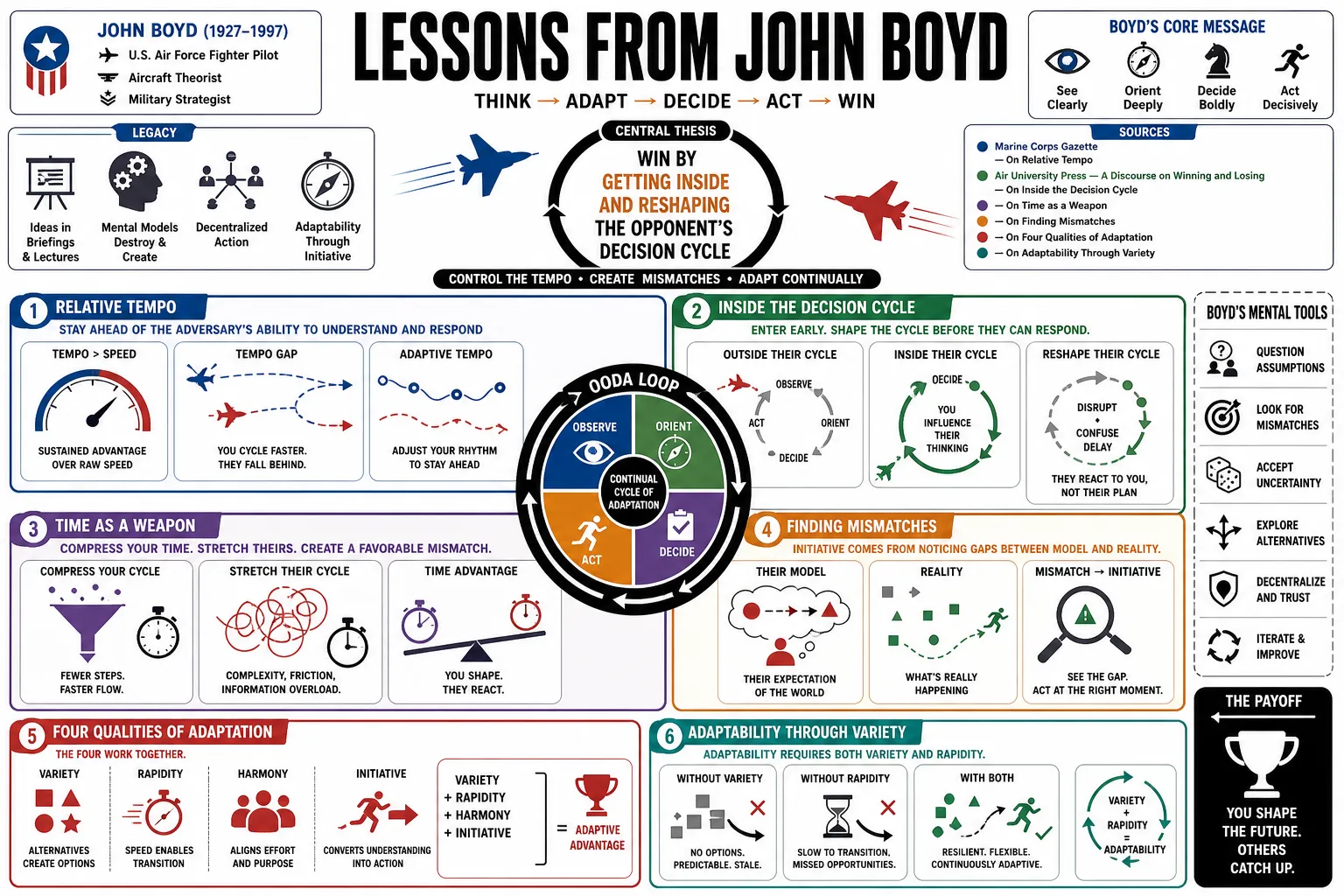
The OODA Loop and Adaptive Tempo
- On Relative Tempo: The competitive advantage is not raw speed in isolation but a tempo that stays meaningfully ahead of an adversary's ability to understand and respond. — Reference: Marine Corps Gazette — Evolving the OODA Loop for Strategy
- On Inside the Decision Cycle: Winning often means entering and reshaping the opponent's decision cycle before the opponent can form an effective response. — Reference: Air University Press — A Discourse on Winning and Losing
- On Time as a Weapon: Compress your own decision time while stretching the adversary's, creating a favorable mismatch in the ability to shape and adapt to change. — Reference: Air University Press — A Discourse on Winning and Losing
- On Finding Mismatches: Initiative depends on noticing mismatches between a model and reality and acting on them at the right moment. — Reference: Air University Press — A Discourse on Winning and Losing
- On Four Qualities of Adaptation: Variety, rapidity, harmony, and initiative work together: alternatives create options, speed enables transition, harmony aligns effort, and initiative converts understanding into action. — Reference: Air University Press — A Discourse on Winning and Losing
- On Adaptability Through Variety: Adaptability requires both variety and rapidity; without them an organization becomes predictable and cannot cope with unforeseen change. — Reference: Air University Press — A Discourse on Winning and Losing
- On The Cost of Predictability: Security in competition includes remaining difficult to read, because predictability neutralizes the benefits of speed and initiative. — Reference: Air University Press — A Discourse on Winning and Losing
- On Power Is Not Enough: Larger forces do not automatically win; maneuver, timing, surprise, and faster adaptation can overcome superior mass. — Reference: Air University Press — A Discourse on Winning and Losing
- On Attack from Unexpected Directions: Flank and rear attacks, misdirection, timing, and deception matter because they force an opponent to solve several incompatible problems at once. — Reference: Air University Press — A Discourse on Winning and Losing
Strategy and the Nature of Conflict
- On Strategy as a Living Tapestry: Strategy is a changing pattern of intentions that harmonizes effort toward a purpose in an unfolding world, not a fixed plan detached from events. — Reference: Air University Press — A Discourse on Winning and Losing
- On Shape and Adapt: The purpose of strategy is to improve the ability to shape circumstances while adapting as those circumstances evolve. — Reference: Air University Press — A Discourse on Winning and Losing
- On Ambiguity Cannot Be Designed Away: Design methods can help frame conflict, but no planning process can eliminate war's inherent ambiguity and uncertainty. — Reference: Marine Corps Gazette — Evolving the OODA Loop for Strategy
- On Decisions as Hypotheses: A strategic decision is a hypothesis about the causal relationship between an action and a desired end; subsequent events test that theory of success. — Reference: Marine Corps Gazette — Evolving the OODA Loop for Strategy
- On Strategy as Continuous Adaptation: A useful model of conflict must account for cognition, moral factors, feedback, uncertainty, and continuous adaptation rather than reducing strategy to a checklist. — Reference: Marine Corps Gazette — Evolving the OODA Loop for Strategy
- On Disruption Before Destruction: The strategic aim can be to disrupt the opponent's capacity to cope and coordinate, producing collapse without requiring physical annihilation. — Reference: Marine Corps University Journal — Colonel John Boyd's Thoughts on Disruption
- On The Effects Spiral: Uncertainty can cascade through doubt, mistrust, confusion, disorder, fear, panic, and chaos until a system loses its ability to respond coherently. — Reference: Air University Press — A Discourse on Winning and Losing
- On Survival Requires Openness: Boyd connected survival with adaptation and openness; isolation makes organizations brittle and eventually unable to cope with change. — Reference: Marine Corps University Journal — Colonel John Boyd's Thoughts on Disruption
- On Organizations as Adaptive Systems: Organizations and nations behave as collections of interacting organisms, remaining resilient only while they can exchange information and adapt. — Reference: Marine Corps University Journal — Colonel John Boyd's Thoughts on Disruption
Leadership and Organic Command
- On Insight and Vision: Leaders need insight to unveil adversary intentions and vision to anticipate their own appropriate goals and actions. — Reference: Air University Press — A Discourse on Winning and Losing
- On Focus and Direction: Shared focus gives dispersed action a common purpose; without it there can be neither harmony of effort nor vigorous initiative. — Reference: Air University Press — A Discourse on Winning and Losing
- On Commander's Intent: A force can act autonomously only when people understand the commander's intent well enough to make local choices consistent with the larger aim. — Reference: Air University Press — A Discourse on Winning and Losing
- On Implicit Communication: Repeated shared experiences create similar mental images, allowing teams to coordinate through implicit communication and trust rather than constant instruction. — Reference: Air University Press — A Discourse on Winning and Losing
- On A Common Outlook: Training builds a common outlook, language, and way of thinking that lets distributed teams understand tactical concepts without exhaustive explanation. — Reference: Air University Press — A Discourse on Winning and Losing
- On Leadership with Monitoring: In uncertain environments, leadership supported by monitoring is more adaptive than command systems built primarily around tight control. — Reference: Air University Press — A Discourse on Winning and Losing
- On Freedom of Action: Control should preserve the freedom to act and make common cause, because survival and prosperity depend on room to adjust locally. — Reference: Air University Press — A Discourse on Winning and Losing
- On Monitoring Instead of Constraining: Tight control can stifle the freedom required for learning and rapid adaptation; leaders should monitor effects while leaving room for independent judgment. — Reference: Marine Corps Gazette — Evolving the OODA Loop for Strategy
Learning, Orientation, and Mental Models
- On Analysis and Synthesis: Learning alternates between pulling ideas apart and recombining them across domains to create mental images that better match an uncertain world. — Reference: Air University Press — A Discourse on Winning and Losing
- On Destructive Deduction: To escape an outdated concept, separate its parts from the old domain and tolerate the temporary disorder that follows. — Reference: Air University Press — A Discourse on Winning and Losing
- On Creative Induction: Creation begins when previously separated particulars are recombined around new common qualities into a different coherent pattern. — Reference: Air University Press — A Discourse on Winning and Losing
- On Test the Model: A new mental model must be checked for internal coherence and for fit with observed reality; novelty alone does not make it useful. — Reference: Air University Press — A Discourse on Winning and Losing
- On Self-Correcting Inquiry: Science progresses through observation, hypothesis, and test, while engineering substitutes design for hypothesis; both are iterative correction processes. — Reference: Air University Press — A Discourse on Winning and Losing
- On The Conceptual Spiral: Learning begins with a question and advances through repeated exploration, discovery, testing, unlearning, and relearning rather than a single final answer. — Reference: Air University Press — A Discourse on Winning and Losing
- On Orientation Never Stops: Orientation is not a one-time stage; it continuously evolves as circumstances, information, analysis, and synthesis change. — Reference: Marine Corps Gazette — Evolving the OODA Loop for Strategy
- On Avoid Cognitive Stagnation: Locking into a single mental model makes behavior predictable and leaves a strategist unable to absorb changing evidence. — Reference: Marine Corps Gazette — Evolving the OODA Loop for Strategy
- On Discovery Before Design: At the strategic level, observation should become active discovery: a deliberate effort to understand the environment and the adversary's distinctive culture. — Reference: Marine Corps Gazette — Evolving the OODA Loop for Strategy
Modern Applications
- On AI as an Aid: A contemporary extension of Boyd's model uses AI to accelerate data collection, analysis, situational awareness, and decision support. — Reference: Modern War Institute — Warfare at the Speed of Thought
- On Keep Human Judgment: AI should complement rather than replace human thinking, especially when systems are unavailable, compromised, or confronted by unforeseen conditions. — Reference: Modern War Institute — Warfare at the Speed of Thought
- On Orientation Blends Many Inputs: Orientation combines cultural traditions, previous experience, new information, analysis, synthesis, and inherited predispositions. — Reference: Marine Corps University Journal — Colonel John Boyd's Thoughts on Disruption
- On Create Multiple Impressions: Competitive action can generate varied impressions of what is happening and what may happen next, producing mismatches the adversary struggles to reconcile. — Reference: Marine Corps University Journal — Colonel John Boyd's Thoughts on Disruption
- On Tempo Is More Than Speed: Tempo matters because it captures initiative and forces repeated reorientation, not because moving fastest is always best. — Reference: Marine Corps University Journal — Colonel John Boyd's Thoughts on Disruption