John Templeton managed the Templeton Growth Fund and popularized the strategy of investing globally during moments of extreme panic. He built his career on the principle of "maximum pessimism," buying heavily discounted assets when others were selling in fear, starting with distressed stocks at the outbreak of World War II. This compilation organizes his specific rules for navigating market cycles, contrarian psychology, and his later-life focus on the intersection of science and religion.
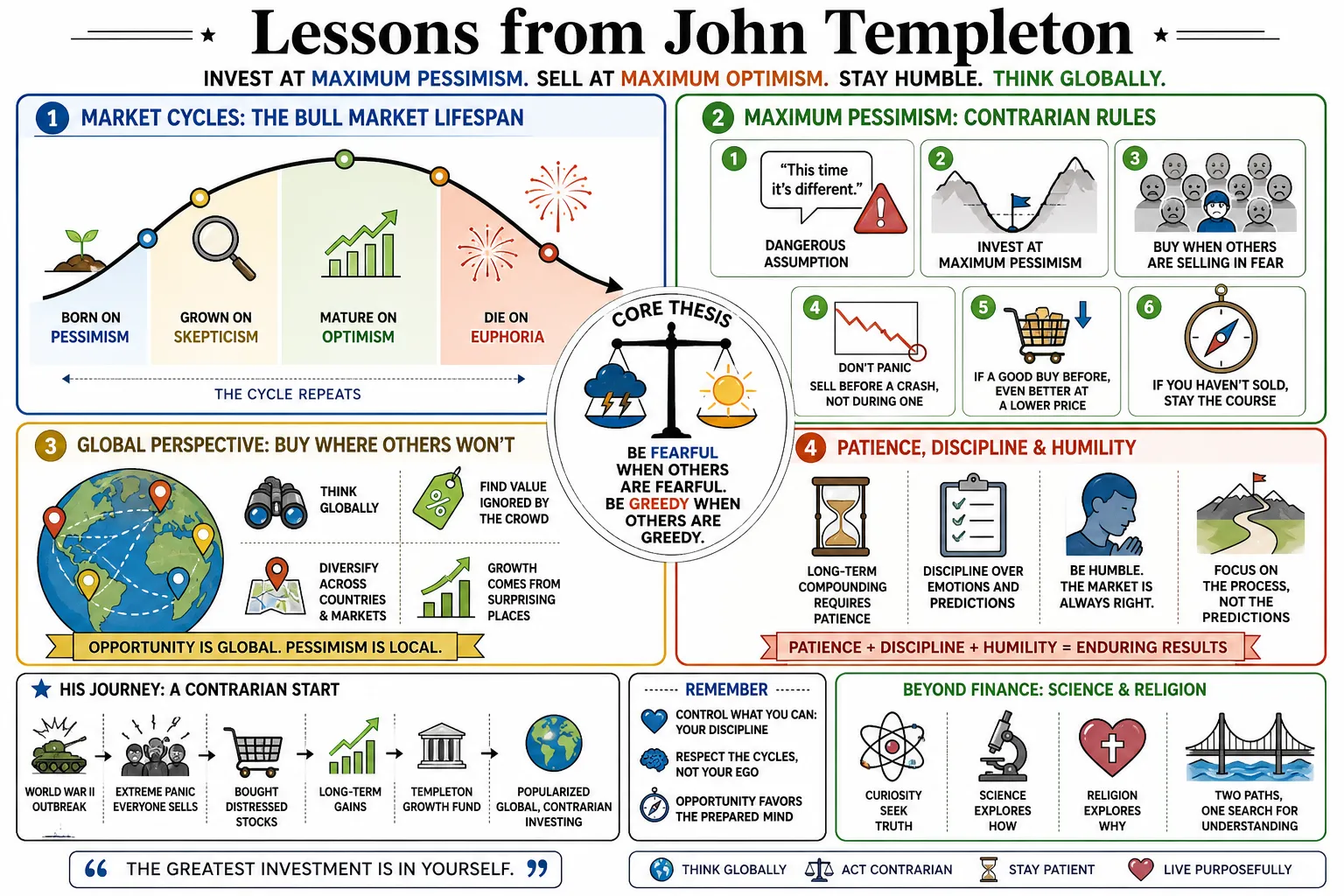
Part 1: Market Cycles and Maximum Pessimism
- On the lifespan of a bull market: "Bull markets are born on pessimism, grown on skepticism, mature on optimism and die on euphoria." — Source: [ACR Alpine Capital Research]
- On dangerous assumptions: "The four most dangerous words in investing are: 'This time it's different.'" — Source: [Tempus Wealth Planning]
- On timing the market: "Invest at the point of maximum pessimism." — Source: [Business Insider]
- On peak optimism: "The time of maximum optimism is the best time to sell." — Source: [Gracious Quotes]
- On market crashes: "Don't panic. The time to sell is usually before a crash, not during one. If you haven't sold, stay the course." — Source: [Bormann Wealth Management]
- On lower prices: If a stock was a good buy before the crash, it is an even better bargain at a lower price. — Source: [Bormann Wealth Management]
- On the nature of opportunity: When everyone is despondent and selling, prices drop far below their intrinsic value, creating the greatest potential for future returns. — Source: [Philanthropy Roundtable]
- On buying during panic: He borrowed money at the onset of World War II to buy stocks trading for less than $1, knowing extreme fear drives extreme discounts. — Source: [Philanthropy Roundtable]
- On taking advantage of sell-offs: The only reason to sell after a market crash is to buy a better bargain that has dropped even further. — Source: [Bormann Wealth Management]
- On value traps vs. true bargains: Pessimism alone isn't enough; the underlying fundamentals must be sound, or else you are buying into a failing enterprise. — Source: [Monevator]
Part 2: Contrarian Strategy and Psychology
- On outperforming the crowd: "If you want to have a better performance than the crowd, you must do things differently from the crowd." — Source: [Investopaper]
- On the cost of conformity: If you buy the same securities as everyone else, you will have the same results as everyone else. — Source: [Wealthy Matters]
- On the difficulty of diverging: "Outperforming the majority of investors requires doing what they are not doing. Buying when others have despaired, and selling when they are full of hope, takes fortitude." — Source: [AZ Quotes]
- On finding bargains: The only way to get a true bargain in the stock market is to buy what most other investors are selling. — Source: [Monevator]
- On emotional strength: "To buy when others are despondently selling and sell when others are greedily buying requires the greatest fortitude and pays the greatest reward." — Source: [Investopaper]
- On ignoring popular sentiment: Never invest based on tips, popular sentiment, or so-called sure things. — Source: [The Wealth Wisher]
- On negative environments: Do not be fearful or negative too often; maintain a positive outlook to spot opportunities where others see only problems. — Source: [The Wealth Wisher]
- On the necessity of unpopularity: You cannot buy a stock at a steep discount if it is universally loved and popular. — Source: [Novel Investor]
- On standing alone: The investor must be willing to act entirely independently of the general consensus of Wall Street. — Source: [Franklin Templeton]
- On doing the opposite: The safest time to buy a stock is when there is maximum pessimism about the industry or the company. — Source: [Enrichwise]
Part 3: Value and Security Selection
- On shifting focus: "Focus on value because most investors focus on outlooks and trends." — Source: [Investopaper]
- On the trigger to sell: "Sell a stock only when you have found a new stock that is a 50% better bargain than the one that you hold." — Source: [Gracious Quotes]
- On true motivations: "I never in all my life bought a stock because I liked it. I bought it because it was a cheaper bargain than any similar stock I would buy anywhere in the rest of the world." — Source: [Gracious Quotes]
- On quality: When searching for bargains, look for companies with a proven track record and strong management that are currently undervalued. — Source: [UnoVest]
- On avoiding macro predictions: Buy value, not market trends or the economic outlook; focus on the individual company's worth rather than trying to predict the economy. — Source: [The Wealth Wisher]
- On intrinsic value: Ignore short-term market outlooks and focus instead on fundamental analysis to calculate the true worth of a business. — Source: [Trustnet]
- On doing your homework: Investigate thoroughly before putting your money at risk, or hire wise experts to help you do so. — Source: [UnoVest]
- On real estate valuation: Real estate is worth no more than the cost to reproduce it; you should not pay more for a house than it would cost to build the same house across the street. — Source: [ABL Online]
- On relative pricing: Always compare opportunities; a stock is only worth buying if it is the lowest-priced relative to its intrinsic value across all available options. — Source: [Gracious Quotes]
Part 4: Global Diversification
- On searching the world: "Search nation after nation for stocks, asking: 'Where is the one that is lowest-priced in relation to what I believe it's worth?'" — Source: [Gracious Quotes]
- On broadening horizons: By searching worldwide, you will find more and better bargains than by limiting yourself to looking in just one country. — Source: [Wealthy Matters]
- On home bias: It is dangerous to limit your investments to one nation; looking across ten nations yields vastly more opportunities to find the right stocks. — Source: [ABL Online]
- On remaining flexible: Remain flexible and open-minded about types of investments, exploring different asset classes, industries, and countries. — Source: [UnoVest]
- On global valuations: Even when prices seem similar globally, international diversification offers a wider net to capture specific, temporary mispricings. — Source: [ABL Online]
- On risk distribution: Spread your risk across different stocks, bonds, and geographical regions to protect against localized downturns. — Source: [The Wealth Wisher]
- On international opportunities: The best bargain in the world is rarely found in your own backyard; expanding your search geography expands your advantage. — Source: [Forbes]
- On economic cycles: Different nations experience economic cycles at different times, making global diversification a crucial buffer against regional recessions. — Source: [Franklin Templeton]
- On open-mindedness: An investor must be willing to abandon familiar markets when better values appear overseas. — Source: [Trustnet]
Part 5: Risk, Discipline, and Real Returns
- On inflation and taxes: "For all long-term investors, there is only one objective: maximum total real return after taxes." — Source: [Investopaper]
- On investing vs. gambling: "The stock market is not a casino, but if you move in and out of stocks every time they move a point or two... the market will be your casino." — Source: [Investopaper]
- On trading frequency: Like most gamblers who treat the stock market as a casino, those who speculate on short-term price movements may lose eventually. — Source: [Bormann Wealth Management]
- On the need for diversification: "Diversification is a safety factor that is essential because we should be humble enough to admit we can be wrong." — Source: [Novel Investor]
- On constant vigilance: Aggressively monitor your investments, as you must be prepared for changes in the market or the specific companies you own. — Source: [UnoVest]
- On measuring success: The goal isn't simply to make money, but to actively increase your actual purchasing power over time. — Source: [The Wealth Wisher]
- On avoiding speculation: Invest for the long-term value of a business rather than attempting to guess short-term price fluctuations. — Source: [UnoVest]
- On free lunches: Accept that there is no free lunch in investing; outsized returns require outsized diligence and emotional control. — Source: [The Wealth Wisher]
- On the cost of friction: High turnover and frequent trading enrich the broker, not the investor; long-term holding minimizes tax drag. — Source: [Bormann Wealth Management]
Part 6: Humility, Mistakes, and Mindset
- On continuous learning: "An investor who has all the answers doesn't even understand all the questions." — Source: [The Wealth Wisher]
- On failing: Every investor makes mistakes; the key is to learn from them and ensure you do not repeat them. — Source: [UnoVest]
- On learning from others: "The big difference between those who are successful and those who are not is that successful people learn from their mistakes and the mistakes of others." — Source: [Investopaper]
- On recognizing limitations: "If we become increasingly humble about how little we know, we may be more eager to search." — Source: [Gracious Quotes]
- On hard work: He attributed his success not to innate genius, but to being deeply industrious and hard-working throughout his life. — Source: [YouTube]
- On clear thinking: He believed that beginning tasks with a prayer helped him think more clearly and make fewer reactionary mistakes. — Source: [Ritholtz]
- On admitting faults: Humility is a practical investing tool; it prevents over-concentration in a single asset based on overconfidence. — Source: [Novel Investor]
- On staying curious: To be an exceptional investor, you must maintain a beginner's mind, constantly eager to learn rather than defending your past beliefs. — Source: [Investopaper]
- On overconfidence: The moment an investor believes they have mastered the market is the moment they are most vulnerable to catastrophic loss. — Source: [UnoVest]
Part 7: Wealth, Giving, and Ethics
- On the nature of wealth: "If you're not grateful, you're not rich—no matter how much you have." — Source: [AZ Quotes]
- On generating riches: "Never forget: the secret of creating riches for oneself is to create them for others." — Source: [Investopaper]
- On the ultimate investment: "The best investment with the least risk and the greatest dividend is giving." — Source: [AZ Quotes]
- On happiness: "Happiness comes from spiritual wealth, not material wealth... Happiness comes from giving, not getting." — Source: [AZ Quotes]
- On character: "It is nice to be important, but it's more important to be nice." — Source: [Gracious Quotes]
- On maintaining joy: "To get joy, we must give it and to keep joy, we must scatter it." — Source: [AZ Quotes]
- On thrift: "Those who spend too much will eventually be owned by those who are thrifty." — Source: [Investopaper]
- On ethical foundations: "High ethics and religious principles form the basis for success and happiness in every area of life." — Source: [Wikiquote]
- On true prosperity: He noted late in life that focusing on charity and spiritual wealth made him busier, more enthusiastic, and more joyful than he had ever been. — Source: [QuoteFancy]
Part 8: Science, Spirituality, and Progress
- On spiritual research: "We are encouraging people to start using the same methods of science that have been so productive in other areas, in order to discover spiritual realities." — Source: [Bookey]
- On the invisible world: "Natural scientists are proving to us year by year that things not seen are vastly greater and more numerous than the things we see." — Source: [Templeton Prize]
- On open-minded faith: "Faith does not imply a closed, but an open mind. Quite the opposite of blindness, faith appreciates the vast spiritual realities that materialists overlook." — Source: [Goodreads]
- On defining divinity: "It is self-centered to think that human beings, as limited as we are, can describe divinity." — Source: [LibQuotes]
- On human connection to God: "You are a tiny part of God somewhat in the same way that a wave is a tiny part of the ocean." — Source: [Templeton Prize]
- On the omnipresence of God: "The question is not 'Is there a God?', but 'Is there anything else except God?'" — Source: [Templeton Prize]
- On theological progress: "God is revealing Himself more and more to the natural scientists, which is creating a new branch of Theology called the Theology of Science." — Source: [Templeton Prize]
- On institutional religion: He believed all religions were becoming obsolete by clinging to ancient concepts, and argued for continuous learning and adaptation. — Source: [QuoteFancy]
- On funding spiritual progress: He questioned what greater blessings might flow if humanity spent a fraction of the resources on religious progress as it does on material products. — Source: [Wikiquote]
- On practical spirituality: "If you live your religion, your home will go better, your business will go better, your government will go better." — Source: [YouTube]