Joon Sung Park is a researcher and entrepreneur whose work bridges artificial intelligence and social computing. He is best known for creating generative agents—computational models of humans that use large language models to simulate social behaviors, memories, and routines at scale. This profile collects his insights on using AI to accurately simulate human behavior, the importance of grounding agents in real qualitative data, and the future of testing societal and commercial policies in virtual environments.
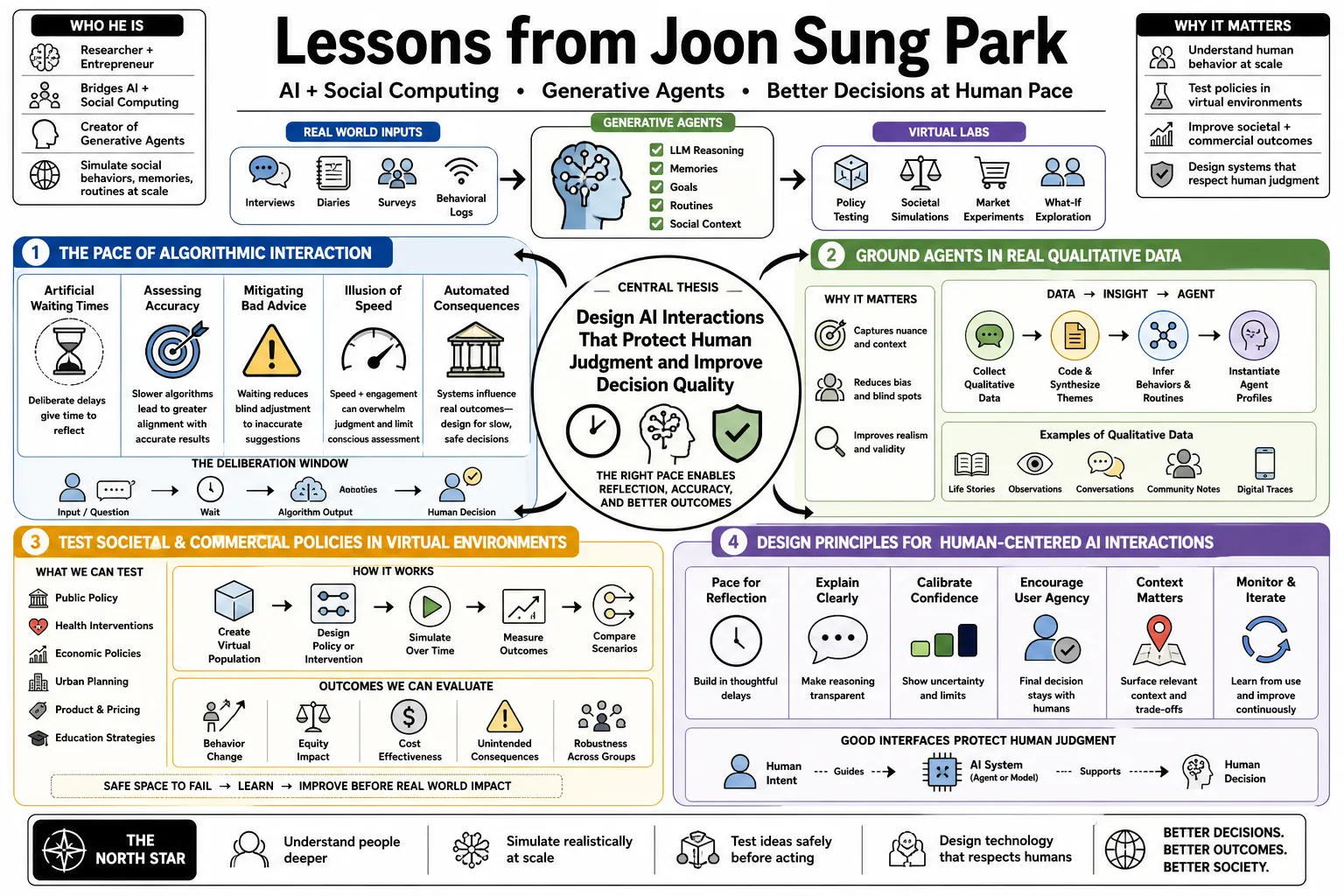
Part 1: The Pace of Algorithmic Interaction
- On artificial waiting times: Introducing intentional delays into an algorithmic response gives users a critical window to reflect, helping prevent them from blindly accepting or rejecting the system's output. — Reference: Faster is not always better
- On assessing accuracy: In visual recognition tasks, users presented with a highly accurate algorithm were more likely to align their final answers with its suggestions when the algorithm was deliberately slowed down. — Reference: Faster is not always better
- On mitigating bad advice: When forced to wait for an algorithm's output, users were less likely to blindly adjust their own estimates to match an inaccurate suggestion compared to users who received instant bad advice. — Reference: Faster is not always better
- On the illusion of speed: While the tech industry optimizes for speed and engagement to maximize productivity, this fast-paced digital environment can overwhelm human judgment and rob users of the opportunity to make conscious assessments. — Reference: Faster is not always better
- On automated consequences: Because algorithms increasingly dictate personal outcomes—ranging from bail eligibility to preventive healthcare—designing interfaces that encourage deliberate, slow reflection is more important than ever. — Reference: Faster is not always better
Part 2: The Genesis of Generative Agents
- On the Smallville experiment: By populating a simulated town with twenty-five generative agents, researchers demonstrated that agents would autonomously wake up, go to work, form opinions, and socialize. — Reference: Generative Agents: Interactive Simulacra of Human Behavior
- On emergent event coordination: Initiated by a single prompt about throwing a Valentine's Day party, simulated agents independently spread invitations, formed relationships, coordinated schedules, and attended the event together. — Reference: Generative Agents: Interactive Simulacra of Human Behavior
- On simulated forgetfulness: The Smallville environment was complex enough that some agents who received party invitations simply forgot to attend. — Reference: Simulating Humans at Scale: Simile's Joon Sung Park
- On unexpected behaviors: Emergent dynamics in the virtual town included uninvited agents showing up to events because another invited agent asked them out on a date. — Reference: Simulating Humans at Scale: Simile's Joon Sung Park
- On identifying LLM capabilities: The true interaction breakthrough of modern large language models was not their capacity to do simple text generation, but their ability to encode and reproduce human behavioral patterns embedded in their training data. — Reference: Simulating Humans at Scale: Simile's Joon Sung Park
- On fulfilling legacy goals: Creating believable software agents that interact continuously in an open world achieves a vision that human-computer interaction pioneers have chased since the early days of cognitive modeling. — Reference: Modeling Human Behavior with Generative Agents
Part 3: The Architecture of an Agent
- On core architecture: To simulate believable behavior, an agent requires a framework that observes its environment, plans future actions, and continually reflects on its experiences. — Reference: Generative Agents: Interactive Simulacra of Human Behavior
- On component necessity: Ablation studies reveal that observation, planning, and reflection each critically contribute to an agent's believability; removing any single component degrades the simulation. — Reference: Generative Agents: Interactive Simulacra of Human Behavior
- On synthesizing memories: Agents use natural language to maintain a complete log of their experiences, which the system periodically synthesizes into higher-level reflections to guide future behavior. — Reference: Generative Agents: Interactive Simulacra of Human Behavior
- On dynamic retrieval: When deciding how to act, agents dynamically query their natural-language memory banks to pull relevant past observations and reflections into their current context. — Reference: Generative Agents: Interactive Simulacra of Human Behavior
- On micro-contexts: When provided with highly specific, localized situational constraints, language models excel at generating plausible, human-like responses. — Reference: Simulating Humans at Scale: Simile's Joon Sung Park
Part 4: Prototyping Social Systems
- On the challenges of scaling: The hardest part of designing a social platform is understanding how millions of users will interact and anticipating the emergent phenomena that occur at scale. — Reference: Simulating Humans at Scale: Simile's Joon Sung Park
- On the risks of field testing: Historically, testing a new social network design meant releasing a prototype to the public, creating a real human cost if the platform inadvertently amplified negative emotions. — Reference: Simulating Humans at Scale: Simile's Joon Sung Park
- On safe prototyping: Utilizing generative simulations allows platform architects to evaluate moderation strategies and observe community dynamics safely, without exposing real users to toxic system designs. — Reference: Simulating Humans at Scale: Simile's Joon Sung Park
- On Social Simulacra: Before creating generative agents with persistent memories, researchers used language models to prototype entire subreddits, predicting how a simulated community might discuss topics or plan trips within a defined space. — Reference: Simulating Humans at Scale: Simile's Joon Sung Park
Part 5: Grounding Agents in Real Human Data
- On the limits of fictional bios: While a paragraph-long fictional backstory can create a fun character for a sandbox game, designing simulations for serious policymaking requires agents deeply grounded in real human data. — Reference: AI Agents Simulate 1,052 Individuals’ Personalities with Impressive Accuracy
- On role-playing real people: Generative models act as proxies for interviewees by adopting their specific viewpoints and answering questions as if they were those individuals. — Reference: AI Agents Simulate 1,052 Individuals’ Personalities with Impressive Accuracy
- On automated interviewing: To capture the lived experiences of over 1,000 Americans, researchers deployed an AI interviewer to dynamically ask follow-up questions during two-hour biographical sessions. — Reference: AI Agents Simulate 1,052 Individuals’ Personalities with Impressive Accuracy
- On expert syntheses: Researchers task language models with distilling complex interview transcripts into concise psychological and economic traits, effectively acting as expert analysts. — Reference: AI Agents Simulate 1,052 Individuals’ Personalities with Impressive Accuracy
- On mitigating bias: Grounding models in deep, idiosyncratic interview data prevents them from falling back on broad demographic or race-based generalizations. — Reference: AI Agents Simulate 1,052 Individuals’ Personalities with Impressive Accuracy
- On data saturation: Fusing qualitative interviews with structured survey data yields the most accurate simulation of an individual, though predictive gains asymptote once the model processes enough domain evidence. — Reference: LLM Agents Grounded in Self-Reports Enable General-Purpose Simulation of Individuals
Part 6: Accuracy and Behavioral Prediction
- On establishing ground truth: When evaluating simulations, researchers use human participants' responses to established social science experiments as the baseline for assessing agent accuracy. — Reference: AI Agents Simulate 1,052 Individuals’ Personalities with Impressive Accuracy
- On survey prediction: Generative agents constructed from interviews predicted participants’ General Social Survey answers 85% as accurately as the human participants were able to match their own answers two weeks later. — Reference: AI Agents Simulate 1,052 Individuals’ Personalities with Impressive Accuracy
- On economic behavior: Grounded AI agents achieved a strong correlation with their human counterparts when playing standard behavioral economic games, such as the prisoner's dilemma. — Reference: AI Agents Simulate 1,052 Individuals’ Personalities with Impressive Accuracy
- On replicating experimental effects: When challenged to replicate five distinct social science experiments, interview-based AI agents successfully reproduced the treatment effects in four of them. — Reference: LLM Agents Grounded in Self-Reports Enable General-Purpose Simulation of Individuals
- On general-purpose simulation: Agents built from deep self-reports can predict responses across a variety of outcomes, eliminating the need to train specialized models for every new behavioral variable. — Reference: LLM Agents Grounded in Self-Reports Enable General-Purpose Simulation of Individuals
Part 7: Commercial Applications and the Say-Do Gap
- On convergent vs. divergent outcomes: A simulation is considered convergent if the system always settles near a similar equilibrium; it is divergent if minor variations compound to create entirely different futures. — Reference: Simulating Humans at Scale: Simile's Joon Sung Park
- On measuring convergent accuracy: For population-level questions where outcomes converge, achieving a Total Variation Distance score below 0.15 indicates the simulation is reliable enough to inform enterprise decisions. — Reference: Simulating Humans at Scale: Simile's Joon Sung Park
- On managing divergent simulations: When modeling a highly divergent scenario, enterprises must run hundreds of simulations and apply bootstrap resampling to establish accurate statistical confidence intervals. — Reference: Simulating Humans at Scale: Simile's Joon Sung Park
- On testing concepts at scale: Unlike traditional market research which restricts companies to testing a handful of ideas, accurate agent simulations allow enterprises to instantly test thousands of variations against thousands of demographic sub-populations. — Reference: Simulating Humans at Scale: Simile's Joon Sung Park
- On capturing subjective values: Frontier language models are designed to act as super-intelligent, rational CPUs; however, modeling actual consumer behavior requires a "GPU of intelligence" capable of encoding human irrationality and subjective taste. — Reference: Simulating Humans at Scale: Simile's Joon Sung Park
- On the say-do gap: Standard language models are trained on what people say online, meaning they struggle to predict what people will actually do unless they are grounded by narrative life-story data and behavioral signals. — Reference: Simulating Humans at Scale: Simile's Joon Sung Park
- On downstream product impacts: Commercial simulations enable companies to forecast how launching a single new product might ripple through the market and alter consumer perception of their entire existing portfolio. — Reference: Simulating Humans at Scale: Simile's Joon Sung Park
Part 8: Ethics, Privacy, and the Future of Society
- On data ownership: An individual's generative agent serves as a detailed computational portrait and should remain under the strict ownership and control of the person it represents, similar to genomic data. — Reference: AI Agents Simulate 1,052 Individuals’ Personalities with Impressive Accuracy
- On withdrawing consent: Participants must retain the right to revoke their data and completely remove their corresponding generative agents from any active simulations. — Reference: AI Agents Simulate 1,052 Individuals’ Personalities with Impressive Accuracy
- On restricted research access: To prevent misuse, banks of generative agents based on real people must not be released publicly; researchers should have to apply for access and guarantee strict privacy protections. — Reference: AI Agents Simulate 1,052 Individuals’ Personalities with Impressive Accuracy
- On solving wicked problems: Society currently struggles to test policy solutions for massive challenges like climate change; accurate generative testbeds offer a way to safely model the impacts of complex interventions. — Reference: AI Agents Simulate 1,052 Individuals’ Personalities with Impressive Accuracy
- On the pillars of advanced civilization: Advanced societies envisioned in science fiction are often built on dual foundations: artificial general intelligence and sophisticated simulations used to guide civilization. — Reference: Simulating Humans at Scale: Simile's Joon Sung Park
- On building the simulation: The current generation of models makes it possible to take a serious first attempt at building simulations that could help guide society. — Reference: Simulating Humans at Scale: Simile's Joon Sung Park
Part 9: From Prototypes to Experimental Science
- On populating prototypes: Social simulacra can turn a community design—its goal, rules, and seed personas—into thousands of synthetic members, posts, replies, and antisocial interactions before the community is launched. — Reference: Social Simulacra: Creating Populated Prototypes for Social Computing Systems
- On testing design changes: Simulated communities shift their behavior when designers alter goals, rules, personas, or moderator interventions, making it possible to compare design choices before exposing real users to them. — Reference: Social Simulacra: Creating Populated Prototypes for Social Computing Systems
- On making prototypes actionable: When designers explored populated simulations, they identified likely successes and failure modes and used those observations to refine their social-system designs. — Reference: Social Simulacra: Creating Populated Prototypes for Social Computing Systems
- On assembling behavioral training data: The SocSci210 dataset combines 2.9 million individual responses from more than 400,000 participants across 210 open social-science experiments, turning accumulated research into training material for behavioral prediction. — Reference: Finetuning LLMs for Human Behavior Prediction in Social Science Experiments
- On specializing models with evidence: Fine-tuning a language model on past experimental responses produced human-response distributions that aligned substantially better than those of the unchanged base model. — Reference: Finetuning LLMs for Human Behavior Prediction in Social Science Experiments
- On generalizing to new studies: Behavioral models trained across many experiments can improve predictions for entirely unseen studies, showing that learned social patterns can transfer beyond the exact tasks in the training set. — Reference: Finetuning LLMs for Human Behavior Prediction in Social Science Experiments
- On learning from partial experiments: Training on only some conditions within a study can sharply improve predictions for conditions the model has never seen, allowing experiments to inform nearby counterfactuals. — Reference: Finetuning LLMs for Human Behavior Prediction in Social Science Experiments
- On reducing demographic error: Rich demographic information in social-science datasets can be used during fine-tuning to reduce disparities in behavioral predictions rather than leaving the model to rely on broad population stereotypes. — Reference: Finetuning LLMs for Human Behavior Prediction in Social Science Experiments
- On simulations as scientific instruments: Generative-agent simulations are most useful as complements to empirical observation: they can challenge institutional assumptions, reveal emergent dynamics, and generate testable hypotheses before real-world deployment. — Reference: Generative Agent Simulations of Human Behavior
Part 10: General User Models and Proactive Computing
- On confidence-weighted understanding: A general user model should translate unstructured observations such as screenshots into propositions about a person's knowledge, goals, and preferences while retaining confidence estimates for each inference. — Reference: Creating General User Models from Computer Use
- On revising the model of a person: Useful personalization requires a system that retrieves related beliefs and continually updates or replaces them as new behavior provides better evidence. — Reference: Creating General User Models from Computer Use
- On carrying context across applications: A user model becomes more valuable when it can transfer context across apps, helping assistants personalize conversations, adapt actions, and decide which notifications deserve attention. — Reference: Creating General User Models from Computer Use
- On proactive assistance: Assistants grounded in a continuously updated user model can identify and perform useful actions that people would benefit from but might never think to request explicitly. — Reference: Creating General User Models from Computer Use