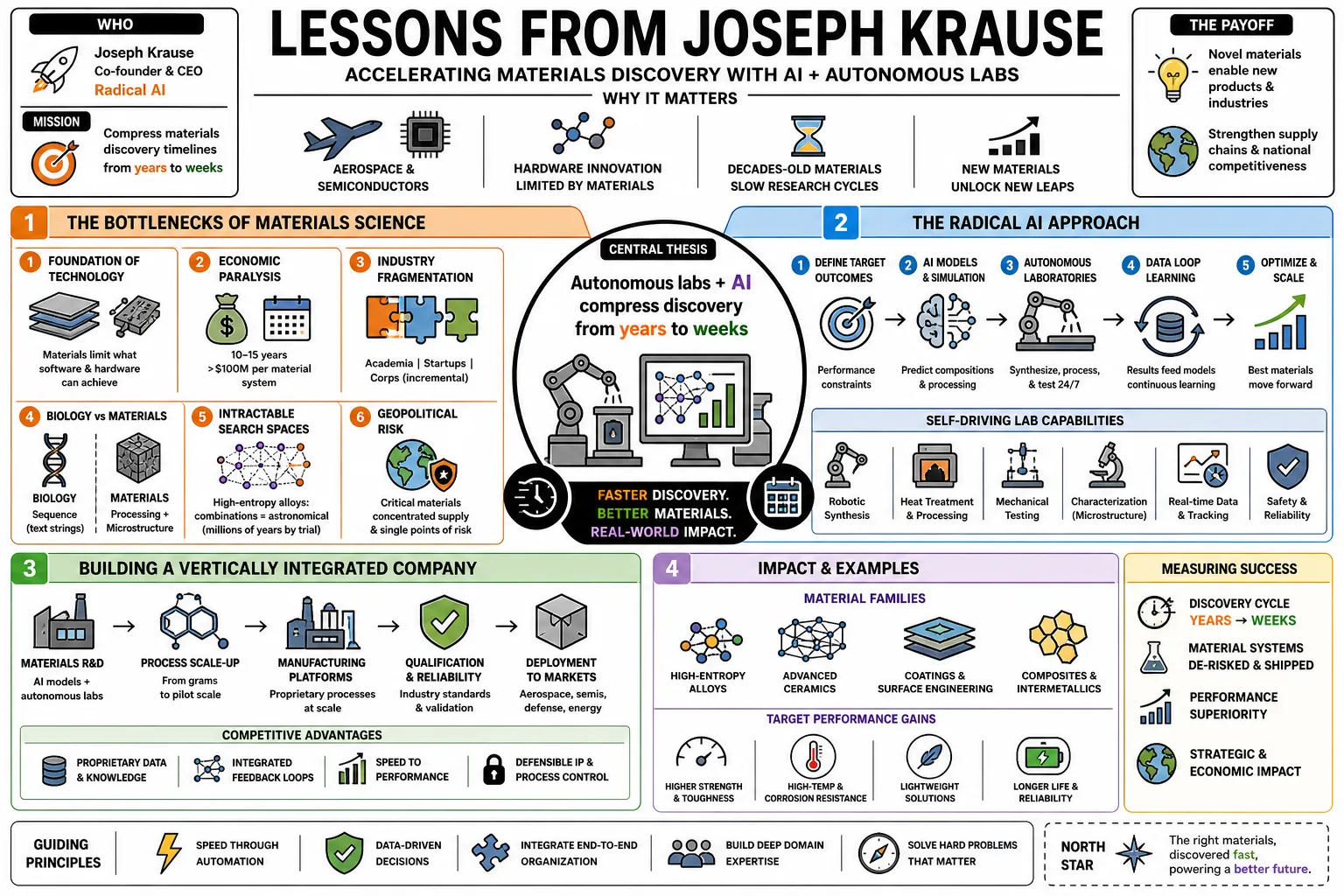
Joseph Krause is the co-founder and CEO of Radical AI, a company focused on accelerating materials science by combining artificial intelligence with autonomous, self-driving laboratories. Krause recognized that hardware innovation in industries like aerospace and semiconductors was constrained by decades-old materials and prohibitively slow research cycles. This profile explores his approach to compressing materials discovery timelines from years to weeks, scaling deep tech, and building a vertically integrated manufacturing company.
Part 1: The Bottlenecks of Materials Science
- On the foundation of technology: New software and hardware products are ultimately constrained by the physical materials available, meaning true technological leaps require novel materials rather than just code. — Reference: Burkland Associates
- On economic paralysis: The traditional timeline of 10 to 15 years and costs exceeding $100 million for a single material system force companies to optimize existing products rather than invent new ones. — Reference: Frontlines
- On industry fragmentation: The materials ecosystem is disconnected, with academia focused on fundamental understanding, startups handling light testing, and large corporations focused on incremental improvements. — Reference: Latent Space
- On biology versus materials: Unlike biological molecules that can be represented by text strings, structural materials rely on processing techniques, microstructures, and manufacturing methods that cannot be captured in a simple string. — Reference: Latent Space
- On intractable search spaces: High-entropy alloys possess so many potential combinations that traditional human trial-and-error would take millions of years, making them an ideal target for machine learning. — Reference: Frontlines
- On geopolitical risk: Relying on outdated supply chains for materials like rare earth elements creates national security vulnerabilities as competitors actively develop advanced alloys and secure critical minerals. — Reference: Craig Picken Executive Search
- On incremental vs. enabling tech: Radical AI focuses on creating enabling technology that unlocks new product categories, rather than optimization technology that simply improves the margins of existing items. — Reference: Frontlines
- On the real constraint: Materials science is constrained less by compute than by the speed and quality of physical experiments, so better feedback loops matter more than simply scaling model size. — Reference: Latent Space
Part 2: Autonomous Labs and the Data Advantage
- On serial workflows: Human researchers are limited by working sequentially through reading, hypothesizing, synthesizing, and testing, whereas autonomous systems can process and test thousands of candidates in parallel. — Reference: Open Source CEO
- On institutional amnesia: "If you and I worked on the exact same material problem, I'd have no idea what you did in the lab. And you have no idea what we've done here." — Source: Frontlines
- On capturing failure: Because scientists rarely publish failed experiments, vast amounts of critical data are lost; autonomous labs capture this messy data to build a comprehensive training set. — Reference: The Pair Program
- On physical ground truth: An AI model cannot reliably predict a finished material in one shot; it must be connected to a lab that physically synthesizes and tests the material to feed real-world data back into the system. — Reference: Latent Space
- On hardware limitations: Commercial lab instruments often lack accessible data interfaces, forcing startups to rewrite the operating systems of their equipment to enable automation. — Reference: Materialism Podcast
- On language models in science: Language-model embeddings are useful for translating complex scientific descriptors, like specific chemical percentages, into a format that Bayesian optimization tools can process. — Reference: Materialism Podcast
- On automation versus autonomy: An automated lab executes individual tasks faster, while a self-driving lab forms hypotheses, adapts its path, and runs an entire research campaign. — Reference: Latent Space
- On encoding scientific intuition: Training an AI scientist requires capturing the judgments experts make when reading microscopy images and other physical outputs, not only the final measurements. — Reference: Latent Space
- On specialized agents: A capable AI scientist is more likely to be a coordinated system of specialized literature, vision, reasoning, and orchestration agents than one monolithic model. — Reference: Latent Space
- On searching neglected spaces: AI can systematically explore alloy families that human researchers have avoided because of inherited assumptions about what is stable or synthesizable. — Reference: Latent Space
- On elevating human work: Self-driving labs should make scientists more important by moving their time from manual processing and file formatting toward defining target properties and interpreting results. — Reference: Investment Reports
- On measuring throughput: Radical AI produced 300 novel hypersonics-related materials in 16 weeks, compared with 3,425 alloys experimentally studied across that field over more than two decades. — Reference: Investment Reports
Part 3: From Lab Discovery to Manufacturing Scale
- On the importance of processing: A material's composition is only a starting point; the final properties are dictated by post-processing and manufacturing methods like annealing or casting. — Reference: Latent Space
- On the valley of death: Many discoveries fail because scaling up to commercial manufacturing introduces new physical variables that require scientists to restart the discovery process from scratch. — Reference: Frontlines
- On concurrent engineering: By recording processing variables like temperature, pressure, and humidity during the initial lab synthesis, scientists can map early data directly to future manufacturing specifications. — Reference: Frontlines
- On retaining intellectual property: Rather than simply licensing chemical compositions, a materials company must handle its own manufacturing, as the most valuable IP and training data are generated on the production floor. — Reference: Materialism Podcast
- On trade secrets over patents: Protecting the specific processing techniques required to scale a material is often more critical to a company's success than patenting the raw composition. — Reference: Startup Intros
- On defining discovery: A design, synthesis, or characterization result is only a milestone; the discovery is complete when the material is manufactured into a working product. — Reference: Latent Space
- On independent validation: Before committing to production scale-up, send the strongest candidate materials to an independent institute for third-party performance testing. — Reference: Investment Reports
Part 4: Go-to-Market Strategy and Commercialization
- On vertical integration: Radical AI decided early on not to be a software vendor or a lab-services shop, but to build a full-stack, vertically integrated materials company comparable to a next-generation Dow Chemical. — Reference: Burkland Associates
- On choosing a beachhead: Startups should target problems that are technically challenging for human scientists but have immediate market demand if the material constraint is solved. — Reference: Frontlines
- On dual-track customer bases: Serving both government and commercial clients allows a company to balance long-horizon research funding with immediate product revenue. — Reference: Frontlines
- On government as a bridge: The public sector is uniquely positioned to fund and validate long-term frontier technology, such as the materials required for nuclear fusion reactors. — Reference: Frontlines
- On validating the business: Government contracts prove that a startup's underlying technology works, while commercial contracts prove that the market actually wants the resulting product. — Reference: Frontlines
- On open models and proprietary experiments: Scientific models will commoditize, so sharing them can improve the ecosystem while proprietary experimental data remains the durable advantage. — Reference: Latent Space
- On strategic investors: Corporate investors can contribute more than capital by translating future product requirements into concrete materials-science priorities. — Reference: Investment Reports
- On adoption through trials: Let prospective partners run their own research on a new scientific platform; direct experience is more persuasive than abstract claims about its capability. — Reference: Investment Reports
Part 5: Leadership, Culture, and Building a Deep Tech Startup
- On setting the vision: "The founder’s job—especially the CEO’s—is to be unbelievably concrete on the vision and flexible on the details." — Source: Open Source CEO
- On capital constraint: "When you get comfortable is where great ideas go to die, because you have no incentive and no chip on your shoulder to execute." — Source: Upstarts Media
- On ignoring the competition: Rather than fixating on competitors, the focus should be on aggressively out-executing them by building the best possible technology and company. — Reference: Open Source CEO
- On staying the course: Deep tech founders often fail when they hit an obstacle and immediately try to pivot based on outside opinions, rather than trusting their original execution plan. — Reference: Upstarts Media
- On interdisciplinary moats: Building a team where materials scientists, machine learning engineers, and roboticists truly collaborate takes years and forms a significant competitive barrier. — Reference: Upstarts Media
- On military lessons: Serving in the military instills the resilience, mental toughness, and systems thinking required to handle the daily friction of entrepreneurship. — Reference: Clock Speed Podcast
- On academic detachment: The incentive structure in academia often prioritizes research for its own sake, rather than pushing physical products out of the lab and into the commercial world. — Reference: Burkland Associates
- On making the right bet: "It is making the bet that you are right that typically pays off in the long run." — Source: Upstarts Media
- On learning to follow: Leaders benefit from first learning to execute within a disciplined structure, because understanding followership improves how they later lead others. — Reference: VentureFizz
- On decision velocity: Once a decision is slightly more likely than not to be right, acting and learning from the result can be faster than waiting for greater certainty. — Reference: VentureFizz
- On institutionalizing first principles: Everyone in the company, regardless of seniority, should be expected to keep asking why and challenge assumptions that no longer serve the mission. — Reference: VentureFizz
- On hiring for a mission: Ambiguous deep-tech work requires people who see the mission as part of their life’s work, not candidates seeking a conventional job. — Reference: VentureFizz
- On preserving specialization: Interdisciplinary teams work best when machine-learning engineers and materials scientists bring deep expertise to a shared product instead of trying to become diluted versions of one another. — Reference: Latent Space