Lessons from Josh Albrecht
Josh Albrecht co-founded Imbue with Kanjun Qiu to build AI that can actually reason and write code. Instead of focusing on conversational models, he works on the hard engineering required to make agents capable of finishing complex tasks. This profile gathers his thinking on software development, AI, and infrastructure.
Part 1: The Transition from General AI to Reasoning Agents
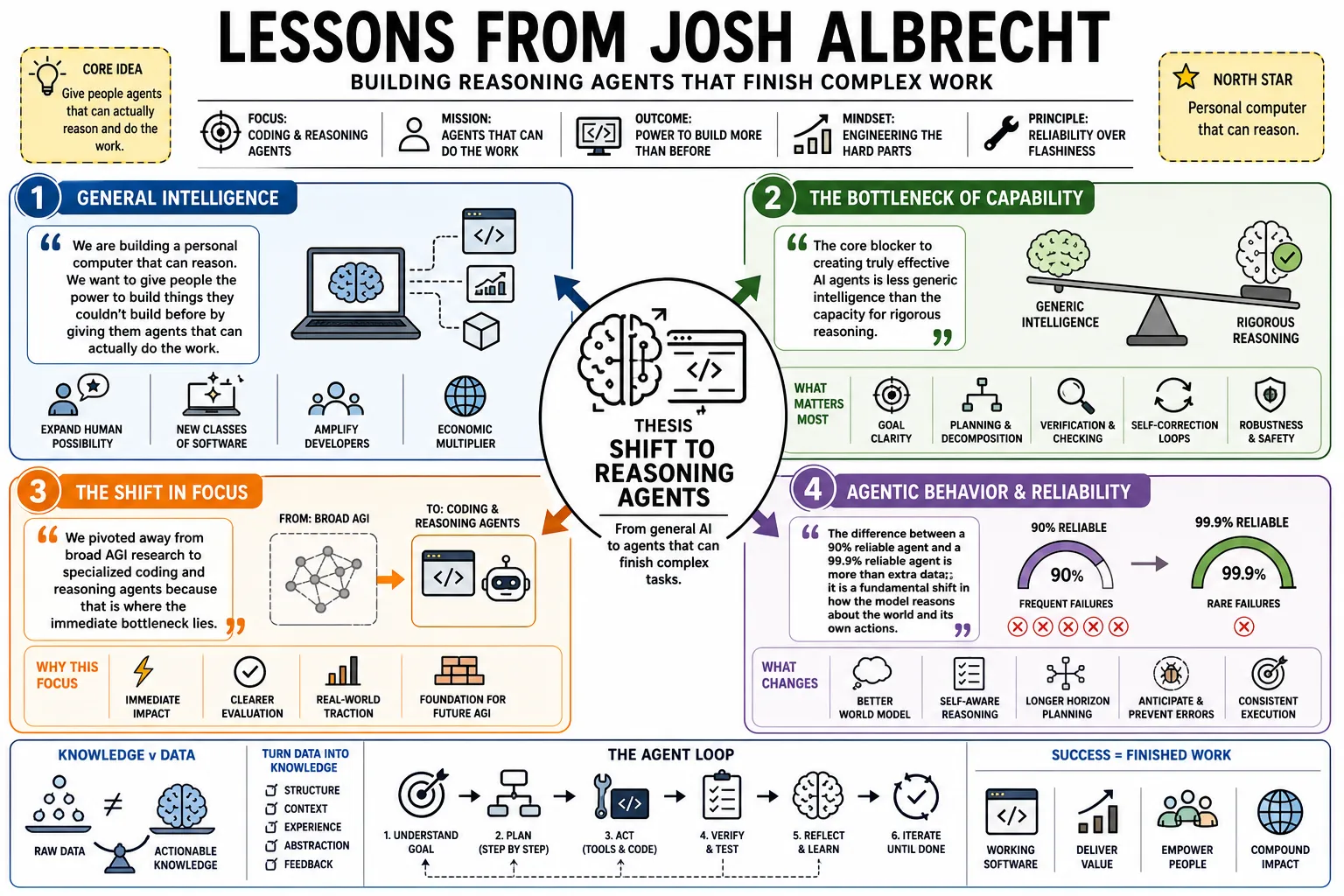
- On General Intelligence: "We are building a personal computer that can reason. We want to give people the power to build things they couldn't build before by giving them agents that can actually do the work." — Source: [The Cognitive Revolution Podcast]
- On the Bottleneck of Capability: "The core blocker to creating truly effective AI agents is less generic intelligence than the capacity for rigorous reasoning." — Source: [Imbue]
- On the Shift in Focus: "We pivoted away from broad AGI research to specialized coding and reasoning agents because that is where the immediate bottleneck lies." — Source: [The Cognitive Revolution Podcast]
- On Agentic Behavior: "The difference between a 90% reliable agent and a 99.9% reliable agent is more than extra data; it is a fundamental shift in how the model reasons about the world and its own actions." — Source: [The Cognitive Revolution Podcast]
- On Knowledge vs. Action: "If you have no information, it's kind of hard to transform it. But having the information alone does not equate to the ability to reason with it." — Source: [No Priors Podcast]
- On Human Agency in AGI: "We founded Imbue in 2021 to build an AGI future where humans remain at the helm, shaping powerful AI systems rather than being subordinated to them." — Source: [More Reasonable]
- On Action over Chat: "The transition from next-token prediction to goal-oriented action requires an entirely different kind of training and evaluation framework." — Source: [The Cognitive Revolution Podcast]
- On Stepwise Learning: "Models often learn skills in steps rather than linearly. Understanding this stepwise progress helps show when a model has truly grokked a reasoning concept." — Source: [The Cognitive Revolution Podcast]
- On Real-World Application: "For an agent to be useful, it must integrate multiple modalities—vision, audio, and text—to understand and act on complex user environments." — Source: [Imbue]
- On Building Foundation Models: "We train our own 70-billion-parameter foundation models from scratch because we need systems optimized specifically for reasoning tasks, not general conversation." — Source: [Imbue]
Part 2: Defining Reasoning as a Practical Capability
- On Information Transformation: "Reasoning is probably like a set of heuristics or skills or ways of transforming information." — Source: [No Priors Podcast]
- On the Limits of Transformers: "Addition transformers do not learn general purpose addition; at best they learn what is called modular addition." — Source: [No Priors Podcast]
- On Pattern Matching: "Current large language models are excellent at pattern matching, but they struggle with multi-step logic, self-correction, and handling ambiguity." — Source: [Imbue]
- On Self-Correction: "A reliable agent must have the ability to think before it acts and correct its own mistakes during the execution of a task." — Source: [The Cognitive Revolution Podcast]
- On Developing World Models: "For AI to be truly useful, it needs better world models that correspond to reality, rather than statistical representations that fail to align with physical logic." — Source: [Imbue]
- On Domain-Specific Logic: "We don't want to be spending a lot of time working on the problems that are going to get solved naturally by scale; we want to focus on the domain-specific reasoning that really matters." — Source: [No Priors Podcast]
- On Objectivity: "Reasoning requires environments where outcomes are objective and testable, which is why conversational fluency is a poor proxy for intelligence." — Source: [Imbue]
- On the Theory of Deep Learning: "It will be wonderful to have a real theory of precisely why deep learning works. Right now, the field is full of people who think making AI more intelligent will automatically solve all our problems." — Source: [More Reasonable]
- On Intellectual Honesty: "If a product-market fit isn't strong enough to reach the desired scale, it is better to pivot or start over than to zombie along. Reasoning requires the same honesty about failures." — Source: [Outset Capital]
- On Recognizing Limitations: "When an agent fails a test, it must be able to recognize the failure, update its context, and attempt a different logical path." — Source: [AI Engineer World's Fair]
Part 3: Code as the Ultimate Proving Ground
- On Code as Truth: "We focus heavily on coding agents because code provides a ground truth environment where reasoning can be tested and verified objectively." — Source: [The Cognitive Revolution Podcast]
- On Automated Verification: "If the code doesn't run or fails a test, the agent knows it has failed and can attempt to reason through a fix without hallucinating success." — Source: [The Cognitive Revolution Podcast]
- On the Importance of Testing: "If you liked it, you should have put a test on it. You don't want your coding agent to go change the behavior of your system in a way that you don't understand." — Source: [AI Engineer World's Fair]
- On Functional Programming: "Writing code in a functional style with no side effects makes it significantly easier for LLMs to reason about, test, and modify." — Source: [Imbue]
- On Planning Before Coding: "We force AI agents to generate a plan before writing any code. Clear specs and documentation are first-class parts of the workflow." — Source: [Imbue]
- On Sculpting Software: "The transition from vibe-coding to dependable engineering requires environments like Sculptor, where agents build systems that are provably correct." — Source: [AI Engineer World's Fair]
- On Problem Formulation: "A problem well-stated is half-solved. This applies directly to how developers must interact with AI to fix bugs effectively." — Source: [AI Engineer World's Fair]
- On Avoiding Technical Debt: "By forcing agents to write tests and documentation alongside their code, we prevent the massive technical debt that comes from AI-generated spaghetti code." — Source: [Imbue]
- On Agent Reviewers: "When code review becomes a bottleneck for AI-generated code, you have to build agent reviewers to verify the work at scale." — Source: [Imbue]
- On Building the Infrastructure: "Scaling from 1 to 100 coding agents breaks traditional workflows. You have to build your way out of bottlenecks using tools like mngr." — Source: [Imbue]
Part 4: The 25-Person Unicorn Vision
- On the Future of Startups: "The future of tech is 25-person companies powered by AI agents that help us accomplish our larger goals." — Source: [No Priors Podcast]
- On Augmentation over Automation: "AI should be a tool for augmentation, empowering humans to handle higher-level conceptual work while agents handle production-oriented tasks." — Source: [The Cognitive Revolution Podcast]
- On Small Teams: "Small teams using agentic systems will be able to build and scale products that previously required hundreds of engineers." — Source: [Outset Capital]
- On the Changing Role of Engineers: "What if software engineering becomes more like gardening? Developers will tend to systems of agents rather than writing every line manually." — Source: [More Reasonable]
- On Solving Hard Problems: "Developers should stop solving problems that will naturally be fixed by better models, like context window size, and focus on the unique value of their product." — Source: [No Priors Podcast]
- On Capital Efficiency: "Returning capital when a startup isn't scaling at venture speed is rare, but it preserves the resources and focus needed to tackle truly massive problems later." — Source: [Outset Capital]
- On Managing Knowledge: "In the near future, AI agents will make important decisions as representatives of us and manage our organizational knowledge." — Source: [More Reasonable]
- On Empowering Founders: "The goal of agentic AI is not to replace the founder, but to give them the operational capacity of a massive enterprise from day one." — Source: [Outset Capital]
- On Value Creation: "If a small team can iterate on reasoning tasks with the speed of an AI cluster, the traditional metrics of startup valuation and headcount will fundamentally break." — Source: [No Priors Podcast]
Part 5: From "Vibe-Coding" to Production Engineering
- On the Prototype Trap: "Vibe-coding is great for prototypes that look right, but true engineering requires systems that are provably correct through automated linting and formal specs." — Source: [AI Engineer World's Fair]
- On Manual to Automated Pipelines: "Perform a workflow manually a few times to recognize the pattern, then slowly turn that pattern into code. This is how you build reliable agent workflows." — Source: [Imbue]
- On the Cost of Errors: "An agent that generates code with silent failures is worse than no agent at all. Robustness is the only metric that matters in production." — Source: [AI Engineer World's Fair]
- On Rigorous Standards: "When dealing with high-stakes systems, rigorous engineering standards are non-negotiable. This principle applies as much to AI agents as it did to financial infrastructure." — Source: [Outset Capital]
- On Predictability: "We must ensure that agentic behavior is predictable, explainable, and aligned with human intent before deploying it in complex environments." — Source: [Imbue]
- On Tooling: "Building the right tools for agents to use—like secure SSH, Git integrations, and isolated tmux sessions—is more important than marginally improving the base model." — Source: [Imbue]
- On Transparency: "Open-source CLI tools for managing agents ensure transparency and give users ownership over the infrastructure their agents rely on." — Source: [Imbue]
- On Breaking Systems: "You have to purposefully stress-test agents to see how they recover when a dependency fails or a server goes down. That recovery is true reasoning." — Source: [AI Engineer World's Fair]
- On Formal Specifications: "Agents perform exponentially better when constrained by formal specifications rather than vague natural language prompts." — Source: [AI Engineer World's Fair]
Part 6: Building "Street Smart" Infrastructure
- On Book Smart vs. Street Smart: "The technical challenge is moving from book smart models that can ace exams to street smart agents that can actually execute tasks in the messy real world." — Source: [The Cognitive Revolution Podcast]
- On the Avalon Environment: "We developed the Avalon 3D reinforcement learning environment to test how well agents can generalize skills and survive in a world with physics." — Source: [Imbue]
- On the Fundamentals of Intelligence: "Spatial reasoning and navigating a built environment are fundamental components of human-like intelligence that text alone cannot teach." — Source: [Imbue]
- On Compute Optimization: "Training foundation models from scratch on 10,000 H100 GPUs requires custom infrastructure designed specifically for reasoning workloads." — Source: [Imbue]
- On Parallel Execution: "Running agents in parallel exposes the hidden bottlenecks in traditional software architecture, forcing us to rebuild deployment pipelines from the ground up." — Source: [Imbue]
- On Mastery: "Deep technical mastery requires putting in the hours. I spent over 20,000 hours programming before feeling truly proficient in building complex, street-smart systems." — Source: [Outset Capital]
- On System Feedback: "Street smart agents rely on immediate, high-fidelity feedback loops from their environment to adjust their behavior in real-time." — Source: [The Cognitive Revolution Podcast]
- On Custom Hardware Utilization: "You cannot build advanced reasoning agents by treating GPUs as a black box; you have to understand the hardware to optimize the learning step." — Source: [Imbue]
- On Navigating Ambiguity: "The real world does not have clean APIs. Agents must learn to handle undocumented edge cases and messy data structures autonomously." — Source: [The Cognitive Revolution Podcast]
Part 7: Human-in-the-Loop and Interface Design
- On Delegating Menial Tasks: "The best user experience comes from agents that focus on reliable debugging and testing while keeping the human engineer in control of the architecture." — Source: [Imbue]
- On Avoiding Full Autonomy: "Fully autonomous, one-click solutions often abstract away too much context. A human-in-the-loop approach ensures the final product aligns with user intent." — Source: [Imbue]
- On Collaborative Intelligence: "We are not building a replacement for the software engineer; we are building an intelligent collaborator that magnifies the engineer's creative capacity." — Source: [Imbue]
- On the Personal Computer Metaphor: "We need to re-envision the personal computer as a tool that works actively for the user, rather than just being a passive platform for running apps." — Source: [Outset Capital]
- On Feedback Mechanisms: "Interfaces for agentic AI must allow humans to easily intervene, correct assumptions, and steer the agent back on course during multi-step tasks." — Source: [AI Engineer World's Fair]
- On Aligning Incentives: "If the human and the agent do not share the exact same context window of the problem, the agent's output will inevitably drift from the human's goal." — Source: [The Cognitive Revolution Podcast]
- On Trusting AI: "Trust is built when an agent transparently shows its work, its test results, and its logic tree, rather than just outputting a final block of code." — Source: [AI Engineer World's Fair]
- On Creative Direction: "Humans should spend their time determining what needs to exist and why, while agents handle the how." — Source: [No Priors Podcast]
- On Managing Agents: "The user interface of the future will look less like a code editor and more like a dashboard for managing a fleet of specialized digital workers." — Source: [Imbue]
Part 8: Institutional Failure and The Dead Economy
- On the Palimpsest: "History and systems are layered like a palimpsest; new innovations must account for the traces of the old systems they are built upon." — Source: [More Reasonable]
- On Open Ecosystems: "We must build an open AI ecosystem. It's embarrassing how self-serving some major labs' policy proposals have been regarding regulation." — Source: [More Reasonable]
- On Stagnation: "The Dead Economy Theory suggests that without fundamentally new models of growth and innovation, our current economic systems will stagnate." — Source: [More Reasonable]
- On Institutional Sclerosis: "Modern institutions have become sclerotic. The future requires a fundamental fixing of how we organize, govern, and build technology." — Source: [More Reasonable]
- On Political Discourse: "The current political landscape is often a distraction from the structural failures we face. We need a serious discussion about the future we're actually building." — Source: [More Reasonable]
- On Awareness: "The future is pretty bleak unless more people realize the scale of the changes AI will bring and actively work to shape them." — Source: [More Reasonable]
- On Rejecting Apathy: "If you have no critiques of the current institutional failures, you are implicitly endorsing a system that is breaking down under its own weight." — Source: [More Reasonable]
- On Fixing Things: "The core motivation behind building powerful AI is more than technical curiosity; it is a pragmatic need to build better tools to fix broken systems." — Source: [More Reasonable]
- On the Path Forward: "We are still at the phase where people weirdly deny that technological stagnation is a problem. The only way out is to build our way out." — Source: [More Reasonable]