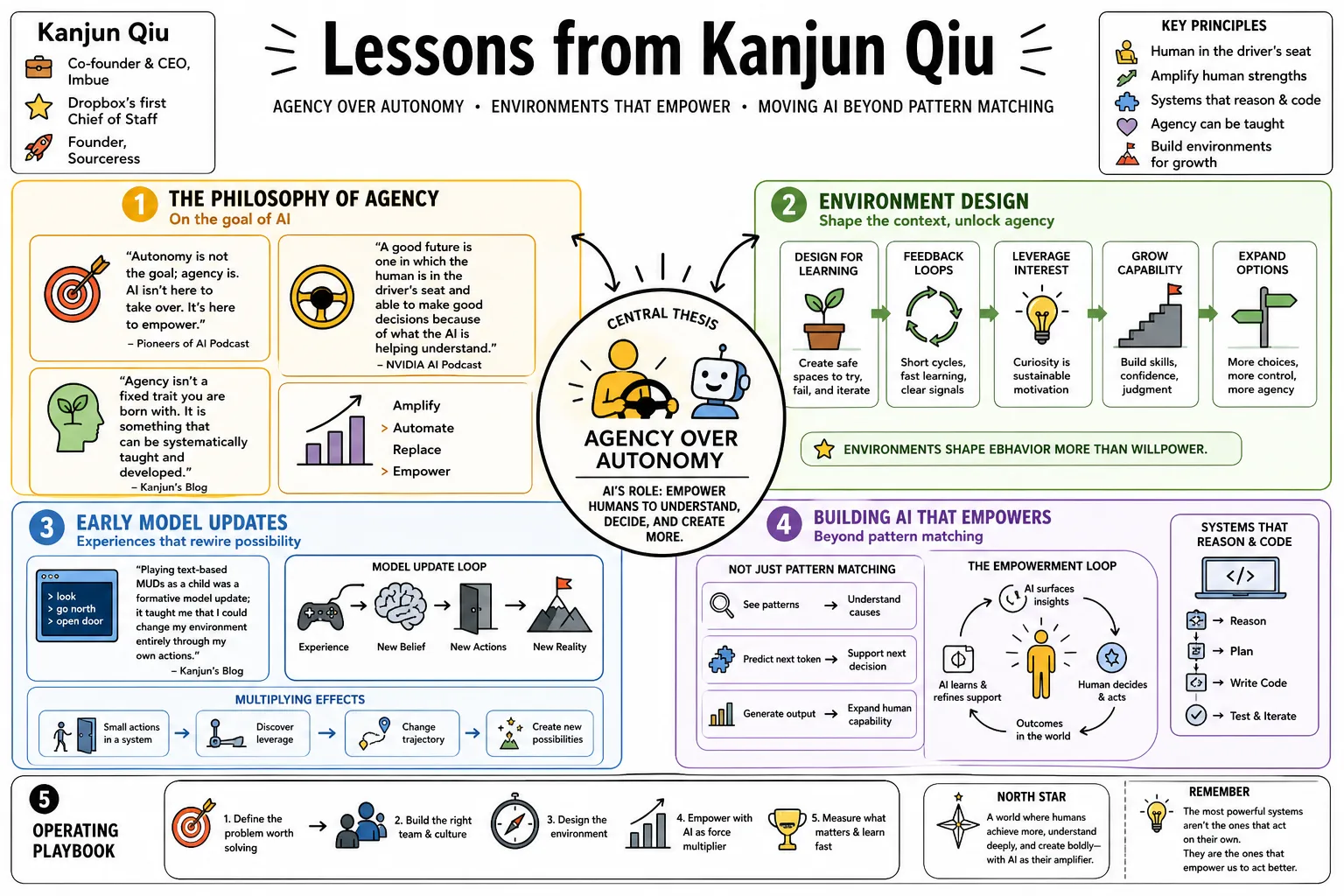
Lessons from Kanjun Qiu
Kanjun Qiu is the co-founder and CEO of Imbue, an AI lab building systems that reason and code. Previously Dropbox’s first Chief of Staff and founder of the startup Sourceress, her work operates on a single premise: software should amplify human agency, not automate it away. This profile collects her thoughts on the mechanics of ambition, environment design, and moving AI beyond simple pattern matching.
Part 1: The Philosophy of Agency
- On the goal of AI: "Autonomy is not the goal; agency is. AI isn't here to take over. It's here to empower." — Source: [Pioneers of AI Podcast
- On the distinction between autonomy and agency: "A good future is one in which the human is in the driver's seat and the human is able to make good decisions because of what the AI is helping the human understand." — Source: [NVIDIA AI Podcast
- On early mental models: "Playing text-based MUDs as a child was a formative model update; it taught me that I could change my environment entirely through my own actions." — Source: [Kanjun's Blog
- On redefining capability: "Agency isn't a fixed trait you are born with. It is something that can be systematically taught and developed over time." — Source: [South Park Commons Interview
- On technology's role in freedom: "The purpose of building powerful computing tools is to give individuals true control over their digital and physical lives." — Source: [Imbue Manifesto
- On the personal computer revolution: "We are trying to rekindle the dream of the personal computer—a tool that acts as a bicycle for the mind rather than a replacement for it." — Source: [Masters of Scale
- On the risk of AI centralization: "The largest danger of modern AI is the centralization of power. We need tools that allow individuals to own and direct their own agents." — Source: [Dwarkesh Podcast
- On shaping reality: "Agency is fundamentally the belief that the world is malleable, combined with the capability to actually mold it." — Source: [Kanjun's Essays
- On agentic interfaces: "We want to move away from rigid software to interfaces that act as collaborative partners, bridging the gap between user intent and computer execution." — Source: [Latent Space Podcast
- On shifting narratives: "What an individual thinks they can accomplish is often the only limiting factor to what they end up doing." — Source: [The Archive Retrospective
Part 2: Building Reasoning-First AI
- On the limitations of LLMs: "Current foundation models are exceptional at pattern matching, but they fundamentally struggle with deep, reliable reasoning." — Source: [No Priors Podcast
- On building trust: "Trust is at the core of product development. I can only trust an AI agent if I can verify it is doing exactly what I intended it to do." — Source: [Imbue Research Blog
- On custom models: "Training our own large-scale foundation models allows us to optimize explicitly for reasoning, rather than settling for the statistical averages of internet text." — Source: [Generally Intelligent Podcast
- On verification: "We spend a massive amount of our research effort on code verification—how a user can trust the output without having to read every line of code generated." — Source: [NVIDIA GTC Keynote
- On long-horizon tasks: "For an agent to be genuinely useful, it must handle tasks that require sustained effort, planning, and self-correction over long time horizons." — Source: [Imbue Blog
- On open ecosystems: "We are building an open agent ecosystem so users can inspect, modify, and completely understand the logic driving their AI." — Source: [Latent Space
- On tackling ambiguity: "The hardest part of building AI agents is teaching them to navigate ambiguous user intent without needing constant hand-holding." — Source: [South Park Commons
- On the physics of deep learning: "To push past current plateaus, we need to stop treating deep learning as alchemy and start understanding its fundamental physics." — Source: [Generally Intelligent Podcast
- On self-correction: "A reasoning agent isn't one that never makes mistakes; it's one that can recognize an error, step back, and iterate toward a better solution." — Source: [No Priors Podcast
- On coding as a reasoning test: "We started with coding agents because software engineering is the ultimate test of pure logic, reasoning, and verifiable execution." — Source: [Imbue Research Updates
Part 3: Scaling Laws and Economic Shifts
- On capital vs. labor: "One of the most profound shifts AI will cause is the transfer of power from labor to capital. We have to design systems that mitigate this inequality." — Source: [Dwarkesh Podcast
- On the future internet: "The internet five years from now is going to be super wacky. It will allow people to go back to a world where everyone feels empowered to create weird, bespoke things." — Source: [Pioneers of AI
- On abundance and liberty: "Technological abundance is not enough on its own; without liberty and decentralization, abundance just leads to comfortable subjugation." — Source: [Kanjun's Essays
- On bottom-up automation: "Top-down automation replaces workers; bottom-up automation gives individual workers the tools to out-produce entire traditional companies." — Source: [Outset Capital Memos
- On model size: "Parameter count isn't the final metric of success. A smaller model trained specifically to reason will out-perform a massive model trained only to predict." — Source: [No Priors Podcast
- On empowering bad actors: "We cannot ignore that reducing the cost of intelligence also reduces the cost of disruption. Building defense systems must happen concurrently with capability research." — Source: [Imbue Safety Blog
- On the value of engineers: "People who understand how to build software will still have a massive advantage. Concepts like algorithms and data structures don't lose value just because the syntax is automated." — Source: [South Park Commons
- On economic malleability: "When the marginal cost of intelligence trends toward zero, the primary economic bottleneck becomes human imagination and physical world logistics." — Source: [Dwarkesh Podcast
- On the AI market structure: "If we rely exclusively on a few mega-models, we risk a monoculture of thought. We need a diverse ecosystem of specialized, agentic models." — Source: [Latent Space
Part 4: Human-Computer Interaction and Malleable Software
- On rewriting rules: "We are moving from hard-coded logic to malleable software that rewrites itself based on the specific, real-time needs of the user." — Source: [Imbue Manifesto
- On conversational interfaces: "Chat is a surprisingly low-bandwidth interface. The future of interaction with agents will involve shared visual spaces and complex, non-linear workflows." — Source: [NVIDIA AI Podcast
- On software friction: "Software should not dictate your workflow. The best tools mold themselves to your natural way of thinking." — Source: [Kanjun.me
- On the magic of computing: "I want to recapture the magic I felt at the MIT Media Lab—the feeling that computers are tools of infinite creative expression." — Source: [Masters of Scale
- On physical and digital boundaries: "Through projects like Sew Electric, I learned that computing becomes truly intuitive when it bridges the gap into the physical world." — Source: [MIT Media Lab Archives
- On intent translation: "The core problem of modern user experience is intent translation: how efficiently can the computer understand what is in your head?" — Source: [Imbue Research
- On iterative design: "You don't build a great agent by making it perfect on the first try. You build it by making the correction loop as fast and painless as possible." — Source: [Generally Intelligent Podcast
- On tool ownership: "A tool you cannot inspect or modify is a tool you do not truly own. True agency requires ownership of the underlying logic." — Source: [Latent Space
- On reducing boilerplate: "By automating the repetitive scaffolding of software engineering, we free human minds to focus entirely on architecture and user experience." — Source: [No Priors Podcast
Part 5: Environment Design and Collective Intelligence
- On the concept of Scenius: "Genius is rarely solitary. 'Scenius' is the collective intelligence of a group, and it is something you can actively engineer through environment design." — Source: [The Archive Retrospective
- On coliving spaces: "We built The Archive as a cultural experiment to see if density and shared values could artificially accelerate human potential, rather than merely serving as a place to live." — Source: [Megyn Kelly Today Interview
- On physical neighborhoods: "The Neighborhood project in San Francisco is an attempt to recreate the serendipity and intellectual density of a university campus for modern adult living." — Source: [Kanjun.me
- On ambient ambition: "When you surround yourself with people who view the world as highly malleable, their ambition becomes ambient and contagious." — Source: [South Park Commons
- On community rules: "The most effective communities don't rely on strict rules; they rely on strong, implicit cultural norms that select for high-agency behavior." — Source: [The Archive Essays
- On serendipity: "You cannot schedule breakthrough ideas, but you can increase the collision rate of smart people in relaxed environments." — Source: [Masters of Scale
- On institutional design: "Many of our modern institutions stifle agency. We have to build new social technologies that default to trust and experimentation." — Source: [Dwarkesh Podcast
- On play: "Play is the highest form of research. An environment that doesn't allow for unstructured play will never produce truly novel ideas." — Source: [Generally Intelligent Podcast
- On filtering for capability: "When designing a community, look for people who are 'kind and capable'—everything else can be taught or adapted." — Source: [Outset Capital
Part 6: Startups, Founders, and Capital
- On founder traits: "At Outset Capital, we look for a very specific combination: founders who are highly capable, relentlessly resourceful, and fundamentally kind." — Source: [Outset Capital Memos
- On scaling a company: "During my time at Dropbox, I learned that scaling a company from 300 to 1,500 people is less about maintaining culture and more about consciously evolving it." — Source: [Kanjun.me
- On early-stage recruiting: "At Sourceress, we saw firsthand that traditional recruiting metrics fail to capture the actual trajectory of a person's capability." — Source: [Sourceress Retrospective
- On the role of a Chief of Staff: "A great Chief of Staff acts as a router for the CEO's intent, ensuring that the organization moves smoothly even when communication breaks down." — Source: [Dropbox Leadership Reflections
- On raising capital: "Venture capital should act as an accelerant for agency, not a mechanism for extracting quick returns." — Source: [Outset Capital
- On iterating ideas: "Your first idea is almost never your best idea. The goal of an early-stage startup is to survive long enough to find the actual problem." — Source: [South Park Commons
- On building hard tech: "Deep tech and AI require a fundamentally different management style than SaaS—you have to manage for unknown timelines and high variance in research." — Source: [No Priors Podcast
- On avoiding consensus: "If everyone agrees with your startup idea immediately, you are likely too late. The best ideas sit in the space of non-consensus but right." — Source: [Outset Capital Memos
- On organizational debt: "Every quick fix in an organization creates debt. If you don't pay down cultural and structural debt, the company eventually grinds to a halt." — Source: [Dropbox Reflections
Part 7: Epistemology and the Nature of Discovery
- On research as understanding: "Research is the deep, internal process of constructing a better mental model of the world, rather than simply a method for producing novel discoveries." — Source: [Kanjun's Essays
- On the science of science: "The way we fund and evaluate scientific research is stuck in the past. We need to apply metascience to accelerate the rate of human discovery." — Source: [Generally Intelligent Podcast
- On model updates: "True learning requires breaking down your existing beliefs. I treat personal growth as a series of deliberate model updates to my own brain." — Source: [Kanjun.me
- On learning from anomalies: "The most valuable data point in any research is the anomaly. The thing that doesn't fit your model is the thing that will force it to improve." — Source: [Imbue Research
- On abstractions: "Intelligence is fundamentally the ability to form permanent, reusable abstractions out of chaotic, high-dimensional data." — Source: [Latent Space
- On first principles thinking: "You cannot build truly novel AI architectures if you are just iterating on the edges of existing papers. You have to rethink things from first principles constantly." — Source: [No Priors Podcast
- On knowledge representation: "We are still in the early days of understanding how to encode human knowledge in a way that machines can logically manipulate rather than just recite." — Source: [NVIDIA GTC Keynote
- On tools for thought: "We are building the modern equivalent of the Memex—technologies that actively help you think through information, moving beyond basic storage." — Source: [Kanjun's Essays
- On truth-seeking: "A strong research culture requires an ego-less commitment to truth-seeking. You must be thrilled to be proven wrong." — Source: [Imbue Culture Doc
- On iterative epistemology: "Understanding is never binary. It is a continuous, iterative process of reducing uncertainty and refining your map of reality." — Source: [Kanjun.me
Part 8: Cultivating Ambition and Learning
- On the mechanics of ambition: "Ambition is largely a byproduct of the narratives we absorb. Change the stories you hear, and you will naturally unlock a deeper well of ambition." — Source: [South Park Commons
- On internal narratives: "The most dangerous limitations are the ones you quietly place on yourself. Upgrading your internal narrative is the most effective thing you can do." — Source: [The Archive Retrospective
- On the generating function of behavior: "Instead of looking at a person's current output, look for their generating function—the core engine that drives how they learn and adapt over time." — Source: [Kanjun.me
- On educational innovation: "Traditional education penalizes mistakes. But in computing, the mistake—and the process of debugging it—is precisely where the learning happens." — Source: [Sew Electric Book Reflections
- On curiosity: "Curiosity is the antidote to fear. If you can stay genuinely curious about a problem, you won't have the bandwidth to be afraid of failing at it." — Source: [Pioneers of AI
- On hands-on learning: "We wrote Sew Electric because making something physical and tangible is the fastest way to demystify complex systems like computer science." — Source: [MIT Media Lab Archives
- On tracking personal data: "I keep extensive notes on my own model updates because memory is lossy. To grow consistently, you must treat your own psychology as a research subject." — Source: [Kanjun's Essays
- On uncredentialed talent: "Some of the highest-agency people in the world look terrible on paper. You have to learn how to identify raw trajectory rather than past credentials." — Source: [Sourceress Retrospective
- On long-term focus: "To do anything truly significant, you have to be willing to work on problems that might take a decade to solve, even when everyone else is optimizing for the next six months." — Source: [Generally Intelligent Podcast