Kelly McGonigal is a health psychologist and Stanford lecturer who translates complex neuroscience and psychology into practical tools for everyday life. She is best known for reframing stress as a catalyst for resilience, rather than an enemy to be avoided, and for treating willpower as a biological function instead of a moral failing. This collection organizes her core arguments on movement, self-compassion, and the mind-body connection.
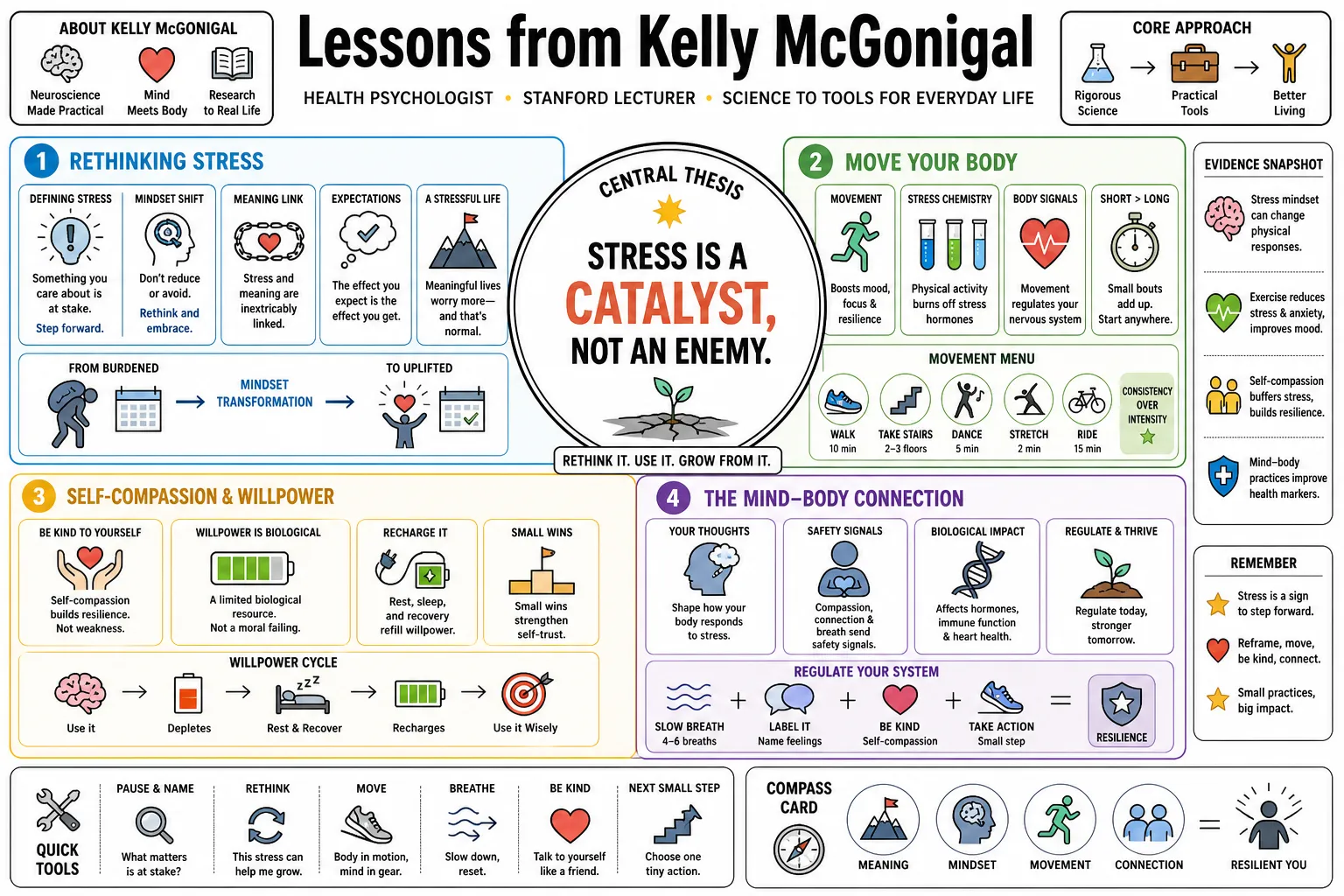
Part 1: Rethinking Stress
- On defining stress: "Stress happens when something you care about is at stake. It's not a sign to run away—it's a sign to step forward." — Source: [The Upside of Stress]
- On mindset: "The best way to manage stress isn't to reduce or avoid it, but rather to rethink and even embrace it." — Source: [The Upside of Stress]
- On meaning: "Stress and meaning are inextricably linked. You don't stress out about things you don't care about, and you can't create a meaningful life without experiencing some stress." — Source: [The Upside of Stress]
- On expectations: "The effect you expect is the effect you get. Feeling burdened rather than uplifted by everyday duties is more a mindset than a measure of what is going on in your life." — Source: [The Upside of Stress]
- On a stressful life: "People with very meaningful lives worry more and have more stress than people with less meaningful lives." — Source: [The Upside of Stress]
- On growth: "Even if we would prefer to have less stress in our lives, it's the difficult times that give rise to growth." — Source: [The Upside of Stress]
- On the source of good: "The good that comes from difficult experiences isn't from the stressful or traumatic event itself; it comes from you—from the strengths that are awakened by adversity." — Source: [The Upside of Stress]
- On the biology of courage: "When you choose to view your stress response as helpful, you create the biology of courage." — Source: [TED Talk: How to Make Stress Your Friend]
- On avoiding discomfort: "Chasing meaning is better for your health than trying to avoid discomfort." — Source: [TED Talk: How to Make Stress Your Friend]
- On facing the future: "Go after what it is that creates meaning in your life and then trust yourself to handle the stress that follows." — Source: [TED Talk: How to Make Stress Your Friend]
Part 2: The Biology of Willpower
- On human nature: "The development of willpower—I will, I won’t, and I want—may define what it means to be human." — Source: [The Willpower Instinct]
- On the biological instinct: "Willpower is a biological instinct, like stress, that evolved to help us protect ourselves from ourselves." — Source: [The Willpower Instinct]
- On self-knowledge: "Self-knowledge—especially of how we find ourselves in willpower trouble—is the foundation of self-control." — Source: [The Willpower Instinct]
- On conflicting desires: "While we all have the capacity to do the harder thing, we also have the desire to do exactly the opposite." — Source: [The Willpower Instinct]
- On willpower enemies: "The biggest enemies of willpower: temptation, self-criticism, and stress." — Source: [The Willpower Instinct]
- On stress vs. control: "Stress is the enemy of willpower. Anything that puts you in a state of stress will make it harder to resist temptation." — Source: [The Willpower Instinct]
- On a preoccupied mind: "When your mind is preoccupied, your impulses—not your long-term goals—will guide your choices." — Source: [The Willpower Instinct]
- On inner peace: "People who have the greatest self-control aren’t waging self-war." — Source: [The Willpower Instinct]
- On training capacity: "If self-control is a muscle, it should be possible to train it, too." — Source: [The Willpower Instinct]
- On true rewards: "We need to separate the real rewards that give our lives meaning from the false rewards that keep us distracted and addicted." — Source: [The Willpower Instinct]
Part 3: The Joy of Movement
- On human needs: "Movement offers us pleasure, identity, belonging and hope. It puts us in places that are good for us, whether that's outdoors in nature, in an environment that challenges us, or with a supportive community." — Source: [The Joy of Movement]
- On accessing the good: "It is as if what is good in us is most easily activated or accessed through movement." — Source: [The Joy of Movement]
- On rejecting exercise: "Rejecting exercise means rejecting significant experiences of being human." — Source: [The Joy of Movement]
- On enduring suffering: "Experiencing a state of elevation during a moment of deep exhaustion provides a reminder that flashes of pure happiness can take you by surprise even when things seem the most bleak." — Source: [The Joy of Movement]
- On changing the brain: "Regular exercise also remodels the physical structure of your brain to make you more receptive to joy and social connection." — Source: [The Joy of Movement]
- On collective effervescence: "The joy of collective effervescence helps explain why fitness friendships and sports teams feel like family. The neurochemistry that makes moving in unison euphoric also bonds strangers and builds trust." — Source: [The Joy of Movement]
- On shared celebration: "Sometimes you are the one crushing the goal and ringing the bell. Sometimes you get to be part of the crowd that hugs and cheers the person ringing the bell." — Source: [The Joy of Movement]
- On fundamental value: "Physical activity stands out in its ability to fulfill so many human needs, and that makes it worth considering as a fundamentally valuable endeavour." — Source: [The Joy of Movement]
- On mood chemistry: "The psychological effects of movement cannot be reduced to an endorphin rush. Physical activity influences many other brain chemicals, including those that give you energy, alleviate worry, and help you bond with others." — Source: [The Joy of Movement]
Part 4: Self-Compassion vs. Self-Criticism
- On self-kindness: "Self-compassion—being supportive and kind to yourself, especially in the face of stress and failure—is associated with more motivation and better self-control." — Source: [The Willpower Instinct]
- On forgiving procrastination: "Students who were harder on themselves for procrastinating on their first exam were more likely to procrastinate on later exams than students who forgave themselves." — Source: [The Willpower Instinct]
- On the inner voice: "We all have the tendency to believe self-doubt and self-criticism, but listening to this voice never gets us closer to our goals. Instead, try on the point of view of a mentor or good friend who believes in you." — Source: [Compassion Institute]
- On moral licensing: "Whenever we have conflicting desires, being good gives us permission to be a little bit bad." — Source: [The Willpower Instinct]
- On virtuous motivation: "If the only thing motivating your self-control is the desire to be a good enough person, you’re going to give in whenever you’re already feeling good about yourself." — Source: [The Willpower Instinct]
- On goals over virtue: "For better self-control, forget virtue, and focus on goals and values." — Source: [The Willpower Instinct]
- On active compassion: Compassion is an active way of being in the world that allows us to stay present with suffering while also being motivated to alleviate it. — Source: [Compassion Institute]
- On recognizing humanity: Recognizing that suffering and setbacks are a universal part of being human allows us to approach our own failures with grace instead of shame. — Source: [The Willpower Instinct]
- On the 'what-the-hell' effect: Guilt and shame over a minor indulgence often lead to bingeing; acknowledging the feeling without judgment breaks the cycle. — Source: [The Willpower Instinct]
- On self-criticism as a stressor: Harsh inner dialogue operates physiologically like an external threat, triggering a stress response that further drains willpower. — Source: [The Science of Willpower]
Part 5: Mindfulness and Awareness
- On the purpose of meditation: "Meditation is not about getting rid of all your thoughts; it’s learning not to get so lost in them that you forget what your goal is." — Source: [The Willpower Instinct]
- On daily consistency: "A short practice that you do every day is better than a long practice you keep putting off to tomorrow." — Source: [The Willpower Instinct]
- On the mindful path: "My favorite definition of the mindful path is the one that reveals itself as you walk down it. You cannot find the path until you step onto it." — Source: [The Willpower Instinct]
- On the secret of self-control: "If there is a secret for greater self-control, the science points to one thing: the power of paying attention." — Source: [The Willpower Instinct]
- On stepping off autopilot: Mindfulness is training the mind to recognize when you’re actually making a choice, rather than running on pure instinct or habit. — Source: [The Willpower Instinct]
- On urging surfing: Learning to sit still and feel a physical urge—like an itch—without automatically moving to scratch it is the physical foundation of self-control. — Source: [The Willpower Instinct]
- On the pause-and-plan response: True self-control requires shifting the nervous system into a state that slows down breathing and heart rate, allowing the prefrontal cortex to take charge. — Source: [The Willpower Instinct]
- On observing cravings: Notice what you are feeling in the body when a craving hits; simply observing the sensation strips it of its urgent, overwhelming power. — Source: [Mindful Magazine]
- On the future self: Treating your future self as a real person—rather than an abstract concept—helps bridge the gap between immediate desires and long-term consequences. — Source: [The Willpower Instinct]
Part 6: Social Connection and Support
- On stress and socializing: "Stress makes you social." — Source: [TED Talk: How to Make Stress Your Friend]
- On the role of oxytocin: "Oxytocin is a neuro-hormone. It fine-tunes your brain's social instincts. It primes you to do things that strengthen close relationships." — Source: [TED Talk: How to Make Stress Your Friend]
- On healing the heart: "Your heart has receptors for this hormone, and oxytocin helps heart cells regenerate and heal from any stress-induced damage. This stress hormone strengthens your heart." — Source: [TED Talk: How to Make Stress Your Friend]
- On connection creating resilience: "When you choose to connect with others under stress, you can create resilience." — Source: [TED Talk: How to Make Stress Your Friend]
- On caring building strength: "Caring creates resilience." — Source: [The Upside of Stress]
- On biochemistry of help: "When we care for others, it changes our biochemistry, activating systems of the brain that produce feelings of hope and courage." — Source: [The Upside of Stress]
- On the capacity for hope: "Even in circumstances of great suffering, human beings have a natural capacity to find hope, exert choice, and make meaning." — Source: [The Upside of Stress]
- On generosity first: "Sometimes, we make the choice to be generous first, and the uplift comes later." — Source: [The Upside of Stress]
- On reaching out: Asking for help during difficult moments is a biological drive designed to protect your physical and mental health, rather than a sign of weakness. — Source: [The Courageous Life Podcast]
Part 7: The Mind-Body Connection
- On trusting the body: "Yoga teaches you how to be befriending your body. People with pain often feel betrayed by their body. Yoga can help you restore trust and learn how to listen to your body and develop intuition about what it needs." — Source: [Yoga for Pain Relief]
- On accessible practice: "Yoga is not about twisting your body into uncomfortable positions, and you can practice yoga even if you cannot get out of bed." — Source: [Yoga for Pain Relief]
- On the essence of yoga: "If you can breathe, you can do yoga. If you can pay attention to your thoughts and feelings, you can do yoga. If you are willing to explore what the body feels and how to take care of it, you can do yoga." — Source: [Yoga for Pain Relief]
- On neuroplasticity: "Neuroplasticity provides an explanation for chronic pain but also a solution." — Source: [Yoga for Pain Relief]
- On making peace: "By taking care of your body in a gentle way, yoga can help you make peace with your body and overcome the anger, sadness, and frustration." — Source: [Yoga for Pain Relief]
- On tension release: Gentle somatic practices teach the nervous system relaxation techniques that help you physically let go of accumulated emotional tension. — Source: [Yoga for Pain Relief]
- On pain acceptance: Rather than fighting physical discomfort, mindfulness allows you to observe the sensation objectively, breaking the feedback loop between physical pain and emotional suffering. — Source: [Yoga for Pain Relief]
- On regulating the nervous system: Breath and movement serve as direct lines of communication to the brain, signaling it to shift from the threat response into states of rest. — Source: [Yoga for Pain Relief]
- On caring for distress: True healing begins when we stop viewing a painful body as a broken machine, and instead treat it as a living organism that needs compassionate care. — Source: [Yoga for Pain Relief]
Part 8: Motivation and Habit Change
- On the three powers: Habit change relies on balancing "I Will" power (doing the hard thing), "I Won't" power (resisting temptation), and "I Want" power (remembering your core goals). — Source: [The Willpower Instinct]
- On the importance of 'I Want': "To say no when you need to say no, and yes when you need to say yes, you need a third power: the ability to remember what you really want." — Source: [The Willpower Instinct]
- On the danger of fatigue: Willpower is a limited resource that tires throughout the day; trying to overhaul every bad habit at once guarantees failure. — Source: [The Willpower Instinct]
- On dopamine traps: The brain's reward system often promises happiness from habits that actually leave us feeling drained; learning to distinguish true rewards from false promises is key to lasting change. — Source: [The Willpower Instinct]
- On the 'halo effect' of movement: Establishing just one positive physical habit, like daily movement, naturally spills over into other areas, making it easier to eat well and manage time. — Source: [The Joy of Movement]
- On tracking behavior: Simply paying close attention to a specific habit—writing down what you eat or how much you spend—instantly improves self-control even without a conscious effort to change. — Source: [The Willpower Instinct]
- On environmental design: Because resisting temptation drains energy, the most reliable way to alter a habit is to reshape your environment so you rarely have to rely on self-control. — Source: [The Willpower Instinct]
- On values-driven action: True motivation sustains itself when anchored to a deeply held personal value, rather than driven by a fear of punishment or external judgment. — Source: [The Willpower Instinct]
- On embracing the struggle: The friction of changing a habit is evidence that you are exercising the uniquely human capacity for self-evolution. — Source: [The Willpower Instinct]